Part 1
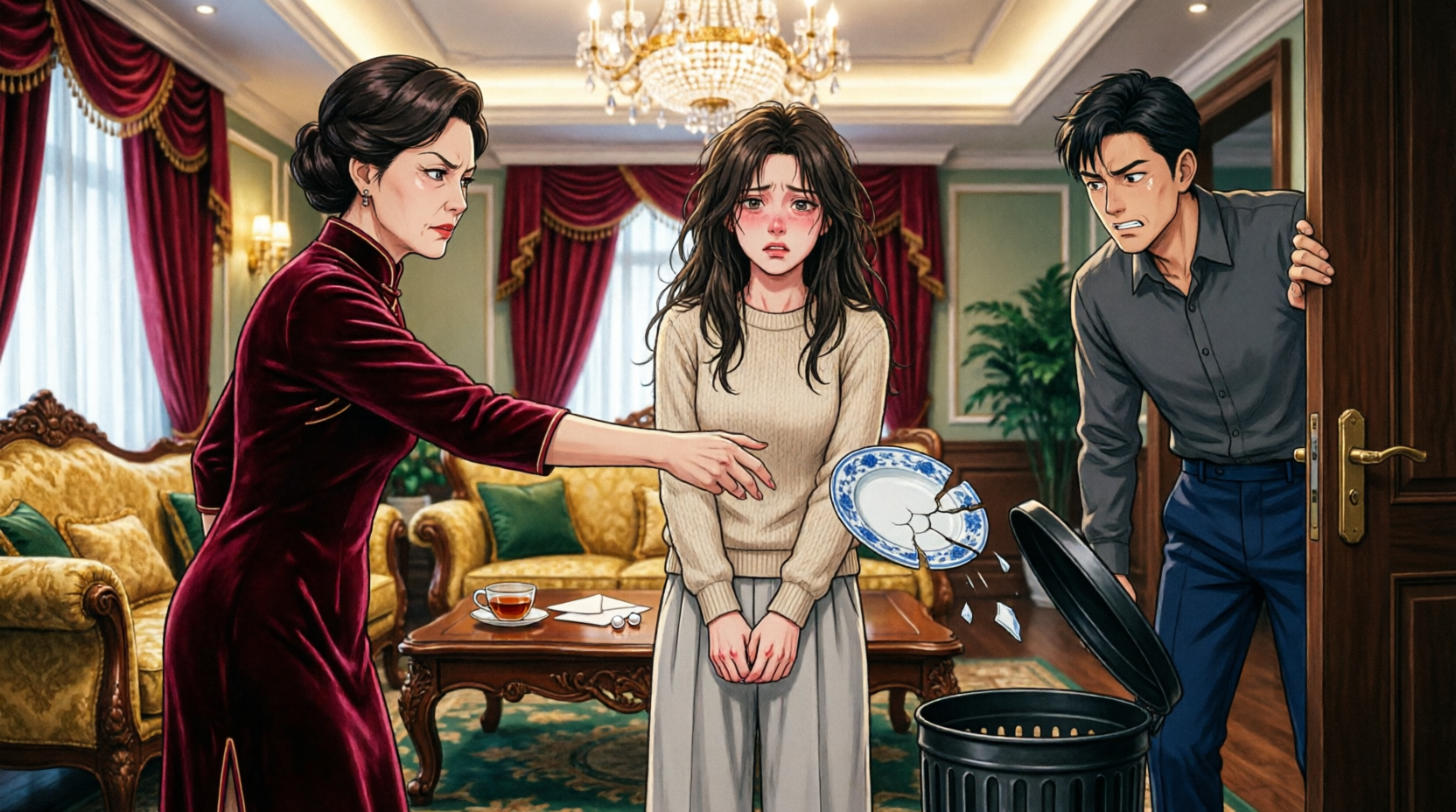
The dish hit the bottom of the trash can with a wet, heavy thud.
I stopped in the kitchen doorway with one hand still on the frame, my body half turned toward the hall, and watched my mother-in-law press the lid down with both hands like she was sealing up evidence.
For one stunned second, I didn’t understand what I was seeing.
The kitchen was loud behind her silence. Ice clinked in glasses in the dining room. Somebody laughed too hard out on the back porch. The oven fan hummed. A football game roared faintly from the den. The house smelled like turkey, butter, old wood, and too many people wearing perfume in warm weather.
And underneath all of it, rising from the trash can, was the smell of my bourbon peach cobbler.
Brown sugar. Caramelized fruit. Vanilla. A little smoky bite from the bourbon Aunt Colleen had insisted I buy from one specific store across town because, according to her, “If you use that cheap stuff, Darcy, I’ll know, even with my new knee.”
I stared at the trash can.
Then I looked at my husband.
Gage stood three feet from his mother, his hands loose at his sides, face pale in a way I had almost never seen. Not shocked exactly. More like something he had expected for years had finally happened in a form too ugly to explain away.
His mother, Paulette Embry, had not seen me yet.
Gage had.
The look in his eyes told me this was not going to end with “Mom didn’t mean it.”
That was new.
For seven years, “Mom didn’t mean it” had been the weather system of my marriage. It rolled in after every family gathering, every backhanded compliment, every little humiliation served with sweet tea and a smile sharp enough to cut glass.
I used to believe him.
Or maybe I just wanted to.
My name is Darcy Embry. I’m thirty-four, a logistics coordinator for a shipping company, wife to Gage, mother to a five-year-old named Tatum, and for a long time I thought being reasonable was the same thing as being strong.
I met Gage at a cookout almost ten years ago. He was the kind of man who refilled the cooler without being asked and stayed late to help fold tables. Quiet. Steady. Not flashy, not loud. He made me feel like I didn’t have to perform for attention.
His mother was the opposite.
Paulette could command a room with one eyebrow and half a sentence. She was loud, polished, opinionated, and somehow always surrounded by people who seemed both entertained and slightly afraid of disappointing her. At first I told myself she was just one of those big-personality Southern women who believed honesty and cruelty were cousins. Confident women get judged unfairly, I told myself. I wanted to be generous.
Then came my first Thanksgiving with the Embrys.
I brought a pecan pie I had made from scratch, crust and all. I still remember standing in my apartment kitchen the night before, flour in my hair, butter under my nails, proud in the quiet way you are when you make something with care.
At dinner, Paulette looked at it and said, “Oh, store-bought? That’s fine, sweetie. Not everybody has time.”
I opened my mouth.
Gage squeezed my hand under the table.
“She does that,” he whispered later while we washed dishes. “Just let it go.”
So I did.
I let it go when she rearranged my entire kitchen after Tatum was born because “new mothers get overwhelmed and make odd little systems.” I let it go when she planned a baby shower without asking me and invited thirty of her friends, then acted wounded when I looked surprised by strangers rubbing my stomach. I let it go when she stood in my living room, pointed at a framed photo of Gage and me, and said, “You know, he almost married Brienne Kelsey. Lovely girl. Very family-oriented.”
Every time, Gage gave me that same look.
Half apology. Half plea.
Please don’t make this bigger.
And I didn’t, because I loved him, and because his mother had raised him inside a house where keeping her calm had probably felt like keeping oxygen in the room.
His younger sister, Waverly, was no help back then. Not cruel, exactly. Just careful. She laughed nervously whenever Paulette took a dig at me, then changed the subject with the speed of someone swerving away from a cliff.
I used to think Waverly was weak.
Later, I understood she was surviving.
The annual Embry family gathering was Paulette’s masterpiece. Every fall, she hosted an enormous potluck-style event at her house, drawing in cousins, aunts, uncles, neighbors who had been absorbed into the family by repetition, and at least three people whose relationship to the Embrys no one could explain.
Paulette ran it like a military operation with gingham napkins.
There was a spreadsheet.
Of course there was a spreadsheet.
Six weeks before the gathering, she emailed assignments. Turkey, dressing, sweet potatoes, deviled eggs, rolls, three kinds of salad, desserts. My name sat next to green bean casserole.
Simple enough.
I could make green bean casserole half-asleep, which was good because by then I was living half-asleep. My manager, Renata, had gone on medical leave, and I was quietly absorbing half her workload without the title or raise. I spent my days tracking shipments, calming clients, chasing freight exceptions, and drinking coffee that tasted like burnt cardboard. At night I came home to Tatum, who was in a phase where every bath required negotiation like a hostage crisis.
Gage noticed.
He picked up laundry. He handled bedtime. He made frozen pizza without complaint and cut Tatum’s slices into triangles because she had decided squares were “too bossy.” He was good that way. Quietly good.
But good in private is not the same as brave in public.
Two weeks before the gathering, Aunt Colleen called.
Colleen was Paulette’s older sister and everything Paulette pretended to be: sharp, warm, funny, impossible to bully. She had smoked for thirty years, quit by force of personality, and still sounded like she was laughing at something even when discussing surgery.
“Darcy, honey,” she said. “I need a favor.”
I tucked the phone between my shoulder and ear while sorting Tatum’s school forms. “Anything.”
“I’m having knee surgery next week, and I can’t make the gathering. But my bourbon peach cobbler needs to be there.”
I smiled. “The famous one?”
“The only one worth eating.”
She walked me through the recipe slowly. Fresh peaches if I could find them. Specific bourbon. Dark brown sugar, not light. Fresh nutmeg. Butter cold enough to make my fingers ache. She made me repeat the oven temperature twice.
Then her voice changed.
“One more thing,” she said. “Don’t tell Paulette it’s my recipe.”
I paused with my pen over the paper.
“Why?”
“Because she’ll find a reason to have a problem with it.”
There was no bitterness in her voice. That made it worse. It was just a fact, worn smooth by decades.
I should have heard the warning bell.
Instead I said, “Okay.”
That was me then. Always willing to carry one more awkward thing if it kept the peace balanced for another day.
The week of the gathering, Tatum got an ear infection.
Not the mild kind. The crying-at-midnight, fever-flushed, antibiotics-taste-like-poison kind. Two nights of almost no sleep. One urgent care visit. Three calls to the pediatrician. Gage took a half day off work and spent forty minutes convincing our tiny furious warrior to swallow medicine by bribing her with stickers and a plastic dinosaur.
By the night before the gathering, I was exhausted enough to feel hollow.
Still, I made the cobbler.
The kitchen glowed warm past midnight. Peaches softened in bourbon and brown sugar until the whole room smelled like summer trying to survive autumn. The crust came together under my hands, buttery and rough. I pressed it over the fruit and brushed it with cream, remembering every instruction Colleen had given me.
Gage wandered in around twelve-fifteen, barefoot, hair messy, Tatum’s stuffed rabbit under one arm.
“You know Mom’s going to find something wrong with it,” he said quietly.
I slid the baking dish into the oven. “Probably.”
“Then why are you doing this to yourself?”
“Because Colleen asked me.” I wiped my hands on a towel. “And because maybe your mother will taste it before she realizes I made it and accidentally say something nice.”
He looked at me for a long second.
Not amused.
Sad.
“I’ll back you up,” he said. “Whatever happens.”
I should have asked him what he thought was going to happen.
Instead I smiled like promises fixed things.
The day of the gathering was hot in a way late autumn had no right to be. The air felt swollen, damp, and impatient. Paulette’s house was already packed when we arrived. Kids ran shrieking across the lawn. Men argued about football near the grill. Women moved through the kitchen in practiced chaos, carrying foil-covered dishes and glass pitchers of iced tea.
I carried the cobbler in both hands like something sacred.
Paulette glanced at me when we came in.
“Darcy,” she said. “You made it.”
Not We’re glad you’re here.
Not How’s Tatum feeling?
You made it.
I set the cobbler on the dessert table beside a store-bought pumpkin pie and a tray of brownies. Tatum wriggled out of Gage’s arms and bolted toward the backyard after her second cousin Rory. I watched her go, pigtails bouncing, and tried to relax.
Then Waverly appeared beside me, arms crossed tightly despite the heat.
“Mom’s in a mood,” she murmured.
“When isn’t she?”
“No,” Waverly said. “A mood mood.”
I looked toward the kitchen, where Paulette was rearranging serving spoons with the intensity of a surgeon. “Why?”
“She found out Colleen isn’t coming. She thinks it’s a statement.”
“It’s knee surgery.”
Waverly gave me a look that said reason had never stopped Paulette before.
I took a breath. Smelled turkey, butter, peach cobbler, and rain hiding somewhere behind the heat.
I told myself I could get through one afternoon.
I had no idea the fuse had already been lit.
And I definitely didn’t know Aunt Colleen had handed me more than a recipe.
Part 2
For the first hour, nothing exploded.
That almost made it worse.
Family gatherings in Paulette’s house always felt like standing too close to a kettle that hadn’t started screaming yet. You could hear the pressure building if you knew what to listen for, but everyone else kept pouring sweet tea and pretending the kitchen wasn’t boiling.
I tried to do the same.
I took Tatum outside and watched her run through the yard with Rory, both of them dragging lawn chairs into some kind of obstacle course that made no safety sense whatsoever. The grass was dry enough to crackle under my sandals. Somewhere beyond the fence, a neighbor was mowing even though the air was already thick with heat. Cicadas buzzed in the trees like loose electricity.
Gage stood by the grill with his uncle Martin, who was flipping sausages and telling a story about a busted pipe with the gravity of a war veteran. Gage caught my eye once and gave me a small smile. I wanted to believe that meant we were fine.
Waverly moved in and out of the yard like someone assigned to monitor invisible alarms.
She checked on the napkins. Then the drinks. Then her phone. Then Paulette through the kitchen window. She kept smoothing her cardigan sleeves even though sweat had gathered at her hairline.
“You okay?” I asked when she stopped beside me near the porch steps.
She glanced toward the house. “Fine.”
That word again. In the Embry family, fine meant anything from mildly irritated to emotionally bleeding.
Before I could push, Paulette appeared at the back door and called, “Waverly, I asked you to help with the dining room, not wander.”
Waverly’s face shut down instantly.
“Coming,” she said.
The shift was so fast I felt it in my own chest.
That was the thing I didn’t understand for years. I thought I was the outsider, the only one who felt Paulette’s edges. But Waverly had been born inside the edges. She had learned not to bump them long before I arrived.
Dinner prep reached full chaos around four.
The kitchen counters were crowded with casseroles, serving platters, foil lids, potholders, ladles, and one aunt who kept asking where Paulette kept “the good salt” as if salt had social rank. The windows fogged slightly from steam. The ceiling fan spun lazily and did nothing. Ice melted too fast in plastic cups. Somebody spilled gravy near the stove and Paulette snapped, “Careful,” in a voice that made three adults straighten.
I stayed out of the way.
That had become a skill.
When the bathrooms downstairs were occupied, I went to the one off the hallway near the laundry room. I washed my hands, stared at myself in the mirror for an extra second, and noticed the tiredness under my eyes. Not just from Tatum’s ear infection. Years of swallowing words had their own kind of fatigue.
On my way back, I stopped because I heard my name.
Paulette’s voice came from the kitchen, low but not low enough.
“She brought some cobbler,” she said.
There was a pause. Martin mumbled something.
“I assigned her green bean casserole. It was on the spreadsheet. How hard is it to follow a spreadsheet?”
My stomach tightened.
I stood against the hallway wall, one shoulder pressed into the framed family photos. Gage at twelve in a baseball uniform. Waverly missing two front teeth. Paulette smiling in every picture with the same bright grip on the room.
“She just shows up with whatever she wants,” Paulette continued. “That’s Darcy. Always doing her own thing and expecting everyone else to adjust.”
Another murmur from Martin.
“No, I’m not putting it out,” Paulette said. “If she can’t follow basic instructions, she doesn’t get table space.”
My face went hot.
I could have walked in then. I could have said, Colleen asked me. I could have explained the surgery, the recipe, the promise, the fact that I had been up until one in the morning making that cobbler while my child slept fitfully upstairs and my inbox continued collecting work emergencies like cursed confetti.
But some part of me, still trained after seven years, hesitated.
Maybe I wanted Gage with me.
Maybe I wanted one witness.
Maybe I was tired of defending myself alone in rooms where Paulette always knew how to turn innocence into disrespect.
So I walked outside instead.
The heat hit me hard after the hallway’s dim coolness. Tatum was laughing so wildly she had hiccups. Rory had tied a dish towel around his neck like a cape. Gage stood near the grill holding a paper plate, listening to Martin’s brother talk about boat insurance.
I touched his elbow.
He turned immediately. “What’s wrong?”
I told him.
Not emotionally. Not dramatically. Word for word.
“She said she won’t put it out because I didn’t follow the spreadsheet.”
His face changed.
It wasn’t the usual wince. The usual please don’t escalate wasn’t there. His jaw tightened, and something behind his eyes went flat.
“She said that?”
“Yes.”
“About the cobbler Colleen asked you to make?”
“Yes.”
He set his plate down on the porch railing.
“I’ll talk to her.”
“Gage, don’t.”
I said it automatically. Years of habit. Keep the peace. Don’t make a scene. Don’t be the daughter-in-law who causes trouble at family events.
But he was already walking toward the house.
I followed a minute later, because a new fear had opened in me. Not fear of Paulette exactly. Fear of what might happen if Gage finally told the truth and she refused to hear it.
The hallway smelled like dust, old carpet, and lemon furniture polish. I heard voices before I reached the kitchen. Gage’s, low and controlled. Paulette’s, dismissive.
Then the heavy thud.
Wet.
Final.
I stepped into the doorway.
Paulette stood over the trash can, both hands on the lid.
Gage stood in front of her, white-faced.
The deep glass baking dish was gone.
Not set aside. Not moved to another counter. Not covered in the pantry.
Gone.
My cobbler was in the trash.
The dish I had borrowed from Colleen—the old heavy one with tiny etched flowers around the edge—sat buried under paper towels, vegetable scraps, and whatever else Paulette had decided was unworthy of the table.
For a second nobody moved.
Then Gage said, in a voice I almost didn’t recognize, “Mom. What did you just do?”
Paulette brushed her hands together, the gesture so casual it seemed rehearsed. “I made room.”
“For what?”
“For food that was actually assigned.”
Martin stood near the refrigerator with a pitcher of tea in one hand, frozen mid-pour. Waverly appeared in the other doorway holding a stack of napkins. Her eyes went to the trash can, then to me, and something like horror crossed her face.
Gage stepped closer to Paulette.
“That wasn’t Darcy’s dish to choose,” he said. “Aunt Colleen asked her to make it.”
Paulette’s expression flickered.
Tiny. Fast. But real.
“Colleen?”
“Yes. Colleen’s bourbon peach cobbler. The one she makes every year. She gave Darcy the exact recipe because she couldn’t come after surgery.”
The kitchen went silent enough that I could hear the ice maker drop a fresh batch into the freezer.
Paulette recovered quickly. Too quickly.
“Well, how was I supposed to know that?” she said.
I finally spoke.
“Would it have mattered?”
She looked at me like she had forgotten I was standing there.
“What?”
“If I’d told you it was Colleen’s recipe, would you have left it alone? Or would you have found a different reason?”
Her mouth tightened.
No answer.
That was answer enough.
Gage turned toward me briefly, and the look on his face made something in my chest ache. Not because he was angry. Because he finally looked ashamed of something he had participated in by silence.
Then Waverly set the napkins down on the counter.
The sound was soft.
Still, everyone turned.
“Mom,” she said, and her voice shook, “Darcy’s right.”
Paulette’s head snapped toward her. “Excuse me?”
Waverly swallowed. Her hands were clasped so tightly the knuckles had gone white.
“You do this. Every time.”
The words were not loud.
They didn’t need to be.
Paulette stared at her daughter as if Waverly had just slapped her in front of the whole family.
Gage went very still.
I had the strange feeling that we were no longer talking about a cobbler at all.
And then Waverly took a breath like someone stepping off a ledge and said the thing none of us could pretend not to hear.
“It’s not just Darcy. It’s everyone you can’t control.”
Part 3
The kitchen did not erupt right away.
That surprised me.
I had spent years imagining what would happen if someone finally said no to Paulette Embry in her own house. I expected shouting. Plates breaking. Maybe a hand on the chest and a dramatic demand for loyalty. But for a few seconds after Waverly spoke, silence took over completely.
The kind of silence that feels like the whole room is deciding what it knows.
Paulette stood near the trash can, one palm still resting on the lid. Her face looked strangely smooth, all expression wiped clean except for her eyes. Those stayed sharp.
“Waverly,” she said. “This is not the time.”
Waverly laughed once, but there was no humor in it.
“That’s the thing. It’s never the time.”
Martin set the tea pitcher down so carefully it barely made a sound. I saw him glance toward the dining room, where conversations were still floating in from the rest of the family, unaware that the emotional fault line of the Embry house had just cracked open beside the stove.
Gage said nothing.
He didn’t need to. His jaw was tight, his shoulders squared, and for once he did not look like a man trying to shrink a conflict down to something survivable.
He looked like a man finally understanding that survival had cost other people too much.
Paulette turned on me first. Of course she did.
“I don’t appreciate you stirring this up in my home,” she said.
I almost smiled. Not because anything was funny, but because the predictability was so clean. The cobbler was in the trash. Waverly had spoken. Gage had confronted her. But I was still, somehow, the cause.
“I didn’t throw anything away,” I said.
“You brought something I didn’t ask for.”
“Colleen did.”
“You could have told me.”
“You could have asked.”
Her nostrils flared.
Waverly stepped forward before Paulette could answer. “No, Mom. You don’t ask. You assume. And then you punish people for not fitting whatever story you already made up.”
Paulette’s eyes widened at that word.
“Punish?”
“Yes,” Waverly said. “You punish people. You make comments. You leave them out. You embarrass them and then say everyone is too sensitive when they react.”
My skin prickled.
Because Waverly wasn’t just defending me now. She was reading from a book she had memorized over a lifetime.
“That is not true,” Paulette said.
“It is.” Waverly’s voice steadied. “You did it to Aunt Colleen after she stopped letting you rewrite family plans. You did it to Dad’s sister before she stopped coming. You did it to Martin’s wife until she refused to attend anything here. And you’ve done it to Darcy for seven years.”
Martin looked down at the floor.
That told me more than words would have.
I remembered his wife, Marianne, vaguely. She had been at two gatherings early in my marriage, a quiet woman with beautiful silver hair and a laugh that made people turn toward her. Then she stopped coming. I had heard Paulette say Marianne was “delicate” and “not much for family.” I never questioned it.
How many women had been explained away like that?
Paulette’s face flushed deep red. “You have no idea what you’re talking about.”
Waverly’s eyes filled, but she didn’t look away. “I have spent my whole life knowing exactly what I’m talking about.”
That was when the first person from the dining room appeared.
Cousin Martin’s daughter, Elise, poked her head in and froze immediately. “Everything okay?”
Nobody answered.
Then someone behind her asked what was happening. Footsteps gathered in the hall. The family started drifting toward the kitchen, pulled by the scent of conflict stronger than any dinner bell.
Paulette saw the audience forming and shifted instantly.
It was almost impressive.
Her shoulders dropped. Her chin trembled. Her voice softened into wounded disbelief.
“I cannot believe my own children would attack me in my kitchen over a dessert.”
Gage spoke then.
“Don’t.”
One word.
Low. Final.
Paulette looked at him.
He shook his head once. “Don’t make this small.”
Her mouth opened, but no sound came.
Gage took a breath. “You threw away something Darcy stayed up half the night making because you assumed it was hers and wanted to humiliate her. Then when you found out it was Aunt Colleen’s, you tried to blame Darcy for not warning you.”
Paulette whispered, “I didn’t know.”
“But you knew you were being cruel.”
The room changed again.
I felt it in the people standing behind us. Cousins. Aunts. Men with paper plates in their hands. Teenagers hovering behind adults, sensing more than they understood. For years, Paulette had controlled the room by naming reality first. This time, Gage got there before her.
Paulette’s eyes shone.
For one strange second, I thought she might break open. Not apologize exactly, maybe she wasn’t capable of that yet, but soften. Admit something. Say she was tired or scared or jealous of the women her sons loved. Anything human.
Instead she gripped the counter.
“I think you all should go.”
No one moved.
“I mean it,” she said, voice hardening. “If you came here to disrespect me in my own home, you can leave.”
Gage looked at me.
That small glance carried seven years.
Every time he had asked me to stay.
Every time I had swallowed hurt for his comfort.
Every time he had chosen quiet over justice.
Then he turned back to his mother.
“Okay,” he said.
Paulette blinked.
That, apparently, she had not expected.
“We’ll go,” he continued. “And we won’t be back until you can admit what you did.”
A rustle went through the gathered family.
Waverly wiped quickly under one eye. “I’m going too.”
Paulette looked at her daughter like the betrayal was physical.
“Waverly.”
“No,” Waverly said. “I’m not staying to help you pretend.”
The air in the kitchen felt thick enough to chew.
I moved to the trash can.
Not to rescue the cobbler. There was no rescuing it now. But Colleen’s dish was in there, and somehow the thought of leaving it behind under coffee grounds and onion skins felt unbearable.
Paulette stepped in front of it. “Leave it.”
I met her eyes.
“That dish belongs to Colleen.”
Her mouth tightened. “Then she can ask for it herself.”
Gage moved beside me. “Step aside, Mom.”
Two words I don’t think he had ever said to her in his life.
Paulette stared at him, and I saw it then: not grief, not remorse, but calculation. How far could she push? Who was watching? What could she still control?
Too many people were there now.
She stepped aside.
I opened the trash can.
The smell that rose was sour and sweet at once. Bourbon peaches mixed with garbage. I reached in with a wad of paper towels and pulled out the heavy glass dish, sticky and ruined but intact. The cobbler slumped inside it, broken, gray at the edges from scraps of trash. My stomach twisted.
Not because of the food.
Because of the hours. The care. The hope I had baked into something she had decided deserved the garbage.
Waverly silently handed me a plastic bag.
I slid the dish into it.
No one said anything.
Outside, the heat had finally started to break. Clouds gathered low and dark over the trees. Tatum ran toward us from the backyard, cheeks flushed, hair escaping her ponytail.
“Mommy, why is everybody weird?”
I crouched and brushed grass from her knee. “We’re going home, baby.”
“But we didn’t eat pie.”
Gage picked her up. “We’ll get ice cream.”
She considered this trade and accepted it immediately.
We walked out through the front door.
No one stopped us. A few cousins watched from the porch. Martin looked like he wanted to say something and didn’t have the courage. Elise mouthed, “I’m sorry,” as we passed.
Waverly followed with her keys in her hand.
At the end of the walkway, she stopped beside me. The first drops of rain hit the pavement, fat and sudden, darkening the concrete in spots.
“I should have said something years ago,” she said.
I looked at her.
Her face was pale, eyes red, mouth tight with the effort of not folding back into old patterns.
“You said it today,” I told her.
She gave a small, broken laugh. “Maybe too late.”
“Maybe not.”
She hugged me then.
It was awkward at first, both of us surprised by it. Then real. Her cardigan was damp with sweat and rain. She smelled like lavender detergent and stress.
It was the first time she had ever hugged me without Paulette watching.
On the drive home, Tatum fell asleep with chocolate ice cream on her chin, the plastic bag with Colleen’s ruined dish resting on the floorboard by my feet.
Gage didn’t speak until we turned onto our street.
“I’m sorry,” he said.
“For what?”
He kept both hands on the wheel. Rain streaked the windshield, blurring the porch lights of passing houses.
“For teaching you that peace meant swallowing it.”
I looked at him, and for the first time all day, I felt the emotional turn I hadn’t expected.
Not victory.
Possibility.
But when my phone buzzed on my lap and Aunt Colleen’s name appeared, I suddenly remembered the one person who hadn’t been in that kitchen.
And I wondered how much of this she had already known would happen.
Part 4
I waited until Tatum was asleep before I called Aunt Colleen back.
The house was quiet in that post-disaster way where every ordinary sound feels too loud. The dishwasher hummed. Rain tapped against the living room windows. Gage was upstairs changing Tatum out of her sticky party clothes and into pajamas, moving carefully, almost reverently, like the whole house had become something fragile.
Colleen answered on the second ring.
“Well?” she said, voice groggy and thick from pain medicine. “Did my cobbler make everybody remember why they tolerate this family?”
I sat on the edge of my bed and looked at the plastic bag on the floor. Inside it, her glass dish was soaking in soapy water in my kitchen sink, but I could still imagine the ruined cobbler folded into trash.
“Colleen,” I said.
There was a pause.
“Oh no,” she said softly. “What did she do?”
I told her.
Not just the trash can. Everything. The hallway. Paulette saying I didn’t deserve table space. Gage confronting her. Waverly speaking up. The family gathering in the doorway. Paulette telling us all to leave.
By the time I finished, Colleen was silent.
The rain got harder outside, a steady rush against the windows.
Finally she said, “I’m sorry.”
The words were low and tired, and something in them made me sit up straighter.
“Sorry she did it?”
“Yes,” Colleen said. “And sorry I sent you in there knowing she might.”
My hand tightened around the phone.
“What?”
Colleen exhaled, and it crackled faintly through the speaker. “Darcy, honey, I didn’t know she’d throw it away. I need you to believe that. But I did suspect she’d do something.”
I stared at the dresser across from me. A bottle of lotion. Gage’s watch. A framed picture of Tatum at the pumpkin patch.
“You asked me not to tell her it was yours.”
“Because I wanted to see whether she’d treat the dish differently if she thought it came from you.”
The room seemed to tilt slightly.
“So I was a test?”
Colleen didn’t answer quickly enough.
That hurt more than I expected.
When she finally spoke, her voice had lost all its teasing warmth. “Yes. And that was unfair.”
I pressed my free hand to my forehead.
I liked Colleen. Trusted her more than anyone on Gage’s side of the family. She had always been direct with me. Always kind. The idea that she had used me, even for a reason I could understand, landed in a tender place.
“Why?” I asked.
Colleen was quiet for a long time.
“Because I’ve watched my sister do this for thirty years,” she said. “To me. To Marianne. To Waverly. To you. Every time someone tries to name it, Paulette turns it into a misunderstanding. A tone issue. A sensitivity problem. People excuse her because she’s generous with money and loud with love when it suits her.”
I heard a tremor in her voice now.
“And I’m tired, Darcy. I am so tired of watching everyone bend themselves around her.”
I looked toward the hallway, where I could hear Gage’s footsteps moving downstairs again.
“So you needed proof.”
“I needed everyone else to see what some of us already knew.”
The honesty was brutal. It also made sense in a way I hated.
Colleen hadn’t created Paulette’s cruelty. She had staged a mirror in front of it.
But I had been the one holding the dish.
“I wish you’d told me,” I said.
“I know. I should have.”
“You could have asked me if I was willing.”
“I was afraid you’d say no.”
“I might have.”
“That’s why I’m ashamed.”
There it was.
Not defensiveness. Not performance. Shame, cleanly named. I realized then how rarely I’d heard anyone in that family take responsibility without trying to hand part of it back to the person they hurt.
“I’m angry,” I said.
“You should be.”
“I also understand.”
“You don’t have to.”
“I know.”
We sat in that complicated truth together.
Finally Colleen said, “Did Gage stand up to her?”
I looked toward the bedroom door. “Yes.”
“Good.”
“Like really stood up.”
“Then something broke open.”
“Maybe.”
“No maybe,” she said. “Paulette can survive criticism. What she can’t survive is losing the people who keep pretending for her.”
After we hung up, I stayed on the edge of the bed for a long time.
Gage came in quietly. He had changed into an old T-shirt and sweatpants. His hair was damp from the rain; he must have gone out to grab something from the car. He looked at me carefully.
“Colleen?”
I nodded.
“How is she?”
“Honest.”
He sat beside me, leaving space between us.
I told him what she’d admitted.
His shoulders dropped. “She set it up.”
“Not exactly. But close enough.”
Gage rubbed both hands over his face. “God.”
“I’m mad at her.”
“You should be.”
“I’m also mad because it worked.”
He looked over at me then, and for the first time all night, his expression almost broke. “Darcy, I should have believed you without needing a trash can full of evidence.”
That sentence went straight through me.
For years, I had told myself I didn’t need him to fully see it as long as he loved me. But love that asks you to keep explaining your wounds becomes another wound eventually.
“Yes,” I said. “You should have.”
He nodded.
No defense. No “I was trying.” No “She’s my mom.” No long speech about complicated family dynamics.
Just nodding.
That made room for the real conversation.
I told him about the first Thanksgiving pie. About the photo comment with Brienne. About his mother rearranging my kitchen and how humiliated I felt trying to find bottles in my own cabinets while recovering from childbirth. About every time he squeezed my hand under the table and asked me to let it go without ever asking what it cost me to hold it.
He listened.
At one point his eyes filled, but he didn’t interrupt me with his guilt. I appreciated that. Guilt can be another way of taking over the room if you’re not careful.
When I finished, my throat hurt.
Gage stared down at his hands.
“I thought I was protecting you from a bigger fight,” he said finally. “But I was protecting myself from having to fight her.”
That was the truest thing he’d said all day.
“Yeah,” I said quietly.
He breathed out. “I don’t want to do that anymore.”
“What happens when she calls?”
“I tell her we need space until she can acknowledge what she did.”
“And when she says I turned you against her?”
“I tell her she did that herself.”
“And when she cries?”
His jaw tightened. “Then she cries.”
I studied him for a long moment.
I wanted to believe him immediately. A large part of me did. But the woman I had become after seven years of swallowing remarks knew better than to confuse one brave afternoon with permanent change.
“I need actions,” I said. “Not promises.”
“You’ll have them.”
I wanted to ask how I could know that.
Then I realized I didn’t need to know tonight. I could watch.
The next day was Sunday, gray and cooler after the rain. The air smelled washed clean. Tatum woke up cheerful, asking if Grandma had saved pie for later, and Gage froze over his coffee like a man realizing consequences come in small voices too.
I crouched beside her chair. “Grandma’s party ended early yesterday.”
“Was she mad?”
“Yes.”
“At me?”
“No, baby. Not at you.”
Tatum considered this. “Was it because Mommy’s dessert went in the trash?”
Gage closed his eyes.
So she had seen something. Heard enough. Children always do.
I kept my voice steady. “That was part of it.”
“Why did Grandma throw away Mommy’s dessert?”
I looked at Gage.
This was one of those parenting moments where the easy lie sits right there within reach. Accident. Misunderstanding. Grandma was overwhelmed. Anything soft enough to keep the adult world intact.
Gage set his coffee down and turned toward our daughter.
“Grandma made a wrong choice,” he said. “A mean one. And we left because people don’t get to be mean to Mommy just because they’re family.”
Tatum thought about that with the seriousness only five-year-olds can bring to moral law.
“Good,” she said, and bit into her toast.
I nearly cried into my mug.
Paulette called at 9:12.
Gage looked at the phone on the counter.
Then he silenced it.
She called again at 9:14.
Again at 9:20.
At 9:31, Waverly called me.
Her voice sounded raw. “Mom left me a three-minute voicemail about betrayal.”
“Only three minutes? She’s losing stamina.”
Waverly laughed, then sniffed. “I don’t know what to do.”
“Do you want advice or company?”
There was a small pause.
“Company.”
So I stayed on the phone with her while folding laundry, and for once, we did not orbit Paulette. We talked about Tatum’s ear infection, Waverly’s job, Colleen’s surgery, and a show she was watching where everyone apparently made terrible decisions in beautiful kitchens.
It was the first conversation we’d ever had that felt like family instead of strategy.
That evening, Paulette called Gage again.
He answered on speaker while I sat beside him at the kitchen table. Not because he needed backup. Because we had agreed there would be no more private rooms where Paulette could rewrite things.
Her voice came through sharp and wounded.
“I hope you’re proud of yourself. Your sister embarrassed me in front of everyone. Darcy stood there like she enjoyed it. You let your family walk out over a dessert.”
Gage looked at me, then down at the table.
“No,” he said. “We walked out because you were cruel and refused to admit it.”
Silence.
Then Paulette said the line I knew was coming.
“After everything I’ve done for this family—”
Gage interrupted her.
“That doesn’t give you the right to mistreat people.”
Another silence.
Longer this time.
Then a click.
She had hung up.
Gage set the phone down, and his hand was shaking.
I reached for it.
That was the moment I understood something: the fallout wasn’t going to be one big explosion. It was going to be smaller blasts, every time someone refused to step back into their assigned place.
And the next blast, I suspected, would come from someone none of us expected.
Part 5
By Monday morning, the story had already started changing shape.
That was how Paulette survived things. She got to the narrative early and stood in front of it with a serving spoon like it was a gate.
I knew because Gage got three texts before breakfast.
One from Cousin Elise: Heard things got intense. Hope everyone’s okay.
One from Martin: Your mom says Darcy had some kind of reaction over the food. Call me.
And one from an aunt whose name I always forgot until Christmas cards arrived: Family disagreements shouldn’t happen in front of children. Very disappointing.
Gage read the last one out loud and stared at the phone like he wanted to crush it.
“Don’t respond angry,” I said.
He looked at me.
Old habit, I guess. I had spent years preventing escalation.
I corrected myself before he could. “Actually, respond honestly.”
He did.
He wrote: Mom threw away Aunt Colleen’s cobbler because she assumed Darcy made it to defy her. When confronted, she refused to apologize and asked us to leave. That is what happened.
Then he sent the exact same message to all three people.
I watched him do it.
It mattered more than flowers would have.
At work that day, my own life decided it wanted attention too.
Renata was still out, her replacement was overwhelmed, and a shipment delay in Jacksonville had turned into six emails, two phone calls, and one client acting like I had personally stolen a truck. By ten-thirty I had already had three coffees and no breakfast. My inbox looked like a crime scene.
Normally, I would have put my head down and absorbed it. That was my specialty. Absorb. Adapt. Don’t create inconvenience. Don’t ask for recognition until someone offers it, which they won’t, but at least nobody can say you made a fuss.
Then I thought of the cobbler hitting the trash can.
I stood up, walked to the temporary manager’s office, and knocked.
Her name was Lydia. She was nice, but nice in corporate leadership often means comfortable letting competent people drown quietly.
“Do you have a minute?” I asked.
She looked up from her laptop. “Sure.”
I stepped inside and closed the door.
My heart beat hard, which annoyed me. I had survived Paulette Embry in her kitchen. I could survive a workload conversation under fluorescent lights.
“I need to discuss my responsibilities while Renata is out,” I said. “I’ve been covering functions outside my role for six weeks. If this continues, I need either temporary compensation, formal title adjustment, or redistribution.”
Lydia blinked.
That blink told me she had not expected the quiet logistics coordinator with the clean spreadsheets to use words like compensation.
She recovered quickly. “I appreciate everything you’re doing, Darcy.”
“I know. But appreciation isn’t a staffing plan.”
I wish I could say the conversation was instantly successful. It wasn’t. She stalled. Mentioned budgets. Mentioned timing. Mentioned how everyone was stretched. But I stayed in the chair. I repeated the facts. I asked for a written follow-up by Friday.
When I walked back to my desk, my hands shook.
But underneath the nerves was something else.
A little spark.
Standing in Paulette’s kitchen had done something to me. Not healed me. Not transformed me overnight. I still had laundry at home and a sick kid recovering and a marriage with real repair work ahead. But the old reflex to shrink had cracked.
That mattered.
At lunch, Waverly called.
“Mom says I humiliated her.”
I leaned back in my car with a sad vending machine sandwich in my lap. “Did you?”
“Probably.”
“Was what you said true?”
“Yes.”
“Then maybe humiliation was a side effect of accuracy.”
Waverly laughed, small and tired.
“She also said I sounded just like Dad.”
I knew enough about the Embry divorce to understand that was meant as a knife. Gage’s father had left when Waverly was in high school and Gage was already out of the house. Paulette spoke of him rarely, but when she did, she made him sound weak, selfish, and allergic to family duty.
“How do you feel about that?” I asked.
“Honestly?” Waverly said. “Kind of proud.”
That made me smile.
Then she said, more quietly, “Dad used to stand up to her.”
The sentence sat between us.
I had never heard Waverly talk about her father that way. In the Embry family, he was treated less like a person and more like a cautionary tale.
“What happened?” I asked.
“To him?”
“To all of you.”
Waverly was quiet for a few seconds. When she spoke, her voice had dropped.
“He got tired. I think. He wasn’t perfect. But Mom made every disagreement a loyalty test. Eventually he left because staying meant becoming someone else or disappearing.”
I thought of Gage. Quietly holding things together until he couldn’t.
“Do you talk to him?” I asked.
“Not much.”
“Do you want to?”
Another silence.
“I don’t know.”
That answer felt honest enough to be a beginning.
By Wednesday, Colleen called again.
She sounded clearer this time, less drugged, more herself. “I hear your husband has been committing small acts of rebellion.”
“Accurate texting, mostly.”
“That counts in our family.”
I was sitting on the back steps while Tatum drew chalk suns on the patio. The evening air smelled like damp leaves and barbecue from a neighbor’s yard.
“I’m still mad at you,” I said.
“I know.”
“But I’m glad you called.”
“I was hoping both could be true.”
I watched Tatum draw a purple dog with six legs. “They can.”
Colleen sighed. “Paulette called me.”
“Oh?”
“Told me I had caused trouble by involving you.”
I snorted. “That’s rich.”
“She said if I wanted my recipe represented, I should have come myself.”
“With your surgical knee?”
“Apparently weakness runs in the family now.”
I heard the old hurt under her humor.
“What did you say?”
“I told her if she hadn’t thrown out food like a tyrant in an apron, none of this would have happened.”
I laughed before I could stop myself.
“Then I told her I’m done protecting her version of family.”
That phrase stayed with me.
Protecting her version of family.
How many people had been doing that for years? Gage by silence. Waverly by nervous laughter. Colleen by staying away until she forced a scene through a recipe. Me by letting every insult pass because I wanted a stable extended family for Tatum.
That night, Gage and I talked again after Tatum went to bed.
Not a neat talk. Not one of those movie conversations where someone apologizes beautifully and everything softens. This one was messy. I was angrier than I expected. He was more ashamed than he knew what to do with. We circled old moments.
The Thanksgiving pie.
The kitchen rearrangement.
Brienne Kelsey.
The baby shower.
The time Paulette corrected how I held Tatum because “Embry babies like a firmer touch,” as if my child came with her grandmother’s instruction manual.
Gage listened until I ran out of examples, which took longer than either of us liked.
Finally he said, “I thought if I didn’t join in, I wasn’t part of it.”
I looked at him across the couch.
“That’s not true.”
“I know that now.”
“Do you?”
He swallowed. “I’m starting to.”
It wasn’t enough. It was more than before.
That’s the strange math of repair. Not enough can still be movement.
Friday afternoon, Lydia emailed me.
Temporary stipend approved. Acting lead title until Renata returned. Two major responsibilities reassigned to another coordinator.
I read it twice.
Then I sat at my desk and cried quietly for about thirty seconds before wiping my face and pretending to review freight data.
That evening, I told Gage.
He grinned, genuinely. “That’s amazing.”
“I should’ve asked weeks ago.”
“Maybe.”
I raised an eyebrow.
He corrected himself. “No. You asked when you were ready.”
That answer felt like growth in a plain shirt.
For two full weeks, Paulette did not call me.
She called Gage. She called Waverly. She called Colleen. She called Martin. She called people who had not been in the kitchen and apparently gave them versions of the story where she had simply “cleared away an unassigned dessert” and I had “taken offense in a way that derailed dinner.”
But she did not call me.
Then, on the third Saturday after the gathering, a card arrived in our mailbox.
Cream envelope. My name in Paulette’s perfect handwriting.
I stood at the kitchen island staring at it.
Gage came in from the garage carrying a bag of potting soil because Tatum had decided we needed “winter flowers,” which I had not yet informed her were not a real project in our climate.
He saw the envelope.
“Do you want me to open it?”
“No.”
I slid my finger under the flap.
Inside was a blank card with a watercolor wreath on the front.
Paulette had written four sentences.
Darcy,
I’m sorry you were upset by what happened at the gathering. Family events can be stressful, and emotions ran high. I hope we can all move past this for Gage and Tatum’s sake.
Paulette
I read it once.
Then I handed it to Gage.
His face hardened line by line.
“She didn’t apologize,” he said.
“No.”
“She apologized for your reaction.”
“Yes.”
He set the card down like it smelled bad.
Then Tatum wandered in from the living room holding a stuffed rabbit by one ear and asked, “Is Grandma still in timeout?”
Gage and I looked at each other.
And for the first time since the cobbler hit the trash can, we both started laughing.
But the laughter died when Gage’s phone rang seconds later and his father’s name—one I had never seen on his screen before—lit up bright and impossible.
Part 6
Gage’s father had been a ghost in the Embry family for fifteen years.
Not dead. Just edited out.
His name was Nolan, though Paulette rarely used it. When she spoke of him at all, she said your father in the same tone people use for unpaid bills or weather damage. Gage had told me the broad strokes early in our marriage: Nolan left when Waverly was sixteen, Gage was twenty-two, and Paulette had turned the divorce into a family loyalty exam everyone passed by pretending not to miss him.
Gage kept minimal contact. A birthday text here, a Christmas voicemail there. Nothing deep. Nothing that would upset the balance.
And now his name was glowing on the kitchen counter.
Gage stared at it until the ringing almost stopped.
“Answer,” I said.
He looked at me.
“Unless you don’t want to.”
He picked up.
“Dad?”
The word sounded strange in his mouth. Too young for him.
I could hear only the faint rumble of a male voice through the speaker, not the words. Gage’s expression shifted slowly from guarded to confused to something like grief being asked to stand up after years in a chair.
“Who told you?” he asked.
Pause.
“Colleen.”
Of course.
He listened longer. Tatum, bored by adult silence, wandered back into the living room. I stayed by the island with Paulette’s non-apology card between my fingers.
Gage said, “Yeah. She threw it away.”
Then, quieter, “No, Darcy didn’t deserve that.”
My throat tightened.
Such a simple sentence. Years late. Still something.
Nolan talked for a long time.
Gage leaned one hip against the counter and pressed his free hand over his eyes. When he finally hung up, he didn’t speak right away.
“What did he say?” I asked.
Gage lowered the phone.
“He said he was sorry he left us with her.”
That was not what I expected.
I sat down at the island.
Gage remained standing, looking at the screen like it might ring again.
“He said he tried to fight for us after the divorce,” Gage continued. “But Mom made every call, every visit, every holiday into a war. Said he was turning us against her. Said if we spent too much time with him, we didn’t care what she had sacrificed.”
His voice went rough.
“I remember some of that. But I remembered it like he just stopped trying.”
I said nothing.
Sometimes silence is the only decent room you can offer someone.
“He said he’s watched from a distance for years and didn’t know how to get back in. Colleen told him what happened because she thought maybe…” He trailed off.
“Maybe you needed to hear from someone who got out,” I finished.
He nodded.
The phrase hung there.
Someone who got out.
That evening, after Tatum went to bed, Gage called Nolan back.
I went upstairs and folded laundry slowly, giving him privacy but hearing enough through the floorboards to know the conversation was not easy. Long silences. Gage’s voice breaking once. A quiet “I was angry at you for a long time.” Then later, “I think I understand more now.”
Paulette called twice during that conversation.
Gage ignored both.
The next morning, Waverly showed up at our house with coffee and a box of donuts.
She had never done that before.
Not casually. Not just because.
She stood on the porch in jeans and a sweatshirt, hair pulled into a messy bun, looking like someone who had made a decision and driven over before she could talk herself out of it.
“I brought sugar,” she said.
I stepped aside. “Come in.”
Tatum accepted a sprinkle donut with the solemn joy of a child receiving treasure. Gage came downstairs and stopped when he saw his sister at the kitchen table. For a second they just looked at each other.
Then Waverly said, “Dad called me.”
Gage sat down.
I poured coffee.
Nobody spoke for a minute.
Waverly picked at the lid of her cup. “He apologized.”
“For leaving?” Gage asked.
“For leaving us with her. For not fighting smarter. For letting Mom control the story.”
Gage nodded slowly. “Same.”
Waverly laughed a little, but her eyes were wet. “I spent years thinking he didn’t want us enough.”
“I did too.”
“And now I’m wondering how many things I think because Mom said them first.”
There it was.
The deeper damage.
Not just the cobbler. Not just me. Not just a mother-in-law being rude.
The entire family had been living inside Paulette’s version of reality for so long that even memories needed fresh air.
Gage reached across the table and put a hand over Waverly’s.
She started crying then. Not loud. Just tears sliding down her face while Tatum, thankfully oblivious, watched cartoons in the living room and dropped sprinkles on the couch.
“I’m sorry,” Waverly said to me.
I set down the coffee pot.
“For what?”
“For laughing when she made comments. For changing the subject. For letting you think you were alone.”
I sat across from her.
“You were scared of being next.”
“That doesn’t make it okay.”
“No,” I said gently. “But it makes it understandable.”
She nodded, crying harder.
The old me might have rushed to comfort her until her guilt became smaller than my hurt. The new me didn’t. I let the apology stand without decorating it.
“Thank you for saying it,” I said.
That was enough.
For the next month, the Embry family rearranged itself in small, painful ways.
Gage and Waverly began talking to Nolan weekly. Not some instant reunion. More like careful excavation. They compared memories. Asked questions. Learned that some childhood events they had thought were proof of their father’s indifference were actually situations Paulette had blocked, twisted, or made impossible.
Colleen recovered from surgery and started calling every Sunday, usually during dinner prep. She sent me a new dessert recipe each week, which became funnier after the fourth one.
“This one is safe from your sister, right?” I asked once.
“Honey, no dessert is safe from Paulette if it contains a woman’s confidence.”
I laughed so hard I had to put the phone down.
Meanwhile, Paulette grew quieter publicly and louder privately.
She sent more cards. Each one a masterpiece of almost-apology.
I regret that the gathering ended unpleasantly.
I never intended to cause division.
I hope you can reflect on your role in the misunderstanding.
Gage returned them unopened after the third.
That was his idea.
He took them to the post office himself and came home with a lighter expression, like physical mail could carry emotional chains and he had finally stopped accepting delivery.
At work, my acting lead role became official.
Renata returned part-time and told upper management exactly how much I had been carrying. I got the title. The raise. The authority to tell one particularly dramatic client that freight delays caused by hurricanes could not be solved by “better energy.”
The first thing I bought after the raise hit was a new baking dish for Colleen.
Heavy glass. Etched flowers around the edge. Almost identical to the one Paulette had ruined, except this one came from me.
I mailed it with a note: No tests attached.
She called me laughing and crying.
The next Embry family event was supposed to be Christmas.
Paulette hosted every year. White lights. Matching stockings. Too much food. Mandatory attendance disguised as tradition.
Gage and I discussed it at the kitchen table after Tatum went to bed.
“I don’t want to go,” I said.
“I don’t either.”
That was new.
He didn’t say but it’s Christmas.
He didn’t say maybe she’ll behave.
He didn’t ask me to give her one more chance for his sake.
He just said, “I don’t either.”
So we didn’t.
We hosted our own small Christmas Eve instead. Waverly came. Colleen came, still using a cane and swearing at it. Nolan came too, looking nervous in a worn blazer and holding a wooden train set for Tatum like an offering.
Gage opened the door and froze.
Nolan said, “Hi, son.”
Gage stepped forward and hugged him.
Not smoothly. Not easily. But fully.
I stood in the hallway with a dish towel in my hands and watched a different kind of family begin, not from perfection but from honesty.
Later that night, after dinner, Tatum sat on the floor making the wooden train circle the tree. Waverly and Colleen argued about whether gingerbread needed molasses to count as real gingerbread. Gage and Nolan stood on the porch talking softly in the cold.
My phone buzzed.
A text from an unknown number.
I knew before I opened it.
Paulette.
I hope you’re happy. You got what you wanted. My family is ruined.
I looked through the window at the people inside my house—messy, imperfect, laughing, healing—and felt no guilt at all.
Then Gage came in from the porch, saw my face, and asked, “Mom?”
I handed him the phone.
He read it, typed one sentence, and sent it before I could ask.
No, Mom. It’s finally telling the truth.
Part 7
Paulette did not take truth well.
That probably shouldn’t have surprised any of us, but hope is stupid and persistent. Some small part of me expected distance to soften her, or at least bore her into silence. Instead, January arrived with cold rain, Tatum’s return to preschool, and Paulette’s full transformation into the wronged matriarch.
She called relatives.
She called church friends.
She called Waverly’s workplace once, which was such a terrible idea that Waverly’s boss—an exhausted woman named June who apparently had no patience for family drama crossing into office hours—told Paulette any further calls would be considered harassment.
That became the first time Waverly laughed about her mother without sounding afraid.
“She got professionally redirected,” Waverly told me over the phone. “It was beautiful.”
Paulette also sent Gage a six-page email titled Family Unity.
No one who titles an email Family Unity is about to say anything healthy.
Gage printed it, not because he wanted a copy, but because he had started therapy and his counselor had suggested looking at written communication with a pen in hand. “Mark the manipulation,” she told him.
So one Thursday night, after Tatum went to bed, he sat at the dining table with the email, a red pen, and a mug of tea he forgot to drink.
I folded towels nearby.
For twenty minutes he circled phrases.
After everything I sacrificed.
Your wife has influenced you.
You’ve always been easily led.
I suppose I’m the villain now.
A mother’s love should count for something.
By the end, the pages looked like they’d been graded by a very angry English teacher.
Gage stared at them.
“She doesn’t ask one question,” he said.
“What do you mean?”
“She never asks how I feel. Or what hurt me. Or what I need. She just tells me what role I’m supposed to play.”
I set down the towel.
That was the kind of realization therapy gives people when it starts working. Obvious to outsiders, devastating from the inside.
“What role is that?” I asked.
He looked at the pages again. “The son who makes her feel like she didn’t do anything wrong.”
“And do you want that role?”
“No.”
That one came fast.
Good.
My own therapy was not formal, not yet. Maybe it should have been. Instead I had conversations with Colleen, long walks during lunch breaks, and a growing habit of telling the truth before resentment had time to harden. At work, I delegated. At home, I let Gage do things differently without silently correcting him. With Waverly, I allowed closeness to develop without needing it to erase the past.
One Saturday in February, Waverly came over to help me make soup while Gage took Tatum to a birthday party.
She stood at my counter chopping carrots unevenly and told me she had called Nolan again.
“How did it go?” I asked.
“Weird. Good weird. He asked what I remember about the year before he left.”
I stirred onions in the pot. Butter hissed. Steam fogged the window slightly.
“What do you remember?”
“Mom crying a lot. Dad sleeping in the guest room. Lots of whispering.”
She paused, knife hovering.
“And Mom telling me he didn’t care enough to stay.”
I waited.
“Dad says he asked her to go to counseling and she told him counseling was for people who wanted strangers to validate selfishness.”
“That sounds like Paulette.”
Waverly nodded. “He says he stayed two years longer than he should have because he didn’t want to leave us. But by then, Mom had made sure staying meant constant war.”
I added garlic to the pot. The smell rose warm and sharp.
“Do you believe him?”
“I believe it’s more complicated than Mom’s version.”
That was progress, maybe the only kind that mattered.
In March, Paulette showed up at our house.
Unannounced.
I was home alone with Tatum, who was in the living room building a tower out of blocks and narrating the entire process to a stuffed giraffe. The doorbell rang. I checked the peephole and felt my stomach drop.
Paulette stood on the porch in a camel-colored coat, hair perfect, lipstick perfect, holding a covered dish.
Of course she brought food.
I did not open the door.
Instead I called Gage.
“Your mother is on the porch.”
His voice changed instantly. “Don’t open it.”
“I’m not.”
“I’m leaving work now.”
Paulette rang again.
Then knocked.
Then leaned close enough to the door that her voice came through clearly.
“Darcy, I know you’re home.”
Tatum looked up from her tower. “Is that Grandma?”
I kept my voice calm. “Yes, baby.”
“Is she still in timeout?”
“Yes.”
Paulette knocked again, harder. “I brought dinner. I thought we could act like adults.”
I almost laughed.
A covered dish as a peace offering after weaponizing food for years. It was so on the nose I wondered if she had any self-awareness at all.
“Darcy,” she called. “Don’t be childish.”
That did it.
I opened the inner door but left the locked storm door between us.
Paulette’s face rearranged into something close to victory, then tightened when she saw the barrier.
“Can I help you?” I asked.
Her eyes flicked past me toward the living room, where Tatum had gone very quiet.
“I’d like to see my granddaughter.”
“That isn’t happening today.”
“I brought chicken casserole.”
“No, thank you.”
Her mouth thinned. “Are you really going to keep punishing me forever over one mistake?”
“It wasn’t one mistake.”
“That dessert was not assigned.”
“And there it is,” I said.
Her eyes flashed. “Excuse me?”
“You still think the problem was the spreadsheet.”
She shifted the dish in her hands. The foil crinkled.
“I raised my children to value family.”
“No,” I said. “You raised them to protect your feelings.”
Her face changed.
For one second, I saw the real thing under the polish. Rage. Not sadness. Not regret. Rage at being seen accurately.
“I don’t know who you think you are,” she said.
“I’m the person who decides whether my daughter is around people who disrespect me in my own home.”
The words surprised us both.
Behind me, Tatum whispered, “Whoa.”
Paulette heard it. Her eyes flicked toward the living room again, and something like calculation moved across her face.
“Sweetheart,” she called past me. “Grandma just wants to see you.”
I stepped fully into the doorway, blocking her view.
“No.”
Her voice dropped. “Gage will hear about this.”
“Good. He’s on his way.”
That landed differently than she expected. The old Paulette would have assumed her son’s arrival meant backup. This Paulette had reason to know better.
She stood there another few seconds, breathing through her nose.
Then she placed the covered dish on the porch floor.
“I hope you enjoy being the woman who broke this family,” she said.
I looked at the casserole.
“No,” I said. “Take that with you.”
She did not move.
“I mean it. Take it.”
For a moment, I thought she’d leave it there just to make a point. Then she bent stiffly, picked up the dish, turned, and walked down the porch steps without another word.
Gage pulled into the driveway seven minutes later, tires hitting the curb too hard.
By then Paulette was gone.
He came inside looking wild-eyed. “Are you okay?”
“Yes.”
“Tatum?”
“She’s fine.”
From the living room, Tatum announced, “Grandma brought timeout chicken.”
Despite everything, Gage laughed so hard he had to sit down.
That night, after Tatum slept, Gage called Paulette.
Speakerphone again.
This time his voice was not shaky.
“If you come to our house uninvited again, we will not answer the door, and we will consider formal boundaries in writing.”
Paulette said something I couldn’t hear clearly, sharp and fast.
Gage interrupted. “No. You do not contact Tatum through Darcy. You do not show up with food and call it adult behavior. You do not get access because you’re uncomfortable with the consequences of your actions.”
Silence.
Then Paulette said, “You’re choosing her over your mother.”
Gage closed his eyes briefly.
Then he said, “I’m choosing my family over your control.”
This time, he was the one who hung up.
And the silence after that did mean peace—not complete peace, not forever peace, but the first kind that comes when a door finally stays closed.
Part 8
Spring came in slowly that year.
The kind of spring that starts as mud and stubborn buds, then suddenly one morning every tree is showing off like it invented green. Tatum brought home construction-paper flowers from preschool. Gage started therapy every other week instead of weekly. Waverly began having Sunday coffee with Nolan twice a month, carefully not calling it “rebuilding” because that word felt too much like pressure.
Paulette went quiet.
Not permanently. I didn’t trust permanently with her. But quiet enough that my shoulders stopped creeping toward my ears every time the phone rang.
Life did what life always does after upheaval. It asked for groceries. Dentist appointments. Oil changes. Work deadlines. Preschool snack rotation. The small, repetitive demands that can either exhaust you or save you, depending on the season.
For me, they saved me.
I loved boring days that year.
Boring meant nobody threw anything away to prove a point. Boring meant Gage asking, “Do you want me to handle dinner?” and then actually handling it badly but earnestly. Boring meant Waverly texting me a picture of a terrible office birthday cake and writing: At least it survived table space politics.
In May, Renata returned full-time, but my promotion stayed.
The new title changed more than my paycheck. People asked for my decisions instead of assuming I’d quietly execute someone else’s. I learned to say, “That deadline isn’t feasible,” without apologizing three times. I learned that most adults do not collapse when told no. The ones who do are generally people who needed to hear it earlier.
Funny how lessons travel.
At home, Gage kept changing in small ways that meant more than declarations.
When his mother sent a Mother’s Day card containing the sentence “I hope one day Darcy understands the value of family elders,” he didn’t show it to me first and ask what we should do. He put it in an envelope, wrote Return to Sender, and dropped it in the mailbox himself.
When Tatum asked why Grandma didn’t come to her preschool spring show, he said, “Grandma is not making kind choices right now, so we are taking space,” without making me the villain or the translator.
When Waverly invited us to a small dinner with Nolan, Gage asked me privately whether I felt comfortable going and told me no was an acceptable answer.
We went.
Nolan lived in a modest ranch house with a porch swing that creaked and a golden retriever named Biscuit who immediately fell in love with Tatum. He was not the monster Paulette had painted, nor was he some perfect wronged saint. He was a quiet man with tired eyes, an awkward laugh, and a habit of over-explaining side dishes because silence still made him nervous.
Dinner was grilled chicken, corn salad, and peach cobbler.
Yes, really.
Colleen made it and brought it in the new dish I’d given her.
When she set it on Nolan’s table, the whole room paused for half a second. Then Colleen looked at me and said, “This one has bodyguards.”
Even Gage laughed.
The cobbler was incredible.
Warm peaches, dark sugar, bourbon glow, crust crisp at the edges. I took one bite and felt something loosen in me. Not because dessert healed anything, but because here it was again—same recipe, different room, no cruelty attached.
That mattered.
After dinner, Nolan and Gage sat on the porch while Waverly helped Tatum feed Biscuit tiny pieces of approved dog treat. Colleen and I washed dishes.
The kitchen window was open. Night air smelled like cut grass and rain coming later.
Colleen handed me a plate to dry. “You know, Paulette’s telling people I planned the whole thing to humiliate her.”
I glanced over. “Did you?”
“Not entirely.”
I laughed.
She smiled, but it faded quickly. “I did want the family to see. I still regret making you part of it without consent.”
“I know.”
“Have you forgiven me?”
I dried the plate slowly.
That was a real question. It deserved a real answer.
“I don’t think forgiveness is the word,” I said. “But I trust you more because you told the truth after.”
Colleen nodded. “That’s fair.”
“I’m not carrying anger around.”
“Also fair.”
She leaned one hip against the counter. “You’ve got better boundaries than I had at your age.”
“No, I have the wreckage of everyone else’s boundaries to study.”
That made her laugh, then cough, then accuse me of trying to take out a woman with a new knee.
By summer, the family had split into versions of itself.
There was Paulette’s circle: a few cousins who disliked conflict, two aunts who believed mothers should be forgiven on principle, and people who attended her events because the food was good and the guilt was familiar.
Then there was everyone else. Not a formal group. Just people who had started saying no in small ways. Martin’s wife, Marianne, actually came back for Colleen’s birthday lunch after years away. She was exactly as I remembered—silver-haired, funny, kind-eyed, with a laugh that turned heads.
She hugged me and said, “I heard about the cobbler.”
“I’m guessing everyone did.”
“Oh, honey,” she said. “That cobbler did missionary work.”
I nearly choked on lemonade.
Marianne told me later, when we were alone near the dessert table, that Paulette had once thrown away a salad she made because it had “too much onion” and then spent the rest of the afternoon implying Marianne was trying to make guests sick.
“I stopped coming because it was easier than feeling insane,” she said.
That sentence followed me home.
Easier than feeling insane.
How many women had left that family’s gatherings not because they disliked family, but because Paulette made reality slippery under their feet?
That fall, one year after the trash can incident, Gage suggested we host a gathering ourselves.
Small. No Paulette. No drama.
“Are you sure?” I asked.
“No,” he said. “But I want Tatum to know family can feel different.”
That answer was good enough for me.
We invited Waverly, Colleen, Nolan, Marianne and Martin, Elise, and a handful of cousins who had made quiet efforts to check in over the year. The day was cool and bright, nothing like the heavy heat of the year before. I made chili, cornbread, and a pear crisp because I was not yet emotionally ready to make peach cobbler for a crowd.
People filled our backyard with folding chairs and easy conversation. Tatum ran around with Biscuit, delighted that a dog could be considered a guest. Gage grilled sausages. Waverly poured drinks without flinching every time someone called her name.
At one point, I stood in the kitchen slicing cornbread and realized no one was performing.
No one was waiting for Paulette’s approval.
No one was bracing.
The room had oxygen.
Colleen came up beside me and bumped my shoulder lightly with hers.
“Look at that,” she said.
“What?”
She nodded toward the backyard, where Gage was laughing with Nolan, Tatum was trying to put a party hat on Biscuit, and Waverly was telling a story animatedly enough to use both hands.
“Table space,” Colleen said.
I looked at the food spread across the counter. Too much, probably. Messy. Imperfect. Welcoming.
“Plenty of it,” I said.
Just then Gage’s phone buzzed on the counter.
We both looked down.
Paulette.
One message.
I heard you’re hosting my family.
My stomach tightened out of habit, but the feeling passed faster than it used to.
Gage walked in, read the message, and looked out at the yard.
Then he typed back:
No, Mom. We’re hosting ours.
He set the phone face down and picked up the platter of cornbread.
And I realized the fallout had not destroyed the family.
It had simply separated the people from the performance.
Part 9
Two years after the cobbler went into the trash, Paulette invited us to Thanksgiving.
Not with a direct call. That would have required humility, or at least courage. Instead she mailed a printed invitation on cream cardstock, the kind usually reserved for weddings or charity luncheons. Embry Family Thanksgiving Dinner. Formal start time. Dress code suggested. Potluck assignments to follow.
At the bottom, in her handwriting, she had added:
I hope we can all behave like family this year.
I read it at the kitchen island while Tatum colored a picture of a dragon wearing sunglasses.
Gage came in from the garage, saw the invitation in my hand, and made a face.
“Absolutely not,” he said.
I raised my eyebrows. “That was fast.”
“I’ve evolved.”
“You have.”
He picked up the card, read the handwritten line, and snorted. “Behave like family means obey her and pretend she didn’t hurt anyone.”
“Usually.”
He tossed it into the recycling.
No discussion. No guilt. No careful emotional weather report.
Just no.
That no felt like a holiday all by itself.
We hosted Thanksgiving again, bigger this time. Marianne brought a salad with extra onion on purpose. Colleen made two cobblers, peach and apple, “in case anyone feels the urge to destroy one.” Waverly brought rolls that were slightly underbaked and announced that imperfection was part of her healing journey. Nolan carved the turkey badly but with enthusiasm.
Tatum, now seven, made place cards for everyone.
Mine said Mommy.
Gage’s said Daddy.
Colleen’s said Aunt Cobbler.
When she made one for Waverly, she paused and asked, “Are you Aunt Waverly or just Waverly?”
Waverly looked at me.
I shrugged.
She knelt beside Tatum. “I’d like to be Aunt Waverly if that’s okay with you.”
Tatum nodded seriously and wrote AUNT WAVRLEE in purple marker.
Waverly kept that place card in her wallet.
After dinner, while everyone lingered in the backyard under patio heaters, Gage and I stood in the kitchen rinsing plates. The sink smelled like dish soap and roasted garlic. The counters were cluttered. Someone had spilled cranberry sauce on the floor. It was, by every old Paulette standard, unacceptable.
It was also one of the happiest rooms I had ever stood in.
Gage handed me a plate. “Do you ever miss going there?”
I knew he meant his mother’s house.
“No,” I said. Then, because honesty mattered, I added, “I miss wanting it to be different.”
He nodded slowly. “Me too.”
That was the grief that remained. Not for the actual gatherings, but for the family we had kept hoping might appear if we behaved well enough. A family where Paulette’s confidence was warmth instead of control. Where Waverly felt safe. Where Gage didn’t confuse silence with loyalty. Where I could bring a dish and not brace for impact.
That family had never existed.
Letting go of it still hurt sometimes.
In January, Paulette fell and broke her wrist.
We learned from Waverly, who learned from Colleen, who learned from a cousin who still attended Paulette’s church. Old family news travels like smoke under doors.
Gage went quiet when Waverly told us.
I watched his face carefully.
“You can call her,” I said.
He looked at me, surprised.
“I know.”
“I mean it. Boundaries don’t have to mean pretending she doesn’t exist.”
He thought about that for a long time.
Then he said, “I don’t want to call because I feel guilty.”
“Okay.”
“I also don’t want to avoid calling just to prove a point.”
“Also okay.”
He ended up sending flowers with a short note: Hope you heal well. Gage.
No invitation. No apology. No reopened door.
Paulette responded with a voicemail that began tearful and ended accusatory, which was a familiar enough arc that Gage deleted it after the first minute.
“I can care that she’s hurt,” he said later, “without letting her use it.”
That was growth I could trust.
Tatum got older, as children rudely insist on doing.
She remembered the “timeout chicken” incident better than the original cobbler scene, which I was grateful for. To her, Paulette became a distant figure, not a wound. Someone in old photos. Someone whose name came up occasionally. Someone who made grown-ups use careful voices.
One night, when she was eight, she asked, “Is Grandma bad?”
I dried my hands on a towel.
The easy answer would have been yes. The overly generous answer would have been no, just complicated. Neither felt right.
“Grandma makes hurtful choices and doesn’t like taking responsibility for them,” I said.
Tatum considered this from the kitchen table, where she was supposed to be doing math and was instead drawing stars in the margin.
“So she’s not safe for feelings.”
I stared at her.
“Exactly,” I said.
She nodded and returned to her stars.
Children understand boundaries better than adults if you don’t teach them to ignore their instincts.
My relationship with Waverly became one of the unexpected blessings of that whole mess. We developed a rhythm that had nothing to do with crisis. Coffee once a month. Random texts. Birthday gifts. She started dating a woman named Paige who had a loud laugh and zero fear of awkward family history. When Waverly brought Paige to dinner, she warned her beforehand that our family was “under renovation.”
Paige showed up with flowers and said, “I love structural improvements.”
I liked her immediately.
Colleen remained Colleen: sharp, loving, unrepentantly nosy. Her knee healed well. She used the cane longer than necessary because, as she said, “It makes people move faster in grocery aisles.” She and Nolan became surprisingly good friends again, united by mutual exhaustion with Paulette and a shared love of terrible crime documentaries.
Three years after the gathering, Gage and I renewed our vows privately.
No big ceremony. No audience. Just us on a weekend trip by a lake, standing on a little dock in late afternoon sunlight while Tatum collected rocks nearby and announced which ones were married.
We did not renew because the marriage had been easy.
We renewed because it had become honest.
Gage said, “I promise not to ask you to make yourself smaller so I can feel less afraid.”
I cried so hard I could barely say my own vows.
Mine were simpler.
“I promise to tell the truth before resentment has to.”
That night, we ate peach cobbler at a small restaurant by the water.
Neither of us missed the symbolism.
Neither of us said anything dramatic about it either.
We just ate.
And it tasted sweet without hurting.
Part 10
Paulette never gave me a real apology.
That used to matter.
For a while, I kept imagining it. Not constantly, not obsessively, but in quiet pockets. I’d picture her showing up changed somehow, less rigid, less certain. She would say, “I was cruel to you.” She would say, “I made my children responsible for my pride.” She would say, “Throwing away that cobbler wasn’t about food. It was about control.”
People who haven’t lived through families like that love to ask, “What would it take for reconciliation?”
They usually don’t like the honest answer.
Reality.
That’s what it would take.
Not flowers. Not a card with careful grammar. Not “sorry you were hurt.” Not “mistakes were made.” Reality spoken without costume.
Paulette never managed it.
So we built around the absence.
Years passed.
Tatum grew into a bright, stubborn kid with skinned knees, strong opinions, and an alarming ability to negotiate bedtime like a labor attorney. She knows some family stories and not others, because children deserve truth in age-appropriate portions, not the full adult pantry dumped at their feet.
She knows Grandma Paulette is not in our regular life because Grandma Paulette hurt people and did not take responsibility.
She knows Aunt Waverly is safe.
She knows Aunt Colleen makes the best desserts and once gave Mommy a recipe that “caused a situation,” which is the family-friendly version and honestly not inaccurate.
She knows her grandfather Nolan arrived late in our lives but tries hard.
Most importantly, she knows that being related does not grant anyone unlimited chances to be unkind.
That may be one of the best gifts we ever gave her.
The Embry family gatherings continued, just not at Paulette’s house, or not only there. Over time, people drifted toward the rooms where they could breathe. Some still attended her events. Some attended ours. Some did both and carried stories between like covered dishes. I stopped needing to know what Paulette said about me.
At first, not knowing was hard. I wanted to correct the record. Defend myself. Make sure everyone understood I had not overreacted, had not poisoned her children against her, had not destroyed the family over dessert.
Then I realized the people who needed the truth had already seen it.
And the people committed to Paulette’s version were not reachable by evidence.
That freed me.
One autumn, five years after the original gathering, Colleen asked me to make the bourbon peach cobbler for her birthday.
“Not because of symbolism,” she said over the phone.
“Of course not.”
“I just like making my sister spiritually uncomfortable from a distance.”
“There it is.”
Her birthday dinner was at our house.
By then we had a bigger dining table, one with scratches from Tatum’s art projects and a small burn mark from a candle Gage pretended not to remember tipping over. Waverly and Paige came. Nolan came with Biscuit, older now and slower but still obsessed with Tatum. Marianne and Martin brought wine. Elise brought a salad and loudly announced that it had enough onion to start a fight.
I made the cobbler in Colleen’s replacement dish.
The kitchen smelled exactly like it had that night years earlier: peaches, bourbon, brown sugar, butter. But this time the smell didn’t make me tense. It filled the house warmly, honestly, without waiting for judgment.
When I carried it to the table, everyone cheered too loudly on purpose.
Colleen stood and raised her glass.
“To table space,” she said.
“To table space,” we all echoed.
I looked around the room.
Gage laughing beside me. Waverly leaning comfortably into Paige. Nolan sneaking Biscuit a forbidden crumb. Tatum drawing tiny stars on her napkin. Colleen’s eyes bright with mischief and age and survival.
The fallout had not been spectacular in the way people imagine. No one got dragged out by security. No inheritance was exposed. No villain screamed in defeat while thunder cracked.
It was more ordinary than that.
A dish in the trash.
A son finally saying no.
A sister finally telling the truth.
An aunt admitting she had forced a mirror into the room.
A marriage forced to decide whether peace meant silence or honesty.
A family rearranging itself around accountability instead of appetite.
That was enough.
Sometimes I still think about the moment the cobbler hit the bottom of the trash can. The sound was awful. Wet. Heavy. Final. At the time, it felt like humiliation. Like proof that nothing I made, offered, or tried would ever be enough for Paulette.
Now I understand it differently.
That sound was the end of my audition.
I had spent seven years trying to earn approval from a woman who experienced other people’s confidence as a threat. I had folded myself into politeness, swallowed little insults, smiled through comparisons, and called cruelty “personality” because that felt safer than naming the truth.
But once something you made with care is thrown away in front of witnesses, denial gets harder to maintain.
Thank God.
Gage and I are not perfect. We still argue. He still goes quiet when he’s overwhelmed, and I still sometimes assume I have to carry too much before asking for help. But we name things now. We do not let rot sit under fresh paint. He does not ask me to let Paulette’s behavior go. I do not pretend I am fine when I am not.
Waverly is my sister now in every way that matters. Not because blood made us so. Because truth did.
Colleen still calls every Sunday.
Paulette, from what I hear, remains Paulette. Older. Lonelier, maybe. Still telling church friends she is “giving us space” as if distance were her gift rather than our boundary. I wish her no harm. I also wish her no access.
Those can both be true.
After Colleen’s birthday dinner, when everyone had gone home and Tatum was asleep, I stood at the sink rinsing the cobbler dish. Warm water ran over the etched flowers. Brown sugar clung stubbornly to one corner. Gage came up behind me and wrapped his arms around my waist.
“Worth it?” he asked.
I looked at the dish in my hands.
The recipe had cost me something once. So had the woman who gave it to me. So had the man holding me. So had the family we lost, and the better one we built.
“Yes,” I said.
Outside, leaves moved against the dark windows. Inside, our kitchen smelled like sugar and soap and the kind of peace you don’t get by avoiding conflict.
You get it by surviving the truth.
And sometimes, if you’re lucky, by saving room at the table only for the people who know how to honor what you bring.