I spent $310,000 on a lakeside gift for my parents’ 40th anniversary. Yet, pulling up, I saw my father shaking. My sister’s car was there, and her husband was talking about leasing the property, stating it was now for the whole family. My sister smiled confidently… until I opened my briefcase.
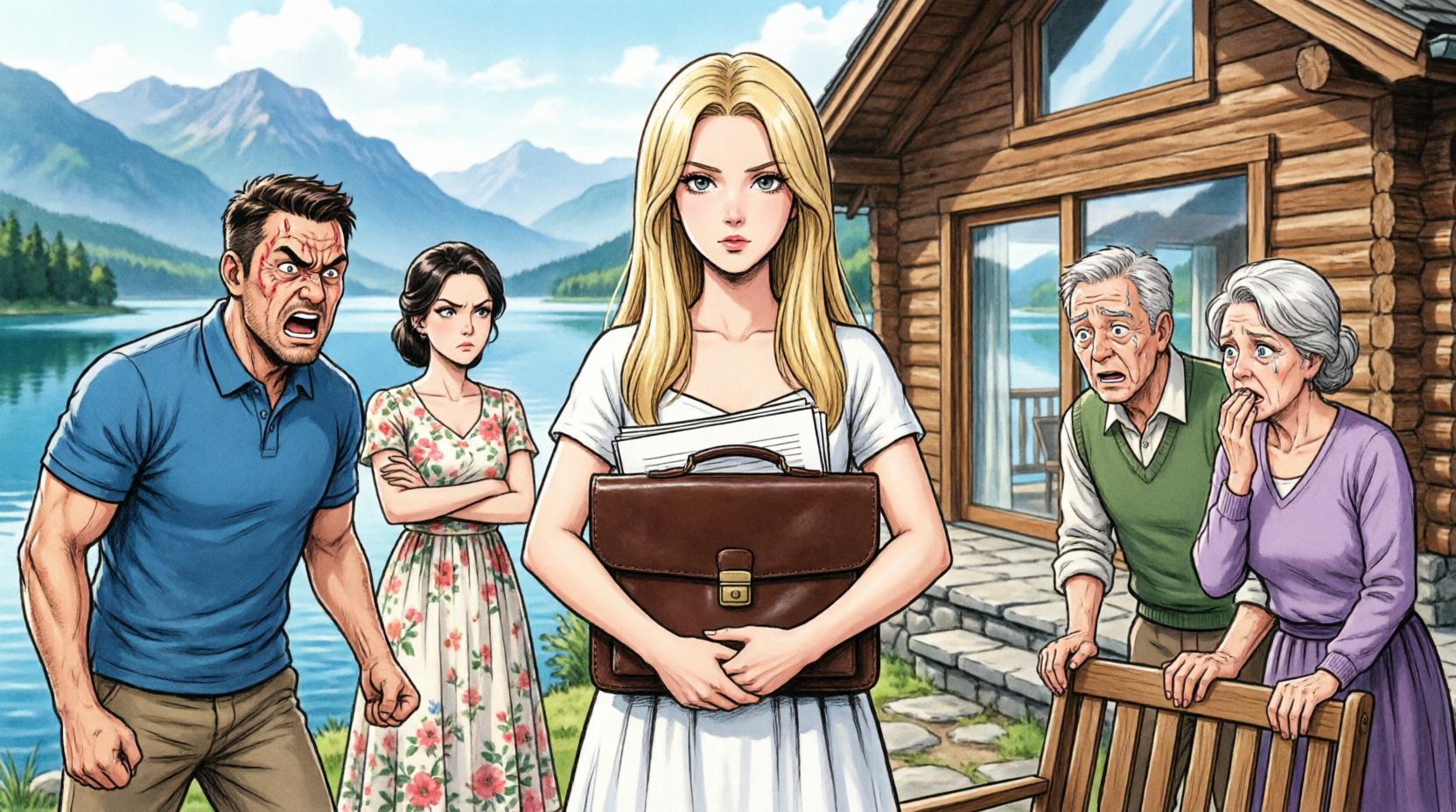
Craig was standing at the end of the kitchen table with one hand braced on the back of my father’s chair when I came through the door. My mother was still in her bathrobe, though it was nearly two in the afternoon. My sister’s boys were outside somewhere, their sneakers thudding across the porch boards, and my father had both hands flat on the table like he was trying to steady the world through the wood.
Craig tapped a spreadsheet with one finger and pointed at my dad with the other.
“Tom, you have to stop thinking so small,” he said. “This is a family asset now.”
My sister smiled the way people smile right before they claim something they did not build.
My father’s hands were shaking so badly the manila folder in front of him rattled against the tabletop.
That was the moment I knew the drive up from Grand Rapids had not been fast enough.
I set my laptop bag down by the mudroom bench, walked back out to my car, and got my briefcase.
The smile stayed on Vanessa’s face until she heard the locks click open.
Then it was gone.
—
My name is Riley Mercer. I was thirty-two that fall, and if you had asked anybody at my office what I did for a living, they would have said some version of contracts, permits, paper, details. Which was true, in the same way it is true to say a bridge is made of steel and concrete. Accurate, but not especially revealing.
What I actually did all day was listen for weak points.
I worked in contract administration for a commercial construction firm based in Grand Rapids, Michigan. Most mornings started with coffee from the lobby Keurig that always tasted faintly of burned plastic, a stack of submittals on my desk, and at least one project manager leaning in my doorway saying, “Can you take a look at this language?” What they meant was usually: can you tell me where this is going to hurt us six months from now.
I could. Usually in under ten minutes.
I knew how to read a clause that sounded generous and ended predatory. I knew how to tell when a deadline had enough vagueness in it to become a lawsuit. I knew how often the worst damage arrived dressed as convenience.
Nobody learns that because they enjoy punctuation.
They learn it because once, somewhere, somebody they loved signed or trusted or yielded at exactly the wrong moment, and it changed the shape of a life.
For me, that lesson started in a hospital corridor when I was nineteen years old.
Dad had always been the steadiest person I knew. He taught civics at a public high school outside Grand Rapids for almost twenty-five years. He was the kind of teacher who got Christmas cards from former students now in their thirties, the kind of man who could fix a screen door, explain the Electoral College, grill corn without burning it, and tell from the sound of an engine whether your oil needed checking. He was not flashy. He was not loud. He simply occupied space in a way that made the people around him feel less rattled.
Then one winter morning he dropped his coffee mug because his hand would not do what his brain asked.
Then he started moving more slowly when he got out of chairs.
Then there were tests. A referral. More tests. A neurologist with kind eyes and a terrible vocabulary for hope.
Early-onset Parkinson’s, he said, and from there the whole universe broke into before and after.
I remember the hallway more than the office. Beige walls. A vending machine humming by the elevator. My mother standing so straight I knew she was one breath from folding in half. Dad looked at the floor tiles while the doctor explained progression and management and quality of life. My mother asked every useful question. Dad asked none.
That was the day I learned there are people who suffer loudly and people who simply start carrying it.
My mother, Linda Mercer, became the second kind almost immediately.
She had worked part-time at the circulation desk in the Kent District Library system and volunteered at church and still somehow remembered every birthday in the family without Facebook reminders. Within a month of Dad’s diagnosis, she was keeping a spiral notebook of medications, appointment times, side effects, insurance calls, and questions for the neurologist. Within three months she was correcting pharmacy mistakes before the pharmacy noticed them. Within a year she knew more about movement disorder specialists in Michigan than some primary care physicians probably did.
She never announced any of this.
She just did it.
That was her genius and, eventually, her vulnerability.
Vanessa, my sister, was four years older than me and had always mistaken performance for presence. She was not cruel in any headline-making way. If you met her at a baby shower or a school fundraiser, you would probably leave thinking she was warm, energetic, maybe a little dramatic, but essentially good-hearted. She cried easily. She hugged often. She had a talent for arriving with muffins and leaving before the cleanup.
For the first six weeks after Dad’s diagnosis, she was there constantly.
She brought casseroles in disposable aluminum pans and stood in our parents’ kitchen with tears in her eyes, telling anybody who called that our family was coming together. She made a color-coded SignUpGenius for meals no one had asked for. She posted vague things on Facebook about cherishing every moment and appreciating the people who matter. She was, for a brief stretch, exactly the daughter extended relatives wanted to believe she was.
Then she got promoted at her job in medical sales.
Then she got engaged.
Then life, in Vanessa’s telling, became unavoidably full.
The casseroles stopped. The tears relocated to holidays. The group texts continued just enough to maintain authorship of concern.
I do not say that bitterly anymore. I say it the way I might state weather conditions before a job site inspection.
It mattered. That was all.
Craig Wolfe entered the family wearing confidence like aftershave.
He sold equipment leases for a while, then real estate leads, then something involving “wealth coaching” that never sounded less fake no matter how many times he explained it over burgers in my parents’ backyard. He had the smile of a man who wanted you to underestimate him and the conversational habits of someone who never stopped scanning for leverage.
The first time I really clocked him was at Thanksgiving the year he and Vanessa got engaged. He asked my father three questions in under five minutes about whether he had disability coverage, whether the house was paid off, and whether he and Mom had ever thought about tapping home equity for flexibility. He asked it lightly, as if he were making conversation. Dad answered lightly too, because he was too polite not to.
I was washing a carving knife at the sink and watched Mom’s shoulders rise half an inch.
Some men enter a room and look for the bathroom. Craig entered a room and looked for the title.
I never forgot that.
By the time he and Vanessa had been married two years, he had opinions about everything that belonged to anyone else. He had thoughts about Dad’s truck, which he thought should be sold before it depreciated further. He had recommendations about Mom’s retirement account, which he referred to as dormant capital. He once told my parents they should downsize “before a crisis forces a bad decision,” as if their lives were a quarterly report he had graciously volunteered to optimize.
He said all of this with such cheerful certainty that people less accustomed to him sometimes mistook it for competence.
I knew better.
So when I found the property on a gray November morning two years before the kitchen-table scene, I told no one but my lender, my contractor, and eventually my attorney.
Not even my parents knew until the cottage was done.
That sounds dramatic, maybe even a little controlling, if I don’t explain the rest.
So here is the rest.
I had been saving for them since I was twenty-two.
Not in some obsessive, martyrdom-soaked way. I was not skipping meals and living in a candlelit attic while humming noble songs. I had a decent salary, a one-bedroom condo in Eastown, a used Subaru with one working heated seat, and a habit of moving any bonus money straight into a high-yield savings account labeled Future. I did not date much. I did not take international vacations. I wore the same wool coat for five winters. I packed my lunch more often than not. None of it felt punitive.
It felt pointed.
Because every year I watched my parents make their lives smaller in practical ways no one who loved them should have accepted as permanent.
Mom stopped going to evening book club because Dad’s meds made late drives harder. Dad started pretending he preferred staying home because walking from a parking lot to a restaurant could ruin his appetite before the first course. They put off house projects because grab bars and wider door clearances and bathroom retrofits were not the sort of upgrades anyone dreams about in their fifties.
Their world did not collapse.
It narrowed.
That kind of loss is easy to miss if you are not looking straight at it.
I was looking straight at it.
The cottage began as a half-acre listing in Newaygo County, about ninety minutes north of Grand Rapids if traffic on US-131 behaved and you did not get trapped behind a boat trailer near Big Rapids. The online photos were terrible. Everything looked damp and underloved. The listing description called the existing structure a seasonal cabin with potential, which in real estate language means either charming fixer-upper or condemned with optimism.
I drove up anyway.
The road was gravel for the last mile and a half. The lake was darker than I expected, still and windless, ringed with hemlocks and tall pines that made the whole shoreline feel private without seeming isolated. The old cabin leaned a little and smelled like wet wood and mice. The deck was soft in two places. The bathroom was impossible. The kitchen had cabinets that looked like they had survived a previous century through sheer resentment.
None of that mattered.
At the waterline, the world went quiet.
I stood there with my boots sinking into cold sand and watched a band of pale light move across the lake. I thought about Dad sitting there with a mug in his hands, not having to perform stamina for anybody. I thought about Mom walking through a kitchen that had been built around her real life instead of around whatever subdivision builder had won cheapest bid in 1994.
I thought, very clearly, they could breathe here.
That was enough.
I bought the property six weeks later.
I did it the only way I know how to do anything that matters: with a spreadsheet, a legal pad, too many tabs open, and a refusal to let sentiment make me sloppy. I set up a separate account for all project expenses. I hired a contractor named Mike Darnell whose firm had worked on three municipal jobs with ours and whose superpower was telling the truth about schedules. I paid for a soil evaluation, septic review, shoreline setback consult, and county permit package before I picked a single light fixture. I went up every other Saturday with site coffee in a thermos and steel-toe boots in the back seat.
What we built was not huge. I never wanted huge.
I wanted ease.
One story. Wide doorways. Lever handles instead of knobs. Zero-step entry through the side door. A bathroom Dad could use safely on bad days without making the room look medical. A kitchen with counters at practical height. Good under-cabinet lighting because medication labels should not require guesswork. A wraparound porch because some afternoons one patch of sunlight means more than an extra bedroom ever could.
I chose durable finishes and forgiving flooring and upholstery Mom could clean without needing a PhD in stain chemistry. I added a dock sturdy enough for two chairs and a cooler and the possibility of hours. I planted hydrangeas by the porch because she loved them and because softness matters when a life has been too efficient for too long.
The whole thing cost me three hundred and ten thousand dollars by the time it was finished.
Land, demo, build, permits, furnishings, dock, appliances, landscaping, contingency overruns, taxes prepaid into escrow.
Three hundred and ten thousand dollars.
I knew the number the way some people know Bible verses.
Not because I resented it.
Because I had meant every dime.
There were nights near the end when I sat alone in my condo with invoices spread across my dining table and thought, this is a ridiculous amount of money for one person to put into something they do not legally keep. Then I would picture my mother’s face the first time she opened a drawer that glided instead of stuck. Or my father’s hand on a porch rail built at exactly the height he needed. Or the way their old house had begun to feel like a daily negotiation with decline.
Then the number changed shape.
It stopped being cost and started becoming translation.
This, in dollars, is how love looks when it gets poured into lumber and concrete and brushed nickel hardware and fifteen years of property taxes paid ahead so no one can weaponize a due date.
Because yes, I paid those too.
I wanted no seam for anyone to pry at.
The legal structure took me nearly as long to think through as the framing plan.
I loved my parents completely. I did not, however, trust the gravitational pull of family once money entered the atmosphere. Too many people hear the word gift and start silently conjugating ownership.
So I met with an estate attorney in Grand Rapids named Sharon Meeks, a woman in her early sixties who wore navy suits like armor and kept peppermint Life Savers in a crystal dish on her desk. I laid out the entire situation: parents, diagnosis, sister, brother-in-law, likely future pressure points, my desire to protect occupancy without creating tax complications or leaving room for opportunists to argue implied rights.
Sharon listened, took three notes, and then said, “You don’t need sentiment. You need structure.”
I liked her immediately.
We created an irrevocable trust with my parents as the sole lifetime beneficiaries. Exclusive occupancy rights. Clear restrictions on sale, transfer, subletting, commercial use, and encumbrance. A trustee with fiduciary duty to the terms. Backup language for incapacity, medical decision interplay, and post-lifetime disposition that would not invite a family knife fight when grief lowered everybody’s IQ.
I signed the documents with dry hands and a steady pulse.
That should tell you how sure I was.
I never told Vanessa any of this because I knew exactly how it would go.
She would cry first.
She would say she could not believe I had done something so big without including her. Then Craig would say nobody was upset, they just wanted transparency. Then somehow the conversation would move, inch by inch, from what our parents needed to what was fair. The word fair would arrive in a tone suggesting it had legal force. Someone would ask whether everyone should be on paper somewhere “for clarity.” Craig would suggest a family LLC before dessert. Vanessa would say she was only trying to keep things equal. By the end of the night, I would be defending the idea that a private gift to two people could remain private.
I was too tired to sponsor that theater.
So I built quietly.
When the cottage was finished, I planned the reveal for my parents’ fortieth anniversary.
I told them I was taking them to dinner near the lake.
Mom wore a dark green sweater and pearl studs because she still believed in dressing for surprises. Dad wore the charcoal quarter-zip she bought him every Christmas in some slight variation because it was easy for his hands on stiff mornings. We drove north through October light, maples burning copper and red along the highway, and Dad asked me twice where we were going.
“You’ll see,” I said both times.
He pretended to be annoyed. Mom kept smiling at the windshield.
When I turned off the main road onto gravel, Dad frowned. “This isn’t dinner.”
“Nope,” I said.
The porch light was on when we came through the trees.
I had set it on a timer that morning because I wanted the whole place to glow when we arrived. The cottage sat low and warm against the water, windows lit, dock reaching out into the darkening lake like a promise made visible.
Mom made a sound I had never heard from her before, something between a laugh and a gasp.
Dad just stared.
I parked and got out first because my hands had started shaking in delayed anticipation. I came around to his side and opened the door. He looked at me, then at the house, then back at me.
“Riley,” he said, and stopped there.
Mom had both hands over her mouth.
“Is this real?” she whispered.
“Yes,” I said. “It’s yours. Both of yours. The trust is already recorded. Nobody can sell it. Nobody can take it. You get to use it exactly how you want for as long as you want.”
My father, who used a cane more often than he admitted by then, got out of the car without it.
That is not a miracle story.
Adrenaline does things. Joy does too.
He walked to the porch slowly but without the cane, put one hand on the railing, and stood there looking at the water while dusk folded in around us. Mom was crying openly now. Not dramatic sobbing. Just tears running down her face while she laughed under her breath like she could not quite absorb what was happening.
Inside, she touched everything. Not in a greedy or acquisitive way. In a grateful one. She opened cabinets. She ran her fingers along the bathroom counter. She stood in the bedroom doorway and looked at the quilt I’d had custom-made from the same navy and cream palette she always used in the old house. Dad kept drifting back to the lake-facing windows as if he was afraid it might disappear if he looked away too long.
We ate takeout on the porch that night because I had ordered from a little place in Big Rapids ahead of time and tucked the bags in the warmer behind my front seat. Burgers, fries, coleslaw, a slice of cherry pie for Dad. Mom said grace with tears still on her cheeks. Dad leaned back in his chair and watched the last light go off the water.
After a while he said, very quietly, “I thought a place like this belonged to some other version of our life.”
I looked at him. “What do you mean?”
He smiled without looking away from the lake. “The version where things went according to plan.”
Mom reached over and took his hand.
He squeezed hers back.
That should have been enough for one story.
It would have been, if everybody in a family understood the difference between blessing and inventory.
For the first week after the reveal, things stayed almost impossibly good.
Mom called me three times to ask if I minded her moving dishes around because the silverware drawer made more sense near the stove. Dad texted me a photo of sunrise on the lake with no caption, which was not his usual style and somehow made it more moving. On Sunday I drove back up with a toolbox and extra batteries and spent the afternoon adjusting a grab bar half an inch because Dad said it felt a little off when his left hand was having a slow day.
Mom reorganized the pantry while pretending not to. Dad sat on the dock with a blanket over his knees and named birds as if he had been waiting years to have somewhere quiet enough to hear himself think.
I drove back to Grand Rapids that evening with the kind of calm that makes you almost superstitious.
Then my mother told Vanessa.
She did not do it maliciously. My mother has never held happiness in well. She leaks it. It is one of the reasons people love her and one of the reasons her boundaries sometimes arrive five minutes late to the argument.
She called to check in on Vanessa after one of the boys had strep, and somewhere in the middle of that conversation she mentioned the cottage, and by the time they hung up Vanessa knew there was a lake, a wraparound porch, and an anniversary surprise involved.
Mom called me that same evening.
Her voice had that careful texture it gets when she is trying not to sound worried too soon.
“Vanessa wants to come up on Saturday with Craig and the boys,” she said. “Just for a quick visit. To see the place. Is that all right?”
I was standing in my kitchen opening a carton of leftover Thai noodles.
I shut the fridge with my hip and looked out the window over the alley. “Mom, it’s your home. You do not need my permission to invite your daughter.”
“I know that,” she said quickly. Then, softer: “I just wanted to check.”
There it was.
The part beneath the sentence.
She already felt something tugging wrong.
I should have driven up that Saturday.
Instead I had a bid deadline on a school renovation and a subcontractor dispute that had turned vicious over liquidated damages. Mike texted me site photos from a municipal job in Lansing, and my phone stayed ugly from breakfast to dark. Around noon Mom sent a picture of the boys on the dock with fishing poles. Around four she sent a heart emoji and said, Great day. At six-fifteen she called and sounded tired.
“They just left,” she said.
“How was it?”
A beat.
“Fine. Busy. Craig had lots of questions.”
“About what?”
“Oh, you know. The dock. The septic. Winterizing. Whether the township allows boat lifts. Just curious questions.”
I closed my eyes for a second.
“Mom.”
“I know,” she said immediately. “I know. It may have been nothing.”
Nothing was not Craig’s preferred lane.
I said, “Call me if he asks anything else.”
“I will.”
She waited a second before adding, “He did say one thing that bothered your father.”
“What?”
“He said places like this shouldn’t sit empty because that’s bad stewardship. Your father told him it wasn’t sitting empty. Craig said he meant most weekdays.”
I set the noodles down without eating them.
“And Dad?”
“He didn’t like it.” Her voice lowered. “But you know your father. He doesn’t like conflict in his own house.”
He had one now, whether he invited it or not.
I did not sleep well that night.
By Tuesday morning, it had already gotten worse.
I was pulling into the parking structure under our office when Dad’s text came through. Cell service down there was terrible. Messages loaded in clumps. I did not see it until I came back up the stairwell into cold air on Monroe Avenue.
Please come now.
Vanessa says we should all discuss the property together. Craig has been making calls. I don’t understand what is happening.
I called immediately.
Voicemail.
I called Mom.
Voicemail.
I called Dad again, then Mom again, then Vanessa, who declined the call after two rings.
That was when my body went cold.
Not panicked.
Focused.
I emailed my supervisor that I had a family emergency, grabbed the project file I needed to review from my desk, then stopped and went back for something else.
My briefcase.
It was black leather, old enough to look serious without looking theatrical, and my parents had given it to me when I finished college. Dad used to joke that it made me look like I sued railroads in my spare time. Mostly it held job files and a backup legal pad and whatever paperwork I thought might matter if a meeting went sideways.
That morning I opened my bottom desk drawer, pulled out the trust packet, a certified copy of the deed, Sharon’s legal memo, county zoning printouts, and the screenshots I had already taken the night before after a bad feeling sent me searching the property address online.
There it was.
A draft listing on a vacation rental platform under a management account linked to Craig’s business email.
Lakefront family retreat. High-demand summer dates. Sleeps eight.
Not live yet. Scheduled.
The posting used two photos of the dock and one of the living room taken from an angle my mother would never choose.
I printed everything at the office printer while my pulse stayed miraculously even.
Then I got in the Subaru and drove north.
The whole trip up US-131 felt like being held one inch behind a wall you already knew was on fire. Trucks drifted slow in the right lane. Somebody in a Jeep rode my bumper through Cedar Springs like urgency could be contagious. I called the rental platform’s fraud line from a red light and opened a ticket before I hit Rockford. I emailed Sharon from a gas station parking lot and asked her to stand by if I needed a formal demand letter by afternoon.
She wrote back in eleven minutes.
Call me when you arrive. Do not improvise.
That was one reason I paid her so well.
The gravel road to the cottage never felt longer than it did that day.
Vanessa’s SUV was in the drive. Craig’s pickup was backed toward the side door with the hatch open. Through the windshield I could see him out on the dock photographing the shoreline with his phone, then counting paces heel to toe like he was measuring yield.
My mother was at the kitchen window when I came through the mudroom. Her face had the strained, too-composed look people get when they have been trying to keep a room stable with nothing but posture.
My father sat at the table with a folder in front of him he clearly had not opened by choice.
Vanessa was in the living room touching the bookshelf.
Just touching things.
Like belonging could be rehearsed with fingertips.
She turned when she heard me and smiled too quickly. “Riley. Finally. We’ve been trying to get you up here all morning.”
I did not answer her first.
I looked at Dad. “Are you okay?”
He nodded once. His jaw was locked tight enough to show along one side of his face. “I am now.”
Then I asked the room, “What is happening?”
Vanessa gave a little exhale as if I were already being difficult. “Nothing dramatic. We just thought it was time to have a practical conversation.”
“About what?”
“About the cottage.” She lifted her hands. “Before this turns into some weird territorial thing.”
My mother stepped toward the table. “Vanessa—”
Vanessa cut gently across her. “Mom, please. We are trying to help.”
That was when the back door opened and Craig came in from the dock, carrying his phone and the kind of confidence men borrow from ignorance.
“Good,” he said when he saw me. “Now we can stop talking in circles.”
He dropped a stapled packet on the table in front of my father.
Rental projections.
Columns, occupancy estimates, average seasonal rates, a list of comparable properties within thirty miles, a cheerful little net revenue line at the bottom like greed became respectable once you gave it formatting.
Craig pulled out a chair and sat down without being asked.
“This place is a dormant asset five days out of seven,” he said. “We’re looking at thirty to forty grand a season conservatively. Maybe more if we package the dock and use the water frontage in marketing. Mom and Dad stay here whenever it’s not booked. Everybody wins.”
“I never agreed to that,” Dad said.
His voice was soft.
His eyes were not.
Craig made a placating face that would have worked on someone less familiar with him. “Tom, nobody’s taking away your weekends. I’m talking about strategy. You don’t let a three-hundred-ten-thousand-dollar property sit idle because of sentiment.”
Vanessa nodded as if she were merely echoing common sense. “Craig knows a management company. They handle check-in, cleaning, deposits, everything. No burden on you guys. Riley doesn’t even have to think about it.”
I looked at her. “Why would I be thinking about it at all?”
Her chin lifted a fraction. “Because you built it.”
“For them.”
Craig leaned back. “Exactly. For the family. Which makes this a family asset now.”
That was the line I heard right before the whole day sharpened into something clean.
I said nothing.
I went back out to my car and got my briefcase.
When I returned, Craig was mid-sentence about occupancy percentages. Vanessa’s smile was still on. The boys were chasing each other past the front windows. Mom stood by the sink clutching a dish towel she was not using. Dad had both hands flat on the table, like if he lifted them the room might tilt.
I set the briefcase down, turned it so the latches faced me, and opened it.
The metal clicks were small.
They changed the temperature of the room anyway.
Craig stopped talking.
I took out the first document and placed it on the table between us.
“Recorded deed,” I said. “Newaygo County. Ten months ago.”
Then the second.
“Trust instrument. Irrevocable.”
Then the third.
“Attorney opinion confirming the structure is valid, enforceable, and not subject to challenge by non-beneficiaries.”
Vanessa crossed her arms. “You’re enjoying this.”
I ignored her.
I looked at Craig.
“This property is not a family asset,” I said. “It is held in trust for two specific people: Tom Mercer and Linda Mercer. They are the sole lifetime beneficiaries. The document grants them exclusive and unconditional right of occupancy and use. It explicitly prohibits subletting, short-term rental, commercial use, assignment, or any other income-generating arrangement without written authorization from the trustee.”
Craig’s mouth tightened. “And that’s you.”
“Yes.”
“So you do control it.”
“No,” I said. “I protect it. That’s a different verb.”
He gave a short laugh. “Trust language gets challenged all the time.”
I slid Sharon’s memo across the table until it touched his printed projections.
“You are welcome to pay an attorney to tell you otherwise,” I said. “Mine already told me you have no standing. Non-beneficiaries cannot challenge beneficiary occupancy rights on property they neither own nor contributed to.”
Mom made a small sound behind me, not fear exactly. Relief arriving too fast.
Craig glanced down at the memo, then back at me. “We’re family. Courts care about intent.”
“Perfect,” I said.
I pulled out the screenshots and laid them beside the legal memo.
“Let’s talk about intent.”
Craig did not move.
Vanessa did.
Her shoulders pulled in half an inch.
“This is a draft rental listing created under an account tied to your business email,” I said. “Timestamped last night. It uses photographs of this property taken without authorization. It describes amenities you have no authority to market. It was scheduled to go live Thursday morning.”
Craig found his voice first. “It was exploratory.”
“It was fraud-adjacent,” I said. “And not especially adjacent.”
His charm thinned visibly. “That’s ridiculous.”
“What’s ridiculous is you trying to monetize a home that belongs to two people whose medication schedule makes surprise guests an actual safety issue.”
I placed another printout on top.
“This is the township short-term rental ordinance. No permit application has been filed for this address. Without one, any listing or rental activity is prohibited. Fines run up to eight thousand dollars per violation, plus a mandatory review period. So even if you had authority, which you don’t, you would still be in violation before your first booking.”
Craig stared at the page like it might rearrange itself into permission if he waited long enough.
Vanessa looked at him, then at me. “You looked all this up today?”
“I looked it up before breakfast.”
Then I took out the last document.
I had drafted it at my office, sent it to Sharon, and gotten a one-line reply that said, Fine as a preliminary notice. Send only if needed.
I slid it toward both of them.
“This is a cease and desist,” I said. “Addressed jointly to Craig Wolfe and Vanessa Wolfe. It instructs you to stop all efforts to list, market, photograph for commercial purposes, represent, or interfere with the private occupancy of this property. Any further attempt to do so will be treated as tortious interference with the trust and referred for immediate legal action.”
The room went silent enough for us to hear the lake against the dock.
Then Vanessa said, very softly, “You had lawyers ready?”
I looked at her. “I had reality ready.”
Craig’s chair scraped back.
“This is insane,” he snapped. “You build a place like this, don’t tell anyone, put it in some controlling trust, and then act shocked when other adults try to think long-term?”
“Other adults?” I said. “You mean the ones trying to list someone else’s home online before asking the people living in it?”
“We’re trying to maximize value.”
“For who?”
He spread his hands. “For the family.”
I looked at my father then. Really looked at him. His hands were still trembling from the stress of the last hour. My mother’s robe belt was tied wrong, one side longer than the other, the way it gets when she is distracted enough not to notice small things. Their weekend bags still sat by the hall closet. Dad’s pill organizer was open on the counter because someone had interrupted lunch.
That was the family Craig was allegedly helping.
I turned back to him.
“Thirteen years ago,” I said, “my father was told his own body would increasingly ignore him. My mother went home that night and reorganized her life without asking anyone to clap. I built this place so they would have somewhere soft, safe, and fully theirs while the rest of the world kept asking them to adapt. Not so you could treat a diagnosis like an underperforming investment.”
Craig’s face hardened. “There it is. The martyr speech. You always do this, Riley. You spend money and then use it to control the room.”
“No,” I said. “I use documents to control men who mistake access for entitlement.”
That landed.
Even Vanessa flinched.
I put both palms on the table and said, very evenly, “You need to leave.”
Vanessa straightened. “Mom? Dad? Are you seriously going to let her talk to us like this?”
My mother looked at my sister with a sadness so tired it made my own throat ache.
“She is talking to you like someone who came when we asked,” Mom said. “And like someone who listened when we said no.”
Vanessa stared at her.
Dad lifted one hand off the table. It shook, but he lifted it anyway.
“Craig,” he said. “Get out of my house.”
Craig laughed once, short and unbelieving. “Your house? Tom, be serious.”
My father’s hand stopped in midair.
He looked at Craig in a way I had not seen since before the diagnosis. Not angry exactly. Clear.
“Yes,” he said. “My house.”
That should have ended it.
It did not end it gracefully.
Craig made two loud phone calls in the driveway about trustee overreach and family rights, pacing beside his truck where he knew we could see him through the window. Vanessa went into the guest bedroom and cried in a way that sounded, to me, more furious than wounded. The boys, who did not deserve any of this, sat on the porch steps tossing pebbles at a coffee can and asking if they still got pizza on the way home.
Mom packed up leftover chicken salad for them anyway.
Because of course she did.
Eventually the pickup reversed down the gravel and the SUV followed. Their taillights disappeared through the trees.
The whole house exhaled.
Mom made coffee though nobody really wanted it. Dad stood at the sink looking out at the lake with his shoulders slowly lowering back into place. I gathered my papers into neat piles because sometimes order is the only merciful shape you can give adrenaline.
After a while Mom said, “The first weekend they came, Craig walked the property line three times.”
I looked up. “What?”
“I thought he was taking it in.” She sat at the table and held her mug in both hands. “He asked about the septic. The shoreline footage. Whether the dock would support a pontoon. Whether the county taxes second homes differently from primary residences. I thought he was making conversation.”
Dad turned from the window. “He asked me if I’d ever considered adding a boathouse.” He paused. “I told him I was thinking bigger than that.”
“You did?” I said.
For the first time all day, the corner of his mouth moved.
“Yes,” he said. “I just didn’t mean what he thought I meant.”
I laughed then. Couldn’t help it.
Mom did too, a little watery.
The sound felt like a railing after a bad staircase.
Before I left that evening, I checked every lock and window latch, pulled up the driveway camera feeds on the kitchen tablet, and made sure both my parents knew how to replay footage. I had installed motion-triggered cameras during construction because a vacant lake property invites curiosity, teenagers, raccoons, and occasionally all three. Now I showed them exactly where the alerts came in, how to call me from the app, how to mute false triggers from blowing leaves.
Mom watched me with that expression she gets when gratitude is trying not to become apology.
“You thought of everything,” she said.
I held the tablet a second longer than necessary. “Not everything.”
Dad touched my sleeve. “Enough,” he said.
But enough, as it turned out, was not yet the same thing as done.
The social media part started four days later.
Craig posted first. Long caption. No names. Plenty of implications.
Sometimes the people who give the biggest gifts attach the tightest strings.
Real love doesn’t need trust documents.
Generosity used as control is still control.
He wrote it in that performative tone men use when they want to look reflective without sacrificing accusation. Vanessa shared it with a comment about healing family dynamics and breaking cycles. A cousin in Kalamazoo messaged me, Hey, is everything okay with your parents? One of Mom’s church friends called her after Bible study to ask whether she was being pressured to stay at the lake house against her wishes.
That part almost impressed me.
How quickly opportunists learn to speak the language of concern.
I did not reply online.
I replied where it counted.
I drafted one email addressed to Vanessa and Craig with Sharon copied, along with Martin Sloane, the senior attorney my construction firm used for commercial disputes nasty enough to justify his hourly rate. The email was dry enough to preserve by drought.
Any public or private statement capable of being reasonably understood as referring to me, my parents, or the trust property, if materially false, will be preserved and addressed through counsel as appropriate. Any attempt to interfere with occupancy, use, or quiet enjoyment of the trust property will be treated as actionable. Direct further communication through counsel or do not communicate.
I sent it at 8:12 a.m. and then turned off email previews for the folder I created under their names.
The posts disappeared within forty-eight hours.
That should have been a clue that Craig was not finished. Men like him don’t take down bait because they have learned. They take it down because they are trying another door.
The midpoint came disguised as silence.
For almost two weeks, nothing happened.
No posts. No calls. No surprise visits. Mom and Dad settled into a rhythm at the cottage that started sounding almost ordinary when she described it, which was its own kind of miracle. Dad found a local bait shop he liked. Mom figured out the grocery store in Fremont and texted me once just to report that the cashier had complimented the hydrangeas out front. I drove up on Sundays when I could, brought Costco groceries and lightbulbs and once a ridiculously expensive heated throw Dad pretended he didn’t need until he used it for six straight hours.
I let myself believe the paper had worked.
Then Thanksgiving blew sideways at my aunt Carol’s house in Ada.
Mom wanted to go because family mattered to her even when it arrived undercooked and loud. Dad wanted to go because he still believed you keep showing up until you truly can’t. I agreed because I am an idiot in the specific way grown daughters sometimes are when they hope one carefully managed holiday might spare their mothers another disappointment.
Vanessa and Craig were there when we arrived.
So were three cousins, two spouses, Carol’s grown son, and enough casseroles to support a small militia.
The first hour held. People asked Dad about the lake. Mom passed rolls. Craig laughed too loudly at something on football. I almost relaxed.
Then my cousin Beth cornered me near the pie table and said, in a voice pitched as sympathy, “I just hope you know giving people a house and then putting conditions on it can feel… complicated from the outside.”
I turned slowly. “From whose outside?”
She blinked. “I just mean, I heard your parents have to clear visitors with you.”
There it was.
Not just a lie.
A crafted lie, distributed socially, plausible enough to travel.
I found Vanessa in the den refilling a wineglass and said, very quietly, “What exactly have you been telling people?”
She did not look up right away. “Nothing that isn’t emotionally true.”
I actually laughed. “Emotionally true?”
Now she looked at me. Her face was flushed, whether from wine or anger I couldn’t tell. “You don’t get to make yourself the hero forever, Riley.”
“What does that mean?”
“It means you do things like this and then everyone has to orbit them. The cottage, the trust, the dramatic legal language. Do you know what it felt like to have Mom call me crying because you had papers ready for us?”
I stared at her. “Mom called you crying because your husband tried to rent her house.”
She set the bottle down too hard. “He was trying to help.”
“No. He was trying to skim.”
Her eyes flashed. “You always think you’re the only person who sees clearly.”
“And you always think tears change facts.”
That one hit where it was meant to.
She went still.
Then she said, low and sharp, “You built that place because you needed somewhere for your goodness to live where people could see it.”
I wish I could tell you I answered with some devastatingly calm line that fixed the whole family dynamic in seven elegant words.
What I actually did was feel my own exhaustion flare so fast it made my skin hot.
“Three hundred and ten thousand dollars,” I said. “That’s what I spent so Mom and Dad would have one place in their lives nobody could turn into a group project. If you hear control in that, maybe ask yourself why protection feels personal.”
Beth came through the doorway then, saw our faces, and vanished again.
Vanessa laughed once without humor. “There it is. The number. You love that number.”
“Because I paid it.”
“And because it buys you moral authority.”
Before I could answer, Dad’s voice came from the hall.
“Riley.”
Just my name.
Nothing else.
I stepped around Vanessa and found him standing near the bathroom with one hand on the wall. Not collapsed. Not injured. Just suddenly more tired than he had been ten minutes earlier.
Too much noise. Too much strain. Too much family mythology in one heated house.
Mom was beside him, worried enough to lose all pretense. We left before dessert.
The whole drive back to the cottage was dark and quiet except for the turn signal clicking on the county roads.
At one point Mom said, from the passenger seat, “Maybe we should have just stayed home.”
Dad was in the back because the rear seat in my Subaru gave him more room to stretch his left leg on bad evenings. He looked out the window and said, “No. Maybe other people should have behaved.”
That was the first time I heard him stop absorbing other people’s bad behavior as if it were weather.
It mattered more than pie ever could.
Still, that night broke something open in me.
Not conviction.
Illusion.
I stopped believing documentation alone would finish this. Paper could draw a line. It could not make people accept shame. It could not prevent them from turning the story into a morality play where boundaries became vanity and access became a birthright.
So I changed tactics.
The week after Thanksgiving, I scheduled an appointment with Sharon for all three of us.
Mom protested immediately. “Do we need more legal things?”
“Yes,” I said. “Because Craig keeps pretending confusion where none exists. I want there to be absolutely no daylight left.”
Sharon had us in her office on a Thursday afternoon. Peppermints in the dish. Navy suit. No patience for euphemism. She walked my parents through the trust structure line by line, then through their wills, medical directives, and powers of attorney. Mom kept saying, “We never thought we needed to be this formal.” Sharon kept replying, “Formality is what keeps opportunists from improvising around grief.”
Dad listened harder than either of us.
At one point Sharon looked at him and said, “Mr. Mercer, has anyone made you feel as though you are not permitted to exercise control over your own living situation?”
He was quiet for a moment.
Then he said, with visible effort, “Yes.”
Mom turned to him, startled.
He kept going. “Not by Riley. By the way everyone else starts talking around me when money comes up. Like the disease made me hypothetical.”
The room got very still.
Sharon nodded once. “Then let’s fix that too.”
We spent the next hour adding what she called clarity provisions: explicit no-trespass authorization, written occupant preference statements, access control language, notice requirements for any invited extended family stay longer than seventy-two hours. Not because my parents needed permission from me, but because they deserved paper that supported the word no when fatigue made speaking it harder.
When we left, Dad held the envelope with the signed copies in his lap all the way back to the parking garage.
At the car he looked at me and said, almost surprised, “I never realized how much of my life lately has been people deciding what would be easiest for everyone.”
I unlocked the Subaru. “Was it easiest for you?”
He gave a tired little smile. “Funny how nobody asks that part.”
That should have been the end of the second act.
It still was not done.
Two weeks later, on a Tuesday morning so cold the office windows had that metallic winter light on them, Dad called with his voice pitched in a register I had never heard from him before.
Controlled panic.
“There’s a man at the door,” he said.
I was at my desk with a bid tab open on one monitor and a utility subcontract on the other. I stood up so fast my chair hit the credenza.
“What man?”
“I don’t know. He says he has a rental agreement. He says Craig arranged it. He has paperwork.”
Every nerve in my body snapped awake.
“Dad, listen to me carefully. Lock the inner door if it’s not already locked. Do not sign anything. Do not step onto the porch again. Put Mom on speaker if she’s with you.”
I was already opening the camera app with my other hand.
There he was.
A man I did not recognize standing on my parents’ porch in a puffer jacket, holding a printed confirmation sheet and a duffel bag. Mid-forties maybe. Not aggressive. Confused. Looking from the page to the house number and back again.
Mom came on the line. “Riley?”
“I’m seeing him. Stay inside.”
I called the township non-emergency line first, then the sheriff’s office, because local deputies reach lake roads faster than state police and because details matter when you need someone to take a thing seriously on first contact. I reported an individual attempting entry based on fraudulent rental documentation at a private residence subject to occupancy protections. Then I screenshotted the porch camera and texted it to Craig with one line.
I am watching this live. If your contact does not leave before the deputy arrives, I will pursue every available remedy.
He replied four minutes later.
Wrong address. Tell him our mistake.
Our mistake.
As if he had sent a pizza to the wrong condo.
The man on the porch got a call right then, looked at his phone, frowned, and stepped back from the door. He seemed embarrassed more than anything. He picked up his duffel and went down the steps just as the county deputy turned onto the gravel.
I stayed on speaker with Mom and Dad through the whole thing while the deputy spoke to the man by the driveway. The man showed him paperwork. The deputy looked toward the house, then back at the page. Eventually the stranger got in his car and left. The deputy came to the door after and spoke to my father through the storm glass while Mom stood just behind him clutching the edge of the counter.
When Dad called me back ten minutes later, his voice was steadier.
“Deputy Larson says the man paid a deposit through some private payment app,” he said. “He thought he had the place for three nights.”
I closed my eyes.
There it was.
Not just interference.
Revenue.
I called Sharon, then Martin, then the rental platform fraud team again, then the deputy back to get the incident number. By noon I had preserved the text from Craig, the camera footage, the deputy’s name, and the stranger’s stated booking reference. By two, Martin had sent Craig a formal demand letter so cold it could have been filed in permafrost. By three, I had driven halfway to the lake before realizing I was gripping the wheel hard enough to hurt.
I made it there by dark.
Mom opened the door before I knocked.
She looked smaller than she had a week before, which made something dangerous move under my ribs.
Dad was in his chair by the window with the envelope from Sharon’s office on the side table beside him. He had not taken off his shoes. The stranger’s footprint was still visible on the porch through the sidelight glass.
I crouched in front of him. “Are you okay?”
He gave me a long look. “I’m angry.”
Good, I thought.
Not because anger is pleasant.
Because anger, in him, meant ownership had finally outrun shame.
We ate soup I do not remember tasting. Later I walked the perimeter in the dark with a flashlight while the cameras picked up my own movement in little bursts of white timestamped certainty. The lake was black. The trees clicked in the wind. At the back property line I stood for a moment and let myself feel the full ugliness of what Craig had done.
He had not just tried to rent a house.
He had introduced uncertainty into the only place my parents had begun to relax.
That is a different category of theft.
Inside, Mom was folding dish towels already folded.
“I hate that this house is turning into a problem,” she said without looking up.
The words hit me harder than anything Craig had said in person.
I sat down across from her. “Do you want to leave?”
She stopped folding.
Dad, from the other room, said, “No.”
One word.
Firm enough to quiet the whole house.
Mom turned toward him.
He pushed himself up more slowly than he would have ten years earlier and came to the table. His hands trembled. He ignored them.
“This place is not the problem,” he said. “The problem is that some people see a good thing and think the good thing must belong to whoever wants it hardest.”
He put one hand on the back of Mom’s chair.
“I am tired of living as if everybody else’s comfort is more important than ours.”
Mom looked at him for a long moment.
Then she nodded.
Very small.
Very real.
That was the dark night turning.
Not because the threat vanished.
Because the right people finally stopped apologizing for needing peace.
The next weekend I came up with a locksmith, a new keypad deadbolt, and a property attorney’s favorite invention besides invoicing: a formally drafted no-trespass notice. Sharon had tweaked the language. Martin had added a paragraph about interference and fraud. Deputy Larson served it to Craig and Vanessa at their house in Ada on Monday afternoon.
Vanessa called Mom sobbing twenty minutes later.
Mom let it go to voicemail.
That told me more than the sobbing did.
We also posted a discreet placard near the entry, not ugly, just clear: Private Residence. No Rental Access. I hated having to do it. I did it anyway. The cameras stayed. The locks changed. The app alerts came to me and to Dad’s tablet both.
When I tested the new code, Dad stood beside me in the hall with his coffee mug and watched the deadbolt turn smoothly.
“You know what I keep thinking?” he said.
“What?”
“How much of my life I’ve spent trying not to be a burden. Trying to make things easy. Trying to need less.” He watched the lock engage again. “I got so used to gratitude that I forgot some things are allowed to simply be mine.”
I looked at him. “They are.”
He smiled then, not the polite smile he used at doctor’s offices or church receptions. The old one. Unmanaged. Warm around the eyes.
“I know that now,” he said.
Around Christmas, Craig sent an email with the subject line Moving Forward.
Two sentences.
I acknowledge I handled the lake property situation poorly. Perhaps when things cool down we can revisit everyone’s long-term interests like adults.
I read it once.
Then I moved it to the folder.
No reply.
There are apologies that are bridges and apologies that are fishing lines.
I was done biting.
Vanessa did not contact me. She sent my mother a card with a snowman on the front and a note inside about family being complicated and the holidays being hard. No direct accountability. No reference to the listing, the fake guest, the lies to relatives, or the fact that she had stood in my parents’ kitchen and smiled while Craig tried to turn their refuge into an earnings chart.
Mom cried over the card anyway.
Not because she was fooled.
Because losing a simpler version of your child hurts even when that version never quite existed.
I sat with her on the porch wrapped in coats and watched our breath move in the air over the lake.
“Do you want me to tell you not to answer her?” I asked.
She shook her head. “No. I want you to let me figure out what contact costs now.”
I nodded.
That was a boundary too.
By January, the cottage had become a season instead of an event.
Snow banked along the drive. The lake skinned over in places near shore. Dad liked to sit in the living room with the gas fireplace on and watch the afternoon light blue itself out over the water. Mom started keeping a basket by the door with knit hats and hand warmers and dog treats even though they did not own a dog, because neighbors on lake roads always eventually arrive with one.
I visited when I could, sometimes with work in my bag, sometimes deliberately without it. The briefcase that had changed the kitchen that day often sat unopened by the bench while I chopped onions or reset the Wi-Fi or helped Dad in from the dock after he insisted on one more minute of cold air.
That, more than anything, told me the story was ending where it should.
The object had gone back to being just leather and hardware.
Protection had done its job.
In late February, I drove up on a Sunday with Costco groceries, a thermos of coffee, and no emergency at all. The sky was clear in that brutal, beautiful Michigan way that makes every tree edge look cut from glass. Mom was under a blanket on the porch with a library book. Dad was at the dock in a knit cap, moving carefully but steadily, staring out toward two cardinals fighting over the feeder we’d hung in November.
He heard my boots on the boards and looked back.
“Sit down,” he said. “You’re missing the whole show.”
I set the groceries inside and joined him. The dock creaked under our weight. The cardinals flashed red against the gray afternoon like somebody had dropped sparks into winter.
After a while Mom came down with three mugs and handed one to each of us.
We sat there without filling the silence just because silence existed.
No one mentioned Craig.
No one mentioned Vanessa.
The house stood behind us, warm and square and entirely itself.
Three hundred and ten thousand dollars had once sounded, even in my own head, like a number too large to say out loud without justifying it. Then it became the amount Craig thought he could monetize. Then it became something else altogether: proof that love can be expensive without being transactional, and that protection is not the opposite of generosity.
It is what keeps generosity from being eaten alive.
I used to think caring for people meant carrying more than they could ask for and then never mentioning the weight. I used to think lines were what selfish people drew when they wanted to keep others out. I used to think if I anticipated enough, covered enough, paid enough, documented enough, I could spare everyone I loved from the uglier parts of human appetite.
I know better now.
A boundary is not a punishment.
It is load-bearing.
It is the frame that keeps a roof from collapsing under weather it was never meant to politely absorb.
The cottage was never about control. It was about translation. Taking years of my parents’ quiet endurance and turning it into something with walls and heat and level thresholds and a porch that caught the last light over the lake. Taking the life they had settled for and saying, no, there is another version still available. One with room to exhale.
If people who did not build it wanted to call that controlling, they were free to do so from somewhere else.
Around dusk the cardinals settled. Dad leaned back in his chair and looked toward the far shore where the hemlocks darkened into one long line.
“You know what the best part is?” he asked.
“What?”
He smiled at the water. “Nobody’s asking us to make this useful.”
Mom let out a soft laugh.
I looked back at the house, at the porch light timed to come on just before evening, at the windows reflecting lake and sky, at the front door with its new keypad and its utterly ordinary lock. My briefcase sat just inside the sidelight where I’d dropped it when I came in, closed and forgettable.
For once, that was all I wanted from it.
Somebody always says families should not need paperwork.
What they usually mean is that some people resent the moment love stops being easy to exploit.
I do not resent that moment anymore.
I think it may be the beginning of peace.
And if you’ve ever been the one left holding the beams while everyone else debated who deserved the house, then you already know why I never apologized for locking the door.
I thought that was the end of it.
Real life is rarely that cooperative.
March came in dirty and half-frozen, the way it always does in Michigan, with gray piles of old snow shrinking into the ditches and the lake beginning to loosen at the edges. The road up to the cottage turned to rutted mud for a week. My parents stayed mostly in Grand Rapids then because Dad had a run of appointments with his neurologist and one medication adjustment that made mornings harder before it made them better.
The cottage sat empty for twelve days.
Twelve days was long enough for me to check the camera feed too often and imagine trouble in every pair of headlights that turned too slowly at the end of the road.
Nothing happened.
No trucks. No fake guests. No social media sermons about generosity and control.
That silence should have comforted me. Instead it made me suspicious in the way quiet job sites make me suspicious. If you’ve ever worked around conflict, you know the feeling. Sometimes nothing is peaceful. Sometimes nothing is merely loading.
Then my mother forwarded me a text from Vanessa.
Can I see you and Dad without Craig? Just me. Please.
No explanation. No crying-face emoji. No defensive paragraph about misunderstandings. Just that.
I stared at the screen long enough for it to dim in my hand.
Mom called before I answered.
“I told her I wouldn’t say yes until I talked to you,” she said.
I leaned against my kitchen counter and watched rain stripe the window over the sink. “Mom, you don’t need my permission.”
“No,” she said gently. “But I do need your honesty.”
That was different.
I sat down at the table. “Do you want to see her?”
She was quiet for a second. I could hear Dad’s pill organizer opening in the background, the little plastic click of compartments that had structured half our lives.
“I want to know whether she knows what happened,” Mom said. “Not the facts. The facts are obvious. I want to know if she understands what she did in this house.”
I thought about the kitchen table, Craig’s spreadsheet, my father’s hands shaking against the wood.
“And if she doesn’t?” I asked.
Mom let out a breath. “Then I need to know that too.”
Have you ever waited on someone you love to finally tell the truth about themselves? Not the polished version. Not the survivable version. The truth that costs them something.
I said, “Then see her. But not here. Not first.”
Mom agreed right away, which told me she had already made the same calculation.
They chose a coffee shop in Cascade, neutral territory, halfway between their house and the sort of neighborhoods Vanessa and Craig liked to call strategic. Dad insisted on going. Mom offered him an out twice. He refused twice.
On the morning of the meeting, Dad called and said, “Drive us.”
He said it casually, but I knew what he meant.
Not because he couldn’t drive that day.
Because he didn’t want to arrive alone.
That mattered.
We met Vanessa at a place off 28th Street with bad parking lot lines and decent coffee. She was already inside when we walked in, seated in a corner booth with a paper cup in front of her and both hands wrapped around it as if warmth could pass for composure. For a second, seeing her there without Craig felt almost disorienting. She looked younger without him. Also older. Her hair was pulled back in a way that suggested speed, not style. She stood up too fast when she saw us.
“Hi,” she said.
Mom nodded. Dad said nothing. I stayed standing until Vanessa looked at me and realized I was not leaving.
“I thought maybe this could just be family,” she said.
“It is family,” Dad said.
His voice was calm enough to make her blink.
We sat. The espresso machine hissed behind the counter. Two teenagers in Forest Hills Central sweatshirts argued over a muffin near the pastry case. Some man in a Lions cap was on a Bluetooth headset talking about equipment financing like the whole world was allergic to irony.
Vanessa looked at Mom first. “I know things got bad.”
Mom did not rescue her. “Yes.”
Vanessa swallowed. “Craig pushed too hard.”
I could actually feel my spine go straighter.
Not because she was lying.
Because she was beginning exactly where I expected her to begin: one inch to the left of accountability.
Dad folded his hands on the table. They trembled, but less than they had in January. “Did he push you,” he asked, “or did you agree with him until it cost you something?”
Vanessa stared at him.
That was new.
My father had spent years conserving energy in family conversations, choosing peace even when peace asked too much of him. The disease had slowed plenty of things. It had not dimmed his aim.
Vanessa looked down at the lid on her coffee. “I thought…” She stopped. Started over. “I thought Riley had built something huge and shut us out on purpose.”
“She did shut you out on purpose,” I said.
Mom shot me a quick look, not warning exactly. Just a reminder to let the scene hold.
Vanessa met my eyes. “See? That’s what I mean. You always say it like you’re proud of it.”
“I am proud of protecting them.”
She shook her head. “That’s not how it felt from my side.”
Have you ever sat across from someone you have loved your whole life and realized they are still reporting their feelings as if feelings are sworn testimony? It is exhausting in a way anger never is.
Dad said, “Then tell us how it felt from your side. Start there. But do not leave anything out to make yourself easier to keep company with.”
Vanessa let out one short breath that almost became a laugh. “That sounds like Riley.”
“No,” Dad said. “That sounds like me.”
For a second she looked almost frightened.
Then, finally, something in her face gave way.
“It felt,” she said slowly, “like no matter what I did, Riley always got to be the one who mattered most when things were serious.”
I opened my mouth. Dad lifted one finger without looking at me.
So I stopped.
Vanessa went on. “When Dad got sick, Riley was there for everything. Every appointment. Every insurance issue. Every contractor. Every legal thing. And I know some of that is my fault. I know I disappeared when I shouldn’t have. But after a while it started to feel like there was no way back in without looking like a fraud. And then the cottage happened and it was so big and so perfect and so… final. Like Riley had built proof that she was the real daughter and I was just whoever showed up late.”
Mom’s face changed at that, not into agreement, but into sorrow.
Because here was the awful part.
Vanessa was telling the truth about her envy.
She still was not telling the truth about her choices.
I said, “And so you decided the answer was to let your husband try to rent their house.”
She looked at me sharply. “I didn’t think he would take it that far.”
Dad’s jaw moved once. “You watched him measure my dock.”
Vanessa’s eyes filled immediately. “Dad—”
“You watched him talk over your mother in her own kitchen.”
“I know.”
“You watched him bring projections into my house like I was dead already and all that mattered was yield.”
The woman at the register looked over at us. Nobody lowered their voice.
Vanessa’s tears slipped free. This time I believed they were real. That did not make them enough.
“I know,” she said again, thinner now.
Dad leaned back, tired but steady. “Then do not say you didn’t think. Say you hoped it would work before anyone stopped you. There is a difference.”
That landed where nothing else had.
Vanessa covered her mouth.
Mom reached for her napkin, then stopped halfway and set her hand back down. Another small change. Another necessary one.
No more automatic cleanup.
Vanessa sat there for a minute with tears running and nobody rushing to organize them for her. When she finally spoke, her voice was rough.
“I was angry,” she said. “At Riley. At myself. At how easy it was to see what she had done for you and how little I had really done. Craig kept saying the cottage proved Riley wanted ownership, not love. He said anybody who made something that expensive was going to use it eventually. He said if we didn’t push back then we would never have any place in your future decisions. And I let him keep saying that until I started hearing it in my own voice.”
That was closer.
Not enough.
Closer.
Mom looked at her for a long time. “Did you hear yourself when you called it a family asset?”
Vanessa shut her eyes.
“Yes,” she whispered.
“Did you hear your father when he said no?”
A beat.
“Yes.”
Mom nodded once. “All right. Then at least we’re discussing the same reality.”
That was the real threshold.
The meeting did not end with hugging. It did not end with some magical exchange where everybody discovered a misunderstood text from childhood and wept our way into a better century.
It ended with terms.
Not mine.
Theirs.
Dad put both hands flat on the little round table and said, very clearly, “You may come see us. You may call your mother. You may come to the cottage when you are invited. Craig does not come there. Not now. Maybe not ever. If that changes, your mother and I will say so. Until then, he is not welcome on that property.”
Vanessa looked at Mom. “You agree with that?”
Mom held her gaze. “I do.”
Vanessa’s breathing went shallow again. “So that’s it? Craig is just out?”
“No,” Mom said. “What is out is this idea that access is automatic. What is out is money talk in a house we are trying to rest in. What is out is posting about us online like you are narrating a wound you created. What is out is speaking around your father as if he is furniture.”
Vanessa stared at her.
Mom’s voice never rose.
“And what is out,” she said, “is making Riley the villain because she protected something you tried to use.”
The coffee shop got very quiet in my head after that, as if all the sound had taken one respectful step back.
Vanessa asked the question I knew she had been carrying in with her.
“What if I want my family back?”
Dad answered first.
“Then come back as family,” he said. “Not as a scout for your husband. Not as an ambassador for his hurt pride. Not as someone inventorying what can be extracted next. Come back as our daughter. If you still know how.”
There are moments that do not look dramatic from across the room. No shouting. No slamming doors. No glasses breaking. Just one sentence laid down so cleanly it changes the floor plan of a relationship.
That was one of them.
Vanessa cried quietly after that. Not theatrically. Almost angrily, as if she hated being reached by the very truth she had come to test. She said she understood. I did not entirely believe her. But I believed she had heard us.
In families like ours, sometimes hearing is the first expensive act.
She left first. At the door she turned back toward Dad like she wanted to say something else, something older and harder and maybe more useful than sorry. Whatever it was, she could not get it into language. She nodded once and walked out into the wet March light.
I drove my parents home in silence.
Halfway down 96, Mom said, “I am sad.”
Dad reached over from the passenger seat and covered her hand with his.
“I know,” he said.
Then, after a minute: “I’m still glad we said it.”
So was I.
That night Vanessa sent one text to the family thread.
I heard you.
Nothing else.
No explanation. No self-defense. No softening adjective trying to make accountability look mutual.
I saved a screenshot anyway.
That is who I am.
By April the snow was fully gone, the road had firmed up, and the lake looked less like something being survived and more like something waiting. Mom wanted to go back to the cottage for a full week. Dad said he wanted to sit on the dock without three layers and see whether the cardinals had kept the feeder territory. I loaded the Subaru with groceries, extra meds, a folding wagon, and more caution than I admitted out loud.
On the second day there, Vanessa showed up alone.
No warning.
No Craig.
Just her SUV in the drive at three-fifteen on a Thursday while I was on the porch tightening one of the rocking chairs and Mom was inside slicing apples for a pie she claimed she wasn’t making for anyone in particular.
When Vanessa got out of the car, she stayed beside the door for a second with both hands on the roof like she needed the metal to steady herself.
Have you ever watched somebody you love stand in your driveway and wondered which version of them had made the trip? The polished one? The desperate one? The honest one? Sometimes you do not know until the screen door opens.
I stood up slowly. “You should have called.”
“I know,” she said.
She looked tired in a way makeup does not fix. Not dramatic, just worn down around the eyes. She held a white bakery box in one hand like she understood showing up empty-handed would insult all available gods.
Mom came to the door behind me, saw Vanessa, and stopped.
For a second none of us moved.
Then Mom said, “Are you alone?”
“Yes.”
“Where is Craig?”
“At home.”
Mom’s face did not soften. “Did he know you were coming here?”
Vanessa hesitated.
That answer was loud enough.
“He knows now,” she said.
Dad’s voice came from inside. “Who is it?”
Mom didn’t look away from Vanessa. “Your daughter.”
A pause.
Then: “Which one?”
It was such a dry, perfectly timed thing that I almost laughed. Vanessa did too, once, through her nose. The tension cracked just enough for air.
Mom opened the screen door.
“You can come in for coffee,” she said. “Not for strategy.”
Vanessa nodded and stepped inside.
She had brought cinnamon rolls from a place in East Grand Rapids Mom liked. That detail should not have mattered to me. It did. It meant she had thought about my mother specifically, not generically. There is a difference between an offering and a prop.
We sat at the kitchen table. The same kitchen table where Craig had spread out his projections like he was evaluating a parcel. Sun came through the windows in pale bands. The lake beyond the glass was blue enough to look almost southern for one reckless minute, until a gust off the water reminded everybody which state we lived in.
Vanessa set the box down and said, “I’m not here to ask for anything.”
Dad looked at her over his mug. “Good.”
She took that without complaint.
Then she told us Craig was angry she had met with our parents without him. She told us he kept saying he had been humiliated, that Riley had turned a family disagreement into a legal spectacle. She told us she was tired of every conflict in her house turning into a campaign with talking points. She told us she did not know yet what she was going to do with her marriage, only that she had finally realized how often she had borrowed his certainty to avoid facing her own envy.
That line, at least, was hers.
I believed it because it did not flatter her.
Mom listened without interrupting. Dad listened with the expression he used in parent-teacher conferences when a teenager was finally telling the truth but still hoping for extra credit.
When Vanessa finished, silence held for a beat.
Then Mom said, “I need you to hear something clearly. Your marriage is your marriage. I am not going to make Riley responsible for it. I am not going to make this house responsible for it either.”
Vanessa nodded. “I know.”
“Do you?” Mom asked. “Because part of what broke my heart was not just Craig. It was watching you stand next to him and call it peace.”
Vanessa’s mouth shook. She looked down at the table. “I know.”
Mom’s voice stayed level. “Good. Then listen carefully. I love you. That is not in question. But love and access are not the same thing anymore. You do not get a key. You do not bring guests here. You do not discuss money here. If your husband sends one more person to this address for any reason, I will be the one who signs the complaint. Not Riley. Me.”
I looked at her.
So did Vanessa.
So did Dad.
My mother, who had spent thirteen years rearranging medication schedules and swallowing her own exhaustion before it could inconvenience anyone else, sat in her own kitchen and sounded like bedrock.
That was the moment that stayed with me.
Not the cease and desist. Not the deputy. Not even Dad saying my house.
This.
The quietest person in the room deciding quiet was no longer the same thing as kind.
Vanessa wiped her cheeks. “Okay,” she said.
Mom nodded once. “All right. Then we start there.”
It was not absolution.
It was a beginning.
Vanessa stayed two hours. She helped Mom wash lettuce without being asked. She carried Dad’s coffee out to the porch and set it beside him without making a production of service. She talked to me once, privately, while Mom was upstairs grabbing a cardigan.
“I hated you for a while,” she said.
I leaned against the counter. “I know.”
“Part of me still does on bad days.”
“That sounds honest.”
She gave a tired half-smile. “You don’t make honesty very cozy.”
“It isn’t cozy.”
She looked down at the dish towel in her hands. “No. It isn’t.”
Then she said the closest thing to apology she had given me yet.
“I knew it was wrong before the listing. I knew it when he started talking about weekly rates and cleaning fees. I knew it when Dad said no the first time and I kept going anyway.”
I let her sit in that.
“Why didn’t you stop?” I asked.
She twisted the towel once. “Because if I admitted he was wrong, then I had to admit I was standing next to someone who would do that to our parents. And I didn’t want to know what that said about my life.”
That, at least, was a real answer.
Not clean. Real.
When she left, Dad watched from the porch until her SUV disappeared through the trees.
“Do you trust her?” I asked.
He thought about it.
“Not yet,” he said. “But I think she finally heard the house creak under what she was asking of it.”
That sounded exactly like a retired civics teacher married to a caregiver and father to a contracts woman.
Some families reconcile by pretending nothing happened.
We did not have that luxury. Maybe we never had it.
What we had instead was a slower, stranger thing. Vanessa came twice more that spring, always alone, always after calling first. Once she brought tulip bulbs. Once she brought a puzzle for Mom and a bag of birdseed Dad insisted the cardinals did not need because they had already become arrogant. Craig never came. His name showed up only once, in a short text Vanessa sent me after her third visit.
He wants to send an apology letter. Mom says no. She’s probably right.
She was right.
By early June, the hydrangeas by the porch had started to take. The lake had gone from steel to blue. Dad’s medication balance was better than it had been in months, and on good mornings he could make it all the way to the dock with only the cane tapping lightly once every few steps. Mom started keeping lemons in a bowl by the sink because summer made her want everything to look brighter than necessary.
One Saturday evening I drove up after a week that had felt like it contained three separate Mondays. I expected quiet. Instead I found music drifting out of the porch speakers and my parents already outside with burgers from a place in Newaygo and paper plates balanced on their knees.
Dad looked at me and said, “You’re late.”
“By what standard?”
“The standard where your mother already stole my fries.”
Mom smiled without shame.
I sat down and took the plate she had saved for me. The porch boards were warm from the day. Somewhere across the lake somebody was laughing near a pontoon. A pair of kids on the far shore were trying and failing to skip stones. The whole evening had that ordinary American summer quality I used to think belonged mostly to commercials and other people’s calendars.
Dad ate half his burger, looked out at the water, and said, “You know what I like best now?”
“I thought the answer was no one asking you to make it useful,” I said.
“That too.” He smiled a little. “But mostly I like that when I sit here, I don’t feel managed.”
Mom went still beside him.
So did I.
Because that was the whole story in one line.
Not the money. Not the trust. Not even the fight.
The absence of management.
The right to exist in a place without becoming a plan for somebody else.
If you have ever had to claw your way back to that feeling, then you know exactly why I would do every bit of it again.
I still keep the briefcase by the mudroom bench when I come up. Some habits don’t leave just because the emergency does. The difference now is that it mostly stays shut. It holds copies of the trust, the no-trespass notice, the camera warranty paperwork, a flashlight, and two legal pads. It is not a weapon anymore. It is just part of the frame.
That matters too.
Because the goal was never to live at red alert. The goal was to build something strong enough that vigilance could eventually relax into maintenance, and maintenance could relax into life.
By the time the first real heat of July settled over the lake, I understood something I wish I had learned years earlier. Holding the line does not always break a family. Sometimes it is the first honest architecture the family has ever had. Everything before that was just people leaning on weak walls and calling them love.
If you’re reading this on Facebook, I keep wondering which moment would stay with you most: Craig calling it a family asset, the sound of my briefcase opening, the stranger on the porch with a fake rental agreement, Dad saying my house, or Mom saying she would sign the complaint herself.
And I keep wondering about the first line you ever drew with family, the first time you said no and meant it all the way through the silence after.
Maybe that’s where a life starts changing.
Maybe that’s where mine did.
Maybe the real gift I built at the lake was not the cottage at all, but a place where the people I love finally learned they were allowed to close the door and still call it love.