It was midnight when my phone lit up with my father’s name. I was 27 years old, a nurse at a small community hospital, and I had just finished 12 hours on my feet. My body felt hollowed out by fluorescent lights, call buttons, medication rounds, charting, and that particular kind of exhaustion hospital workers know too well—the kind that makes your bones feel older than the rest of you. All I wanted was my bed, my shower, the blessed silence of my own little house at the end of a long shift. I was already driving home when the call came.
At first, I almost let it go to voicemail. Not because I didn’t love my father, but because Daniel Carter was the kind of man who checked in often, even when he pretended not to worry. He was a retired firefighter, broad-shouldered, blunt, and built from the sort of practical courage that never needed an audience. My mother, Linda, was softer, more openly anxious, the sort of woman who asked if I had eaten and meant it as an expression of love. My younger brother, Ethan, was the funny one in the family, always trying to loosen tension before it hardened into something ugly. But my father was different from all of us. When he said something, he said it with intention. He had a way of speaking that made words feel like objects he had already tested for weight before handing them over.
So when I answered and heard his voice, I knew instantly something was wrong. He wasn’t angry. He wasn’t urgent in the normal parental way. He was afraid. “Don’t go home,” he said. That was all at first.
His voice shook in a way I had never heard before, and that frightened me more than the words themselves. This was a man who had run into burning buildings for a living. A man who had walked toward smoke when everyone else was trying to get out. He did not shake. “Dad, what?” “Stay where you are,” he said. “Please. Don’t go home. Just trust me.”
I slowed the car without even realizing I was doing it. The road ahead blurred under my headlights, wet with the faint shine of night moisture. My neighborhood was only a few turns away. The route was familiar enough to drive half-asleep. Quiet streets. Modest houses. Porches with pumpkins in fall and string lights in December. The kind of place where people left their doors unlocked, or at least the kind of place I had always believed still existed.
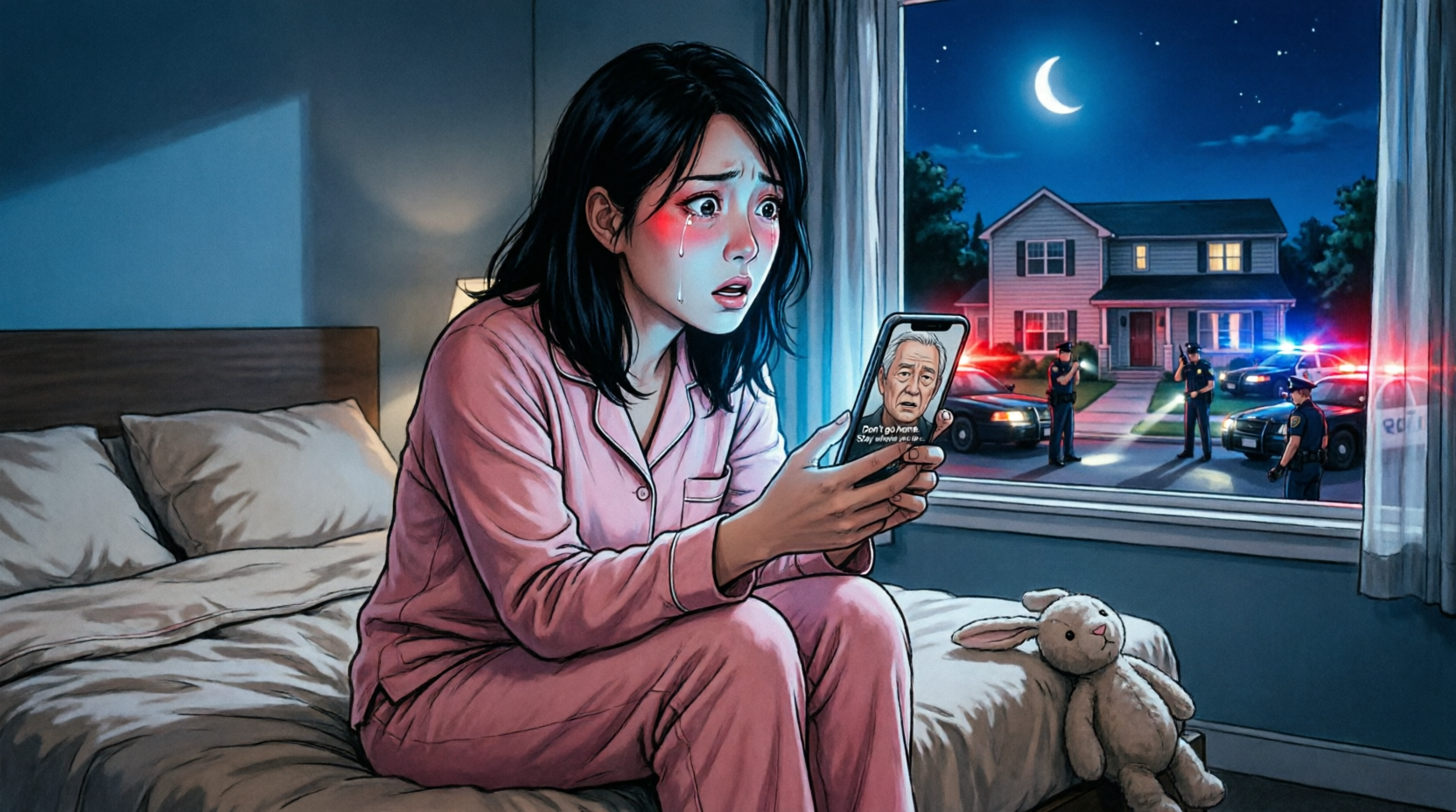
“Why?” I asked. “What’s going on?”
He didn’t answer that.
“Emily, listen to me. Don’t go into that house. Stay somewhere public. Somewhere bright. Don’t move until I tell you it’s safe.”
His breathing was rough, like he was pacing or fighting to keep himself under control.
I pulled into the first place I saw still open: a gas station 3 streets from my house. The lot was washed in pale fluorescent light. A vending machine buzzed near the ice freezer. The sign overhead hummed softly in the dark. It looked flimsy and ordinary and not remotely like the place between me and catastrophe it was about to become.
I parked and turned off the engine.
The silence inside the car was immediate and total.
“Dad,” I said again, quieter now, because something about the way he was speaking had reached past my questions and into pure instinct. “You’re scaring me.”
There was a pause.
Then, in a voice so low it almost broke me, he said, “Good. Be scared enough to listen.”
I sat there gripping the steering wheel, staring past the gas pumps toward the distant line of my neighborhood. Part of me wanted to laugh it off, to tell myself this was some misunderstanding or overreaction, some odd disturbance that would look ridiculous in 5 minutes. Another part of me—the deeper part, the part my father had spent my whole life teaching me not to ignore—understood that he would never call like this unless something was truly wrong.
He kept calling back.
Every time I picked up, he said almost the same thing.
“Stay where you are.”
“Don’t move.”
“Please trust me.”
“The police are on their way.”
No explanation.
No details.
Only command.
The not knowing made everything worse.
I sat there in the glow of the gas station lights, my scrub top wrinkled, my hair still pinned up badly from the shift, my hands trembling against the steering wheel, and tried to make sense of what kind of danger could exist inside my own home without my knowledge. A fire? A break-in? A gas leak? An injured person? A fugitive? Every possibility felt ridiculous and terrifying in turns.
I thought about calling my mother, then decided against it. If she knew nothing, hearing her confusion would only make me more afraid. If she knew something, I wasn’t sure I could survive the tone of her voice. I thought about calling 911 myself, then remembered my father had already said the police were on their way.
So I sat.
And waited.
And fought every instinct I had to drive the last few blocks and see for myself.
That helplessness was almost unbearable.
I hated it. Hated the feeling of my life unfolding somewhere else while I sat in a parked car under gas station lights doing nothing. I had spent years training myself not to freeze in crisis. Nurses don’t get the luxury of panic. You keep moving. You assess, respond, stabilize. Yet here I was, held still by the voice of the only person in the world who could make obedience feel like a survival skill instead of helplessness.
My father had done this before.
Not like this. Never like this.
But he had always had instincts I learned, over the years, not to dismiss. When I was 15, he yanked me out of a lake seconds before lightning struck the water. When I was 19, he refused to let our family drive to Indianapolis in a car he said “felt wrong,” and the mechanic later found failing brakes. There were other, smaller moments too, all threaded through my childhood: the way he would stop at a green light if traffic felt off, the way he checked locks twice without seeming paranoid, the way he noticed people’s hands before their faces.
“If I ever tell you to trust me,” he used to say, “don’t question it. Just move.”
So I stayed put.
At first the night around me remained deceptively ordinary. A dog barked somewhere in the distance. Two teenagers in hoodies came out of the gas station with chips and sodas and got into a truck without even glancing at me. A pickup rolled past too slowly. The fluorescent lights hummed overhead. My pulse was so loud in my ears it almost masked everything else.
Then I heard the sirens.
Faint at first.
A low rising wail somewhere beyond the houses.
Then louder.
Then many.
I turned in my seat and saw the first patrol car flash past the gas station entrance, red and blue lights slicing through the dark. Another followed. Then another. They all turned down my street.
My street.
My breath caught so sharply it hurt.
“Dad,” I whispered when he answered the next time, “the police are there.”
“I know,” he said.
“What’s happening?”
“I’ll explain soon,” he said, but his voice was different now. Still heavy, still tense, but steadier. “Right now I need you alive. That’s all I care about.”
Alive.
That word changed everything.
Until then, even in fear, some part of me was still trying to frame the situation as serious but survivable, dangerous but not personal. Alive stripped all that away. It told me that whatever was unfolding at my house was not abstract. It was not a disturbance. It was not a property issue.
It was about me.
From the gas station lot, I could just make out the pulse of police lights washing across the tops of houses at the far end of the street. More units arrived. Doors opened. Figures moved fast in the spill of headlights. Flashlights cut through front windows. Radios crackled in clipped bursts too far away to understand.
The whole neighborhood transformed in minutes from quiet and forgettable into something that looked like a crime scene from a distance. Neighbors began stepping onto porches in pajamas and robes. My stomach clenched at the thought of all those familiar people looking toward my house and seeing danger there.
I wiped tears off my face with the heel of my hand and called my father again.
“Dad, I can’t do this. Please tell me what’s inside my house.”
He was quiet for a second.
Then he said, very calmly, “If you had walked into that house tonight, I don’t think you’d still be alive.”
My entire body went cold.
He didn’t say it dramatically.
He didn’t raise his voice.
He said it with the awful steadiness of a man who had already pictured the outcome too clearly to soften it for me.
I started crying then. Not loudly. Just helplessly, silently, with my forehead against the steering wheel and my hands shaking so hard I could barely hold the phone.
He didn’t fill the silence with comfort.
He let me cry for 10 seconds, maybe 15, and then said the most practical thing possible.
“Stay exactly where you are. Do not be brave right now. Bravery will get you killed.”
That sentence anchored me.
Because bravery had been exactly what I was reaching for. The stupid, reflexive kind. The urge to move toward my own life just because it belonged to me. The urge to take control by stepping into danger and naming it. The urge to look with my own eyes, no matter the cost.
Instead, I sat there and obeyed.
That decision may have been the most important decision of my life.
Part 2
From the gas station, I watched the police pull a man out of my house.
It happened quickly and somehow in slow motion at the same time, the way shocking things often do. One moment there were just moving lights and figures crossing the lawn. The next, 2 officers came through the front door with someone between them.
He was fighting.
Not wildly, not with movie-scene violence, but with the desperate, jerking resistance of a person who had run out of plans and dropped into instinct. His hands were cuffed behind his back. His clothes were dark and wrinkled. His face was hard to make out at first under the strobing patrol lights, but I could see enough.
He did not look like a burglar surprised mid-theft.
He did not look drunk, confused, or lost.
He looked focused, angry, deliberate.
And worst of all, when the officers forced him down near the patrol car, he twisted his head toward the street like he was looking for something—or someone.
For me.
My phone buzzed again. This time it was my mother.
I answered so fast I nearly dropped the phone.
“Mom?”
Her voice cracked immediately. “Emily, are you okay? Tell me you’re not near the house.”
“I’m at the gas station.”
A sound left her, half sob and half prayer.
“Thank God.”
That was when it hit me fully that this was not just my terror. It had become theirs too. My father had been pacing and calling and making decisions in panic. My mother was crying somewhere. My family was living the same nightmare from different angles, held together only by the thin certainty that I had listened in time.
I watched as more officers moved through the house.
One swept a flashlight beam across my living room window. Another disappeared into the side yard. A third stood near the front walk speaking into his radio with the tight efficiency of someone already working inside the facts of something much darker than a routine break-in.
The man they had pulled out still kept turning his head.
I knew, before anyone told me, that he had not been there for my television or my jewelry.
The officer who eventually approached my car looked to be in his 40s, solid and tired and trying hard to keep his expression professional without making it cold. He stopped outside the driver’s side window, waited for me to lower it, then crouched slightly to bring himself level.
“Miss Carter?”
“Yes.”
“You’re safe now. We’ve cleared the house.”
The sentence should have calmed me. It didn’t.
“Who is he?” I asked. “What was he doing there?”
The officer glanced back toward my street, then back at me.
“Before I answer that, I need to confirm you did not enter the house tonight.”
“No,” I said. “My dad told me not to go home.”
His face changed at that, just slightly. Recognition. Respect.
“That call likely saved your life,” he said.
I gripped the wheel harder.
“Tell me.”
He took a breath.
“We found evidence that the suspect wasn’t there to rob you. He had been following you for several weeks.”
My stomach dropped again, somehow farther this time.
“What?”
The officer’s tone remained measured, but every word hit like a separate blow.
“There were photographs of you laid out across your coffee table. Some appear to have been printed from social media. Others were taken without your knowledge. We found a knife hidden under the couch cushions in your living room.”
I stared at him.
I could hear the gas station sign buzzing above me.
Could hear a car passing on the road behind him.
Could hear my own pulse like a separate living thing.
“If you had entered that house tonight,” he said quietly, “we do not believe you would have made it back out.”
It is a strange thing to hear your possible death described with professional restraint. There is no room inside the body for that kind of sentence. It does not fit cleanly. It scrapes against everything.
I shook my head once, then again.
“No. No, I—”
But there was nothing to deny.
Because even as he spoke, memory began rearranging itself at speed.
The time I thought someone was behind me in the hospital parking garage and laughed at myself all the way to my car.
The evening I found my gate unlatched and told myself the wind must have caught it.
The feeling, twice in the last month, that I was being watched when I walked from my driveway to my front porch.
The black SUV I saw 2 streets over 3 nights in a row and dismissed as a neighbor’s guest.
I had told myself it was stress.
Fatigue.
Night shift nerves.
It had not been nothing.
The officer continued, gentler now.
“A neighbor saw signs of forced entry at your back door and called your father. She knew he could reach you faster than dispatch could explain the situation. He called us and called you at the same time.”
That image nearly undid me.
My father, getting that call.
Understanding enough in an instant to know he did not have time for details.
Choosing the shortest path between me and survival.
I covered my mouth with my hand and started crying again.
The officer didn’t try to stop me.
He just waited.
My father came through the phone a minute later, because I had somehow not even realized I was still holding it against my shoulder.
“Emily?”
“I’m here.”
His voice broke on the next words.
“I told you to trust me.”
“I know.”
“And you did.”
I closed my eyes.
Those 4 words—and you did—carried more emotion than anything else he could have said. Not because they praised me. Because they told me he understood the cost of obedience in that moment. He knew how badly I would have wanted answers. He knew how much of me would have wanted to run home and force reality into something visible. He knew I had chosen him instead.
And because of that, I was still alive.
The officer asked if I wanted to come closer to the scene.
I said no.
He asked if I wanted to see the evidence recovered from the house.
I said no again.
I could not bear the idea of looking at my own living room transformed into a staging ground for violence. I could not bear the sight of my couch, my photographs, my blanket folded on the armrest, my ordinary domestic life laid over with someone else’s intent.
Not that night.
I stayed in the gas station lot until my father came for me in his truck.
The moment I saw him get out, broad shoulders bent under fear he had not yet fully released, I started sobbing in earnest. Not from hysteria. From aftermath. The body can only hold a certain amount of terror before it starts leaking out through whatever weak points it finds.
He crossed the lot in 6 strides and wrapped both arms around me so tightly I could barely breathe.
“You’re safe,” he said into my hair. “That’s all that matters. You’re safe.”
My mother was crying in the passenger seat when he opened the door for me. She reached back and gripped my hand the entire drive to their house.
None of us spoke much.
There wasn’t language yet.
Only survival.
I barely slept that night. My parents put me in the old guest room I had used during breaks from nursing school, the room with the faded quilt and the lamp my mother always claimed she meant to replace. When I closed my eyes, I saw patrol lights flickering over my street. When I opened them, I saw my father sitting once in the hallway outside my room at 3:00 a.m., fully dressed, elbows on his knees, waiting for dawn as if he could physically keep watch against what almost happened.
The next morning, I woke to the low sound of my mother crying in the kitchen.
She had made coffee, burned the toast, forgotten she had made coffee, and sat at the table with both hands around the mug like she needed the heat to remind her she still had a daughter alive to worry over.
When she saw me, she stood so quickly the chair scraped the floor.
“You scared us so badly.”
I nodded because I didn’t know what else to do with that.
This was not just my near-death.
It had already become my family’s trauma too.
My father came in a minute later, and when he hugged me again it was tighter than he had ever hugged me in my adult life. Not because he was sentimental. He wasn’t. Because he had spent the night understanding exactly how close he came to losing me.
Later that morning, the police called with more details.
The man they arrested had a history.
He followed women.
Watched them.
Broke into homes and waited.
He wasn’t interested in valuables, not really. He was interested in control, fear, and the intimacy of trapping women inside the spaces where they felt safest.
He had studied my routines.
My shifts.
My lights.
My patterns.
The nights I worked late.
The hour I usually came home.
Even how long it took me to walk from the driveway to my front door.
The photographs on my coffee table had not been random prints.
They had been arranged.
That word stayed with me longer than I expected. Arranged. It meant time. Intent. Planning. It meant that while I was worrying about laundry, patient charts, grocery lists, and whether I had enough clean scrubs for the week, some man had been composing a private version of my life in my own living room.
The detective said, “If your father hadn’t acted as quickly as he did, you likely would have entered that house while he was waiting.”
Waiting.
The word felt contaminated afterward.
Waiting room.
Waiting shift.
Waiting line.
Everything ordinary suddenly touched by what I had almost walked into.
I did not go back to the house for 3 days.
My father went with the police and collected what I needed: clothes, toiletries, my laptop, nursing license paperwork, the framed picture of me and Ethan on the coast when we were children. He told me not to ask for details about the scene inside, and I listened. I did not want those images in my head yet. I had enough already.
Even without seeing it, I could imagine too much.
My coffee table.
My couch.
My hallway.
My bedroom door shut at the end of the corridor.
The knife under the cushions.
The photographs laid out where I would have seen them.
Or maybe where he would have made me see them.
I stopped the thought every time it started.
For the first week, fear followed me in fragments.
The sound of a phone ringing after dark.
The click of a lock.
A stranger lingering too long in a grocery store aisle.
The automatic sensor light coming on in my parents’ side yard.
My body no longer trusted ordinary things.
That was the hidden cost of survival. Not just gratitude. Not just relief. Damage to the idea of routine itself.
And yet, beneath all of it, something else settled too.
Trust.
Not abstract trust.
Not faith in the world.
Trust in a very specific human voice.
My father’s.
Part 3
A few nights later, I sat on the back porch with my dad while the air cooled around us and the stars scattered themselves thinly over the trees.
My mother had gone inside after fussing over blankets and tea neither of us really wanted. The porch light was off. My father liked the dark when it was honest dark, the kind that belonged to open sky and crickets and distant traffic, not the kind that hid a man in your living room.
We sat without talking for a while.
That was normal for us.
My father and I had never needed to fill silence just to prove love was present. Some of our best conversations in childhood were wordless ones: fishing in bad weather, driving back from softball practice, standing side by side while he fixed something in the garage and I handed him tools without being asked.
Eventually I said the thing I had been holding since the gas station.
“How did you know?”
He took his time answering.
Not because he didn’t know.
Because he wanted to answer it cleanly.
“Your neighbor called me,” he said. “Said she saw someone at your back door and something about it felt wrong. She was scared, and she knew if she called me first, I’d get to you quicker than anyone else could explain.”
He rubbed his thumb over the handle of his mug.
“The second she said your name, I just knew I didn’t have time for details. You were probably already driving home. If I told you too much, you’d head straight there. If I told you too little, maybe you’d listen.”
I nodded slowly.
“You picked the middle.”
“I picked the part that would keep you alive.”
That was my father all over. No drama. No self-congratulation. Just the plain hard center of the matter.
I looked out over my parents’ yard and tried to imagine the chain of minutes again. The neighbor seeing movement at my door. My father answering the phone. Realizing. Calling police. Calling me. Timing all of it against the distance between my shift ending and my key entering the front lock.
“I almost didn’t listen,” I admitted.
He turned toward me.
“But you did.”
That mattered to him as much as it mattered to me.
Trust is not only given.
It is received.
In the weeks after that, life became divided cleanly into before and after.
Before, my house had been a small rented place in a quiet neighborhood where I kicked off my shoes in the same corner every night and left cereal bowls in the sink when I was too tired to wash them before bed. Before, I believed routine itself created safety. Before, I still thought danger announced itself in ways a reasonable person could clearly identify.
After, everything changed.
I moved.
Not right away, but soon enough. I found a new place across town with stronger locks, a monitored alarm system, security cameras over the driveway, and motion lights that made the yard flare bright at the slightest movement. On paper, it was a better house. Cleaner lines. Better insulation. Less charm and more strategy.
That was fine.
After what happened, I no longer cared whether a place had character. I cared whether it could be defended.
Friends brought food.
Neighbors from my old street sent flowers.
Coworkers from the hospital wrote cards full of relief and horror and the awkward tenderness people offer when they almost lose you but still get to speak afterward.
Everyone called me lucky.
I understood what they meant.
I even said thank you.
But luck wasn’t the right word.
Luck is random.
This wasn’t random.
A neighbor noticed something.
My father believed the fear in her voice.
He acted fast.
I trusted him.
There was love in every part of that chain, and love is not luck.
I returned to work after 10 days.
The hospital felt the same and completely different. The same fluorescent lights. The same central desk. The same monitor alarms and rolling carts and call bells and chart updates. Yet moving through it, I felt altered in a way only I could detect. Every patient room threshold felt like a choice. Every late-night walk to the parking lot carried weight. Every ordinary goodbye from coworkers sounded more serious than it had before.
I noticed things more.
The man standing too long in the lobby.
The car idling twice past the same intersection.
The fact that a door should lock smoothly and not “eventually.”
My world had not become more dangerous than it already was. I had just stopped being buffered from that fact by innocence.
That can harden a person if they let it.
I tried not to let it harden me.
Instead, I let it deepen something else.
Gratitude.
Attention.
Precision.
And above all, trust in the right places.
My mother told the story differently than I did.
To her church friends, to her sister, to anyone who called crying and wanting details, she always came back to the same sentence: “She listened to her father.”
That was how she understood salvation. As obedience rooted in love.
My father never told the story at all unless directly asked.
When he did, he kept it brutally simple.
“I called her.”
“She listened.”
“That saved her.”
That was how he understood it. Not as heroism. Not as instinct celebrated. Just cause and effect.
Ethan, when he came home the following weekend, hugged me so hard he nearly lifted me off the ground and then spent 3 days making terrible jokes because that was the only way he knew how to keep terror from suffocating a room. I loved him for it.
One night, not long after I moved into the new place, I sat alone on my couch with the television on mute and my phone in my hand.
It was late.
The house was locked.
The alarm was armed.
The cameras showed still, empty driveways and dark lawns.
And yet I found myself staring at my father’s contact name on the screen as if it had become something sacred.
I thought about that moment at the gas station. The way I had wanted answers more than safety. The way every nerve in my body had wanted motion, not stillness. The way helplessness had felt more intolerable than fear. And I thought about how close I came to overriding love with pride simply because I wanted to be the one in control of my own danger.
That is the trap, I think.
Not only the man in the house.
The other trap.
The belief that trust is weakness.
The belief that not knowing makes action more honorable.
The belief that because a danger belongs to you, you must face it alone to be real inside it.
My father saved my life that night.
But I helped save it too, by believing him when I still had no proof.
That is harder than people think.
Weeks later, we sat on the porch again, and I finally told him that.
“You know,” I said, “the hardest part wasn’t the waiting.”
He looked over.
“It was not understanding. It was having to believe you before I had any facts.”
He nodded slowly.
“That’s why most people get hurt,” he said. “They wait for the facts.”
I let that settle.
Then I asked, “Were you scared?”
For the first time, he didn’t answer immediately.
“Yes,” he said at last. “More than I’ve ever been.”
I had never heard him say anything like that.
This was the man who taught me to ride a bike by running beside me until I found balance. The man who once stitched his own hand with butterfly tape in the garage because he didn’t want my mother worrying. The man who spent 30 years running toward danger for strangers and came home with soot in his hair and calm in his voice.
And yet when it came to me, to 1 call and 1 choice and the possibility of arriving too late, he had been terrified.
That knowledge changed me in a way I didn’t fully understand until much later. Love does not make strong people less afraid. It just teaches them to act through fear faster.
I still carry that night with me.
Not every second.
Not as a wound that bleeds every day.
But as a structural fact of who I became after it.
Every late-night call still makes me pause.
Every unfamiliar car parked too long near a house registers in me.
Every time a person I love says, “Trust me,” I hear the difference between casual reassurance and the kind of warning that comes from somewhere deep and earned.
My new house is safer.
The locks are stronger.
The cameras are better.
The neighborhood is brighter.
I no longer leave the porch light off out of laziness.
I no longer assume a quiet street means a harmless one.
But safety, I learned, is not built only from hardware.
It is built from relationship.
From attention.
From the people who know your name in the voice that matters and call before the worst thing has time to become irreversible.
That man in my house had watched me.
Studied my routines.
Learned my patterns.
Waited for the exact moment I would come home tired and unsuspecting and alone.
He had done all of that.
And still, he lost.
Because someone loved me first.
And because I listened in time.
That is the truth beneath everything else.
Not that danger exists.
It always has.
Not that fathers are heroic.
Some are, some aren’t.
Not even that intuition can save your life, though I know now that it can.
The truth is simpler.
Sometimes the line between life and death is nothing more than the voice of someone who loves you telling you to stop.
Sometimes survival looks like stillness.
Sometimes obedience is not weakness, but wisdom.
Sometimes the bravest thing you can do is not move.
When people ask me now what I learned from that night, I tell them this:
Pay attention to the people who love you.
Do not dismiss the voice that has earned your trust just because it cannot yet explain itself.
And never confuse your need for immediate answers with actual courage.
Because on that night, courage would have gotten me killed.
Trust kept me alive.