MY PARENTS SOLD MY 10-YEAR-OLD DAUGHTER’S RARE FIRST-EDITION BOOK COLLECTION—THE VERY ONE MY GREAT-GRANDMOTHER HAD SPENT YEARS TEACHING HER TO CHERISH AND SAFEGUARD.
The first thing I noticed was the smell.
Fresh paint, cut wood, industrial glue, expensive fabric—everything in my parents’ house smelled new except the one thing that should have endured. The scent hit me before I crossed the threshold, before I saw the contractors’ vans in the circular drive, before I caught the glitter of gold tape marking off measurements on the hardwood floors. Renovation has its own perfume, sharp and chemical and smug. It clings to your hair. It gets in your throat. It announces that something old has been deemed inconvenient and something flashy is on its way to replace it.
I stood in the foyer with my ten-year-old daughter’s hand in mine and knew, with a clarity that felt almost merciful, that something unforgivable had already happened.
Anna’s fingers tightened around mine. She was a quiet child, not shy exactly, but careful. She observed the world the way some people handle fragile glass—attentively, respectfully, with an awareness that things break more easily than others admit. She looked toward the east wing, where the old library had once held the soft amber hush of history, and then up at me. She didn’t ask the question. She knew.
The answer came anyway.
“Oh good, you’re here,” my mother called from the hall, breezing toward us in cream slacks and a silk blouse the color of champagne. Her smile was bright and artificial, as if she had pasted it on in the car mirror. “Try not to look so alarmed. We wanted it to be a surprise.”
A surprise.
I should have laughed, but my body had gone strangely still, as if every muscle in me had decided to preserve its energy for something worse.
My father appeared behind her, sleeves rolled up, radiating the kind of self-satisfaction that made him look taller than he was. He glanced at Anna and then at me with a smile that had never once, in my entire life, preceded good news.
“We’ve transformed the old library,” he said. “You’ll see. It’s going to be magnificent.”
My gaze slid past them into the corridor. At the far end, the doors that had once opened onto the library stood wide. Dust floated in the late-afternoon light. Men carried wrapped panels through the room where my great-grandmother Catherine had taught Anna how to hold a seventeenth-century binding with clean hands and reverent fingers. One wall of shelves was already gone. In its place, a frame of metal studs cut the room into a geometry of loss.
I couldn’t yet see the books.
I looked at my mother. “Where is the collection?”
Her smile flickered.
“The room was overdue for a practical update,” she said. “The children need a space they can actually use.”
The children.
Not Anna, of course. She was never included when my mother said that word, even when Anna was standing right in front of her. The children meant Kayla’s boys, six and eight, loud and adored and treated as if the moon itself had been hung over the family for the sole purpose of illuminating them.
I asked again, quieter this time. “Where is the collection?”
My father exhaled as if I were being difficult about a seating arrangement. “Olivia, don’t turn this into drama. The books were just sitting there. Catherine hadn’t touched most of them in years. We had them appraised. A collector made an excellent offer. Frankly, it was the smart thing to do.”
For one strange second the words didn’t attach themselves to meaning. They hung in the air like labels drifting loose from old files. Then they settled into place, one by one, and the room changed shape around me.
Appraised.
Collector.
Offer.
Sold.
I think Anna understood before I did. Her hand slipped from mine. When I looked down at her, her face had gone pale in that controlled, inward way some children have when the pain is too sharp to express. She didn’t cry. Her chin lifted a fraction, and in that small motion I saw every quiet wound my family had ever taught me to absorb.
My mother noticed my expression and mistook silence for weakness, as she always had.
“Please don’t overreact,” she said. “Anna is only ten. She can read digital copies if she’s interested in that sort of thing. We’ve created something for the entire family now, something modern. Something fun.”
My sister’s laughter floated down the hall before she did. Kayla rounded the corner in cashmere lounge clothes and white sneakers that probably cost more than my monthly grocery budget. She looked radiant, as she always did when standing in the glow of my parents’ approval.
“There you are,” she said, air-kissing the space near my cheek. Then she looked at Anna with the vague fondness people reserve for the child of a distant acquaintance. “You should see the projector specs. The boys are obsessed. Mom says we can do movie marathons every weekend.”
I stared at her.
“What books did you sell?”
She shrugged. “The old ones.”
The old ones.
The first editions. The signed volumes. The hand-tooled bindings. The rare collection my great-grandmother Catherine had begun preserving before my mother was born. The collection she had formally deeded to Anna three years earlier, calling it “a promise across generations.” The collection Anna dusted with cotton gloves. The collection Catherine used to call a living conversation between the dead and the yet-to-come.
My father moved closer, dropping into the voice he used with me when he expected compliance disguised as reason.
“Listen. We got one hundred sixty-five thousand dollars. Do you understand what that kind of money can do? This house needed updating. The family needed a gathering place. This is an investment in all of us.”
It was such a revealing choice of words that I almost admired it. Not a loss. Not a theft. An investment. He looked me in the eye and converted my daughter’s inheritance into a line item for entertainment.
I asked the only question that mattered. “Did Catherine approve this?”
Nobody answered.
Then, from farther down the hall, supported by her cane and walking more slowly than she once had but with more authority than anyone else in that house had ever possessed, my great-grandmother came into view.
Catherine had turned eighty-two that spring. Age had thinned her body but sharpened her face into something noble and exact. Her silver hair was swept back. Her cardigan hung from her shoulders like a ceremonial robe. She took in the open doors, the stripped walls, the contractors, the naked shelves, and then she looked at my parents.
For a moment no one spoke.
My mother recovered first. “Grandma, we were going to explain.”
Catherine’s gaze moved to Anna. That was the moment that split the day in two. Because when she saw Anna’s face—saw that quiet, stricken composure—something in the old woman settled. Not broke. Settled. Like a verdict descending into place.
“Where are her books?” Catherine asked.
My father lifted his chin. “Mother, be reasonable. They weren’t being used. We sold them to finance the renovation. The appraiser said—”
“The appraiser,” Catherine said softly, “did not own them.”
Her voice was not loud. It did not need to be. Everyone in that hall stiffened.
My mother tried a soothing tone. “We’ve built something wonderful for the grandchildren.”
Catherine looked at her long enough to strip the sentence of all its dignity. Then she turned to Anna.
“My dear,” she said, “come here.”
Anna went to her at once. Catherine rested a hand over Anna’s small fingers on the cane handle and asked, very gently, “Did anyone ask your permission?”
Anna shook her head.
“And yours?” Catherine asked me.
“No.”
Catherine nodded once, a movement so slight anyone else might have missed it. Then she smiled.
It was not a warm smile. It wasn’t even an unkind one. It was the expression of someone who had expected a storm for many years and was finally feeling the first drops of rain.
“The collection was never theirs to sell,” she said.
My parents’ faces changed so quickly it was almost physical. My mother’s hand flew to her throat. My father’s expression emptied, then hardened, then emptied again. Kayla looked from one face to another as if she had just realized she’d joined a play without knowing the plot.
I didn’t scream. I didn’t demand answers. I didn’t accuse, because accusation grants a kind of intimacy. It assumes the other party is capable of shame. I had spent thirty-one years in this family. I knew better.
I reached for Anna’s hand.
“We’re leaving,” I said.
My mother blinked. “Don’t be absurd.”
I looked at her for the first time that day with nothing in me that wanted her understanding. “No,” I said. “I’m done being absurd.”
Then I turned, and Anna and I walked out of that house while sawdust floated behind us like the remains of something cremated.
Outside, dusk had begun to settle over the estate. The old colonial facade glowed in the slanting gold light, stately and expensive and falsely serene. The house had always had that effect on strangers. It made people assume stability. Legacy. Decency. They didn’t know how many years I had spent inside it learning that beauty can be used as camouflage.
I buckled Anna into the passenger seat, though she was old enough to do it herself. I needed the motion. Needed the structure of it. Hands. Buckle. Click. Close the door.
When I got into the driver’s seat, I didn’t start the car.
Anna stared straight ahead. Her voice, when it came, was small but not childish.
“Are they really gone?”
I gripped the steering wheel. “I’m going to find out exactly what happened.”
She nodded once. After a while she said, “I thought they were mine because Grandma Catherine said so.”
“They are yours,” I said.
The certainty in my tone surprised both of us.
I reached into the back seat for my laptop bag. The action felt automatic, almost detached, as if another version of me had taken over—the version that understood archives, trusts, tax exemptions, compliance portals, legal filings, and all the dry machinery powerful people ignore until it turns on them.
For years, I had served as the administrative liaison for the estate’s historical designation. I was a trained archivist. My parents loved mentioning that at parties when it made them sound cultured. What they loved even more was what my work saved them: thirty-five thousand dollars a year in property taxes because the house qualified as a protected landmark tied to a documented heritage collection. The library had not merely added charm. It was part of the property’s legal identity.
My parents had always treated my labor like climate control—essential, invisible, expected.
I opened the state registry portal, logged in with my credentials, and pulled up the annual compliance file.
The rules were clear. Protected collection maintained on site. Climate control standards upheld. Historical room preserved. Chain of custody documented.
I stared at the blinking cursor on the non-compliance form and felt something inside me go very quiet.
This was not vengeance, not exactly. Vengeance is hot. This felt cold, precise, almost antiseptic. A correction. A ledger being brought into balance after years of fraudulent accounting.
Under reason for breach, I typed: Significant alteration of protected archival space and unauthorized removal of registered collection assets.
I attached a preliminary notice and submitted the form.
The confirmation screen appeared.
Landmark tax exemption status: under review.
I exhaled slowly.
Beside me, Anna looked over. “What does that do?”
“It tells the truth,” I said.
Then I opened my banking app.
Last month, at my mother’s suggestion—delivered, as always, like a compliment disguised as expectation—I had paid the twelve-thousand-dollar catering deposit for what was now apparently going to be Kayla’s home theater reveal party. My contribution to the family, she had called it. I’d wired the money without argument. I was always easier to ask because I had trained them to believe my boundaries were decorative.
I located the pending transaction and requested a stop payment.
The system asked for confirmation.
For a moment I saw a whole history of myself in that glowing little box on the screen: the daughter who solved problems quietly, who sent birthday gifts even when forgotten herself, who handled estate paperwork on weekends, who paid for practical things while Kayla received beautiful ones, who believed usefulness might eventually become love if she performed it long enough.
Then I pressed confirm.
Transaction canceled.

The word appeared with a crisp efficiency that was almost elegant.
Anna leaned her head against the seat and closed her eyes. She looked tired in a way no child should look.
I set the laptop aside, started the car, and drove us home.
That night, after Anna was asleep, I sat at my kitchen table and let memory sort itself into order.
My earliest clear recollection of being invisible was at eight years old, the age Anna was now when she first learned to say “This isn’t fair” and mean it. Kayla had fallen off her bike in the driveway and skinned her knee. It was a small injury, all things considered, but the household rearranged itself around her tears. My mother rushed for bandages. My father carried her inside as if she’d been rescued from a battlefield. There was ice cream and a movie and a new doll before dinner. An hour later, I sliced my palm opening a can of green beans because I had been trying to help in the kitchen. Blood ran down to my wrist before anyone noticed. My mother took one glance and sighed.
“Olivia, honestly. Why are you always making more work?”
I still remember standing at the sink under the yellow kitchen light, water turning pink around my hand, understanding something without having the language for it yet. Some pain counted. Some pain inconvenienced. Mine belonged to the second category.
By fourteen, I was the dependable one. By seventeen, the mature one. By twenty-two, the independent one. The family vocabulary shifted with my age, but the meaning never changed. Kayla needed things. I managed without them. Therefore, resources flowed toward need, and need was defined by whoever demanded most loudly.
I paid my own way through graduate school with scholarships, assistantships, and three jobs, while my parents financed Kayla’s “creative exploration years,” which included designer clothing, unpaid internships in two different cities, and a photography course in Italy that lasted six weeks and yielded exactly fourteen blurry pictures of doorways.
When I married young and then divorced quietly before Anna turned three, my mother said, “At least you’ve always been resilient.” Kayla once got dumped by a man who sold artisanal candles online, and my parents flew to Napa with her for a healing weekend.
I had spent so long translating their behavior into neutral terms—preference, habit, thoughtlessness, family dynamics—that I nearly missed its true shape. It wasn’t random. It was structural. I was the daughter assigned to absorb impact.
But the library had always been one exception.
Not because my parents valued it. They didn’t. They tolerated it the way people tolerate old architecture—pleasant to point at, expensive to maintain, useful for appearances. The library belonged to Catherine. It existed slightly outside their reach, protected by her presence and by the fact that they did not fully understand it.
Anna loved it because Catherine loved it, and because the room obeyed rules more humane than the rest of the family.
In that room, quiet was not emptiness. It was respect.
Hands were washed before touching anything.
Pages were turned from the corner, not the center.
Sunlight was measured.
Tea was kept on the side table, never on the desk.
Questions were welcomed.
Stories mattered.
When Anna was seven, Catherine lifted a leather-bound volume from the top shelf and placed it, with absurd care, in my daughter’s lap. Anna had looked up in alarm.
“What if I ruin it?”
Catherine smiled. “Then we will mend what can be mended and forgive what cannot. But I do not believe that is your nature.”
I had stood in the doorway and watched them. Anna’s hair had been in two uneven braids. Catherine’s hand, veined and fine-boned, rested over the child’s shoulder as if passing down not just books but citizenship in a private and dignified nation.
That was what my parents had gutted to build a theater.
Not shelves. Not paper. A sanctuary.
At 9:12 p.m., my phone began to ring.
Angela.
I let it ring until it stopped.
At 9:14, it rang again.
Then again.
On the sixth call I answered, more out of curiosity than obligation.
My mother launched into speech before I could say hello.
“I hope you’ve calmed down,” she said. “This level of melodrama helps no one. Your father is beside himself.”
“Interesting,” I said. “I imagine that’s how Anna feels.”
A pause. Then that sigh—the one that always implied my emotions were a lower form of intelligence.
“Olivia, sweetheart, you are not seeing this rationally. Anna is ten years old. Those books were locked in a room. She wasn’t actively using them.”
“She used them every week.”
“She can use the internet,” my mother snapped, and then softened her tone as if graciousness could erase the sentence. “Please. Don’t make this ugly. Kayla is already under tremendous pressure with the boys and the house schedule and now the reveal party—”
“The reveal party?”
“Yes, for the new wing. Honestly, after all we’ve done for you over the years, the least you could do is stop trying to punish the family because you’re sensitive about some old books.”
Old books.
I had spent three decades listening to my mother reveal herself in phrases like that. The cruelty was rarely theatrical. It came wrapped in practicality, stitched into the hem of reasonable language.
“I filed a notice of non-compliance,” I said.
Silence.
Then, cautiously, “What does that mean?”
“It means the estate’s historical exemption is under review because you altered a protected room and removed registered assets.”
Her breath caught. I heard my father say something in the background.
“You had no right,” she said.
“I had every right. I’m the registered liaison.”
My mother’s voice sharpened. “How dare you jeopardize this house?”
I laughed then, a brief unbelieving sound that made her go quiet.
“You sold my daughter’s inheritance,” I said. “You jeopardized the house.”
She changed tactics instantly, dropping into injured softness. “Your father was only trying to create something beautiful for the family.”
“For Kayla.”
“For everyone.”
“That lie doesn’t even embarrass you anymore, does it?”
“Olivia—”
I ended the call.
Three minutes later Kayla posted a reel.
She must have done it between whatever half-panicked conversation my parents were having about the exemption filing and selecting the font overlay, because the timing was vicious in its own childish way. She twirled in the stripped library while work lights gleamed off exposed beams. A sparkling filter turned floating sawdust into faux starlight. Her caption read: Clearing out the dust to make room for the stars ✨ #LuxuryLiving #FamilyFirst #DreamSpace
I stared at it for a long moment.
Then I set my phone down and opened a contact I hadn’t used in months: Marcus Hale, legal counsel for the state university’s rare books department. We had collaborated on a preservation grant two years earlier and had stayed in occasional professional contact. He respected evidence more than emotion, which made him exactly the person I needed.
I wrote a concise email:
Marcus, I need immediate guidance regarding a probable breach of the Catherine Heritage Trust. Protected collection deeded to minor beneficiary has been removed from registered estate library and sold without authorization. Landmark property compliance already flagged. Request urgent review of trust documents and asset inventory.
I attached scans of the trust paperwork Catherine had once insisted I keep in duplicate, “because men with money are never as sentimental as they pretend.”
He replied eleven minutes later.
Call me.
By the end of that call, the matter had left the realm of family grievance and entered the realm of legal consequence.
Marcus had the kind of voice that sounded ironed—smooth, crisp, free of wasted folds.
“Olivia,” he said, after hearing the essentials, “I need you to listen carefully. If the collection was registered within the trust, and if Anna is the named beneficiary, then unauthorized sale is not merely unethical. It may constitute fiduciary breach, conversion of protected assets, and depending on how the registration was structured, potentially a cultural heritage offense.”
I closed my eyes. “Potentially?”
“I need the exact filings. Send everything you have.”
I sent them while we were still on the phone.
He skimmed in silence for several minutes. Then he made a low sound that wasn’t surprise so much as grim confirmation.
“Well,” he said. “Your great-grandmother was thorough.”
That sounded like Catherine.
Marcus continued. “The collection wasn’t just informally designated. It’s tied to a registered preservation trust. That means the books are not personal property in the casual sense. Their storage conditions, chain of custody, and location are embedded in the estate’s protected status. If your parents sold any portion without trustee authority—and from what I’m reading, they did not have unilateral authority—the exposure is substantial.”
“Substantial how?”
“Enough that the university cannot ignore it. We would be obligated to initiate an inquiry if formally notified.”
I looked toward Anna’s bedroom door.
“Then formally notify.”
The next morning, I woke to thirteen missed calls, six texts from my mother, four from my father, and a message from Kayla that read: Seriously? Mom is crying. What is wrong with you?
I made coffee. I packed Anna’s lunch. I braided her hair. I signed her spelling test folder. I drove her to school.
Normality can be its own kind of rebellion when chaos expects obedience.
At drop-off, Anna hesitated before getting out of the car.
“Will they have to give them back?”
“Yes,” I said.
“What if they don’t want to?”
I reached over and tucked a stray piece of hair behind her ear. “Then people who understand rules better than they do will make them.”
That seemed to satisfy her. She nodded, gathered her backpack, and climbed out. Then she turned back.
“Grandma Catherine knew they’d do this, didn’t she?”
The question startled me because I had asked myself the same thing at two in the morning.
“I think,” I said slowly, “she knew they might.”
Anna considered that. “That’s why she always put everything on paper.”
“Yes.”
“She says paper remembers even when people pretend not to.”
I smiled, though it hurt. “She’s right.”
After I left the school, I drove straight to Catherine’s temporary apartment. She had been recovering there after a minor fall, something my parents had conveniently treated as full retirement from estate oversight. When I entered, she was at the dining table wearing reading glasses and reviewing a stack of documents with the concentration of a general studying maps before battle.
Without looking up, she said, “You should have come last night.”
“I thought you needed rest.”
“I need justice more.”
There are people who age into softness. Catherine had aged into precision. She gestured to the chair across from her. I sat.
“I want you to tell me exactly what Marcus said,” she said.
I did. I told her about the trust language, the registered collection, the compliance filing, the likely investigation. I did not spare her my fear. She did not ask me to.
When I finished, she removed her glasses and folded them carefully.
“I drafted that trust when Brandon was thirty-one,” she said. “Kayla was still in pigtails. You were in your first year of university. Your mother thought I was being dramatic.”
“Why did you do it?”
Catherine looked at me as if the answer were not only obvious but ancient.
“Because I raised Brandon. And because I watched Angela teach Kayla that charm could replace character. And because I watched you become useful in ways that made you disappear to them. The only thing greed respects is structure.”
I swallowed.
“Why didn’t you tell me the estate itself was tied to the trust?”
“I told you enough for when the day came. I did not tell you everything because I hoped the day would not come at all.” She leaned back. “Hope is not a strategy, Olivia. Paper is.”
I laughed softly despite myself.
She reached across the table and covered my hand with hers. “You are not cruel for doing what is necessary. They have trained you to confuse self-defense with violence. Do not indulge that confusion now.”
It is astonishing how much strength can return to a person when someone older and wiser names the trap you have mistaken for morality.
That afternoon Marcus called again.
The private collector who had purchased the books, it turned out, was not discreet enough to keep his triumph to himself. He had posted vague but identifiable boasts on a rare book forum frequented by dealers, university buyers, and preservation specialists—just enough information for Marcus’s office to trace the sale. Worse for my parents, the collector had already begun negotiating resales of individual pieces. In the world of protected archives, that was equivalent to trying to part out a stolen cathedral.
“We’ve issued a preservation demand,” Marcus told me. “And, Olivia?”
“Yes?”
“Your parents are in deeper trouble than I originally thought.”
I waited.
“The trust includes a clause tied to occupancy rights,” he said. “The estate was placed in a conditional life arrangement for Brandon and Angela as resident trustees only so long as they preserved the collection and the library intact. Disposal of protected assets triggers dissolution of resident rights.”
I sat down very slowly.
“You’re saying—”
“I’m saying they may no longer have a legal right to live in that house.”
I thought of my father at the head of the dining table, talking about legacy as if he had authored it. I thought of my mother selecting drapes and catering menus for a home she had always spoken of as if it confirmed her worth. I thought of Kayla filming herself in a stolen room for strangers online.
And I thought of how Catherine had smiled.
“They never owned it,” I said.
“Not in the way they believed,” Marcus replied.
The invitation arrived the next day.
It was digital, embossed with animated gold leaves, as tacky as it was expensive. The Henderson Home Theater Grand Reveal. Saturday, 7:00 p.m. Cocktail attire requested. Celebrate a new era of family entertainment.
A private note from my mother accompanied it:
Please be adult enough to attend. Let’s put this unpleasantness behind us for the sake of the family image.
I stared at the note so long the screen dimmed.
Then I laughed.
The family image. Even now, with compliance review underway and legal notices drafting and the collector already under pressure, she was thinking about optics. Of course she was. My mother had spent her whole life arranging reality to flatter itself in public.
I accepted the invitation.
When Saturday came, the estate looked like a magazine spread conceived by someone afraid of silence. The long drive was lined with lanterns. Valets in black ushered guests from luxury SUVs and German sedans. Music drifted from the open windows—something expensive and forgettable, all atmosphere and no melody.
I arrived with Catherine.
That alone turned heads.
She had insisted on coming in person. “If they intend to stage a performance,” she had said while fastening pearl earrings with hands that no longer trembled for anything important, “then I intend to attend opening night.”
She wore deep navy silk and carried her cane like a royal instrument. As we entered, conversations paused around us in ripples. People kissed the air near Catherine’s cheeks. They smiled at me with that socially trained uncertainty reserved for families rumored to be having problems. Kayla’s local influencer circle floated near the champagne station in sequins and curated looseness, already filming content in corners.
The smell hit me again—paint, velvet, expensive wood stain. Beneath it, faint and ghostly, as if memory itself refused erasure, I imagined I could still detect parchment.
My mother intercepted us before we reached the wing.
“You came,” she said, almost surprised.
“Your note was compelling,” I said.
Her eyes flicked to Catherine. “Grandma, you should be resting.”
“I’ll rest when fools stop redecorating my dead husband’s library.”
My mother’s smile tightened so hard it nearly disappeared. “Let’s not create a scene.”
“Then perhaps you should have chosen a less theatrical crime.”
Kayla appeared at my mother’s elbow, already half irritated, half performing. Her hair was blown out in loose waves. Her dress shimmered like she had bribed starlight into compliance.
“Can we please not do this tonight?” she said. “The boys are so excited. There are photographers.”
“Of course there are,” Catherine murmured.
We moved with the crowd into the new theater wing.
The room was obscene.
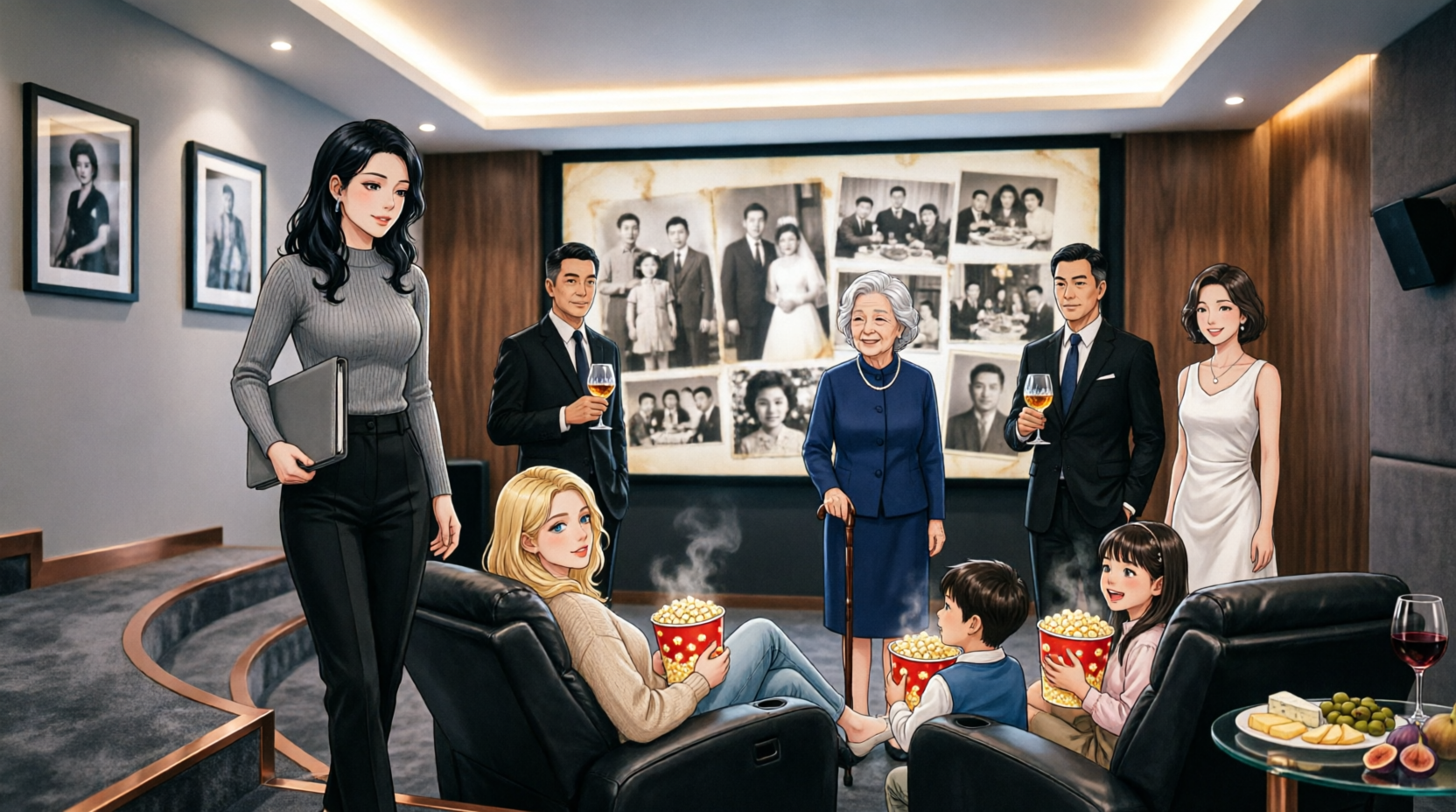
There is no other honest word for luxury built from desecration. A wall-sized screen dominated the far end. Tiered leather recliners gleamed under low gold lighting. Acoustic paneling wrapped the walls where oak shelves had once held voices centuries old. Heavy velvet curtains framed the room like a stage set. A bar of polished stone occupied the back, complete with a popcorn machine pretending to be whimsical while costing more than my first car.
Guests murmured approval. Phones rose. People smiled at the craftsmanship.
I felt none of it.
I saw instead the absent ladder Catherine used to reach the top shelves. Anna’s reading chair. The Persian rug worn pale at the center where generations of feet had stood looking up at knowledge they would never finish inheriting.
My father stepped forward with a glass of vintage champagne.
He loved to make a speech, especially when the speech allowed him to hear himself become the man he imagined himself to be.
“Friends,” he began, voice amplified by the room’s immaculate acoustics, “thank you for joining us tonight. This wing represents our commitment to the next generation. It’s about creating a place where family can gather, where memories can be made, where success can be shared—”
The legal courier entered from the side door so quietly that at first only a few people noticed.
Marcus came with him.
He was in a dark suit, carrying a slim leather folio, his expression as composed as if he were arriving for a board meeting. The courier held an envelope.
My father faltered.
My mother went very still.
Catherine did not move.
Marcus crossed the room and stopped at a respectful distance. “Mr. and Mrs. Henderson,” he said. “I’m sorry to interrupt.”
The lie was polite and necessary. He was not sorry at all.
My father forced a laugh. “Can this wait?”
“No.”
Conversations collapsed across the room.
The courier extended the envelope. My father did not take it. After a beat, my mother snatched it from the man’s hand as if speed could turn command into power. She opened the packet, scanned the first page, and lost color with such dramatic efficiency that Kayla stepped forward instinctively.
“Mom?”
My mother looked up at Catherine.
Catherine stepped slightly ahead of me, her cane clicking once on the floor.
“Well?” she said.
My father’s face had gone the color of wet paper. “This is absurd.”
Marcus’s tone remained almost pleasant. “It is, in fact, a formal notice. Due to verified breach of the Catherine Heritage Trust, resident trustee rights are suspended pending restoration of protected assets or equivalent restitution. The property reverts to trust administration. You have sixty days to vacate unless otherwise ordered.”
One of Kayla’s friends made a tiny gasp that sounded indecently delighted.
My mother stared at Marcus as if legal English might bend itself out of deference to her.
“You cannot remove us from our own home.”
Marcus lifted one brow. “The documents indicate otherwise.”
My father finally found his voice. “I improved this property.”
Catherine looked at him. “You improved your comfort. In a house you were permitted to occupy on condition that you preserve what mattered.”
He turned to her, stunned into honesty. “You did this.”
“No,” she said. “You did.”
My mother’s hands were shaking now. “Mother, tell them this is a misunderstanding.”
Catherine’s gaze was winter-clear.
“The collection,” she said to the room, “and the house tied to it were never yours. Brandon and Angela were caretakers. Trustees. Occupants by condition, not owners by right. They sold assets held in trust for Anna and violated the terms under which they were allowed to remain here.”
The silence that followed was unlike ordinary silence. It had edges. It sliced through clinking glasses and social smiles and lacquered self-regard. People shifted, but no one spoke. There, under the dim theater lights, the mythology of my parents’ status came apart without a single raised voice.
Kayla looked around wildly, seeing not support but retreat.
“This is insane,” she said. “You’re doing this in front of everyone?”
Marcus answered before I could. “Your family scheduled the audience.”
Then he handed my father a second document.
“This concerns the collection itself. Recovery proceedings have begun. Failure to cooperate may result in additional civil and criminal exposure.”
My father glanced at the page and seemed to shrink inside his suit. “Criminal?”
“Removal and sale of registered protected assets is not a trivial matter.”
My mother sank into one of the leather recliners as if her knees no longer trusted the floor. The irony would have been funny if it hadn’t been so fitting: she was collapsing into a chair bought with stolen money in a room built from her own undoing.
Around us, the guests began to recalibrate.
It happens quickly among people who are loyal only to prestige. They had arrived expecting to bask in luxury. Now luxury had become evidence. Their expressions shifted from admiration to distance with the speed of investors sensing a market collapse.
One couple slipped out immediately.
Another moved toward the bar, pretending to be occupied elsewhere.
Kayla’s phone started vibrating in her hand. She looked down, frowned, refreshed, and visibly blanched.
The story had broken online.
The local culture blog had posted first: Preservation inquiry launched into sale of protected rare book collection at Henderson estate. Someone in the room must have sent a tip because within minutes the headline spread across local feeds, and then into broader circles hungry for scandal involving money, history, and hypocrisy.
Kayla’s reel from the gutted library resurfaced almost instantly.
Clearing out the dust to make room for the stars ✨
The caption had aged into self-indictment in less than forty-eight hours.
She stared at the comments as they multiplied.
Thief.
Fraud.
Didn’t those belong to a child?
Imagine filming a crime scene.
Her face changed. Not with moral awakening. With horror that the audience had turned.
The reveal party dissolved in real time. Guests abandoned half-finished drinks. No one wanted a photo against the theater wall anymore. Even the music, still playing softly through the hidden speakers, sounded ridiculous now—anxious jazz trying to flatter a corpse.
I thought I would feel triumphant.
Instead I felt something cleaner.
Relief.
Not because my parents were suffering, though they were. Not because the spectacle pleased me, though I would be lying if I said there was no grim satisfaction in watching illusion meet paperwork. I felt relief because the truth had finally become public enough that I no longer had to carry it alone.
For thirty-one years, my role in that family had depended on ambiguity. They could prefer Kayla because it was easier, not because they were unjust. They could ask more of me because I was capable, not because they were exploitative. They could ignore my pain because I was resilient, not because I had been assigned the burden of invisibility.
But theft is clarifying.
So are legal notices.
When everyone had seen enough to know which way status was flowing, the room emptied. The theater—this expensive monument to misused inheritance—began to feel smaller with every departing guest.
My mother remained in the recliner, still clutching the first page of the notice. My father stood rigidly beside her. Kayla kept refreshing her phone as if a new reality might appear if she scrolled fast enough.
Marcus came to me quietly. “We’ve secured an order preventing transfer of the remaining volumes. The collector is cooperating now that he understands the exposure.”
“Thank you,” I said.
He glanced toward my parents. “Your great-grandmother built a formidable trap.”
“She called it planning.”
He allowed himself the ghost of a smile. “So she did.”
Catherine tapped her cane once. “I’m tired,” she said. “Take me home.”
We left before my mother recovered enough to attempt another appeal.
In the car, Catherine looked out the window at the dark grounds sliding past and said, “Your grandfather used to say that weak people borrow grandeur. They never understand that the loan comes due.”
I drove her back to her apartment and helped her inside. At the door she stopped me.
“Do not rescue them,” she said.
“I wasn’t planning to.”
“Good. Because they will ask you to confuse compassion with surrender. They will speak in the language of family. Remember that family is a word people use when they want forgiveness without accountability.”
I kissed her cheek.
Then I drove home to Anna.
She was awake in bed, her lamp on, a paperback spread open against her knees. I sat beside her and told her, in gentle, edited terms, that the truth had come out and the books were being recovered.
“Did Grandma Catherine tell them?” she asked.
“Yes.”
Anna smiled into her blanket, small and fierce. “I wish I’d seen it.”
The sixty days that followed felt both endless and swift.
My parents fought at first, of course. They hired attorneys who charged by the hour to explain to them, in increasingly expensive language, that the documents said what the documents said. They tried indignation, then charm, then selective amnesia. My mother claimed misunderstanding. My father claimed practical stewardship. Kayla claimed she had nothing to do with “the legal stuff,” as if posting glittered footage from the theft itself were merely an aesthetic choice.
None of it mattered.
The buyer, faced with his own legal jeopardy, surrendered the collection under protest. Some volumes returned quickly. Others had to be traced through intermediaries, but the paper trail held. Catherine’s registration system had been maddeningly meticulous. Every book carried documented provenance, condition photographs, internal marks, and storage records. It turned out that while my parents were busy treating legacy like décor, Catherine had spent decades making sure legacy could survive them.
The tax exemption was revoked almost immediately. The first supplemental property tax bill landed on my parents like an anvil. Thirty-five thousand dollars annually had once been a hidden blessing they accepted as naturally as weather. Now its absence became an invoice.
Then the bank became interested.
Because the renovation loan they had quietly leveraged against projected estate equity—something I only discovered through the trust review—had been issued on assumptions about ownership that were no longer stable. The lender did not appreciate surprises.
Suddenly, luxury was expensive in the old-fashioned way.
My father sold his vintage roadster first. Then the club memberships. My mother quietly consigned jewelry she had once claimed was sentimental. Kayla’s designer bags began disappearing from her social posts. She called me three times in one week.
I did not answer.
When she realized voicemail was all she had, she left messages that progressed through the predictable phases.
First outrage: “You’ve blown this so out of proportion.”
Then blame: “The boys had nothing to do with this.”
Then injury: “I can’t believe you would humiliate your own family.”
Then bargaining: “Maybe we can talk like adults and fix this privately.”
Then the near-miss of truth: “I know things weren’t always fair between us, but—”
She never finished that one. Perhaps because even she knew fairness was too small a word.
My mother sent texts heavy with the manipulative gravity of motherhood.
Have you thought about what this stress is doing to your father?
I hope you’re proud of turning Anna against her grandparents.
Family is all we have in the end.
I answered none of them.
Instead, I worked.
If my childhood had made me invisible, my training had made me efficient. I coordinated with Marcus, with the preservation office, with movers, with climate specialists, with trust administrators. I reviewed inventories until midnight. I cross-checked return receipts. I arranged temporary environmental controls for the library, oversaw conservation assessments, and prepared the documentation for full restoration of the room.
Practical tasks steadied me. They always had. The difference now was that I no longer mistook service for surrender. I was working for Anna. For Catherine. For the integrity of something real.
One rainy Thursday, a truck arrived carrying the first recovered crates.
Anna stood under the porch roof beside me, wrapped in her yellow raincoat, as men in gloves lifted the boxes with extraordinary care. Each crate was labeled. Each seal documented. The air smelled of wet earth and cardboard and possibility.
“Can I help?” she whispered.
“Not yet,” I said. “But you can witness.”
So she did.
That evening, after the crates were secured in the temporary conservation room, Catherine came by. She walked more slowly now than before her fall, but the force of her mind filled every room she entered. She rested her hand on the lid of the largest crate and closed her eyes.
“For a moment,” she said, “I thought I had failed.”
“You didn’t,” I said.
“I failed in one way. I stayed too long in hope.” She opened her eyes. “Never do that, Olivia. Hope is lovely. But it cannot be the only lock on the door.”
I nodded.
She looked at Anna. “Would you like to hear a secret?”
Anna came nearer.
Catherine bent slightly. “The rarest thing in this house was never the books.”
Anna frowned in concentration. “What was it?”
“A child willing to listen.”
Anna smiled so suddenly and sweetly that I had to look away.
A week later, my parents moved into a small apartment on the outskirts of the city.
I know this because my mother sent one final dramatic message from the moving van:
I hope you can live with yourself.
It was the kind of line designed to land in the softest part of a conscience. For years, mine would have received it eagerly. I would have read into it obligations that were not actually there. I would have rushed to ease discomfort, to prove I was not cruel, to restore peace at my own expense.
Instead, I looked around the half-restored library where three shelves had already been rebuilt and climate monitors blinked green against the wall. I looked at Anna on the floor with archival gloves beside her, helping me log returned volumes into the inventory. I thought of the apartment keys in my mother’s purse. I thought of the money they had spent, the lies they had told, the child they had dispossessed, the sanctuary they had gutted, the entitlement with which they had called all of it family.
Then I deleted the message.
The hardest part, surprisingly, was not the legal fight.
It was the aftershock.
When you spend your life being useful to people who only notice you in relation to what you provide, withdrawing that usefulness can make you feel as if you’ve vanished from the world entirely. There is a strange grief in no longer being needed by those who harmed you. Even when the need was exploitative. Even when the role was killing you.
For several weeks, I woke with anxiety already in my chest. I would reach for my phone expecting disaster, accusation, fresh demand. Sometimes there was one. Sometimes there wasn’t. But my nervous system had been trained by years of family volatility to anticipate impact.
I started therapy.
That sentence is simple. The reality was less so. It involved three cancelled intake forms, one panic attack in a parking lot, and finally a Thursday afternoon appointment with a woman named Dr. Marin who had clear eyes and no interest in flattery.
In our second session she said, “Tell me how your family benefited from your silence.”
The question stunned me.
I had spent a lifetime narrating events from the point of view of their needs, their intentions, their pressures, their wounds. To be asked what my silence had done for them—not how it protected me, but how it served them—felt like being handed the key to a room I’d been living beside for years.
“They didn’t have to change,” I said slowly.
Dr. Marin nodded.
“They didn’t have to feel guilty,” I continued. “They could tell themselves I was fine. Strong. Capable. They could take and take and call it balance because I didn’t complain.”
“And what did it cost you?”
I laughed without humor. “What didn’t it cost?”
When you are raised to be the emotional infrastructure of a family, choosing not to collapse for everyone else feels unnatural. It also feels magnificent, once you get used to breathing.
The library restoration became the physical version of that process.
We stripped out the theater wiring. We sold the recliners. The giant screen was removed in sections, leaving behind pale outlines on the walls like the ghost of an insult. Velvet drapes disappeared. Acoustic foam came off in ugly chunks. Day by day the room lost its borrowed fantasy and regained its older dignity.
The shelves were rebuilt in mahogany using the original plans Catherine had somehow preserved in a labeled tube marked LIBRARY WOODWORK—1938.
“Did you save everything?” I asked her once, half laughing.
She looked at me over her glasses. “I saved what mattered.”
When the first restored shelf went up, Anna clapped.
When the Persian rug returned from cleaning and was unrolled in the center of the room, its faded reds glowing softly under the afternoon light, I had to step outside for air. Some grief only emerges when repair begins.
Little by little, the room started breathing again.
The books came back in waves.
Some were perfect. Some had suffered handling damage. One seventeenth-century devotional had a torn endpaper from a dealer’s hasty inspection. A signed nineteenth-century natural history volume had been stored in the wrong humidity for two weeks and needed stabilization. Every flaw enraged me, but it also hardened my gratitude for process. Damage could be documented. Restoration could begin. Facts were anchors.
Anna took the work seriously. I taught her how to read the accession numbers aloud. She learned to check condition notes against incoming reports. Catherine showed her how to cradle a cracked spine in a foam support. Sometimes the three of us worked in companionable silence, the kind that had always felt holier to me than my family’s loudest celebrations.
One evening, as rain tapped softly against the tall windows, Anna asked, “Will Grandpa and Grandma ever come back here?”
The question hung over the room.
Catherine answered before I could. “Not unless the trust allows it.”
“That means no, doesn’t it?” Anna said.
Catherine’s mouth curved slightly. “It means some doors are not reopened just because the people outside them are related to you.”
Anna absorbed that with the seriousness children sometimes reserve for truths adults spend decades avoiding.
I added, “Being family doesn’t mean people get to hurt you and stay.”
She nodded. Then, after a pause, “I’m glad.”
So was I.
News cycles are greedy and shallow. Within a month, the local scandal that had nearly devoured Kayla’s online brand was replaced by fresher disasters and newer villains. But reputation, once cracked, doesn’t fully mend. At least not in the circles my parents cared about. Invitations thinned. Friends became polite strangers. People who had once lingered in the estate’s drawing room praising its charm now discovered other weekends, other hosts, other loyalties.
Kayla tried a rebrand.
First she posted vague quotes about resilience.
Then a teary video about “navigating family betrayal.”
Then a wellness pivot involving candles and forgiveness.
Nothing caught. The comments remembered.
My mother, meanwhile, wrote me a letter.
A physical letter. Cream stationery. Slanted blue ink. Six pages.
I read it at the kitchen table while Anna was at school and the house was quiet.
The first page was nostalgia. My mother reminding me how much she had sacrificed, how difficult motherhood had been, how misunderstood she often felt.
The second page was revisionism. She wrote as if the sale had been a mutual decision blurred by stress and poor communication. She called the books “items of sentimental significance,” which was like calling a cathedral a building with emotional associations.
The third page turned toward injury. She described the humiliation of the party, the cruelty of public exposure, the shock of being “cast out” after all her years of service to the home.
The fourth page begged.
The fifth page accused.
The sixth page ended with, No matter what you think, I have always loved you in my own way.
I sat with that sentence for a long time.
It may even have been true.
But there is a kind of love that demands so much distortion from its recipient that accepting it becomes a form of self-erasure. My mother had loved me, perhaps, the way some people love dependable furniture—grateful for its function, inattentive to its wear, startled when it finally refuses another burden.
I folded the letter and put it in a file marked CORRESPONDENCE—PERSONAL.
Not because I intended to answer.
Because paper remembers.
Spring moved toward summer. The estate changed around us.
Without my parents in it, the house lost its constant layer of performance. Rooms settled. Air shifted. Meals were quieter, but they tasted better. There was less polished silver and more honest conversation. No one was trying to impress anyone. Even the walls seemed relieved.
Catherine moved back in once her doctor cleared her. She reclaimed the morning room and the small rose garden with efficient sovereignty. She did not pretend everything was healed. That was another thing I loved about her. She believed in restoration, not denial.
One afternoon, I found her in the library watching Anna read.
My daughter sat curled in the leather chair by the window, a restored first edition on her lap and a pencil tucked behind one ear because she had insisted on copying a passage into her notebook “just to keep it close.”
Catherine spoke without turning.
“Do you know why I chose Anna?”
I leaned against the doorframe. “Because you love her.”
“Of course. But that is not enough reason to entrust someone with history.” She finally looked at me. “I chose her because she receives without devouring. Very few people do.”
I thought of my parents, of Kayla, of the theater wing, of how greed often presents itself as hunger for more when it is really incapacity for enough.
“You chose well,” I said.
Catherine studied me. “So did she.”
“What do you mean?”
“She chose you. Every time that child is frightened, she comes toward you, not away. Do not undervalue that.”
It is still possible, at thirty-one, to hear one sentence and feel some old internal architecture shift.
That night, after Anna was asleep, I walked through the house alone.
The halls were dim and cool. The restored library door stood open. Moonlight silvered the edge of the rug. The shelves were nearly full again. The room no longer smelled of paint. It smelled of wax polish, tea, paper, and old wood—the scent of endurance.
I sat at the desk in the center of the room, opened my phone, and looked at the family group chat for the first time in weeks.
It was a stagnant swamp of guilt, demand, recrimination, forwarded apartment listings, complaints about legal fees, old photos deployed as emotional bait, and occasional messages from Kayla pretending this had all somehow happened to her.
For years that chat had functioned like an emergency cable attached to my nervous system. Every ping a summons. Every complaint a command. Every small chaos a test I was expected to pass.
I scrolled once. Then I hit delete conversation.
After that I blocked the numbers.
The silence that followed was immediate and almost holy.
Not triumphant. Not dramatic. Just clear.
I set the phone aside and looked around the room my daughter would someday inherit without apology.
There is a lie families like mine tell their quiet children. It goes something like this: Be patient. Be understanding. Be the bigger person. Love means forgiving more, giving more, requiring less. Peace is your responsibility. Harmony is your proof of goodness. If you are hurt, absorb it elegantly. If you are overlooked, wait graciously. If they take from you, call it generosity. If they ask you to disappear so someone else can shine, do it with a smile and call that maturity.
I had believed that lie for most of my life.
It had made me efficient, self-controlled, useful, admired in certain respectable ways. It had also made me available for exploitation so normalized it often wore the face of family ritual.
But standing there in the restored library, with the shelves returned and the trust intact and my daughter asleep under the same roof as the history meant for her, I understood something better.
Boundaries are not cruelty.
Documentation is not betrayal.
Withdrawing your labor from people who consume you is not abandonment.
And silence, when freely chosen instead of fearfully maintained, can sound like freedom.
A few days later, Anna came into the library carrying one of Catherine’s old index boxes.
“What’s this?” she asked.
I opened it. Inside were hundreds of handwritten catalog cards in Catherine’s elegant script, each one describing a volume, its condition, provenance, date, and notes on significance. On the back of some cards she had added personal remarks.
Read during the blizzard of 1968.
Your grandfather loved this binding.
Keep away from direct sun no matter who tells you otherwise.
When Anna is older, show her page 142.
I laughed and then, unexpectedly, cried.
Anna climbed into my lap without asking why.
“What happened?” she whispered.
“She loved us ahead of time,” I said.
Anna leaned her cheek against my shoulder. “Can people do that?”
“Yes,” I said, looking at Catherine’s careful handwriting, the proof of foresight and devotion spanning decades. “The right people can.”
Summer ripened. The final legal matters resolved. The collection was fully restored to trust custody. The estate’s administration transferred formally, with me appointed acting archival steward until Anna reached age. Catherine signed the documents with a hand as steady as old branches in little wind.
At the close of the final meeting, Marcus gathered his files and said, “You know, most families would have destroyed each other over less.”
“Mine tried,” I said.
He gave me a dry look. “Your side simply had better paperwork.”
After he left, Catherine chuckled for nearly a full minute.
It felt good to hear.
On the first cool evening of autumn, the library restoration was declared complete.
No ribbon cutting. No guest list. No champagne tower.
Just us.
Catherine brewed peppermint tea. I lit the brass lamp on the reading desk. Anna placed the last returned volume—one slim first edition of poems in faded blue cloth—onto its proper shelf with both hands.
Then she stepped back.
“That’s all of them,” she said.
The room seemed to listen.
Catherine raised her teacup as if in salute. “Then let the house remember itself.”
We sat together in the deepening amber of the room while the old clock ticked and the windows reflected us back: a child, a mother, an old woman, three generations held not by performance or debt or hierarchy, but by mutual recognition.
No one was invisible there.
Anna eventually curled into the leather chair with a book. Catherine dozed lightly by the fire. I remained at the desk, not working, not fixing, not bracing for anyone’s demand. Just present.
I thought of my parents in their apartment, of Kayla chasing relevance through another reinvention, of the theater wing dismantled down to studs and memory. I did not wish them ruin. Ruin had already found them in the exact form they had built for themselves. I wished them, perhaps, understanding. Though I no longer required it.
Some endings do not arrive with apologies. Some justice does not include repentance. Sometimes the lesson is not that the people who hurt you finally realize your worth. Sometimes the lesson is that your worth was never theirs to measure.
Anna turned a page. The sound was soft and precise.
Catherine opened one eye and said, without moving, “Listen.”
“To what?” I asked.
“The room. It is at peace.”
And it was.
The house no longer held its breath. The library no longer smelled of violation. My phone no longer dictated my pulse. My daughter no longer needed to shrink in spaces where love was rationed according to usefulness.
For thirty-one years I had believed survival meant making myself smaller than the harm. Easier. Quieter. More manageable. But survival is only the first draft of a life. At some point, if you are lucky and brave and furious enough, you revise.
I rose, crossed the room, and drew the curtains against the gathering dark. Then I turned back toward the firelight, toward Anna’s bent head and Catherine’s sleeping profile, toward the shelves lined once more with voices entrusted to our care.
The collection had come home.
So had I.