Part 1
The first thing I remember is the sound of sirens folding over each other like metal tearing.
I was driving south on Interstate 25 after a late shift in downtown Denver, one hand on the wheel, the other wrapped around a paper cup of gas-station coffee that had gone cold twenty minutes earlier.
The sky was already black, the highway slick with old snowmelt, and every set of headlights behind me looked stretched and blurry in my rearview mirror.
Then three police cruisers came out of nowhere.
One slid in front of my Honda.
One pulled hard against my passenger side.
The third tucked in behind me so close I could see the bull bar in my mirror.
Red and blue lights bounced off the concrete median, turning the whole world into a flashing warning sign.
A voice boomed through a loudspeaker.
“Driver, throw your keys out the window.
Keep both hands visible on the steering wheel.”
For a second, my brain refused to attach the command to me.
I was twenty-nine years old, a lead data analyst with a clean driving record and a half-finished wedding seating chart on my kitchen table.
I did not run red lights.
I did not shoplift mascara from drugstores.
I returned library books early.
But the voice came again, sharper.
“Keys out the window.
Now.”
My fingers shook so badly I scraped the key against the ignition before I could pull it free.
The key ring had a little silver mountain charm Caleb bought me during our first trip to Estes Park.
It clicked against my palm like a nervous tooth.
I rolled the window down and dropped everything onto the asphalt.
Cold air slapped my face.
“Hands on the wheel.”
I pressed my palms to ten and two.
My knuckles turned pale.
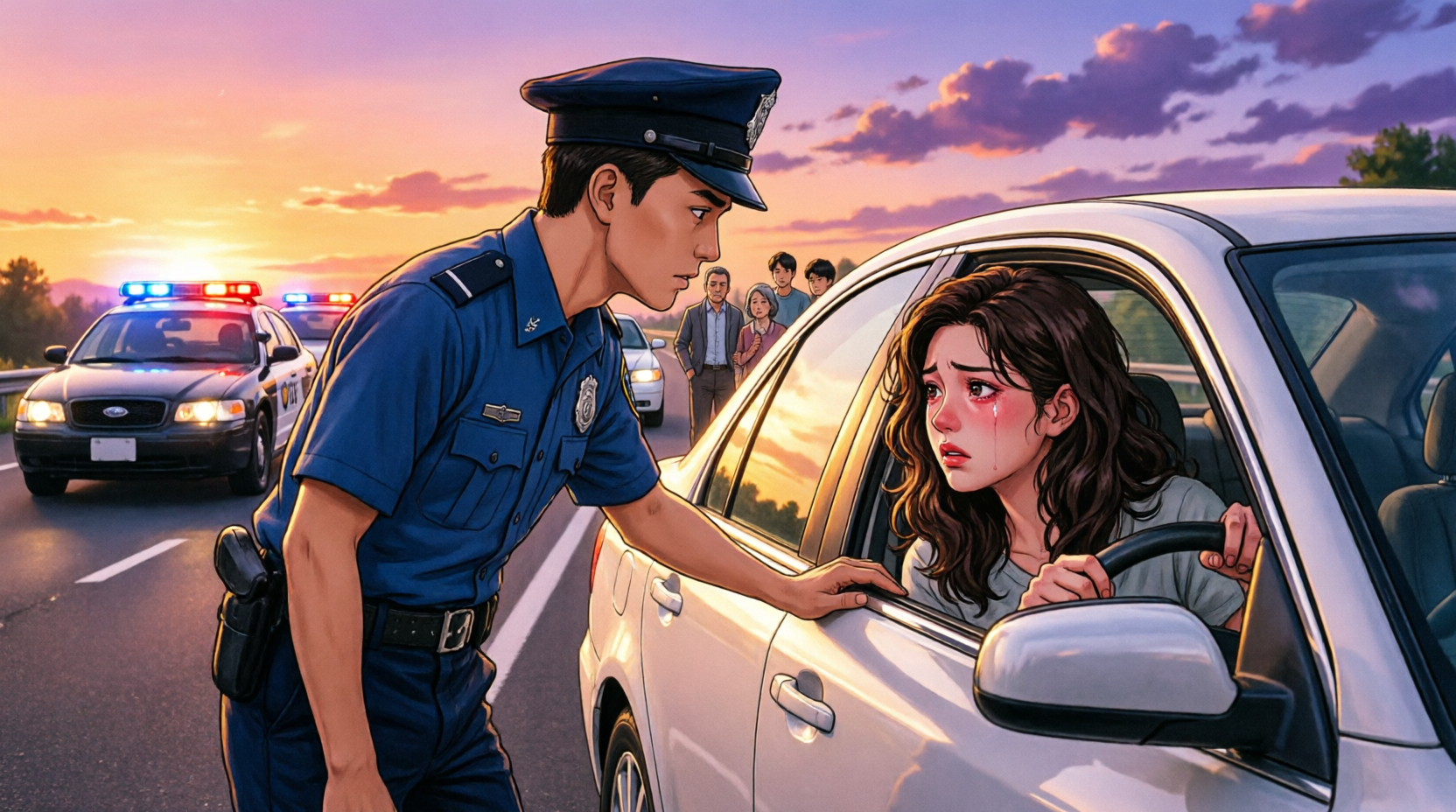
In the side mirror, I saw officers stepping out behind open doors, service weapons drawn, shoulders squared, mouths moving into radios.
The beams from their headlights stabbed through my windshield so brightly I could barely breathe.
I did not know yet who had done it.
I only knew one thing: someone had told the police I was dangerous.
The traffic on the highway slowed as drivers passed, rubbernecking at my humiliation.
Somewhere to my right, an engine idled heavily.
Gravel crunched under boots.
My heartbeat filled my ears so completely I almost missed the next voice.
“Stand down.”
The command cut through the sirens like a blade.
“She’s my fiancée.
Lower your weapons.”
I blinked hard against the glare.
Officer Caleb Owens stepped into the wash of my headlights.
He was still in uniform, dark jacket zipped to his throat, badge catching flashes of red and blue.
His face looked calm from a distance, but I knew him well enough to notice the muscle jumping in his jaw.
He holstered his weapon and walked to my window slowly, like he was approaching a wounded animal.
When he leaned down, the smell of winter air and leather from his duty belt slipped into the car.
“Farah,” he said quietly.
“Baby, look at me.”
My eyes burned.
“I didn’t do anything.”
“I know.”
His hand came through the open window and covered mine.
His fingers were warm and steady.
Mine were ice.
“What’s happening?” I whispered.
He glanced toward one of the other officers, then back at me.
“Your plate was flagged ten minutes ago.
Stolen vehicle.
Reporting party claimed you were hostile and likely to flee.”
The words made no sense.
My Honda was old, reliable, and fully paid off except for the ghost of a college-era title technicality.
Nobody wanted to steal it.
Nobody wanted to chase it.
“Who reported it?”
Caleb’s eyes shifted.
That was when I felt the first real drop in my stomach.
He looked at the screen mounted inside his cruiser, then back at me with a stillness that frightened me more than the guns had.
“Hector Torres,” he said.
“Your father.”
For a moment, the highway vanished.
I saw my father’s hands instead.
Large square hands.
Contractor’s hands.
The same hands that taught me how to hold a hammer, how to change a tire, how to sign my name neatly when I was eighteen and too trusting to read what he placed in front of me.
“My dad?” I said, though I had heard him perfectly.
Caleb’s body camera blinked red to life on his chest.
“Farah,” he said, his voice changing from fiancé to officer, “this has to be documented.
A false stolen vehicle report is serious.
It puts you and every officer here at risk.”
The other officers were lowering their weapons now, confused and embarrassed.
One of them retrieved my keys from the road.
Another spoke into his radio.
But I stayed frozen, hands glued to the wheel, while the truth slowly arranged itself inside my head.
My father had once co-signed paperwork when I bought the car as a sophomore in college.
I made every payment.
I paid the insurance.
I paid the repairs.
I paid for the tires, the oil changes, the cracked windshield after a hailstorm in Pueblo.
But his name, buried somewhere in old title records, had stayed there like a loaded gun.
Tonight, he pulled the trigger.
Caleb leaned closer.
“Why would he do this?”
The heater blew against my ankles, but the rest of me felt numb.
Forty-eight hours earlier, I had sat in my parents’ living room, surrounded by the smell of slow-roasted pork shoulder, warm tortillas, and furniture polish.
My mother, Sylvia, had worn her pearls.
My older sister Elena had cried without ruining her mascara.
My father had asked for fifteen thousand dollars like he was asking me to pass the salt.
And I had said no.
Now I stared at Caleb’s face through the open window, the sirens winding down around us, and understood something that made my hands shake harder than the guns had.
My father had not lost his temper.
He had made a choice.
He had turned my refusal into a felony traffic stop, and I had no idea what he was willing to do next.
Part 2
Two nights before the highway, my mother texted me while I was at work.
We need to talk, Farah.
Family matters.
Come over at six.
No heart emoji.
No little prayer hands.
No dramatic “please.”
Just those seven words sitting on my phone screen between a data report and a calendar reminder about cake tastings.
By five-thirty, I was driving toward Colorado Springs with a tightness under my ribs I could not explain.
My parents’ house sat in a quiet subdivision where every lawn looked combed, every porch light glowed warm, and every neighbor knew whose children had disappointed them.
The windows were lit when I arrived.
Through the glass, I saw movement in the living room.
The house smelled like pork, cumin, and fresh tortillas when I opened the door.
Usually, that smell meant birthdays or Sunday dinners.
That night, it felt like bait.
“Farah,” my mother called.
“We’re in here.”
Her voice had the soft, careful tone she used before bad news or manipulation.
Sometimes both.
I found them arranged like a courtroom.
My father sat in his leather recliner, elbows on the arms, boots planted wide.
Hector Torres had built a contracting business from nothing, and he ran our family the same way he ran a job site: deadlines, obedience, consequences.
My mother perched on the sofa, thumb worrying the clasp of her pearl necklace.
Across from them sat Elena and her husband, Darius.
Elena was beautiful in the kind of polished way that made people assume she was also kind.
Her cashmere sweater matched her lipstick.
Her hair fell in soft, expensive waves.
She looked fragile on purpose.
Darius looked like he had not slept in a week.
He kept his eyes on the rug.
“Sit,” my father said.
I sat in the armchair opposite him.
The leather felt cold through my slacks.
“What’s going on?”
My mother exhaled like I had already made things difficult.
“Your sister and Darius have had a hard few months.”
Elena lowered her eyes.
“Business has been slow,” she said.
“Unexpected expenses.
You know how things pile up.”
I did know how things piled up.
I tracked costs for a living.
I knew emergencies had numbers attached to them, and people avoided numbers when the truth was uglier than the story.
“How much?” I asked.
“Fifteen thousand,” my father said.
The room went very still.
I actually laughed once because I thought I had misheard.
Nobody else laughed.
“Fifteen thousand dollars?”
“It’s a loan,” Elena said quickly.
“Just to get us through this.
We’ll pay you back.”
Darius shifted.
“Farah, you don’t have to—”
Elena turned on him with a look so sharp he stopped mid-breath.
That was my first clue.
Not the amount.
Not the tears.
Darius.
The way he looked less like a man in financial trouble and more like a man trapped inside someone else’s crime.
“I can’t,” I said.
My mother’s hand froze on her pearls.
“What do you mean, you can’t?”
“I mean I’m not giving you fifteen thousand dollars.”
My father leaned forward.
“Don’t lie to me.
I know what you make.”
Heat rose in my chest.
“Yes, I make good money.
I also pay rent.
I pay bills.
Caleb and I are getting married in four months.
We’re saving for a down payment.
That money has a purpose.”
Elena’s face crumpled.
The tears arrived on command.
“So your wedding party is more important than your sister?”
“It’s not a party.”
“You’d rather buy flowers and a dress than help us keep our home?”
Home.
That word landed strangely, like a spoon dropped in a quiet kitchen.
I looked at Darius again.
His jaw flexed.
“Why can’t you get a bank loan?” I asked.
My father’s eyes narrowed.
“We handle family matters inside the family.”
“You mean I handle Elena’s problems inside the family.”
“Watch your tone.”
“No.”
The word came out before I could soften it.
“No, Dad.
I helped when Elena wrecked her car in high school.
I helped when she maxed out credit cards in college.
I helped when Mom said she needed a ‘quiet loan’ for Elena’s baby shower.
I’m done.”
Sylvia gasped as if I had slapped her.
“After everything we’ve done for you?”
“You raised me,” I said.
“That doesn’t make me a bank.”
Hector stood.
The leather chair groaned behind him.
The room seemed to shrink around his shoulders.
“You don’t walk out on this family without consequences.”
I put on my coat with fingers that wanted to tremble but didn’t.
I remember the brass doorknob cold in my palm.
I remember my mother whispering my name like a warning.
I remember Elena watching me with wet eyes that had gone strangely dry at the edges.
I walked out anyway.
Forty-eight hours later, on the shoulder of Interstate 25, those consequences arrived with sirens and drawn weapons.
Caleb drove me home that night in his cruiser while another officer returned my Honda to my apartment lot.
I sat wrapped in a wool blanket from his trunk, my whole body shivering so hard the zipper teeth clicked against each other.
“What your father did wasn’t a tantrum,” Caleb said, eyes on the road.
“It was escalation.”
“But why the car?”
“Because he had leverage there.
Old paperwork.
Familiar enough to sound legitimate.
Dangerous enough to scare you.”
I watched orange streetlights smear across the window.
“Do I press charges?”
Caleb’s silence told me the answer would not be simple.
“Because I responded,” he said, “I can’t investigate it.
Conflict of interest.
I uploaded my bodycam footage and logged everything.
Tomorrow, I’m handing it to Detective Miller in Financial Crimes.”
“Financial Crimes?”
He looked at me.
“Farah, this isn’t about a family argument anymore.”
At my apartment, he checked the windows while I stood in the kitchen drinking water that tasted like pennies.
My phone buzzed on the counter.
A credit monitoring alert lit the screen.
Urgent: new hard inquiry detected.
The lender name meant nothing to me.
The loan type made my skin go cold.
Short-term personal loan.
Requested amount: $15,000.
Caleb read it over my shoulder, and the last softness left his face.
“They didn’t back off,” he said.
“They recalibrated.”
I stared at the number glowing on my phone, the same number Elena had cried over in my parents’ living room.
My father had used the police when I said no.
Now someone was using my Social Security number.
And for the first time that night, I understood the word family could sound exactly like a threat.
Part 3
We froze my credit at my kitchen counter under the harsh white light above the sink.
Equifax.
Experian.
TransUnion.
Three doors slammed shut, one after another, while Caleb stood beside me with his arms crossed and his jaw tight.
I typed passwords, answered security questions, and clicked through warnings that made everything sound like a minor inconvenience instead of a financial break-in by the people whose fingerprints were on my baby pictures.
When the last freeze confirmation appeared, I sat back and stared at the screen.
My apartment was quiet except for the refrigerator humming and the distant sound of someone’s dog barking downstairs.
The place looked exactly as it had that morning: gray sofa, framed hiking photo, stack of unopened wedding invitations on the coffee table.
But it did not feel safe anymore.
“They know everything,” I said.
Caleb leaned against the counter.
“Parents usually do.”
The words were simple.
That made them worse.
They knew my Social Security number because they had filed my childhood tax forms.
They knew my first address, my first school, my mother’s maiden name, the hospital where I was born.
All the little keys that were supposed to prove I was me had been handed to them before I could spell my own name.
Caleb stayed that night.
Neither of us slept much.
He lay on the sofa with one hand near his phone while I sat in bed refreshing credit alerts until dawn bled pale blue through the blinds.
By nine the next morning, I was back at work because I needed something normal.
My office was a glass-walled tech firm in downtown Denver where everything smelled like espresso, warm circuitry, and expensive cleaning products.
Numbers calmed me.
Databases had rules.
Dashboards did not accuse you of betrayal for protecting your savings.
At 9:15, a calendar alert popped up.
Mandatory Personnel Check-In.
Attendees: Sarah Nguyen, my manager.
David Ross, Director of Human Resources.
My stomach folded inward.
Sarah did not handle routine corrections with HR.
David did not attend anything unless lawyers had already been imagined.
I walked down the polished concrete corridor, listening to my heels click too loudly.
The conference room was frosted glass.
Through it, I saw Sarah standing by the window, arms crossed, looking out at the skyline instead of the door.
David sat at the table with a single printed document in front of him.
“Farah,” he said.
“Please sit.”
The chair was cold.
David slid the paper toward me.
“We received a concerning email this morning,” he said.
“It was sent to our chief information security officer and escalated to HR.”
I looked down.
At first glance, it appeared to be a police incident report.
Official heading.
Case number.
Dense language.
But after the night before, after watching Caleb review real records, I saw the tiny mistakes: spacing too clean in one section, badge field misaligned, terminology almost right but not quite.
A fake.
The content made my mouth go dry.
The report claimed I was using company cloud infrastructure to route illegal offshore sports betting funds.
It used words like encrypted financial tumbling, unauthorized server access, proprietary bandwidth misuse.
Whoever wrote it had searched just enough technical jargon to terrify a corporate legal department.
“This is fabricated,” I said.
Sarah finally turned.
Her face looked pained.
“I believe you’re telling us what you believe, Farah.”
“No.
I’m telling you what I know.
My parents are trying to extort me.
Last night someone tried to take out a fifteen-thousand-dollar loan in my name.
I froze my credit.
This is retaliation.”
David’s expression did not change, and that frightened me.
“We have to protect the company and our clients,” he said.
“Until we verify the origin of this report and complete a forensic audit of your activity, your credentials have been revoked.”
The room blurred at the edges.
“What does that mean?”
“You’re being placed on administrative leave effective immediately.”
I swallowed.
“With pay?”
David looked down.
“Because the allegation involves financial misconduct, policy requires unpaid leave during the investigation.”
Unpaid.
That was not a word.
That was a knife.
My parents knew exactly where to cut.
The wedding fund.
The down payment.
Rent.
Groceries.
My independence had a monthly burn rate, and they were trying to starve it.
Security walked me back to my desk with a flat cardboard box.
My coworkers pretended not to watch.
The office that had always hummed around me went silent in a widening circle.
I packed my mug, my notebooks, a framed photo of Caleb and me laughing in the Rockies.
When I reached for my corporate laptop, the guard stepped forward.
“Company property stays.”
David appeared behind him.
“Cybersecurity said she can take the physical hardware.
Her VPN is disabled.
The audit will run from cloud backups.
She’ll need the machine to draft her formal statement.”
So I placed the heavy slate-gray laptop into the box.
It was custom-built for our analytics team, loaded with advanced processing tools and local software I barely used unless a project demanded it.
I did not know then that taking it home would become the mistake my parents never saw coming.
I carried the box to the parking garage and sat in my Honda without starting the engine.
Twenty-four hours earlier, I had been a lead analyst planning a wedding.
Now I was suspended, unpaid, accused, and hunted by my own family.
Then my phone buzzed.
Elena.
Dad said you would have plenty of free time now to rethink your selfishness.
Let us know when you are ready to be a real family again.
I read it twice.
The grief inside me dried up so quickly it almost scared me.
In its place came something clean and cold…………………..