Part 1
By the time I was forty-two, I had learned that most men liked to be seen doing hard things.
They liked the audience for it.
The story of it.
The chance to stand in somebody’s kitchen later with a beer in hand and say, You should’ve seen me.
I had spent seventeen years learning the opposite.
Do the hard thing.
Finish it.
Leave no extra words lying around.
That was probably why Millbrook, Ohio never quite knew what to do with me when I came home for good.
I was the guy with the stiff left shoulder, the square old farmhouse near the edge of town, and the habit of doing my own work without asking for favors.
I fixed fences.
I changed my own oil.
I nodded to people in the grocery store and kept walking.
Around Millbrook, that counted as a personality.
My son, Drew, had a personality enough for both of us.
He was fifteen, all elbows and quick eyes, built like he’d been assembled from spare parts and then somehow made graceful anyway.
He had his mother’s dry sense of humor and my habit of noticing things other people missed.
Not in a dramatic way.
Just little things.
A coach favoring one ankle.
A cashier shorting herself change.
A dog that barked different when it was scared than when it was territorial.
His mother, Rhonda, used to say he came into the world looking like he already suspected adults were making it up as they went.
She had been dead six years.
There are losses that rearrange the furniture inside you, and then there are losses that tear the walls out completely.
Rhonda’s aneurysm happened on a Tuesday that began with coffee and ended with me sitting in a hospital hallway staring at a vending machine that sold stale peanut M&Ms.
One minute she was rinsing a mug in the sink.
By afternoon I was learning words like catastrophic and spontaneous and non-survivable.
After that, I got good at being two people in one body.
I packed lunches.
I learned how long pizza rolls had to cool before a kid burned his mouth.
I figured out science fair tri-fold boards and permission slips and the exact temperature Drew liked his room in winter.
I wasn’t a warm man by nature, but I was a steady one.
Kids notice that, too.
That Thursday in October, the air had that damp, metallic smell that shows up right before real cold takes over.
I was in the backyard replacing a section of fence the last owner had patched with optimism and bad nails.
The posthole digger bit into the earth with a wet, sucking sound.
Somewhere down the block, somebody was burning leaves.
I could hear a football game on a radio through an open garage two houses over.
Drew should have been home by six-thirty.
At six-twelve, my phone rang.
The screen showed Millbrook High School.
I remember wiping my palm on my jeans before I answered, more from habit than fear.
Schools call for stupid things all the time.
Forgotten inhalers.
Scheduling mix-ups.
Somebody’s stomach acting up in third period.
The voice on the other end wasn’t any administrator I knew.
“Mr. Wade?” a woman said, breathless but trying hard not to sound like it.
“This is Jessica Chambers.
I teach Drew’s junior English class.”
I straightened without meaning to.
“What happened?”
A small silence.
In the background I heard doors opening, footsteps, somebody giving clipped instructions.
The sounds of a building that had tipped from routine into emergency.
“There was an incident after practice,” she said.
“In the east parking lot.
Six boys from the wrestling team jumped Drew.
I saw it from my classroom window.
I called 911.
They’ve taken him to St. Catherine’s.”
I set the fence post down carefully on the grass.
My hands were suddenly very clean and very empty.
“How bad?”
Her inhale hitched.
“He was conscious when the ambulance left.
But they didn’t stop when he was down.”
The world did not spin.
It narrowed.
“I’m on my way,” I said.
I don’t remember grabbing my keys, only the truck door slamming hard enough to rattle the frame.
The drive to St. Catherine’s took eleven minutes if every light went against you and seven if you treated traffic laws like loose suggestions.
That night I made it in under eight.
Millbrook looked offensively normal on the way there.
Porch lights glowing.
Minivans in driveways.
Teenagers in hoodies outside the gas station laughing about something stupid and temporary.
A woman walking a golden retriever that would probably live twelve peaceful years and die loved.
Every inch of the town felt like an insult.
At the hospital, the automatic doors opened with their usual cheerful little hiss.
Inside, St. Catherine’s smelled like industrial cleanser, old coffee, and the kind of fear people try to hide under practical questions.
A volunteer in a pink cardigan directed me to the ICU without looking me in the eye for long.
That was the first bad sign.
The second bad sign was the doctor waiting for me before I reached the room.
Dr. Leah Lynn was maybe mid-thirties, hair pinned back, expression composed in the exact way medical people learn when they’ve delivered terrible information before and hate that they’re good at it.
She introduced herself, then got right to it.
“Your son has a punctured lung, four fractured ribs, and a bruised kidney.
He’s stable now.”
Stable now.
Those two words always come carrying a crowd behind them.
She led me down the hall.
My boots made dull sounds on the polished floor.
Somewhere a monitor gave a rhythmic, indifferent beep.
We stopped outside a glass-partitioned room.
Drew lay in the bed looking younger than fifteen and older than I’d ever seen him.
There were tubes, wires, tape, bruising blooming under the hospital gown where they knew no one would see it for a while.
His face was mostly untouched.
That landed harder than if it had been smashed in.
They had chosen where to hurt him.
That is not schoolyard rage.
That is method.
I pulled the chair close and sat down.
His eyes opened after a minute, cloudy with pain medication and effort.
He tried to speak.
“Don’t,” I said quietly.
“I’m here.”
I put my hand over his.
He squeezed once, weak and stubborn.
For four hours I sat there and listened to the room breathe around him.
The ventilator whispered.
Rubber soles passed in the hall.
A cart squeaked somewhere every time it turned left, like it had a complaint no one cared enough to fix.
I watched the bruises darken under fluorescent light and felt something inside me getting very still.
Not rage.
Rage burns hot and wastes oxygen.
This was colder.
When the night nurse came in around eleven to adjust his medication, she glanced at me like she expected tears or questions or a man coming apart in the chair beside his kid’s bed.
I had questions.
I just wasn’t asking them there.
At one in the morning, when Drew slept deeper and the machines had settled into their steady little chorus, I noticed something else.
His knuckles were split.
Skin torn across two fingers on the right hand.
He had swung at someone before they buried him.
A stupid detail for anybody else to care about.
For me, it meant everything.
He hadn’t gone down confused.
He had understood exactly what was happening, and he had still fought.
I looked at my son breathing under hospital light, and the pieces began arranging themselves into the kind of pattern I knew better than I ever wanted to.
This hadn’t been a fight.
It had been a message.
And the moment I understood that, I knew the next question wasn’t who had done it.
It was who had allowed themselves to believe they could.
Part 2
I stayed at the hospital until dawn painted the ICU windows the color of dishwater.
Around five-thirty, a nurse offered me coffee from a machine that sounded like it resented human life.
I took it because my hands needed something to do.
The coffee tasted burnt and metallic, like it had been filtered through old pennies, but the heat helped.
I stood by the glass and watched Drew sleep with one shoulder lifted awkwardly against the pain, same way he used to hunch when he was little and trying not to cry after falling off his bike.
Back then, I could fix most things with antiseptic, a bandage, and a grilled cheese sandwich cut diagonally.
Teenage boys, small towns, and men with influence were a different kind of injury.
At six-fifteen, Drew stirred.
His eyes opened, a little clearer this time.
He looked at me, then at the ceiling, then back at me.
“You look awful,” he whispered.
It wasn’t a joke exactly, but it was close enough to one that I almost smiled.
“You got a punctured lung and you’re critiquing my face.”
He shifted, winced, and the joke evaporated.
His lips went tight until the wave passed.
“I’m okay,” he lied.
“Sure.”
He swallowed.
“I didn’t start it.”
“I know.”
His gaze sharpened just a little.
“How?”
Because they had hit your body and left your face.
Because six boys don’t coordinate that much damage by accident.
Because you came out of the fire door and somebody was already waiting.
Because I had seen what planned violence looked like in places with sand and broken concrete and boys younger than you holding rifles too big for their hands.
Instead I said, “You’re my kid.”
Something moved in his face then.
Relief, probably.
Or maybe just the exhaustion of not having to explain himself yet.
He closed his eyes again.
“There’s more,” he murmured.
I leaned closer.
“Later.”
He let out a shallow breath and drifted back under.
By seven-thirty I was at Millbrook High School.
The building looked exactly like every public school in America built during a decade when people believed cinder block solved everything.
Long beige walls.
Flat windows.
A flag out front snapping in the morning wind.
The parking lot still held the damp shine of a night that had almost frosted.
Kids moved in clumps toward the doors with backpacks slung low and earbuds in, performing normalcy because that is what teenagers do best.
I went to the front office and asked for Principal Pamela Thornton.
The receptionist, a woman with crimson nails and the expression of someone who lived for local scandal as long as it happened to other people, gave me one quick look and picked up the phone.
A minute later she directed me down the hall.
Thornton’s office was warm in that over-conditioned administrative way that felt both expensive and slightly stale.
Framed student awards lined one wall.
Her Ohio State diploma sat centered behind the desk.
She stood when I came in, not out of respect so much as strategy.
Standing let her control the room.
“Mr. Wade,” she said, voice loaded with practiced sympathy.
“I’m so sorry about Drew.”
She motioned me to the chair across from her desk.
I stayed standing for a second, then sat because it’s easier to hear people clearly when they think they’re winning.
She folded her hands and leaned forward just enough to signal concern.
“I want you to know,” she began, “that we take incidents like this very seriously.”
“Six of your wrestlers put my son in the ICU last night.”
Her expression did not crack, but it tightened around the eyes.
Tiny movement.
Most people would’ve missed it.
“We’re still gathering information,” she said.
“I think it’s important not to rush to conclusions before the full process—”
“I’m not asking about the process.”
I kept my voice level.
“I’m asking what you’re going to do.”
That landed.
She leaned back an inch.
“Mr. Wade, several students have mentioned there was tension between Drew and members of the wrestling team earlier this week.”
There it was.
The first soft little drift toward mutual responsibility.
I said nothing.
She continued, encouraged by the silence.
“Apparently your son had argued with some of them.
He may have provoked a situation he couldn’t handle.”
I looked at the framed awards on the wall behind her while she spoke.
State testing recognition.
Academic excellence.
Character leadership.
All the paper language institutions use when they want to smell cleaner than they are.
“Six boys,” I said.
“One kid.
In a parking lot.
And your position is what, exactly?
That he invited a collapsed lung?”
Her jaw set.
The sympathy thinned out.
Underneath it lived management, and management hated being pinned to facts.
“What I’m saying is context matters.”
“No,” I said.
“What you’re saying is those boys belong to families this school is afraid of.”
That got me a longer silence.
You can learn a lot from how people react when you speak the thing they intended to leave floating unnamed in the room.
Pamela Thornton didn’t deny it.
She shifted to offense.
“What do you expect me to do, Mr. Wade?” she asked, a little sharper now.
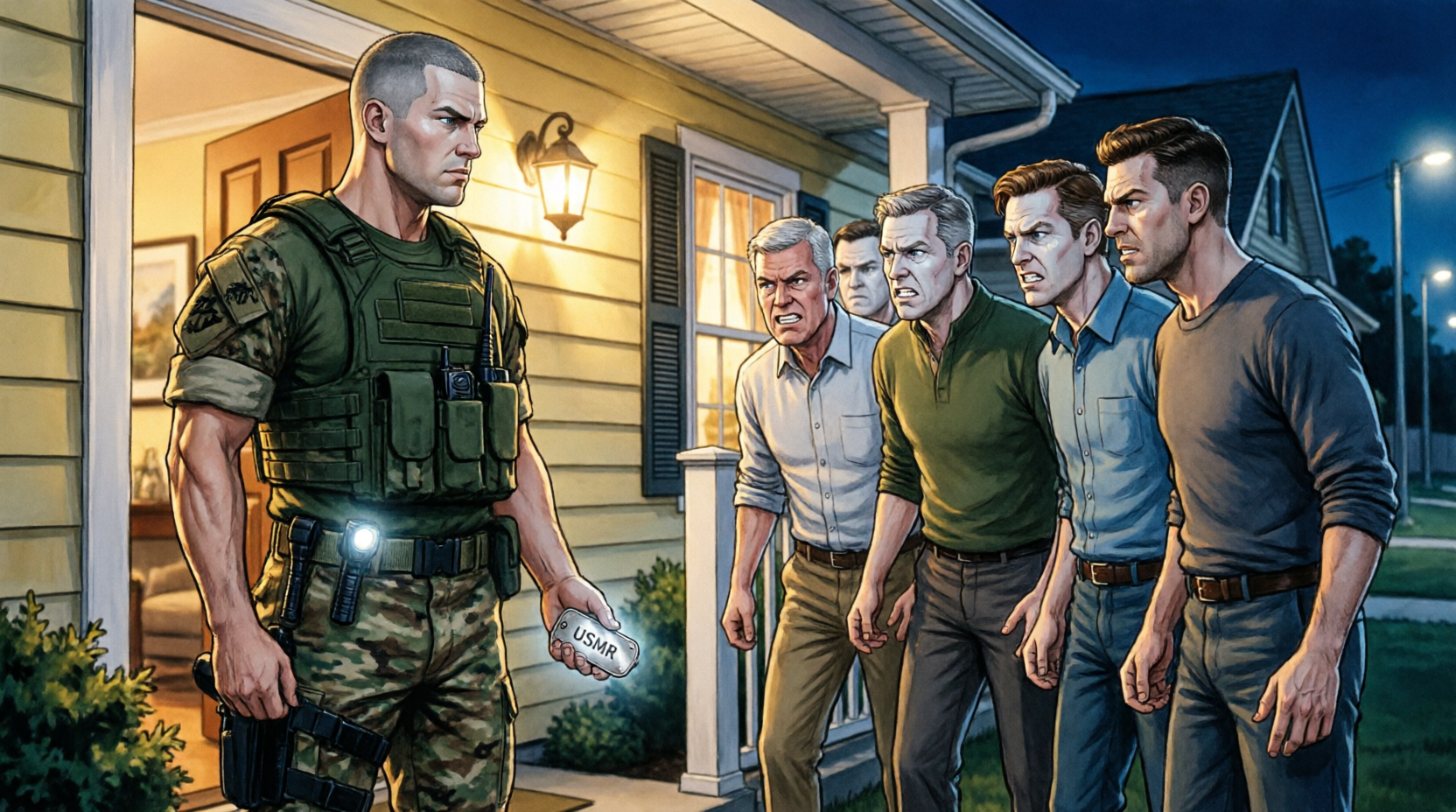
“Call the Marines?”
It was the kind of line a woman like her probably thought sounded clever.
Dismissive enough to reassert control, indirect enough to deny later.
I smiled.
Not because it was funny.
Because in one sentence she told me exactly who she thought I was: a small-town father with a hurt kid and no leverage.
That kind of misread has ended careers before.
I stood up.
“Thanks for your time.”
She looked briefly thrown by the lack of argument.
“That’s all?”
“For now.”
I stepped into the hallway.
The bell rang almost immediately, and classroom doors opened all down the corridor.
Locker doors clanged.
Sneakers squeaked.
Somebody shouted a name.
The school flooded itself with movement.
I was three doors from the main exit when one of the classroom doors opened and Jessica Chambers stepped out.
She was in her early thirties, hair pulled into a rushed knot, cardigan hanging off one shoulder like she’d thrown it on without remembering later.
Her face had the pinched look of a person who hadn’t slept much and regretted several things already.
“Mr. Wade,” she said under her breath.
“Wait.”
She glanced both ways down the hall, then pulled the door mostly shut behind her.
“I filmed it,” she said.
There was a copy of Whitman taped crookedly inside the classroom window.
Leaves of Grass, faded at the corners.
Through the narrow gap I could smell dry erase marker and that dusty-paper smell English rooms always have.
“I was grading by the window,” she said.
“I saw Drew come out.
Ricky Barrett was already there.
Two of the others were on either side near the loading dock.
They were waiting for him.”
Her throat worked once.
“I started recording when I realized they weren’t just yelling.”
The corridor sounds kept moving around us, bright and ordinary.
It made her voice feel even quieter.
“You have the video?”
She nodded.
“The whole thing.”
“Who knows?”
“No one.
I didn’t show Thornton.
I didn’t show the board.”
Her eyes flicked toward the office wing.
“Michael Wrangle’s father is on the school board.
Ricky Barrett’s dad might as well be.
Coach Steel…”
She stopped herself.
“Coach Steel what?”
She shook her head.
“I don’t know what I can prove yet.”
That was a better answer than most adults would’ve given me.
“Keep the video safe,” I said.
“Do not show anyone.
Do not mention it again unless I tell you.”
Her eyes widened just slightly.
There are moments when people decide whether to trust you, and most of that decision happens before either of you speak.
She looked at my face, probably saw whatever was there, and nodded.
“Okay.”
“Can you do that?”
“Yes.”
“Good.”
I turned toward the exit.
“Mr. Wade,” she said.
I looked back.
Her voice dropped even lower.
“This didn’t start yesterday.”
I felt something in my chest settle into place.
“No,” I said.
“I don’t think it did.”
Outside, the wind had picked up.
The flag out front cracked hard against the pole.
Students kept streaming in, none of them looking at me long.
I stood on the front steps with the cold needling through my flannel and thought about planned violence, denied evidence, and a principal who had casually tried to blame a boy with a punctured lung.
Then I thought about Jessica Chambers’s shaking hands when she said Ricky Barrett was already waiting.
That meant setup.
Setup meant forethought.
And forethought meant somebody had known enough to make sure my son stepped into a trap.
I walked to my truck with the strange, clean calm that comes right before a door opens.
If Jessica’s video proved the attack was planned, then the next question was simple.
What, exactly, had Drew seen that made six boys decide he needed to be taught a lesson?………………………….