My son told me I had to wake up at five o’clock the next morning to bring his wife coffee and breakfast in bed because, in his words, “that’s a mother-in-law’s obligation.” He said it after finishing the roast chicken I bought, while sitting in the dining room of the house his father and I spent forty years paying off.
Tiffany didn’t correct him.
She didn’t look embarrassed.
She sat there with her glossy blonde hair, her crossed legs, and that small pleased smile, as if she had been waiting for the moment I would finally be trained properly.
I stood there with the serving spoon still in my hand and felt something inside me go completely still.
My name is Estelle Clark.
I am seventy-one years old, a widow, and the owner of a small blue house on Maple Street that looks cheerful from the outside and has held more sacrifice than anyone who visits could guess.
My husband Marcus died three years ago.
Since then, I have lived quietly.
My days are simple.
I stretch groceries, count pills, watch the birds at the feeder, and do my best to make a Social Security check cover a world that keeps getting more expensive.
It is not a glamorous life, but it was peaceful.
And peace, I learned after Marcus was gone, is a kind of wealth too.
Six months earlier, Terrence called me on a rainy Tuesday evening.
His voice sounded strained.
He said he and Tiffany had lost their apartment.
He said the landlord had finally had enough late payments.
He said they just needed a little time to get back on their feet.
Terrence had lost his roofing job two weeks before.
Tiffany had shut down her nail business under a pile of debt.
He spoke softly, almost like the boy he used to be when he had done something wrong and hoped I would rescue him before he had to face the full consequence of it.
I opened my door before they even finished loading the car.
They showed up with two suitcases, a shoebox stuffed with overdue notices, and the kind of gratitude that comes easily when people have nowhere else to go.
Tiffany hugged me hard and called me a blessing.
Terrence carried their bags to the guest room and kissed my forehead.
I remember standing in the hallway that night, listening to voices in my house again, and feeling something close to relief.
Since Marcus died, silence had settled into those rooms like dust.
I told myself their staying might be good for all of us.
They needed help.
I missed family.
It felt almost noble, the way hard choices sometimes do at the beginning.
For the first two weeks, they behaved like guests who knew they were being carried.
Terrence thanked me for meals.
Tiffany rinsed plates, folded throws in the living room, and said things like, “We won’t forget this.” They talked about job applications, budgets, plans.
I wanted desperately to believe them.
I wanted to think I was helping my son through a hard season rather than helping him create a new way of living.
So I kept my worries to myself.
I cooked more than I needed.
I bought a second carton of eggs.
I smiled when I wanted
to ask harder questions.
Then the requests began.
At first they were ordinary enough.
Could I throw in a load of laundry since mine was already running? Could I pick up cough medicine while I was at the pharmacy? Could I make Terrence’s favorite casserole because he had an interview and wanted something comforting? I said yes because that is what mothers are trained to say.
But the yeses multiplied faster than I noticed.
Soon I was making separate breakfasts, scrubbing their bathroom, changing their sheets, and making special trips for things they could easily have gotten themselves.
Tiffany said strong detergent irritated her skin, so I had to buy the gentle brand.
Terrence said store-brand juice tasted cheap.
Tiffany needed specific fruit because she was trying to eat clean.
Terrence wanted better cuts of meat because he was tired of feeling like he had fallen behind in life.
One week they asked me to deep-clean the whole house because friends might stop by.
Friends, I remember thinking, looking around my own living room with a rag in my hand.
They wanted me to polish my home so they could entertain people while contributing nothing to the bills.
The real shift happened in their tone.
Gratitude disappeared first.
Then courtesy.
Then shame.
Somewhere along the line, Terrence stopped asking and started instructing.
He would call from the bedroom, “Ma, where’s my blue shirt?” as though I were running a laundry service in the house.
Tiffany would stand in the doorway to the kitchen scrolling on her phone and say, “Can you make mine without butter?” without even looking up.
They left half-empty cups in every room, wet towels on the bathroom floor, hair in the sink, crumbs on the couch, shoes in the hallway.
I stopped feeling like a mother helping family and started feeling like unpaid staff in my own home.
And still I swallowed it, because mothers can confuse endurance with love for a very long time.
Then, a month before the breakfast demand, both of them found work again.
Terrence got hired at an insurance office.
Tiffany started at a hair studio across town.
Between the two of them, they were bringing in enough to start over if they truly wanted to.
Not enough for luxury, maybe, but enough for rent on a small place, enough for groceries, enough to stop leaning all their weight on me.
Instead, they leaned harder.
Packages began showing up on my porch.
Tiffany came home with fresh color in her hair and new nails that clicked against my countertop.
Terrence bought cologne and a pair of sneakers so bright they looked lit from within.
They ordered food some nights after I had already cooked.
They talked about brunch plans, a concert, a weekend trip they might take “once things settled.” My pantry thinned out.
My electric bill climbed.
My water bill rose.
It was a cruel kind of education, watching two adults spend like people who didn’t pay rent while I stood in the cereal aisle comparing prices by the ounce.
The dinner that finally changed everything was not special.
That was part of the insult.
I had made roast chicken with potatoes and onions because that was what I had.
I used the good plates out of habit.
Marcus used
to say a plain meal could still be served with dignity.
Terrence ate two helpings.
Tiffany asked if there was any sparkling water.
I said no.
When the plates were nearly empty, Terrence leaned back in his chair and delivered his command.
“Tomorrow, you’re up at five,” he said.
“Tiffany likes milk and coffee in bed.
Make French toast too.
Fresh fruit.
She’s used to being taken care of.
That’s a mother-in-law’s obligation.”
He said it calmly, like a man announcing a schedule.
I looked at Tiffany, waiting for some sign that she knew this was shameful.
She only raised her eyebrows and smoothed her hair.
“I do better in the mornings when I’m taken care of,” she said, as if that settled it.
Something in me broke so cleanly it almost felt like clarity.
That night I lay in bed staring at the ceiling fan.
I thought about Marcus, about how hard he worked, how carefully we built everything Terrence now treated as a personal entitlement.
I thought about the winter I pawned my bracelet to keep the lights on.
The years I worked double shifts and came home with my feet swollen.
The refinance papers Marcus and I signed with tired hands when Terrence was in school and needed more than we had.
The birthdays where I smiled and said I didn’t want a present because the money was needed elsewhere.
I had spent a lifetime translating love into labor.
Somewhere over the years, my son had learned to read that as weakness.
At 3:30 in the morning, I sat up in bed and understood that tears were not going to save me.
I put on my robe, walked down the hallway, and passed the framed family photographs.
Terrence at eight with his two front teeth missing.
Terrence at seventeen in a wrinkled graduation gown.
Marcus in his dark church suit with that patient face I still miss every day.
I stepped into the guest room.
My grown son was asleep under a blanket I had washed and folded.
I took his phone from the nightstand and set the alarm for 4:00 a.m.
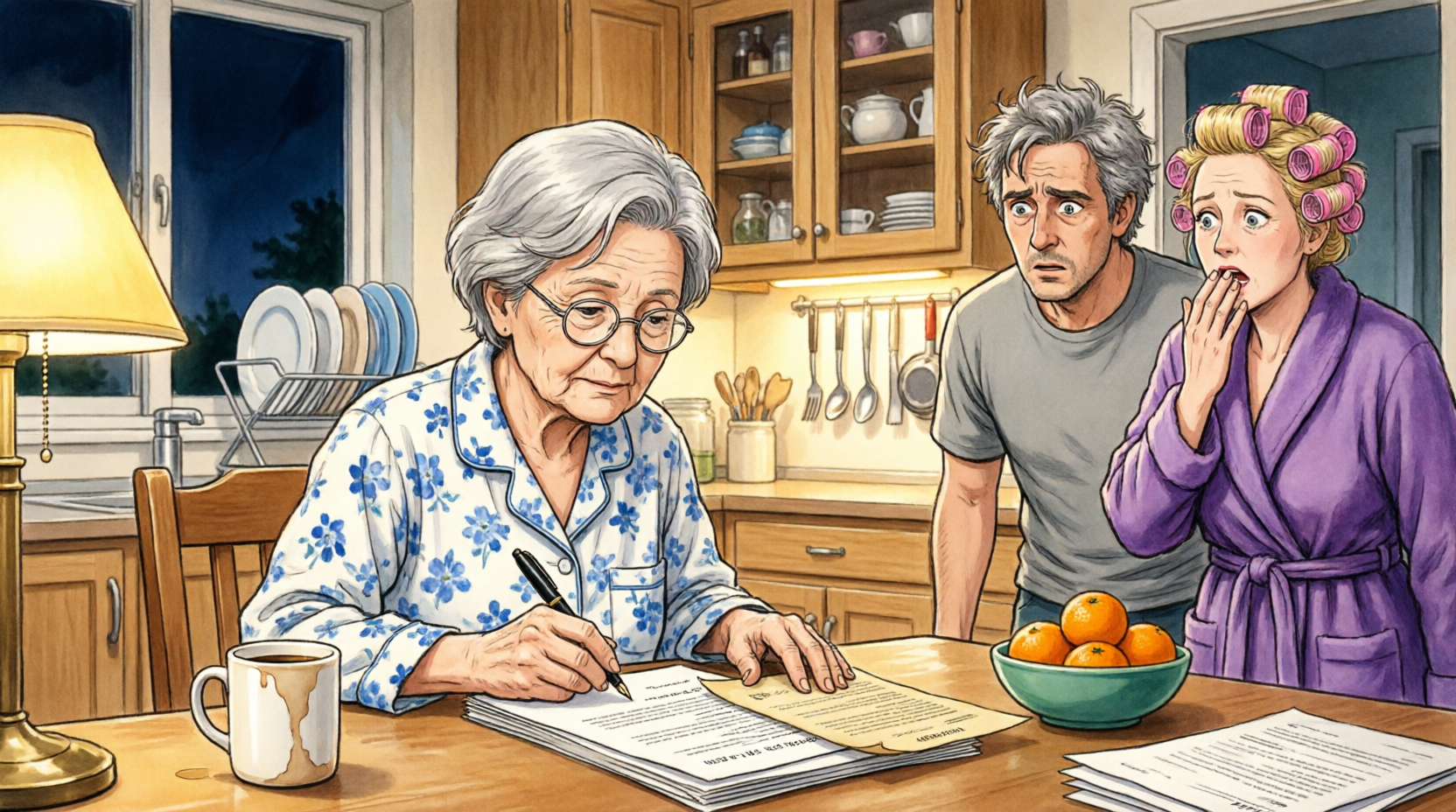
Back in the kitchen, I brewed one cup of coffee for myself and wrote a note in large careful letters: Time to make coffee for your wife like a real husband.
Then I went to the hall cabinet and pulled out my old marble notebook.
I had started keeping that notebook years earlier, back when Terrence first began asking for “small” loans that were always temporary and never truly temporary.
There were entries for car repairs, phone bills, prescriptions, money for textbooks, money for uniforms, money for gaps between jobs, money after breakups, money after bad decisions, money after worse ones.
Over the last six months I had added groceries, utilities, gas, household supplies, and all the extra expenses that came from two adults living as though my house were a free service.
I went line by line, adding everything again to make sure I was not being emotional, not exaggerating, not inventing.
When I finished, the number at the bottom of the page was $14,782.
I stared at it for a long time.
Then I set the notebook in the middle of the kitchen table.
Around it I arranged copies of the latest water
and electric bills, grocery receipts with their preferred items circled, and three apartment listings in neighborhoods they could afford on their current income.
I typed a one-page set of house rules on my old computer.
I also typed a move-out notice with a date fourteen days away.
I slid everything into a large envelope and wrote both their names on the front.
Last, I opened the little tin box where Marcus used to keep spare keys and important cards.
From it I took the extra brass key to the front door.
I laid it beside the envelope like punctuation.
At exactly 4:00 a.m., the alarm went off.
I heard Terrence swear.
I heard Tiffany groan.
A few minutes later they came into the kitchen half awake, expecting confusion and finding me seated at the table in my housecoat, calm as Sunday morning.
Terrence stopped dead.
Tiffany nearly walked into him.
The paper visible through the envelope window read: Occupancy Terms and Final Notice.
“What is this?” Terrence asked.
“Math,” I said.
“And boundaries.
Sit down.”
Tiffany pulled the papers out first.
Her eyes moved over the page quickly, then slowed.
Terrence leaned over her shoulder.
I watched his face change as he saw the rent amount, the chore schedule, the repayment plan, and the move-out date.
“You can’t be serious,” he said.
I turned the notebook toward him.
“Fourteen thousand, seven hundred and eighty-two dollars.
That’s what your emergencies have cost me over the years, not counting the interest I never charged and the peace I never got back.
I am not asking for it all this morning.
I am asking for this nonsense to end.”
Tiffany looked from the notebook to Terrence.
“What is all this old stuff?”
“Things he said he’d repay,” I answered.
Terrence made a dismissive noise.
“Ma, why are you doing this in front of her?”
“Because you felt comfortable ordering me to wait on your wife in front of her.
Public humiliation seems to matter only when it belongs to you.”
Tiffany’s mouth tightened.
She kept reading.
Then she frowned.
“You told me you were giving your mother money every month.”
The kitchen went so quiet I could hear the refrigerator hum.
Terrence looked at her, then at me.
“I helped when I could.”
I slid the utility bills closer.
“Show me where.”
Tiffany’s eyes sharpened.
“You said she liked taking care of things.
You said she didn’t want us paying because it made her feel useful.”
I laughed then, but there was no humor in it.
“Useful? I am seventy-one, not furniture.”
Terrence’s face hardened.
“So what, now you’re throwing us out over breakfast?”
I put the brass key on top of the papers with a small metallic sound.
“No.
I’m throwing you out because you forgot I’m your mother, not your maid.
Breakfast was simply the moment I finally heard how far gone you were.”
He stared at the key.
He knew what it meant.
Marcus had always said a key was trust made visible.
Putting that spare key on the table meant the trust had been taken back.
I explained their options as plainly as I could.
They had fourteen days to move out.
During those fourteen days, they would buy and prepare their own food, clean their own space, wash………………………….