At dinner, I said, “Can’t wait for the family reunion.” My brother laughed, “You’re not invited-it’s for real family only.” Everyone chuckled. I just smiled and walked out. Four days later, my dad tried to withdraw $2,800. I sent him a screenshot: “Payment denied. Must be that ‘family only’ rule.” Two days after that, a loud knock came at my door… The silence was immediate. Not awkward. Not confused. Immediate.
As if everyone at that table had been waiting for Jackson to say it, waiting for someone cruel enough to do what the rest of them had only done quietly for years.
“You’re not invited,” Jackson repeated, louder this time, enjoying the way the words landed.
“It’s for real family only.”
The fork in Diane’s hand trembled.
My adoptive mother looked down at her plate, then at Richard, then at me.
For one heartbreaking second, I thought she might say something.
I thought maybe the woman who had tucked me into bed when I was seven, the woman who had once kissed my forehead after a nightmare and told me I was safe now, would finally defend me.
But Diane only swallowed. Richard cleared his throat. Amelia pressed her napkin to her lips, hiding a smile. Bradley did not bother hiding his. I sat there with the wine I had brought sitting unopened beside Diane’s glass. A bottle of her favorite. Two hundred and eighty dollars. Not because I cared about the wine. Because I cared about her. Because I remembered things. I always remembered things. Birthdays.
Doctor appointments.
Anniversaries.
Mortgage deadlines.
The exact brand of tea Diane drank when her joints hurt.
The fishing lure Richard had once mentioned losing in Montana.
Amelia’s favorite florist.
Jackson’s wife’s allergy to walnuts.
I remembered all the little details of people who treated me like a guest in my own family.
For years, I had convinced myself that love sometimes looked like patience.
That one day, if I gave enough, helped enough, smiled enough, forgave enough, the invisible door between me and them would finally open.
But that night, Jackson slammed it shut in my face.
And everyone laughed.
I looked at Richard.
He was still staring at his plate.
“Dad?” I said quietly.
The word felt childish the second it left my mouth.
Richard’s jaw flexed.
He lifted his eyes, but only halfway.
“Jackson didn’t mean it like that,” he said.
The room relaxed.
Of course.
There it was.
The old family magic trick.
Turn cruelty into misunderstanding.
Turn pain into sensitivity.
Turn me into the problem for noticing.
I nodded slowly.
“How did he mean it?”
Richard’s face hardened.
Diane inhaled sharply.
Jackson snorted.
“Oh, come on, Otis,” he said.
“Don’t do this wounded orphan act tonight.”
The table went completely still again.
Even Bradley stopped smiling for a moment.
Not because he cared.
Because even he understood that Jackson had gone too far.
But Jackson had liquor in his blood and resentment in his bones.
He leaned forward, eyes bright.
“You know what I mean.”
“You weren’t born into this family.”
“You were brought in.”
“There’s a difference.”
Diane whispered, “Jackson.”
But it was too soft.
Too late.
Too meaningless.
Jackson waved her off.
“No, Mom, I’m tired of pretending.”
“He shows up here every month acting like he belongs.”
“He throws money around like that makes him one of us.”
“He named his company Mitchell like it actually means something.”
Then he looked at me with pure disgust.
“But blood is blood.”

I stared at him.
All the years between us collapsed into one ugly little boy guarding his toys from a child who had already lost everything.
“You’re right,” I said.
My voice surprised me.
It was calm.
So calm that everyone looked more uncomfortable than if I had shouted.
Jackson blinked.
“I’m what?”
“You’re right,” I repeated.
“Blood is blood.”
Richard shifted in his chair.
“Otis, let’s not make this dramatic.”
I turned to him.
Something inside me went quiet.
Not numb.
Clear.
For the first time in my life, I saw Richard Mitchell exactly as he was.
Not the man who saved me.
Not the father I still tried to earn.
Just a coward who loved being needed by me but never wanted to claim me when it cost him anything.
“You’re right too,” I said.
“This doesn’t need drama.”
I placed my napkin beside my plate.
Diane’s eyes filled.
“Otis, please don’t leave like this.”
I looked at her.
I wanted to ask why she was only brave when she was asking me to stay quiet.
But I did not.
I was tired of begging for the bare minimum.
I stood.
The chair legs scraped against the hardwood floor.
Every head turned toward me.
Jackson smiled again, thinking he had won.
Maybe he had.
Maybe humiliating me had been his victory.
But there are moments in life when losing the thing you wanted becomes the only way you survive.
I reached into my jacket pocket and pulled out my phone.
Not to make a scene.
Not to threaten anyone.
Just to turn off the automatic payment reminders connected to accounts nobody at that table realized existed.
Then I picked up the bottle of Pinot Noir.
Diane looked startled.
I carried it with me.
At the doorway, I paused.
The dining room glowed behind me, gold and warm and false.
My family sat around a table paid for in part by money I had quietly given them.
My mother’s medicine was in her blood because of me.
My father’s business still had electricity because of me.
Amelia’s wedding photos existed because of me.
Jackson’s failed factory role still had a paycheck attached because of me.
And they had just told me I was not real family.
So I smiled.
It was not the brittle smile from before.
It was something colder.
Something finished.
“Enjoy the reunion,” I said.
Then I walked out.
Nobody followed me.
Not Diane.
Not Richard.
Not Amelia.
Not even out of embarrassment.
The front door closed behind me with a soft click.
For thirty years, I had left that house feeling like a boy waiting to be chosen.
That night, I left as a man who finally chose himself.

Part Two: Payment Denied
The first night was quiet.
That surprised me.
I thought grief would be loud.
I thought I would break things.
I thought I would drink too much, call Diane, send some long pathetic message, and ask why nobody defended me.
Instead, I drove home through the dark streets of Pasadena with the unopened wine bottle lying on the passenger seat like evidence.
My house was not enormous, but it was mine.
Clean lines.
Warm wood.
Tall windows overlooking a garden I had planted myself.
No portraits of ancestors.
No family crest.
No inherited furniture pretending love could be passed down with property.
Just a home built by a man who had learned too early that safety had to be self-made.
I sat in the kitchen for a long time.
Then I opened my laptop.
The old me would have waited.
The old me would have cooled down.
The old me would have told himself they were family and family deserved grace.
But grace without boundaries is just permission.
So I made a list.
Not emotional.
Not dramatic.
Just facts.
Monthly transfer to Diane’s medical provider.
Stopped.
Emergency maintenance account for Richard’s house.
Stopped.
Auto-pay for Mitchell Manufacturing software subscriptions I had quietly covered after Richard said cash flow was tight.
Stopped.
Line of credit I had personally guaranteed for Richard’s payroll bridge.
Frozen pending legal review.
Annual reunion cabin deposit on my business card.
Canceled.
Amelia’s charity gala sponsorship under Mitchell Tech Solutions.
Withdrawn.
Bradley’s investment introduction request.
Deleted.
Jackson’s consulting salary supplement hidden inside a vendor contract.
Terminated.
By 2:13 a.m., I was staring at a screen that looked ordinary but represented the collapse of a lie I had funded for years.
My phone buzzed once.
Diane.
I stared at her name until the screen went dark.
Then it lit again.
Otis, honey, please call me.
I did not.
Another message.
Jackson was out of line, but leaving like that hurt your father.
I laughed.
Not because it was funny.
Because it was perfect.
Jackson sliced me open at the dinner table.
But I had hurt Richard by bleeding on the rug.
I turned the phone face down.
Then I slept better than I had in months.
The first call came two days later.
Richard.
I let it ring.
Then came Diane.
Then Amelia.
Then an unknown number I recognized as Bradley’s office line.
By the third day, my inbox was filling with polite little emergencies.
The reunion resort needed a new card.
Mitchell Manufacturing’s payroll processing software had suspended service.
Diane’s medication coordinator could not verify coverage.
The property tax installment was due within forty-eight hours.
Nobody said the real words.
Nobody wrote, “We need your money.”
They wrote around it.
They said there had been “a mix-up.”
They asked if “something accidentally changed.”
They wondered whether “your assistant perhaps canceled the wrong account.”
My assistant, Grace, messaged me at noon.
Your family is calling the main office.
Richard Mitchell has called four times.
Jackson called once and asked whether we were having “technical problems.”
I typed back.
We are not.
Grace responded with one word.
Understood.
Grace had worked with me for seven years.
She knew almost everything.
Not because I complained.
Because people who answer your phone eventually learn whose voices make you go still.
On the fourth day, Richard tried to withdraw $2,800 from the emergency account I had created for him under the polite fiction of “shared family reserves.”
The account rejected him.
I received the alert while sitting in a glass conference room with investors discussing expansion into Europe.
My phone vibrated once.
Declined Transaction: $2,800.
Mitchell Household Reserve.
My chest tightened.
For a second, the old instinct returned.
Fix it.
Smooth it over.
Do not make Dad angry.
Do not make Mom worry.
Do not let them think you are ungrateful.
Then I remembered Jackson’s face.
Real family only.
I took a screenshot.
I sent it to Richard.
Payment denied.
Must be that “family only” rule.
Then I turned my phone off and returned to the meeting.
I gave the best presentation of my career.
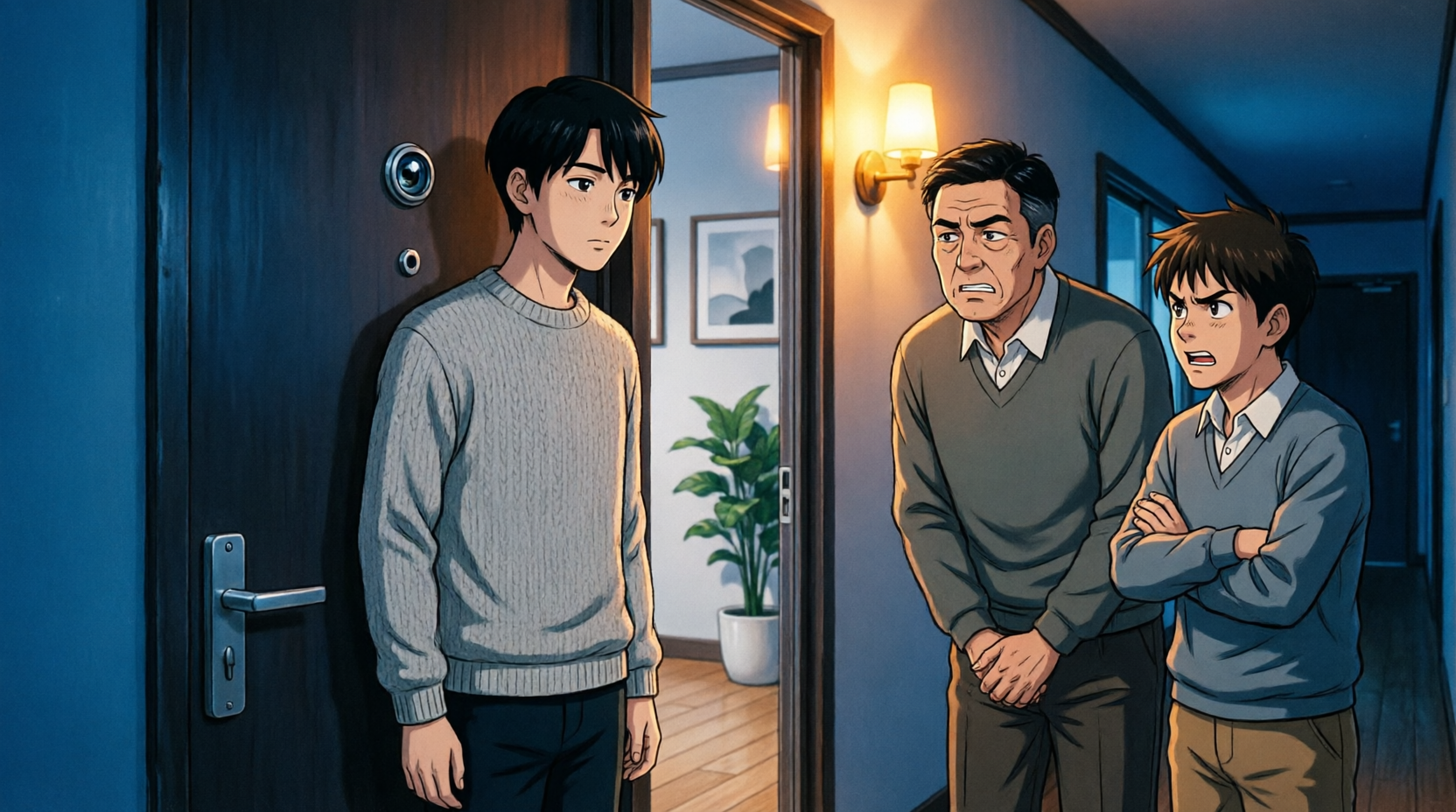
Two days after that, the loud knock came at my door.
Not polite.
Not uncertain.
A fist against wood.
Hard.
Angry.
I was in my study reviewing legal documents when the sound echoed through the house.
My security system showed Richard standing on my front steps.
Jackson stood beside him.
Diane was behind them, wrapped in a pale cardigan, her face drawn.
Amelia and Bradley waited near the driveway, as if my home were contagious.
I watched the camera feed for a moment.
Richard raised his fist again.
Before he could knock, I opened the door.
He froze.
Maybe he expected me to look guilty.
Maybe he expected a son desperate to repair things.
Instead, I stood there in a dark sweater and bare feet, calm enough to frighten him.
“Otis,” Richard said.
He always started with my name when he needed something.
Never son.
Never champ anymore.
Just Otis.
“Can we come in?”
“No.”
His eyebrows shot up.
Jackson scoffed.
“You’re seriously going to make Mom stand outside?”
I looked past him at Diane.
She would not meet my eyes.
“She has a home,” I said.
“A home where I was told I do not belong.”
Diane flinched.
Richard stepped closer.
“This has gone far enough.”
I almost smiled.
There he was.
The CEO voice.
The father voice.
The voice that had once made me confess to things Jackson did because it was easier than watching Richard’s disappointment land on me.
“You’re right,” I said.
“It went far enough at dinner.”
Jackson rolled his eyes.
“Oh my God.”
“Are we still doing this?”
“You got your feelings hurt over a joke, and now you’re trying to bankrupt Dad?”
I looked at him.
“No, Jackson.”
“You did not make a joke.”
“You clarified a policy.”
“And I adjusted my financial involvement accordingly.”
Bradley coughed behind him.
Amelia whispered something sharp to him.
Richard’s face darkened.
“You have no idea what kind of position you’ve put us in.”
“I have a pretty clear idea.”
“The factory accounts are locked.”
“They are under review.”
“The reunion cabin was canceled.”
“Yes.”
“Your mother’s treatment—”
He stopped.
That was the first crack.
For years, he had pretended not to know.
I watched the shame flicker across his face, small and brief and quickly buried beneath anger.
Diane looked up.
Her eyes were wet.
“You paid for my medication?” she whispered.
The porch went silent.
Richard turned away.
Jackson’s expression shifted from annoyance to calculation.
Amelia stared at me like I had just ruined the story she preferred about herself.
I nodded.
“For three years.”
Diane covered her mouth.
“Why didn’t you tell me?”
“Because you were already ashamed of needing help.”
“I did not want to add gratitude to your pain.”
A tear slipped down her cheek.
For one second, I saw my mother.
Not the silent woman from the dinner table.
The woman who used to sit beside my bed after nightmares.
Then Richard ruined it.
“You had no right to do this without telling us,” he snapped.
That almost made me laugh.
“No right to pay?”
“No right to hide things from this family.”
I stared at him.
“This family?”
Richard’s jaw clenched.
“You know what I mean.”
“I really do.”
Jackson stepped forward.
“This is insane.”
“You are acting like some rejected kid throwing a tantrum.”
“You want an apology?”
“Fine.”
He spread his arms, theatrical and empty.
“I’m sorry your feelings got hurt.”
Diane whispered, “Jackson, stop.”
But he did not.
“You think money makes you powerful now?”
“You think because your little computer company got lucky, you can punish us?”
I tilted my head.
“My little computer company currently holds the cybersecurity contract keeping Mitchell Manufacturing from drowning in ransomware attempts.”
Richard’s face changed.
He had not known I knew.
Of course he had not.
Richard knew manufacturing.
Not technology.
Not the silent disasters I had been preventing for eighteen months at a discounted rate because he was too proud to ask and too careless to protect himself.
Jackson looked confused.
Bradley did not.
His face went pale.
“You should all leave,” I said.
Richard’s voice dropped.
“Otis, listen to me.”
“No.”
The word landed cleanly.
Richard blinked.
I realized then that I had almost never said no to him.
Not like that.
Not without explaining.
Not without apologizing for the shape of my boundary.
“You don’t get to stand at my door and demand access after letting your son tell me I am not real family.”
Richard’s face twisted.
“I adopted you.”
“Yes.”
“You had nothing.”
“Yes.”
“We gave you a home.”
“Yes.”
His voice rose.
“And this is how you repay us?”
There it was.
The sentence beneath every silence.
Every favor.
Every tuition reminder.
Every comment about gratitude.
I was never their son.
I was a debt.
I looked at him for a long time.
“When you adopted a grieving seven-year-old,” I said slowly, “was the plan always to collect interest?”
Diane sobbed.
Richard stepped back as if I had struck him.
Jackson’s mouth opened, then closed.
For once, no clever insult came.
I stepped inside.
Then I paused.
“Richard.”
He looked up.
Not Dad.
Richard.
His face registered it.
Good.
“The documents related to Mitchell Manufacturing’s outstanding obligations will be handled through attorneys from now on.”
“What documents?”
“You’ll receive them soon.”
“What the hell does that mean?”
“It means I am done being useful to people who are embarrassed to call me family.”
Then I closed the door.
This time, Diane did not knock.
But someone else did.
Not loudly.
Not angrily.
A small knock near midnight.
I checked the camera.
Amelia stood alone on my porch.
No Bradley.
No Richard.
No Jackson.
Just my younger sister, arms wrapped around herself, mascara smudged, looking less polished than I had seen her in years.
I considered ignoring her.
Then I opened the door.
She looked at me for a long moment.
“I know you probably hate me,” she said.
“I don’t.”
Her mouth trembled.
“That might be worse.”
I stepped aside.
She entered slowly, glancing around my house like she had never really seen where I lived.
Which was true.
They had all been invited.
Rarely came.
My home was not part of the family map.
I made coffee.
She sat at the kitchen island, holding the mug with both hands.
For a while, neither of us spoke.
Then Amelia said, “Jackson told everyone you were never supposed to come to the reunion.”
“I gathered that.”
“He said Dad agreed.”
I looked at her.
“Did he?”
She swallowed.
“Yes.”
I felt the words hit, but not as sharply as they would have a week earlier.
Some wounds lose their surprise.
“Why are you here, Amelia?”
Her eyes filled.
“Because I laughed.”
I waited.
“At dinner,” she continued.
“I laughed because Bradley laughed.”
“And because Jackson laughed.”
“And because I didn’t want everyone looking at me.”
Her voice cracked.
“But I saw your face.”
I looked down at my coffee.
“And?”
“And I keep seeing it.”
The kitchen hummed softly around us.
She wiped her cheek angrily.
“I was ten when I first realized you were treated differently.”
“I didn’t understand it then.”
“I just thought Jackson was mean.”
“But later, I knew.”
“I knew Dad gave Jackson more.”
“I knew Mom avoided conflict.”
“I knew you were always the one people called when something broke.”
“And I still let it happen.”
Her honesty surprised me more than any apology would have.
“I’m not here to ask you to fix anything,” she said quickly.
“I’m not here for money.”
“I swear.”
“Then why?”
She reached into her purse and pulled out a folded envelope.
“I found this in Dad’s office.”
She slid it across the counter.
My name was written on the front.
Not Otis Mitchell.
Otis Aaron Vale.
My birth name.
The air left my lungs.
“Where did you get this?”
“I told you.”
“Dad’s office.”
“He was going through old files after you shut everything down.”
“He threw some papers into the fireplace.”
“I saw your name.”
“I pulled this out before it burned.”
My hands moved slowly as I opened it.
Inside were photocopies of legal documents.
Adoption records.
Insurance records.
Estate correspondence.
And one letter from a law firm dated twenty-seven years earlier.
I read the first paragraph once.
Then again.
The room tilted.
Amelia whispered, “What is it?”
I could not answer at first.
Because in my hand was proof that the Mitchells had not simply adopted a poor orphan out of kindness.
They had adopted a child whose birth parents had left behind a settlement, a modest trust, and a life insurance payout meant for his care and education.
The documents showed Richard had been appointed guardian of those funds.
The funds had disappeared by the time I was twelve.
I read the final page.
A handwritten note in Richard’s sharp block letters.
Use for household stabilization.
Child benefits entire family.
My vision blurred.
Not from tears.
From rage.
Amelia pressed a hand to her mouth.
“Oh my God,” she whispered.
I folded the papers with mechanical care.
Everything rearranged itself.
The tuition reminders.
The gratitude lectures.
The “we sacrificed for you” speeches.
The way Richard always made me feel like a burden.
I had not been a burden.
I had come with money.
And they had spent it.
Then made me pay them back emotionally for the privilege.
My phone buzzed on the counter.
Richard.
Again.
I stared at the name.
Then I looked at Amelia.
“Does Jackson know?”
She shook her head.
“I don’t think so.”
“Does Diane?”
“I don’t know.”
That answer hurt in a different way.
Because there were two possibilities.
Either Diane knew and stayed silent.
Or Diane never knew because Richard had lied to her too.
I did not know which one I wanted to be true.
Amelia reached across the counter.
“I’m sorry.”
Not polished.
Not defensive.
Not enough.
But real.
I looked at her hand.
Then at her.
“Thank you for bringing this.”
She nodded, crying now.
“What are you going to do?”
I looked at the envelope.
For the first time since dinner, I felt something stronger than grief.
Purpose.
“I’m going to find out exactly what kind of family I was adopted into.”
Part Three: Blood, Paper, and Lies
The next morning, I called my attorney.
Her name was Lena Brooks.
She had the kind of voice that made arrogant men sit up straighter.
I had hired her five years earlier when a competitor tried to steal proprietary software and then cried victim after getting caught.
Lena did not waste words.
When she finished reading the scanned documents, she said, “Otis, this is not just ugly.”
“It may be actionable.”
“How actionable?”
“Depending on the full records, misappropriation of guardianship funds, concealment, breach of fiduciary duty, possibly fraud.”
The word fraud sat between us like a lit match.
“Can we prove it?”
“Not from this alone.”
“But we can subpoena records if necessary.”
“You should prepare yourself.”
“For what?”
“For the possibility that your adoption was financially convenient.”
I closed my eyes.
There are sentences that do not wound because they are surprising.
They wound because they confirm what some part of you always feared.
Lena continued.
“Do not speak to Richard alone.”
“Do not threaten him.”
“Do not negotiate informally.”
“And Otis?”
“Yes?”
“Do not let grief make you generous before the truth is documented.”
That was good advice.
Hard advice.
But good.
By noon, my company’s legal department had forwarded notices to Mitchell Manufacturing regarding outstanding unpaid services.
By evening, Richard had received Lena’s formal request for financial records related to my guardianship, adoption funds, and any trust assets connected to my birth parents.
At 8:47 p.m., Diane called me sixteen times.
I answered on the seventeenth.
For a moment, there was only breathing.
Then she said, “Is it true?”
Her voice sounded older than I had ever heard it.
“Which part?”
“Richard said you’re accusing him of stealing from you.”
“I’m asking for records.”
“Otis.”
“Did you know?”
Silence.
My hand tightened around the phone.
“Diane.”
The absence of Mom came naturally now.
“Did you know there was money?”
A soft sob.
“I knew there had been some insurance.”
My chest tightened.
“How much?”
“I don’t know.”
“That isn’t what I asked.”
She cried harder.
“Richard handled everything.”
“Did you know he spent it?”
“I knew things were difficult then.”
“Did you know he used money meant for me?”
Another silence.
Then, barely audible.
“I suspected.”
The word entered me cleanly.
Not like a knife.
Like a verdict.
I sat down.
All the anger drained out for a second, leaving only a tired emptiness.
“You suspected.”
“I was young.”
“I had Jackson.”
“Richard said we needed to stabilize the household.”
“He said you benefited too because you lived there.”
My laugh came out broken.
“I was seven.”
“I know.”
“Do you?”
She sobbed.
“Otis, I loved you.”
That hurt worst of all.
Because I believed her.
In her flawed, frightened, conflict-avoidant way, Diane had loved me.
She had also failed me.
Those truths did not cancel each other out.
They sat side by side, impossible and heavy.
“You let me grow up thinking I was an expense,” I said.
“You let him make me grateful for money that was partly mine.”
“I’m sorry.”
The words came fast now.
“I’m so sorry.”
“I should have protected you.”
“I should have asked more questions.”
“I should have said something at dinner.”
“At dinner?”
My voice sharpened.
“You should have said something when I was ten and Jackson told me adopted kids could be returned.”
“You should have said something when Richard called him his real son at that dealership.”
“You should have said something when I paid for your medication and everyone pretended I was just being dramatic for wanting a seat at the table.”
She gasped.
“I didn’t know about the medication until yesterday.”
“I know.”
“That one is on Richard.”
“But the silence?”
“That belonged to everyone.”
Diane cried softly.
For once, I did not comfort her.
“Do you hate me?” she whispered.
“No.”
It came out before I could decide whether it was true.
“I wish I did.”
She broke then.
Not performatively.
Not loudly.
Quietly.
The way people break when they finally stop defending themselves.
“I don’t know how to fix this,” she said.
“You can start by telling the truth.”
“To whom?”
“To yourself first.”
Then I ended the call.
The next week moved like a storm.
Richard responded through his attorney with outrage.
He denied wrongdoing.
He claimed all funds had been used for my benefit.
He described me as “emotionally unstable due to unresolved adoption trauma.”
That phrase made Lena laugh for the first time since I met her.
“Men like him always reach for psychology when accounting fails,” she said.
Then the records began arriving.
Bank transfers.
Old checks.
Tuition payments.
Household repairs.
Jackson’s private school fees during a year my trust account was supposedly covering my educational needs.
A family vacation to Hawaii labeled “child enrichment.”
New factory equipment.
A roof replacement.
A country club initiation fee.
My birth parents’ money had not disappeared in one dramatic theft.
It had been absorbed.
Renamed.
Justified.
Made invisible.
Like me.
Meanwhile, the family fractured.
Amelia stopped taking Bradley’s calls for three days after he told her not to get involved.
Jackson accused her of betraying the family.
Richard stopped speaking to Diane after she admitted she had given Lena permission to review old household records.
And I kept working.
That surprised everyone.
They expected collapse.
A public meltdown.
A revenge campaign.
But trauma had made me disciplined long before success did.
I went to meetings.
Closed contracts.
Mentored employees.
Signed bonuses.
And at night, I read old records until my eyes burned.
That was how I found the photo.
It was tucked inside a scanned file from my adoption case.
My birth parents stood outside a small blue house in Oregon.
My father, Aaron Vale, had dark curly hair like mine.
My mother, Elise, had one hand resting on his arm and the other holding my toddler hand.
I did not remember the house.
I did not remember their voices.
But I remembered, suddenly and painfully, my mother’s necklace.
A small silver moon.
I stared at it for a long time.
The next morning, I hired a genealogist.
Not because I wanted to replace anyone.
Because I wanted to know what had been stolen besides money.
Her name was Ruth Ellery, and she found answers in nine days.
My mother had a younger sister.
Claire Vale.
Alive.
Living in Portland.
I read Ruth’s email three times before I understood it.
Then I sat in my office, CEO of a company worth more than Richard would earn in five lifetimes, and shook like the seven-year-old who had been told everyone was gone.
Claire had tried to contact me after the accident.
The adoption file showed three letters.
All returned.
All marked “not in child’s best interest.”
Signed by Richard.
For several minutes, I could not breathe properly.
The world became too bright.
Too sharp.
Grace found me sitting on the floor of my office with the printed email in my hand.
She did not ask unnecessary questions.
She just sat beside me.
Eventually, I whispered, “I had an aunt.”
Grace was quiet.
“Not had,” she said gently.
“Have.”
I flew to Portland two days later.
Lena told me not to make major emotional decisions.
Grace told me to bring a coat.
Amelia texted, Be safe.
Diane texted, I hope she loves you.
I did not answer Diane.
Claire Vale lived in a yellow house with climbing roses and a blue mailbox.
She was sixty-one years old, with silver hair, my mother’s eyes, and my hands.
When she opened the door, she knew me instantly.
She covered her mouth.
Then she said my birth name.
“Otis Aaron.”
No one had called me that since I was seven.
I broke.
Not gracefully.
Not quietly.
Claire pulled me into her arms, and I cried like someone had opened a room inside me that had been locked for twenty-seven years.
She smelled like lavender soap and rain.
“I tried,” she kept saying.
“I tried so hard.”
“I wrote.”
“I called.”
“They told me you were adjusting.”
“They told me contact would confuse you.”
“I thought maybe when you were older, you’d find me.”
I held onto her like the child I had been never stopped waiting.
Inside her house, she had photos.
Dozens of them.
My mother at sixteen.
My father holding a guitar.
Me as a baby in a knitted green hat.
Birthday cards Claire had written every year and never sent because Richard’s attorney warned her continued contact could be considered harassment.
A box full of love with nowhere to go.
We sat at her kitchen table for six hours.
She told me my mother sang off-key.
My father burned pancakes every Sunday.
They had planned to move to California because my father had been offered a teaching position.
They had loved me.
Desperately.
Ordinarily.
Completely.
That was the strangest comfort.
Not that I had come from tragedy.
But that before tragedy, I had come from love.
When I returned to Los Angeles, I was different.
Not healed.
Healing.
There is a difference.
Healing does not erase the wound.
It gives you back ownership of your skin.
Part Four: The Reunion
The Mitchell family reunion happened without me.
At least, it tried to.
The cabin cancellation had forced them to move from the lakeside resort to Richard’s backyard.
No catered dinner.
No rented boats.
No embroidered Mitchell Family Weekend shirts, because I had always paid for those too.
Instead, folding chairs appeared on the lawn.
Store-bought lemonade sat in plastic pitchers.
Someone brought a grocery-store cake.
Jackson complained loudly that the whole thing felt “cheap.”
A cousin texted me a photo.
Not maliciously.
Just confused.
Where are you?
People are asking.
I stared at the image.
Richard stood near the grill, shoulders tense.
Diane sat alone beneath the maple tree.
Jackson held a beer.
Amelia was not there.
I typed back.
I wasn’t invited.
The cousin responded with three dots.
Then nothing.
By sunset, my phone began lighting up.
Cousin Mark.
Aunt Judith.
Uncle Peter.
Second cousin Lila.
People I had not heard from except at holidays suddenly wanted context.
Apparently, Jackson had made a toast.
Apparently, he had said the reunion was “stronger when it honored bloodline.”
Apparently, Diane had stood up in front of everyone, pale and shaking, and said, “Then I don’t belong either, because real family is not blood.”
That stunned me.
I replayed Amelia’s voicemail twice.
Mom said it in front of everyone.
Dad looked furious.
Jackson stormed off.
I think something is finally breaking open.
I sat with that for a long time.
Part of me wanted to feel triumph.
I did not.
Triumph requires a clean enemy.
This was messier.
A woman who had failed me had finally found courage, but courage that arrives late still leaves years of damage behind.
That night, Diane came to my house alone.
This time, she did not knock hard.
She rang once and waited.
I opened the door.
She looked smaller.
No makeup.
No pearls.
No careful mother-of-the-family presentation.
Just Diane.
In her hands was a shoebox.
“I won’t stay if you ask me to leave,” she said.
I stepped aside.
She entered the kitchen and placed the box on the counter.
“I found these.”
Inside were cards.
Photos.
School projects.
Every birthday drawing I had ever made her.
A clay handprint from third grade.
A Mother’s Day poem written in crooked pencil.
A photo of me asleep on the couch at eight, curled under a blanket with Jackson’s baseball glove on my lap because I had wanted him to play with me.
My throat tightened.
“I kept them,” she whispered.
“I know that doesn’t fix anything.”
“But I need you to know I kept them.”
I touched the old clay handprint.
It was small.
So small.
“I was a child,” I said.
Diane nodded, tears falling.
“You were.”
“And we made you earn what should have been freely given.”
I looked at her.
That was the first honest sentence she had spoken.
Not sorry you were hurt.
Not sorry things got complicated.
Not sorry Jackson upset you.
We made you earn what should have been freely given.
Diane reached into the box and pulled out a folded paper.
“I also found this.”
It was a letter.
Written by Richard.
Never sent.
Addressed to me when I was eighteen.
My hands turned cold.
Diane said, “Read it when you’re ready.”
“Did you read it?”
“Yes.”
“What does it say?”
She closed her eyes.
“It says he was proud of you.”
The laugh that escaped me was bitter.
“That’s convenient.”
“I know.”
“It says more.”
“What more?”
She looked at me with unbearable sadness.
“It says he was afraid you would leave once you realized you never needed us.”
The room went quiet.
I unfolded the letter.
Richard’s handwriting was exactly as I remembered.
Rigid.
Controlled.
Almost angry.
Otis,
You leave for college tomorrow.
I am not good with this sort of thing, and maybe that is why I am writing instead of speaking.
You are smarter than I know how to handle.
That has been true since you were small.
I thought taking you in would be simple.
A good deed.
A duty.
A chance to give a child a home.
Then you became mine in ways I did not expect, and I became afraid of that.
Afraid because you had already lost parents better than me.
Afraid because I did not know how to love a child who looked at me like I could save him.
Afraid because Jackson needed me, and you seemed not to.
That was my mistake.
You needed me too.
I see now how often I failed to show up.
I see how often I praised your strength because it excused my distance.
I am proud of you.
More than I have ever said.
Maybe more than I have earned the right to say.
Dad.
I sat down slowly.
The letter shook in my hand.
Diane cried silently.
I read it again.
Then again.
It did not erase the stolen funds.
It did not erase the silence.
It did not erase real family only.
But grief is cruel because it lets love and harm occupy the same room.
Richard had loved me.
Richard had failed me.
Richard had stolen from me.
Richard had been proud of me.
All of it was true.
And truth is heavier than hate.
“Why didn’t he give it to me?” I asked.
Diane wiped her eyes.
“Because Jackson got arrested that night.”
I looked up.
“What?”
“DUI.”
“Richard spent the evening dealing with lawyers.”
“By morning, he was angry and ashamed and the letter went into a drawer.”
I stared at the paper.
Of course.
Even Richard’s almost-love had been interrupted by Jackson’s actual chaos.
I folded the letter carefully.
“Thank you for bringing this.”
Diane nodded.
Then she said, “I’m leaving him.”
I looked at her sharply.
She gave a tired smile.
“Not because of you.”
“Because of me.”
“Because I have spent forty years smoothing over cruelty and calling it peace.”
“Because I watched my son walk out of my house with a broken heart and still worried first about upsetting my husband.”
“Because I don’t want to die as the woman who stayed quiet.”
I believed her.
Not fully.
Not blindly.
But enough to respect the first step.
“Where will you go?”
“Amelia invited me.”
That surprised me.
Then pleased me.
“Good.”
Diane touched the shoebox.
“May I ask one thing?”
I braced myself.
“What?”
“Don’t forgive us quickly just to make us comfortable.”
My eyes burned.
“That won’t be a problem.”
She laughed through tears.
A real laugh.
Small, sad, human.
When she left, she hugged me.
I let her.
For the first time in years, her arms felt like an apology instead of a request.
Part Five: Richard Mitchell Falls
Richard did not fall dramatically.
Men like him rarely do.
They do not collapse in public with thunder and confession.
They lose things slowly.
Contracts.
Respect.
Control.
The factory audit exposed years of mismanagement.
Outdated systems.
Inflated salaries.
Personal expenses hidden as business costs.
Jackson’s department had been bleeding money for eighteen months.
The cybersecurity vulnerabilities I had patched quietly were worse than Richard admitted.
Without my discounted support, Mitchell Manufacturing became exposed.
A ransomware attempt hit their system three weeks after I withdrew services.
My team was not legally responsible.
Still, when Grace told me, I sat silently for a long time.
Then I called Lena.
“Can we help without compromising the case?”
She sighed.
“You are annoyingly decent.”
“Can we?”
“Yes.”
“But bill full price.”
I sent a team.
Not for Richard.
For the employees.
For the machinists, payroll clerks, drivers, warehouse workers, and office staff who had nothing to do with my family’s cruelty.
We restored the system in thirty-six hours.
We billed full market rate.
Richard paid because he had no choice.
Two days later, he came to my office.
Lena insisted on being present.
Grace sat outside, ready to interrupt if needed.
Richard looked older.
Not weak.
Men like Richard resist weakness until it kills them.
But smaller somehow.
He stood in my conference room, looking out at the Los Angeles skyline, hands clasped behind his back.
“I built my company from nothing,” he said.
“No,” I replied.
“You inherited part of it from your father.”
His mouth tightened.
The old Richard would have snapped.
This Richard only nodded once.
“I suppose that’s true.”
Lena watched him like a hawk.
Richard turned.
“I owe you records.”
“You owe me more than records.”
“Yes.”
The word surprised me.
He reached into his briefcase and removed a folder.
“Full accounting.”
“Or as full as I could reconstruct.”
“Your attorney will find gaps.”
“There are many.”
Lena took the folder without expression.
Richard looked at me.
“I used the money.”
I said nothing.
“At first, I told myself it was temporary.”
“The business was struggling.”
“The house needed repairs.”
“Jackson’s tuition came due.”
“You were living under our roof.”
“I convinced myself it all served the household.”
He swallowed.
“Then it became easier not to separate what was yours from what was mine.”
“What was a grieving child’s from what was yours,” I corrected.
He flinched.
“Yes.”
I waited.
Richard’s voice roughened.
“I resented you.”
There it was.
Ugly.
Honest.
“I know.”
His eyes lifted.
“You do?”
“A child knows when love comes with resentment.”
Richard looked away.
For a long moment, the city filled the silence.
“I loved you too,” he said.
“I did not know how to hold both things.”
“You should have learned.”
“Yes.”
No defense.
No anger.
Just yes.
That almost undid me.
I had spent years preparing arguments against denial.
I had far less armor against truth.
Richard removed another envelope.
“This is a repayment proposal.”
Lena reached for it.
He held it out to her, not me.
Smart.
“Liquidating assets.”
“Selling the lake property.”
“Stepping down from the company.”
“Jackson will be removed from payroll.”
That landed.
“What?”
Richard’s mouth twisted.
“He is not capable of running anything.”
A bitter laugh escaped me.
“Took you long enough.”
“Yes.”
He looked ashamed.
Really ashamed.
Not because he had been caught.
Because he had finally seen the cost of his favoritism and could not unsee it.
“Jackson won’t accept it,” I said.
“No.”
“He’ll blame me.”
“He already does.”
“Will you let him?”
Richard looked at me.
Then shook his head.
“No.”
It was such a small answer.
Yet it was the answer I had waited thirty years to hear.
Not enough.
But something.
Richard’s eyes reddened.
“I read the letter.”
I knew which one.
“Diane gave it to you?”
“Yes.”
“I wrote it because I was too cowardly to say the words.”
“I know.”
“I was proud of you.”
I looked down.
“Don’t.”
He stopped.
I took a breath.
“You don’t get to use pride as a bandage now.”
“I understand.”
“I needed a father when I was seven.”
“When I was twelve.”
“When I was eighteen.”
“At that dinner.”
My voice cracked despite my effort.
“You don’t get to arrive after the damage and expect gratitude for finally telling the truth.”
Richard’s face folded.
For a moment, I saw not the patriarch, not the businessman, not the man whose approval had ruled my childhood.
Just an old man facing the bill for every silence he had signed.
“I don’t expect gratitude,” he said.
“I’m asking for the chance to make restitution.”
“Restitution is not reconciliation.”
“I know.”
“Do you?”
He nodded.
“I am learning.”
Lena’s expression softened by perhaps one percent.
That was practically applause from her.
Richard turned to leave.
At the door, he paused.
“Otis.”
I looked at him.
“I am sorry I made you feel lucky to be loved.”
I could not answer.
He left.
And I hated him less.
Not because he deserved it.
Because hatred was exhausting.
And I was tired of carrying him.
Part Six: Jackson’s Last Performance
Jackson came to my office three days later.
Security stopped him in the lobby.
He made a scene.
Of course he did.
By the time Grace called me, he had already shouted that I was destroying the family, brainwashing Diane, manipulating Richard, and trying to steal Mitchell Manufacturing.
I almost told security to remove him.
Then I changed my mind.
Some endings need witnesses.
I let him up.
But I asked Grace, Lena, and two security officers to remain nearby.
Jackson entered my office like he still expected the room to rearrange itself around his anger.
He looked tired.
Unshaven.
Eyes bloodshot.
But the smirk was there.
A cracked version of the same one from dinner.
“Well,” he said.
“Look at you.”
I stayed seated.
That annoyed him immediately.
“You enjoying this?”
“No.”
“Liar.”
I said nothing.
He stepped closer.
“You always wanted to take my place.”
There it was.
The childhood wound wearing adult clothes.
“Jackson.”
“No, don’t Jackson me.”
“You came into our house and everyone acted like you were some miracle charity case.”
“You got attention because you were sad.”
“You got praised because you were smart.”
“You got away with everything because nobody wanted to hurt the orphan.”
I almost laughed.
He truly believed that.
Not as strategy.
As religion.
“Do you know what I wanted?” I asked.
He scoffed.
“Everything.”
“I wanted Dad to take me fishing.”
Jackson blinked.
The simplicity of it disarmed him for half a second.
“I wanted you to let me play catch.”
“I wanted Mom to say stop when you called me charity trash.”
“I wanted Amelia to stop looking scared when everyone argued.”
“I wanted one family photo where I wasn’t standing at the edge.”
His jaw tightened.
“You had everything.”
“No.”
I stood.
“I had survival.”
“You had belonging.”
Jackson’s face twisted.
“Don’t act like you didn’t love being better than me.”
“I hated that being better still wasn’t enough.”
That silenced him.
Only for a moment.
Then he reached for anger again because anger was easier than grief.
“You ruined us.”
“No.”
“I stopped funding the illusion.”
“You think Claire is your family now?”
My blood went cold.
“How do you know about Claire?”
His smile returned.
Ugly.
“There he is.”
“There’s the orphan.”
I pressed the intercom button.
Grace answered instantly.
“Yes?”
“Ask security to step inside.”
Jackson’s smile faltered.
“You serious?”
“Very.”
He leaned forward.
“You can hide behind your money and lawyers, but you’re still not one of us.”
The office door opened.
Security entered.
Lena stood behind them, arms folded.
I looked at Jackson.
For once, his words did not enter me.
They hit the glass and fell.
“You’re right,” I said.
“I am not one of you.”
His eyes flashed with victory.
Then I finished.
“And I thank God for that.”
The smirk died.
Security escorted him out while he shouted threats about lawsuits, inheritance, blood, loyalty, and betrayal.
By lunch, he had sent twelve texts.
By dinner, he had been removed from Mitchell Manufacturing’s accounts.
By midnight, Amelia called me crying.
Jackson had shown up at her apartment demanding Diane come home and “fix what Otis broke.”
Diane refused.
Amelia called the police when he kicked the door.
No one was badly hurt.
But the fantasy of Jackson as misunderstood golden boy finally cracked beyond repair.
Richard did not bail him out immediately.
That mattered.
He waited until morning.
Then he bailed him out with conditions.
Therapy.
Rehab evaluation.
No contact with me, Amelia, or Diane.
Removal from company operations.
Jackson called it betrayal.
I called it the first fatherly thing Richard had done for him in years.
Because enabling is not love.
It is cowardice wearing love’s coat.
Part Seven: A Different Table
Six months passed.
Not peacefully.
Healing is not a straight road through sunlight.
It is paperwork.
Therapy.
Unanswered calls.
Unexpected grief in grocery aisles.
Rage triggered by old songs.
Relief that feels suspicious.
Some nights I missed the family I thought I had, even while knowing it had never fully existed.
Some mornings I woke lighter than I had in years.
Diane moved into a small townhouse near Amelia.
She began volunteering at a literacy center and attending therapy twice a week.
She sent me letters.
Not texts.
Letters.
She did not ask for forgiveness.
She wrote memories.
Some beautiful.
Some painful.
Some corrected.
I learned that the blue bike I thought Richard had bought me for my tenth birthday had actually been purchased with money Claire had sent before Richard blocked contact.
I learned Diane had kept every report card.
I learned she had once fought Richard about sending me to therapy after the adoption, but gave up when he said therapy was “for people who want excuses.”
She ended every letter the same way.
I am telling the truth now.
You do not have to answer.
Sometimes I did not.
Sometimes I wrote back one sentence.
Sometimes that was enough.
Richard sold the lake property.
He liquidated investments.
He stepped down from Mitchell Manufacturing and appointed an outside restructuring firm.
The repayment fund began.
Not all at once.
Not enough to restore the past.
But real.
Documented.
Legally binding.
Jackson entered treatment after a second arrest scared him badly enough to stop performing.
I did not visit.
I did not wish him harm.
That was the best I could do.
Amelia divorced Bradley.
That surprised everyone except Grace, who said, “I never liked his loafers.”
Amelia laughed for the first time in months when I told her that.
She started coming over on Sundays.
At first, it was awkward.
We did not know how to be siblings without the old family stage around us.
Then one afternoon, she brought groceries and demanded I teach her how to make the garlic pasta I posted online.
She burned the garlic.
I mocked her gently.
She threw a dish towel at me.
And just like that, something small and real began growing where obligation used to be.
Claire visited in spring.
She and Diane met in my garden.
I nearly canceled it three times.
I was terrified.
Not of conflict.
Of tenderness.
Tenderness is harder when you have spent years armored against disappointment.
But Claire insisted.
“I don’t need to hate her to love you,” she told me.
Diane arrived with trembling hands and a lemon cake.
Claire brought a box of photographs.
They sat beneath the olive tree while I paced inside pretending to answer emails.
After twenty minutes, Grace called me from the office.
“You are not working,” she said.
“You are hovering.”
“I am multitasking.”
“You are emotionally lurking.”
I looked through the window.
Claire was showing Diane a photo.
Diane was crying.
Claire reached across the table and touched her hand.
I stopped pacing.
Sometimes grace looks nothing like forgetting.
Sometimes it looks like two women who loved the same child in different ways, one by blood and loss, one by presence and failure, sitting together with the truth finally between them.
That evening, Claire cooked my father’s Sunday pancakes.
She burned the first batch.
Apparently, that part was genetic.
Diane laughed.
Amelia laughed.
Even I laughed.
And for a moment, my kitchen felt like something I had never trusted enough to imagine.
Not perfect.
Not painless.
But warm.
Part Eight: The Knock at the Door
One year after the dinner, I hosted my own reunion.
I did not call it that at first.
I called it Sunday dinner.
But Amelia saw through me immediately.
“You bought twelve chairs,” she said.
“I like options.”
“You bought matching plates.”
“I enjoy symmetry.”
“You asked Claire if she had any family recipes.”
“Research.”
She smiled.
“You’re hosting a reunion.”
I looked around my dining room.
The table was set simply.
No chandelier performance.
No bloodline speeches.
No portraits of dead men measuring everyone’s worth.
Just food, flowers, wine, and enough space for people who wanted to be there without needing anyone else to shrink.
Claire arrived first.
She brought photo albums and a pie.
Diane arrived next.
She wore no pearls.
She brought salad and a nervous smile.
Amelia came with her new haircut, new apartment keys, and a bottle of sparkling cider because she said too many Mitchell events had involved alcohol and emotional damage.
Grace came because by then she had stopped pretending she was only an employee.
Lena came late, carrying bread and a warning that she would bill anyone who asked legal questions during dinner.
Even Richard came.
I had debated that invitation for weeks.
Therapist.
Attorney.
Claire.
Amelia.
Everyone had opinions.
In the end, I invited him because I wanted to know whether I could sit across from him without becoming seven years old again.
Not for him.
For me.
He arrived alone.
No commanding entrance.
No booming voice.
He stood on my porch holding a small wrapped box.
When I opened the door, he looked at me and said, “Thank you for inviting me.”
Not son.
Not champ.
Not manipulation.
Just gratitude.
I let him in.
Dinner was strange.
Then less strange.
Then almost easy.
Claire told stories about my birth parents.
Diane listened with tears in her eyes but did not center herself.
Richard apologized to Claire for blocking her contact.
Not perfectly.
His voice shook.
He said some sentences badly.
But he said them.
Claire did not forgive him immediately.
She thanked him for saying it.
That was enough.
Halfway through dessert, the doorbell rang.
Everyone froze.
Old habits.
Old fears.
I checked the camera.
Jackson stood outside.
My stomach tightened.
He looked different.
Thinner.
Clear-eyed.
Holding no bottle.
Wearing no smirk.
Just standing there with his hands visible and his shoulders hunched against the cold.
Amelia whispered, “You don’t have to.”
Richard looked at me but said nothing.
That mattered too.
No command.
No pressure.
My house.
My choice.
I opened the door but did not step aside.
Jackson swallowed.
“Hi.”
“Hi.”
“I know I’m not invited.”
“No.”
He nodded.
“I’m not here to come in.”
I waited.
His hands shook slightly.
“I’m nine months sober.”
I said nothing.
Not cruelly.
Carefully.
He looked down.
“I’ve been writing letters.”
“My therapist says I shouldn’t send most of them.”
“Smart therapist.”
A ghost of a smile touched his mouth, then disappeared.
“I’m not asking you to forgive me.”
“I’m not asking for money.”
“I’m not asking Dad to fix anything.”
He looked up.
“I just wanted to say that what I said at dinner was not a joke.”
“It was what I believed.”
The honesty startled me.
“And I believed it because believing you weren’t real family made it easier to hate you for being everything I wasn’t.”
Behind me, the dining room was silent.
Jackson’s eyes filled, but he did not wipe them.
“I was cruel to you when we were kids.”
“I was cruel when we were adults.”
“I used blood as an excuse because I was afraid that if family was about character, I’d lose.”
The boy in me wanted this speech twenty years earlier.
The man in me did not know what to do with it now.
“Jackson—”
He shook his head.
“Please let me finish.”
I nodded once.
“I’m sorry.”
“For the dinner.”
“For the years before it.”
“For making your grief another thing I thought I had to compete with.”
“For every time I made you feel like you were standing outside a door that was supposed to be open.”
His voice broke.
“You didn’t deserve that.”
Something in my chest loosened.
Not forgiveness.
Not yet.
But the first unclenching of a fist I had forgotten I was making.
“Thank you for saying that,” I said.
He nodded quickly, like he knew not to ask for more.
“I’ll go.”
He turned.
Then paused.
“Oh.”
He reached into his coat and pulled out a small plastic case.
“I found this in my old stuff.”
“I think it was yours.”
He handed it to me.
Inside was a fishing lure.
Green and silver.
Scratched.
Familiar.
I stared at it.
Richard appeared behind me.
His breath caught.
Jackson looked at him.
“You told him you lost it in Montana.”
Richard’s face went pale.
Jackson nodded.
“I stole it.”
“I didn’t even want it.”
“I just didn’t want him to have something you noticed.”
The silence was enormous.
Richard closed his eyes.
Jackson looked back at me.
“I’m sorry.”
Then he walked away.
No drama.
No demand.
Just snow beginning to fall lightly over my porch in Los Angeles, rare and impossible and maybe only ash from some distant mountain cold enough to pretend.
I stood there holding the lure.
Richard whispered, “Otis.”
I looked at him.
His eyes were full.
For once, he did not explain.
He did not defend.
He did not ask me to be bigger than the wound.
He simply said, “I should have taken you fishing.”
The boy in me broke again.
But softer this time.
“I know,” I said.
Richard nodded.
“I know.”
I closed the door.
Dinner resumed slowly.
No one pretended nothing had happened.
That was the new rule.
Truth did not have to leave the room for people to stay.
Later, after everyone went home, I sat alone in the kitchen.
The dishes were stacked.
The candles had burned low.
The old fishing lure sat on the table beside Claire’s photo album, Diane’s handwritten salad recipe, Amelia’s forgotten scarf, and Richard’s small wrapped box.
I opened the box at last.
Inside was a framed photograph.
Not old.
New.
Taken six months earlier in my garden.
I was standing between Claire and Amelia.
Diane was laughing beside us.
Richard stood at the edge.
Not excluded.
Just not centered.
On the back, he had written:
A family photo where Otis is not at the edge.
I pressed my hand over my mouth.
For a long time, I sat there and cried.
Not because everything was fixed.
It was not.
Not because the past had been repaired.
It could not be.
I cried because the table had changed.
Because I had changed.
Because love, when it finally became honest, did not feel like begging.
It felt like breathing.
Epilogue: Real Family
Two years later, Mitchell Manufacturing no longer existed under that name.
The restructuring firm sold parts of it.
The remaining employees formed a smaller company with modern systems, fair wages, and no Mitchell family member in charge.
I invested anonymously at first.
Then publicly.
Not to preserve Richard’s legacy.
To preserve the livelihoods of people who had given decades to a company that did not deserve their loyalty as much as they deserved security.
Richard moved into a modest apartment.
He took up woodworking badly.
Very badly.
The first shelf he made for Diane collapsed under the weight of three paperback books.
Diane laughed so hard she had to sit down.
They did not remarry.
They did not pretend the separation had been a phase.
But they became kinder to each other with distance.
Sometimes that is the warmest ending two people can earn.
Diane and I built something careful.
She was not simply Mom again.
Not immediately.
Some days I called her Diane.
Some days I called her Mom without thinking.
The first time it happened, she cried after hanging up.
Amelia told me.
I pretended not to know.
Claire became Aunt Claire with terrifying speed.
She mailed sweaters.
She criticized my coffee.
She told embarrassing stories about my birth parents to anyone who would listen.
Every year on the anniversary of their death, we cooked pancakes.
We burned the first batch on purpose.
Jackson stayed sober.
That sentence still feels miraculous.
We did not become best friends.
This is not that kind of story.
But one summer afternoon, he asked if I would meet him at a lake outside the city.
I almost said no.
Then I went.
He brought two fishing rods.
Richard came too, walking slower than before, carrying a tackle box like an apology.
For three hours, we barely spoke.
The lake moved quietly.
Dragonflies skimmed the surface.
Jackson caught nothing.
Richard caught a branch.
I caught one small bass and released it.
When the sun started going down, Richard looked at me and said, “I’m glad you came.”
I looked at the water.
“So am I.”
Jackson wiped his hands on his jeans.
Then he said, “For what it’s worth, you broke my record.”
I laughed.
A real laugh.
The kind that does not ask permission.
The kind that does not check the room first.
Years earlier, at a dinner table full of people who should have loved me better, my brother had told me I was not real family.
For a while, I believed the wound was the ending.
But life is strange.
Sometimes the sentence meant to exile you becomes the doorway out of a house where you were never truly safe.
Sometimes losing your place at one table gives you the courage to build another.
And sometimes real family is not the people who share your blood.
Or your name.
Or your childhood walls.
Sometimes real family is the people who tell the truth.
The people who come back without demanding entry.
The people who learn your pain without trying to own it.
The people who sit beside you while the first batch of pancakes burns.
The people who make room.
And finally, after thirty years of trying to earn a place I should never have had to beg for, I understood something simple.
I had not been abandoned at that dinner.
I had been released.
Released from the debt.
Released from the performance.
Released from the old hunger to be chosen by people who only loved me when I was useful.
I was Otis Aaron Vale.
I was Otis Mitchell too.
Not because Richard gave me the name.
Not because Jackson allowed it.
Not because blood approved it.
Because I had carried that name through fire and made it honest.
The next reunion was held in my backyard again.
No speeches about bloodlines.
No tests of loyalty.
No quiet cruelty hidden under polite laughter.
Just Claire arguing with Diane over pie crust.
Amelia chasing her daughter through the garden.
Grace telling Lena she was too intense about board games.
Richard sanding a crooked wooden bench no one had asked him to make.
Jackson teaching a group of kids how to bait a hook with surprising patience.
And me, standing at the grill, watching the people I had lost, found, confronted, forgiven in pieces, and chosen carefully gather beneath warm string lights.
Diane came up beside me.
“You okay?” she asked.
I looked around the yard.
At the noise.
At the imperfect faces.
At the table where nobody had to earn their chair.
Then I smiled.
“Yeah,” I said.
“I’m home.”
And this time, nobody laughed.