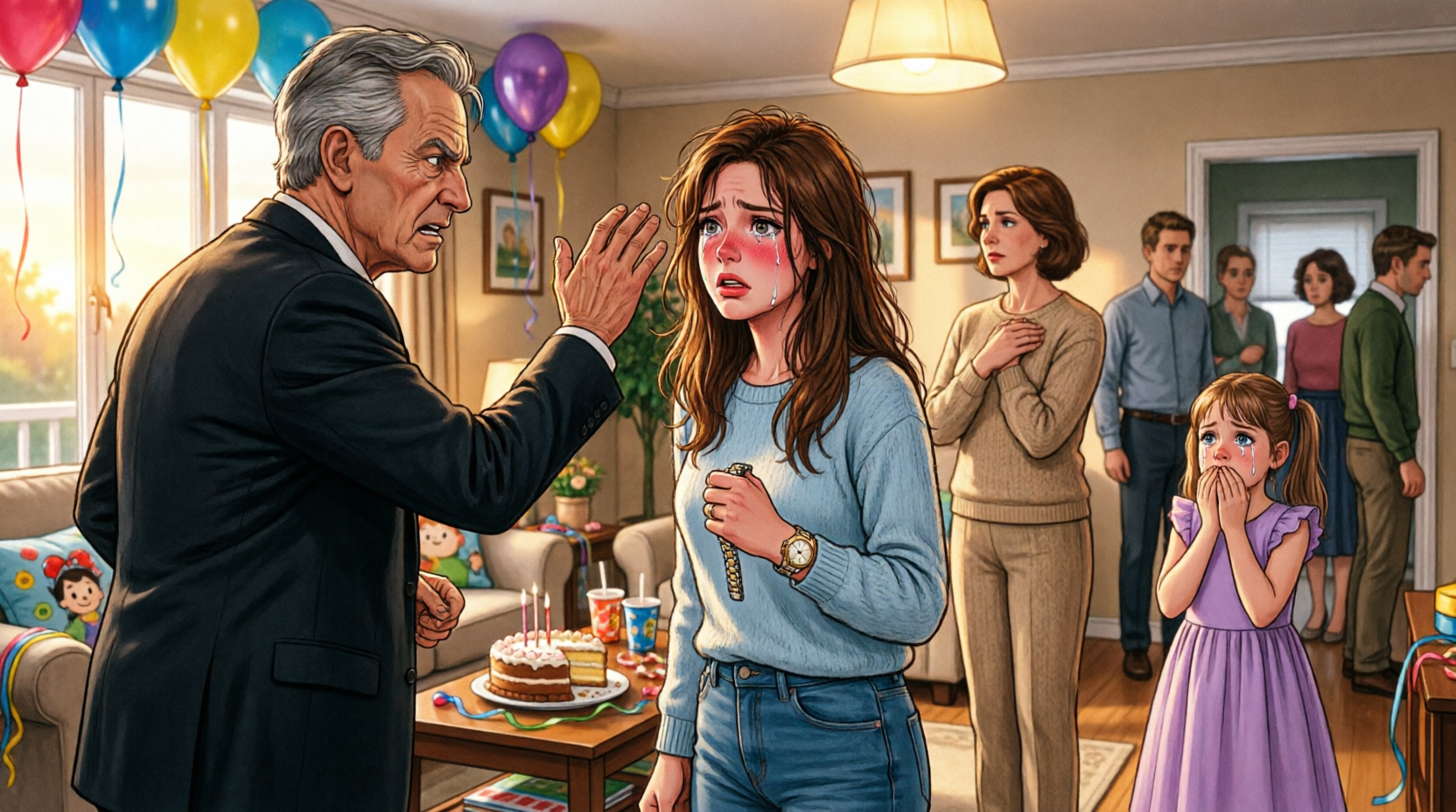
My father slapped my birthday gift into the grass and shouted, “What kind of worthless junk did you give me?” in front of the entire backyard, and for one silent second, I felt every person at that party stop breathing with me. The watch I had saved six months to buy landed face down near the grill, half-hidden in the lawn, glittering in the hot North Carolina sun like something beautiful that had been punished for existing.
My name is Allison Grace Talbott, and by then I should have known better than to hope. I should have known one gift could not rewrite twenty-one years of being treated like an extra piece in someone else’s family portrait, but hope is stubborn when you have been starved of love long enough. The night before, I had stood in our kitchen making steamed shrimp and grits for Dad’s birthday dinner, hands trembling over the saucepan while the pressure cooker hissed behind me. The house smelled like lemon, butter, and old bay, and all I wanted was to get the meal right, because in that house, mistakes were never just mistakes when I made them.
Mom leaned against the counter, watching me struggle with the grits like she had paid for front-row seats to a comedy show. “Allison,” she said, her voice sharp with amusement, “what is that supposed to be?” I forced a smile and stirred faster. “It just needs a minute to thicken.” She laughed loudly, cruelly. “Girl, it’s soup. Even Emma knows better.”
Emma, my little sister, sat at the breakfast nook with her legs swinging under the chair. Technically, she was their biological daughter and I was not, though nobody ever had to say it for me to feel the difference. Her face flushed as Mom kept laughing, and she looked down at her hands like she wanted to disappear for me.
Dad glanced up from his recliner with a beer in one hand. “Didn’t we show you how to do that years ago?”
“I was twelve,” I murmured.
Mom wiped tears from her eyes like my humiliation was a sitcom scene. “Seriously, why do you always mess up the easy stuff?”
Then Dad scoffed, tossed a bottle cap toward the sink, and said the sentence that split something open inside me.
“Why did we even keep you?”
The room went silent except for the ticking wall clock. Even the mixer seemed to pause. Emma gasped, her bottom lip trembling, and whispered, “Daddy,” like she was begging him to take it back before it became real.
I stepped backward, my stomach twisting. “You didn’t just say that.”
He did not answer. He looked back at his drink like I was not worth the effort of regret.
That was when I looked at my mother, still smiling, still unbothered, and realized there was no adult in that room coming to save me. “I’ve never belonged here,” I said, my voice cracking but loud enough to rattle the dishes in the sink. “And you’ve all made sure I never forget it.”
“Allison,” Emma whispered, already crying.
But I could not stop. “I try and try, and this is what I get. Forget the grits. Cook your own dinner.”
“Allison, don’t talk to your parents that way,” Mom snapped, suddenly stern, as if I had broken some sacred rule by reacting to being <.
“You’re not my parents,” I said before fear could catch up with me. “You’re actors in a play where I’m the mistake who ruins the scene.”
Emma sobbed as I ripped off the apron and threw it onto the counter. The stove heat mixed with the tears stinging my eyes, and I shoved the back door open before I could weaken. The thick North Carolina air hit me like a wall, sticky and heavy with summer humidity, but I welcomed it because at least the night did not laugh.
I walked barefoot down the porch steps, the dirt cool beneath my feet. I did not look back, because if I had, I might have stayed, and if I stayed, I knew something in me would shatter.
The street outside our house had that sleepy Southern stillness that makes you hear your own thoughts too clearly. It was just after nine, porch lights flickering on one by one, sprinklers ticking across neat lawns, and the faint smell of fresh-cut grass drifting from somewhere nearby.
Everything looked peaceful, which made my unraveling feel even lonelier.
I sank onto the curb beneath a streetlight two houses down, fingers digging into the hem of my shirt as I stared at my knees. I told myself not to cry, because crying felt like letting them win, but the longer I sat there, the more the ache pressed against my ribs.
It was not the grits. It was never the grits.
It was twenty-one years of being reminded in small, polished, smiling ways that I was not really one of them. A guest in my own home. A tolerated inconvenience. The adopted girl they praised themselves for keeping whenever they needed to feel generous.
“Allison?”
The voice came from across the street, soft and familiar. Jonah Briggs stood outside the bookstore where he worked, keys in one hand and a brown paper bag in the other. He wore his faded Reed Band Books T-shirt, and a smudge of ink marked his cheek.
He crossed toward me with worry pulling at his face, then crouched beside me carefully. “Hey. What happened?”
I shook my head, and a sound came out of me that was half laugh, half sob.
Jonah sat on the curb beside me without asking. He held out the paper bag. “It’s peach pie,” he said. “Slightly squashed, but honest food.”
That cracked me open. I laughed for real, then cried so hard I had to cover my face with both hands, ugly, gasping sobs that made my shoulders shake. Jonah did not flinch, did not rush me, did not demand the whole story before offering comfort.
When I finally spoke, my voice sounded small. “He said, ‘Why did we even keep you?’ Like I’m some mistake they couldn’t return.”
Jonah’s jaw tightened. “Your dad?”
I nodded. “And my mom just laughed before that. Like I’m a joke. Like I’m nothing.”
“You shouldn’t have to live like that,” he said quietly. “Allison, you don’t deserve how they treat you. You never have.”
He looked at me fully, gentle but fierce. “They act like your pain is their inconvenience. That’s not love. That’s control.”
I stared at the cracked asphalt, holding the bag of pie like it might keep me from floating away. “I don’t even know who I am outside of trying to please them.”
“Then you start there,” Jonah said. “You start figuring out who Allison Grace Talbott is when nobody is asking her to shrink.”
His words settled around me like a blanket. For the first time all night, I did not feel invisible.
I eventually told him I should go back, mostly because of Emma. She had looked at me like I was the last clean breath in a room full of smoke, and I could not leave her alone with that tension.
Jonah offered to walk me. I shook my head. Before I left, he said, “Just because you live in that house doesn’t mean they own your story. You’re allowed to rewrite it.”
“Even if it hurts?” I asked.
“Especially if it hurts,” he said. “That’s where the good stories begin.”
I walked back toward the cul-de-sac with the peach pie tucked against my chest and something small and defiant stirring beneath the ache. The porch light was still on, bright and ordinary, like nothing had happened, and for a moment I almost believed the night might end quietly.
Then I heard the engine.
Low, smooth, expensive.
A sleek black luxury car rolled to a silent stop halfway down the block, all tinted windows and no plates I could see. It did not belong in our neighborhood, not on a street where everyone knew every mailbox and every unfamiliar vehicle was noticed before it reached the second driveway.
I froze. The car sat there, watching.
When the driver’s side window began to roll down, I ran.
The pie bag slipped from my arms and burst open on the driveway, but I did not stop. I slammed through the screen door, locked the deadbolt with shaking hands, and slid down against the wood until I could breathe again.
The kitchen was still a mess, the grits drying in the pot, the spoon on the tile like evidence. I crawled to the front window and looked through the curtain.
The car was gone.
Part 2….
That night, I lay awake in my small upstairs bedroom in Raleigh with the bedside lamp still on, trying to convince myself the black car had been nothing. Someone lost, maybe. A stranger visiting the wrong house. A quiet engine and tinted windows did not have to mean danger just because my body insisted otherwise.
But I kept seeing it. Sitting there. Waiting.
Near midnight, I opened my nightstand drawer and pulled out the midnight-blue velvet box I had hidden beneath old birthday cards and a faded picture of Emma and me at the state fair. Inside was the watch I had bought for Dad after six months of extra diner shifts, skipped lunches, and walks home when I could not justify bus fare.
Sleek silver. Clean lines. Real stainless steel.
I touched the cool metal and whispered, “Maybe this will finally be enough.”
Emma knocked softly and slipped into my room with her stuffed giraffe tucked under one arm. Her eyes were still swollen from crying.
“Is that for Daddy?” she asked.
“Yeah.”
“After what he said?”
I nodded because I did not know how to explain that some part of me still wanted him to choose me.
Emma squeezed my hand. “You’re already better, Ally.”
The next afternoon, the backyard filled with relatives, neighbors, folding chairs, lemonade, and the smell of charcoal. I wore a soft lavender sundress Emma had picked because she said it made me look kind, and I held the gift bag like it was made of glass.
Mom called across the yard, “Allison, did you want to give your father that gift now, honey?”
All eyes turned.
I walked the twenty feet across the grass like I was crossing a battlefield. Dad opened the bag, lifted the box, and for one second, surprise softened his face. Then his mouth twisted.
“This what you spent your tip money on?” he asked loudly. “Some cheap knockoff?”
“It’s not a knockoff,” I said. “It’s real. I saved—”
He threw the box into the grass.
“What kind of worthless junk did you give me?” he barked.
I walked inside before anyone could watch me fall apart. Hours later, after the party faded and nobody came upstairs to check on me, I pulled a hoodie over my wrinkled dress and left barefoot into the night.
Past the parked cars. Past the sprinklers. Past the edge of the neighborhood where the road curved toward the woods.
Then I heard it again.
That same low, smooth engine.
The black car sat across the street, headlights off, windows tinted. Only this time, it was not still.
The back door cracked open.
Then
SAY “OK” IF YOU WANT TO READ THE FULL STORY — sending you lots of love ❤️👇 👇
My name is Allison Grace Talbett, and the moment I slid the pristine court file across the table to my adoptive mother, I watched her mascara smudge as the color drained from her face. The judge called it emotional neglect, I said quietly. And he’s not wrong. I turned to my father, the man who once asked why they even kept me, and added, “Turns out biology isn’t the only thing that makes someone a real parent.
Compassion does, too. Where are you watching from? Drop your city or country in the comments. I want to know how far this story reaches. And if you’ve ever been treated like an outsider in your own family, let me know I’m not alone. Now, let me take you back to where it all began. It was supposed to be a simple evening.
Steamed shrimp and grits for dad’s birthday. Nothing fancy. The kitchen smelled like lemon and old ba, and my hands were trembling over the saucepan trying to get the consistency right. The pressure cooker hissed behind me while the mixer word on low and I was on edge like always trying not to mess up. Allison.
Mom’s voice cut through the air with that familiar edge of amusement. What is that supposed to be? She pointed at the runny bowl of grits I was trying to rescue. I forced a smile. Just needs a minute to thicken. She laughed. Loud, sharp, cruel. Girl, it’s soup. Even Emma knows better. Dad looked up from his recliner across the room. Beer in hand.
Didn’t we show you how to do that years ago? I was 12, I murmured, trying not to flinch. Emma, my little sister, well, technically their biological daughter, sat quietly at the breakfast nook, swinging her legs under the table. Her face flushed when mom kept laughing. Seriously, why do you always mess up the easy stuff? Mom chuckled, wiping tears from her eyes like I was some sitcom blooper.
And then came the sentence that split something open inside me. Dad scoffed, tossing the bottle cap into the sink. Why did we even keep you? The room went silent except for the ticking wall clock. Even the mixer seemed to pause. Emma gasped, then her lip trembled. Daddy. I stepped back, my stomach turning.
You didn’t just say that. He didn’t answer, just went back to his drink like I wasn’t worth a second thought. I dropped the spoon with a clatter and looked straight at my mother, who was still smiling, unbothered. I’ve never belonged here, I said, my voice cracking but loud enough to rattle the dishes in the sink.
And you’ve all made damn sure I never forget that. Allison, Emma whispered, tears welling up, but it was too late. I try and try and this is what I get, I laughed, a short, breathless sound. Forget the grits. Cook your own dinner. Allison, don’t talk to your parents that way. Mom snapped, her voice suddenly stern like I’d broken some sacred rule.
You’re not my parents, I said before I could stop myself. You’re actors in a play where I’m the mistake who ruins the scene. I heard Emma sobb as I ripped off the apron and threw it onto the counter. The heat from the stove mixed with the tears stinging my eyes as I shoved the back door open.
The thick North Carolina air hit me like a wall, sticky and heavy with summer humidity. But I welcomed it. It didn’t judge me. Behind me, the screen door creaked as it shut. I walked barefoot down the porch steps, the dirt cool beneath my feet, the sun long gone, but the pain burning just as hot. I didn’t look back, because if I did, I might have stayed.
And if I stayed, I would have shattered. The street outside our house had that sleepy southern stillness that made you hear things you didn’t want to hear, like your own thoughts. It was just past 900 p.m., but the humidity clung to my skin like punishment. I kept walking, arms wrapped around my waist, breath catching in my throat like I might scream if I didn’t hold myself together tight enough.
The porch lights flickered on down the road one by one. Sprinklers ticked on in some yards, and I could smell the faint sweetness of fresh cut grass and grilled food from a neighbor’s back patio. Everything looked normal, peaceful, but I was unraveling. I sank to the curb beneath the street light two houses down from mine, fingers digging into the hem of my shirt as I stared at my knees.
I couldn’t cry, not yet. Crying felt like letting them win. But the longer I sat there, the more the ache pressed against my ribs. My throat tightened. My hands started to shake. It wasn’t the grits. It was never the grits. It was 21 years of being reminded in a hundred little ways that I wasn’t really one of them.
a guest in my own home. A tolerated inconvenience. Allison. The voice cut through the fog, soft and familiar. I looked up, blinking against the brightness of the bookstore sign across the street. Jonah Briggs stood outside the shop, keys in one hand and a brown paper bag in the other. He wore that same faded Reed Band books t-shirt and had a smudge of ink on his cheek, his brows knit as he crossed toward me. Hey.
He crouched beside me, careful like I might break. What happened? I didn’t answer, just shook my head and let out a sound between a laugh and a sob. He sat beside me on the curb without asking, handing me the paper bag. It’s peach pie, he said. Slightly squashed, you know, honest food. That cracked something in me.
I laughed, really laughed, and then I cried. Ugly, messy, gasping sobs that I tried to hide behind my palms, but Jonah just waited, not flinching, not filling the silence, not asking me to explain. When I could finally speak, I whispered. he said. “Why did we even keep you? Like I’m some mistake they couldn’t return.
” Jonah’s jaw tightened. “Your dad?” I nodded. And my mom just laughed like it was funny, like I’m a sitcom gag. Emma started crying and I couldn’t stay. I couldn’t. You shouldn’t have to, Jonah said, his voice steady but low. Allison, you don’t deserve how they treat you. You never have.
He tilted his head to look at me fully, eyes gentle but fierce. They act like your pain is their inconvenience. That’s not love. That’s control. It’s not your fault you ended up with people who didn’t know what to do with someone like you. Someone like me. I’d heard that before from teachers, neighbors, even at church. She’s a little different. Quiet doesn’t quite fit.
It never mattered how hard I tried. They always saw the seams. I don’t even know who I am outside of trying to please them. I admitted the words tumbling out faster now. I thought maybe if I did everything right, they’d eventually, I don’t know, care. They care about control, Jonah said. Not about you, I stared at the cracked asphalt.
So what now? I just float. No, he said, nudging the pie bag closer. You start figuring out who you are without them. Who Allison Grace Talbot is when no one’s watching. You already survived them. That’s no small thing. His words settled around me like a soft blanket. For the first time all night, I didn’t feel invisible or unworthy.
I should probably go back, I said quietly. At least so Emma doesn’t think I disappeared. Jonah nodded. You want me to walk you? I shook my head. No, I can do it. He stood up, then paused. Hey, just because you live in that house doesn’t mean they own your story. You’re allowed to rewrite it. I looked up at him. Even if it hurts.
Especially if it hurts, he said. That’s where the good stories begin. I took the pie and stood legs stiff. Thanks, Jonah. For what? For being the only one who doesn’t ask me to shrink. As I walked back toward the house, the porch light still on like nothing happened. My chest still achd, but underneath it, something small and defiant had started to stir.
I wasn’t whole, but I wasn’t broken beyond repair either. By the time I reached the corner of our culde-sac, Jonah’s words had started to fade into the background like a dream dissolving just before you wake. I held the paper bag against my chest as the crickets buzzed through the thick night air.
A porch light flickered up ahead. hours still on, still waiting like it always did. Even when the people inside felt a world away, I didn’t want to go back in. Not really. But Emma, she’d looked at me like I was the last bit of oxygen in a room choking with smoke. I couldn’t leave her alone with them. Not tonight.
I slowed my steps as our house came into view. Familiar gravel underfoot. The hedges trimmed too neatly. The shutter’s mom painted eggplant purple one spring because it made us look less poor. And then something shifted in the air, so subtle it might have been nothing. Until I heard it, a low hum. Not the buzz of cicas, but an engine quiet, expensive.
That sound didn’t belong to any of our neighbors. I stopped walking. My eyes flicked to the street, and that’s when I saw it. A sleek black luxury car rolled to a silent stop halfway down the block. All tinted windows, no plates I could see, no sound beyond the gentle purr of its idol. It didn’t belong here.
Not in our part of North Carolina. Not on a street where everyone knew everyone and nothing fancy ever parked for long. I froze. Every instinct in my body screaming go. The car didn’t move, didn’t flash its lights, just sat there watching. My grip tightened on the pie bag as I took a step forward, heart racing.
Maybe it was a lost Yuber or someone visiting the Gonzalez family down the road. But as I took another step, the driver’s side window began to roll down. I didn’t wait to see the face inside. I ran. I bolted up our cracked driveway, lungs burning, shoes slapping the concrete, breath sharp in my throat. The bag fell from my arms, the pie bursting through the bottom like a casualty of war. But I didn’t stop.
My fingers fumbled with the screen door latch, then the knob. Thank God it was unlocked. I slammed the door behind me and locked it, twisting the deadbolt with shaking hands. My back hit the wood as I slid down to the floor, trying to catch my breath. Silence? Not even the creek of footsteps upstairs, just the distant hum of the refrigerator and the tick of the dining room clock.
The kitchen was still a mess, grits drying in the pot, the spoon I’d thrown still lying on the tile like evidence of a crime. I crawled over to the front window and peeked through the slit in the curtain. The car was gone. No tail lights, no movement, just the stillness of the street again like it had never been there at all.
I sat back on my heels and tried to convince myself it meant nothing. that maybe it was just someone lost or testing out a new ride. Maybe it had nothing to do with me. But deep down I knew better. That wasn’t a neighbor. That wasn’t a coincidence. It was a warning wrapped in quiet. My hands still trembled as I stood up and double-checked the locks twice.
I tiptoed down the hall toward the stairs, my heart thudding with each creek of the wood beneath my feet. The house felt colder than before, like the argument had sucked out all the warmth and left behind an echo of something ugly. At the top of the stairs, Emma’s bedroom door was a jar. I peeked inside.
She was asleep, curled under her pink comforter, her face still stained from crying. Her stuffed giraffe was tucked under her arm the way it always was when she felt scared. I didn’t wake her. I just pulled the door gently shut. Back in my own room, I sat on the edge of the bed, still in my day old jeans, and stared at my reflection in the darkened window.
The girl looking back at me didn’t seem like someone a luxury car would follow. She looked small, invisible. I told myself I was safe, that the doors were locked, that no one would come here for someone like me. But the unease crept into my bones and refused to leave. I lay down without turning off the light, and I didn’t sleep.
It was nearly midnight in my small upstairs bedroom in Raleigh, North Carolina, and the only light came from my bedside lamp. the soft yellow glow barely pushing back the shadows clinging to the walls. I hadn’t changed out of my clothes. I hadn’t slept, and I definitely hadn’t stopped thinking about what Dad said.
“Why did we even keep you?” The words echoed like a dented bell inside my chest. I reached for my nightstand drawer slowly, as if the act required courage. Inside, tucked beneath old birthday cards and a faded photograph of Emma and me at the state fair, was a velvet box the color of midnight blue.
I held it in my hands for a long moment before opening it. The watch caught the light instantly. Sleek, silver, clean lines, the kind of understated luxury my father admired whenever he flipped through magazines he’d never admit he liked. I’d saved for 6 months, working extra shifts at the diner, skipping lunches, walking instead of taking the bus.
I traced the cool metal with my fingertip. Maybe this will finally be enough, I whispered into the quiet room. Enough to make him look at me differently. Enough to stop the jokes. Enough to prove I wasn’t just the girl they kept. I swallowed hard and set the watch carefully into a small gift bag I’d hidden in my closet weeks ago.
I even added tissue paper, white, crisp, untouched. It felt stupidly ceremonial for something that probably wouldn’t change anything. But hope is a stubborn thing, even when it’s bruised. I sat cross-legged on my bed, staring at the bag. My mind replayed tomorrow’s party, the relatives, the backyard barbecue, mom’s fake laughter, dad holding court like he always did.
I imagine walking up to him. Happy birthday, Dad. Maybe he’d smile. Maybe he’d nod. Maybe, just maybe, he’d say, “Thank you, Allison.” My chest tightened at the thought. There was a soft knock at my door. “Ally,” Emma’s small voice drifted in. “She never called me Allison. Only Ally, like I was hers. You can come in,” I said quietly.
She slipped inside, her stuffed giraffe tucked under her arm, eyes still swollen from crying earlier. “Are you still mad?” I forced a small smile. “Not at you.” She climbed onto my bed and sat beside me, studying the gift bag. Is that for daddy? Yeah. She tilted her head after what he said. I hesitated, then nodded. Emma frowned.
Why? Because I still want him to choose me. Because I’m tired of feeling replaceable. Because I don’t know who I am without trying. Instead, I said softly. Because sometimes people say things they don’t mean. Emma didn’t look convinced. He didn’t look like he didn’t mean it. The honesty in her voice cut deeper than anything my father had said.
I exhaled slowly. I just want tomorrow to be better. She reached out and squeezed my hand. You’re already better, Ally. I laughed gently. Since when did you get so wise? She shrugged. I watch people. That made two of us. Emma leaned against my shoulder and for a moment the house didn’t feel so hostile. It just felt small, fragile, like something that might collapse if anyone breath too hard.
Do you think you’ll like it? I asked quietly. The watch? Yeah. She studied it like it was a science experiment. He’d have to be blind not to. I smiled at that. After she padded back to her room, I lay down again, the gift bag resting on my desk where I could see it. My heart felt like a tightroppe walker, balanced between hope and humiliation.
Part of me knew a gift wouldn’t rewrite history. But another part, smaller, softer, still believed tomorrow might shift something. That maybe if I tried one more time, I wouldn’t feel like the extra piece at someone else’s table. The house was quiet, too quiet. And somewhere in the back of my mind, I couldn’t shake the memory of that black car.
But tonight, I chose to focus on the watch, on the possibility, on the fragile, flickering hope that maybe, just maybe, this time I’d be enough. The next afternoon was warm, too warm for spring. North Carolina weather liked to play dress up as summer early, and today it chose humidity and heat. I stood at the edge of our backyard in a soft lavender sundress that Emma had picked out for me that morning.
“You look kind,” she’d said. I guess she didn’t know how much that meant. Laughter bubbled through the yard. Folding chairs were scattered across the freshly cut grass. Aunt Melinda was already three glasses of wine in talking politics she didn’t understand. Cousin Tyler was showing off his new drone, which buzzed above us like a lazy hornet.
Mom darted between guests with a picture of lemonade and her signature polished smile, but I barely noticed any of it. I was holding the gift bag like it was made of glass, carefully tucked against my side, praying the tissue didn’t wrinkle, praying my hands didn’t sweat through the paper. Dad was at the grill, of course.
His throne, a navy polo stretched tight over his stomach, tongs in one hand, a beer in the other, nodding and smirking like a king among his court. I watched from a distance as people greeted him like he was some local celebrity. 60 looks good on you, Raymond. What’s your secret? Charcoal or gas? Still running the show, huh? He loved it. He always loved it.
My stomach twisted. I waited for a quiet lull in the conversations. A gap where he was finally alone, but there was never one. Just a revolving door of friends and family, laughing like nothing in this world ever went wrong. Like we were a perfect picture, like I was part of it. But I wasn’t. Not really, Allison.
Mom’s voice cut through the noise. Did you want to give your father that gift now, honey, before we bring out the cake? Suddenly, all eyes were on me. I froze. Go on, she urged, a practiced smile tugging her lips. He’s right there. Emma stood a few feet away, watching with wide eyes. I caught her gaze.
She nodded once, small but certain. I swallowed hard, stepped forward, and walked the 20 ft across the lawn that felt like a battlefield. My sandals sank slightly into the grass. “Hey,” I said, trying to sound light. Dad looked over his shoulder. “Yeah, I uh I got you something for your birthday.” I held out the bag with both hands.
My arms felt stiff mechanical. He blinked, surprised. You did? Yeah, I said suddenly self-conscious. I’ve been saving up for it, I thought. I don’t know. You might like it. The conversation around us quieted. Not entirely, but enough. I could feel people watching. that subtle lull in the party where everyone’s ears turned toward tension, waiting to see if they should laugh or stay silent.
He took the bag and dug into the tissue paper like a man unwrapping socks on Christmas detached, mildly annoyed, going through the motions. When he opened the box, a small murmur rose from someone nearby. The watch caught the sun just like it had in my room the night before. For a second, just a second, his face changed.
Surprise! Something close to emotion. Then his mouth twisted. “This what you spent your tip money on?” he asked loudly, holding the box up for everyone to see. “Some cheap knockoff?” my breath caught. “It’s not a knockoff,” I said quickly, quietly. “It’s real, I saved up,” he didn’t let me finish. He tossed the box.
Right there in front of everyone, my mother, my cousins, neighbors, from two doors down, the box with the watch arked through the air and landed in the grass with a dull thud. “What kind of worthless junk did you give me?” he barked. You think I’m going to wear this plastic piece of garbage? A gasp. I don’t even know who it came from. It might have been me.
My hands trembled as the heat rose to my face. I could feel everyone’s eyes now. No longer curious. No longer polite, just stunned. I I reached toward the box like I could make it all go away. It’s stainless steel real. I even I said I don’t want it. He snapped. Save your pennies for something that matters next time.
I heard someone whisper, “Wow!” under their breath. Mom was frozen nearby, mouth parted, but not saying a word. Not one word. Emma had her hands baldled into fists at her sides like she wanted to scream, but didn’t know how. I didn’t pick up the watch. I didn’t say anything else. I turned. I walked, not quickly, not dramatically, just walked.
Each step was heavier than the last, but I made it inside the house and up the stairs before the tears came. This time, I didn’t even try to stop them. I didn’t come back downstairs for cake. Didn’t hear them sing. Didn’t want to. The watch lay where it had landed, face down on the lawn, swallowed by the grass like it never mattered.
I curled into a ball beneath my blankets. The lavender dress wrinkled. Makeup smudged under my eyes. Mascara drying like ash on my cheeks. The laughter outside never fully stopped. Just softened, shifted. They moved on. People always do. No one came up to check on me. Not mom, not dad, not even to fake concern for appearances. Only Emma knocked once.
A soft, timid tap. I didn’t answer. I couldn’t. And then the house went quiet. Eventually, the clink of plates and folding chairs being dragged inside faded, replaced by the distant hum of cicas and the dull wor of the fridge downstairs. I lay there staring at the ceiling in the dark until I couldn’t anymore.
At some point, I sat up, peeled myself off the bed like my skin didn’t fit right, and stepped barefoot onto the cool floor. My breath felt tight in my chest, like if I stayed in that house one minute longer, something inside me would burst open, and I wouldn’t know how to close it again. So, I left. No shoes, just the hoodie I threw over my dress and a set of house keys shoved in my pocket with trembling fingers.
The porch creaked under my weight as I stepped out into the night. The air smelled like charcoal and cut grass. Still sticky with leftover heat, but gentler now. I didn’t know where I was going. I didn’t even care. I just knew I needed out. I walked down the street, past the parked cars still lining the curb, past the sprinklers whispering across empty lawns.
Street lights blinked above me, casting thin pools of gold that made my shadow stretch like a stranger behind me. My feet achd against the pavement, but I didn’t stop. I kept walking. one block, then another, trying to outrun the echo of his voice. What kind of worthless junk did you give me? I didn’t even realize tears were falling again until I tasted salt.
The road curved near the edge of the neighborhood. Beyond that, just woods and a long stretch of county road that led to nothing in particular. I hesitated there. The dark felt deeper past that bend. Heavier. And then I heard it, that sound, that engine. Low and smooth and far too quiet for a car its size. I turned and there it was again.
The black car parked across the street, headlights off, windows tinted, same as before. Only this time it wasn’t still. The back door cracked open. Then two men stepped out, both in dark clothes, tall, broad- shouldered, moving with the kind of slow precision that made my stomach drop. I stepped back. They stepped forward.
I turned to run, but gravel slipped beneath my feet. I barely got two strides before hands grabbed my arms. rough, sudden, unyielding. “Let me go,” I screamed, but the sound bounced off empty trees. One of them pressed something cold and sharp against my ribs. Not a blade, but a warning. The other yanked the hood over my head, muffling my voice. “No, stop, please.
” My feet kicked, scraped, but I couldn’t find footing. I twisted, jerked, fought like my life depended on it because something told me it did. The car door opened. I was shoved inside. The leather was cold against my skin. A door slammed shut. then another. The engine revved, the tires rolled forward, and just like that, I was gone, swallowed by the night. I couldn’t breathe.
The car smelled like leather, cologne, and something sterile, like a hospital or a new wallet. The interior was dark, except for the dashboard’s faint blue glow. My wrists were free, but I was pinned by silence and fear, frozen between the two men who now flanked me on either side like I wasn’t even human. I blinked back tears, my voice cracking as I finally choked out.
Where are you taking me? No answer. I looked to the man on my right, older, maybe mid-40s, graying at the temples, jaw clenched so tight it could have been carved from stone. Please, I said, I don’t understand. What is this? Still nothing. The younger man on my left had a clean shaven face, dark skin, and eyes hidden behind glasses. He didn’t look at me.
Neither of them did. as if acknowledging me would make me real and keeping me unreal somehow made this okay. Are you going to hurt me? My voice barely came out. Is this about my family? I hated that question. Hated that it made sense in my brain that someone might want to punish me for something they’d done.
A punishment by proxy. Still nothing. Panic swelled so hard in my chest it hurt. My breath turned shallow. Every second without an answer twisted the knife deeper. I I don’t have any money, I stammered. I don’t have anything. If this is about ransom, you’ve got the wrong person. I laughed high-pitched and desperate.
They wouldn’t pay for me anyway. The man on the right flinched just slightly. That small movement sent a chill through me. They knew something. Please, I whispered. At least tell me why. Still, they said nothing, so I started to spiral. Maybe it was revenge. Maybe I’d said something at school that angered someone.
Maybe it was random, wrong place, wrong time. Or maybe worse, maybe someone had finally decided to make me disappear because I’d become too inconvenient to exist. I bit my lip until I tasted blood. Time stretched and twisted. My phone was still in my pocket, but I wasn’t stupid. I knew reaching for it would be pointless. If they meant to stop me, they’d stop me.
If they didn’t, they’d already removed the battery or jammed the signal, or worse. So, I sat there, arms trembling in my lap, eyes darting between the rearview mirror and the shadows beyond the window. It was too dark to recognize anything outside, just flickers of trees, signs, occasional headlights flashing past like ghosts.
After what felt like an eternity, the car slowed. I leaned forward hard in my throat. We pulled off the road and onto a long, winding driveway lined with manicured hedges that seemed to stretch forever. The gates had opened for us without anyone getting out, without a word. My mouth went dry. The house, or maybe it was a mansion, estate compound, appeared slowly, lit like something from a movie.
Columns, arches, massive windows glowing from within. The lawn was spotless. The gravel drive crunched softly under the tires as we pulled up to the circular entrance, framed by hedges cut so precisely, it looked unnatural. The car stopped. Neither man moved. I gripped the seat. Please, I said, my voice barely audible.
What is this place? The man on the right finally turned his head. Get out. I didn’t move. The car door opened, but not by my hand. The man on my right had stepped out and now stood outside, holding the door with a practiced patience, as if this were some black tie event and not a midnight abduction. My legs didn’t want to work, but something colder than fear pushed me forward. Survival, maybe.
I slid out of the back seat slowly, the gravel sharp under my bare feet. I hadn’t even thought about shoes when I fled the house. The air here smelled different, like jasmine and something older. Expensive. The massive white columns loomed over me as I was guided up the wide marble steps toward the glowing porch.
Neither man touched me now, but their presence behind me was clear. I wasn’t free to leave. And then the door opened. A tall man stepped into the frame, bathed in soft yellow light, salt and pepper hair, tailored slacks. He looked like he belonged on the cover of a luxury magazine. Late 50s, maybe early 60s, confident, but quiet and strangely familiar.
His voice was smooth, not cold, not rushed. “Hello, dear,” I blinked. He stepped forward, hands loose at his sides. “I know this is overwhelming,” he said gently, “but I need you to hear this.” He paused. Then with a strange steadiness, he said the words that rewrote everything. I’m your biological father. The porch tilted under me.
I stared at him, heart hammering in my chest. What? My name is Jonathan Pierce. His voice was calm, measured. Your mother’s name was Camille. You were born in the state hospital 21 years ago. The adoption was not what I agreed to. You were taken before I could get back. No, I breathd. No, that’s not. He reached into his jacket and pulled out a small manila envelope, holding it out like it contained something sacred.
Photos, birth records, and this. He gestured toward the heavy wooden door behind him. A mirror that might explain more than any document. I didn’t take the envelope. I couldn’t move. I I have parents, I said, even as the words tasted like rust. I already have a family. They raised you, he said, no bitterness in his tone.
But they didn’t tell you who you are. I don’t believe you, he nodded as if he expected that. Come inside just for a moment. I should have run, should have screamed, but curiosity swelled past the fear, and deep under that a splinter of hope or desperation, or both. I followed him into the mansion. The entryway was all polished floors and high ceilings.
Every corner glowed. It was too clean, too quiet, the kind of place that didn’t creek or exhale. I felt like an intruder, barefoot and messy in a house built for statues. He led me down a hallway to a wide gilded mirror. Stand here, I did. He stepped beside me and I saw it. The same chin, same high cheekbones, same curve of the eyes.
It was like seeing my face projected onto a different life, a richer life, a warmer one. My throat tightened. He handed me the envelope finally. You can open it when you’re ready. I still hadn’t said a word. Jonathan studied my face like he was memorizing it. I’ve been looking for you for a very long time, Allison.
I whispered, “You knew my name. I knew everything but where you were.” I wanted to scream. I wanted to collapse. Instead, I just stared at the mirror because suddenly everything I thought I knew had fractured, and the reflection was still standing. The study was warm. Not just in temperature, but in feeling. Soft amber lighting from wall sconces, velvet chairs that swallowed you whole, and shelves lined with thick books that probably hadn’t been touched in years.
The kind of space where time slowed, and everything felt a little unreal. I sat across from him, still barefoot, legs curled awkwardly under me on the edge of a leather armchair. I held the manila envelope in my lap like it might catch fire. I hadn’t opened it yet. Jonathan, he insisted I call him, that for now, poured us both tea, not coffee, from a porcelain set that looked older than me.
The way he moved, deliberate, gentle, as if any sudden motion might startle me away. He was right. The silence stretched, but it wasn’t awkward. It was full, heavy, with everything unspoken between us. Finally, he sat down and looked at me. Not past me, not through me, but at me. Your mother’s name was Camille, he began softly.
She was 23 when you were born. We weren’t married. We were young and I was finishing a fellowship overseas when she found out she was pregnant. I swallowed but didn’t interrupt. She tried to reach me but communication back then. Well, it wasn’t like today. We wrote letters. She left voicemails. I didn’t get them in time.
He paused, eyes clouding. She died giving birth to you, Allison. The words didn’t land all at once. They fell in layers. She died giving birth to me. She had no living family, he continued. Wasn’t listed on the birth certificate. another complication from being out of the country. He looked down at his teacup.
By the time I returned to the States and found out you were already in the system, already placed. The adoption happened fast, quieter than it should have. I didn’t even know your name until years later. I clutched the envelope tighter. I tried to fight it, he said. Hired lawyers, hired investigators, but every time I got close to tracking you down, something would shift.
Records sealed, agencies folded. It felt like chasing a ghost. Why now? My voice was horsearo. Why find me now? He looked at me steady because I never stopped. That did something to me. I didn’t know this man. And yet, I didn’t feel unsafe. I didn’t feel small. I didn’t feel like a burden someone regretted keeping.
I felt seen. You grew up in Raleigh? He asked gently. I nodded. Yeah, since I was two. His jaw tightened ever so slightly. They never told you. Not a thing, I whispered. They acted like I just appeared. like I was a project. They got tired of halfway through. Jonathan leaned forward, elbows on his knees. You were wanted, Allison, from the beginning. You still are.
Something cracked in my chest at those words. Not a break, a shift. I used to dream about her, I said before I could stop myself. A woman with dark hair singing. I thought I made her up. He smiled almost painfully. Camille used to hum when she washed dishes. Couldn’t carry a tune to save her life. My lips curved slightly.
That sounds like me. That sounds like her, too. The warmth spread slowly, hesitantly, but it was there. I opened the envelope in my lap. Inside were copies of letters, a hospital bracelet with the name Baby Girl Pierce, and a photograph, faded but unmistakable, of Camille, pregnant, standing beside Jonathan, laughing into the wind.
They looked like the beginning of something. I had never known the beginning of anything until now. The next morning, sunlight poured through the tall windows of Jonathan’s guest room. Not filtered through dusty blinds or yellowed curtains like at home, but bright and clean like a new beginning trying to break through.
I woke up slowly, unsure where I was at first. The sheets were too soft, the room too quiet, and then it all came rushing back. The car, the mirror, the truth. He was waiting in the kitchen, reading the paper like it was any other Tuesday, except it wasn’t. He looked up and smiled. Morning. You’re hungry? Maria made blueberry pancakes? I blinked. Who’s Maria? He chuckled.
Housekeeper/head chef/ unofficial aunt. She’s been with me since before you were born. And just like that, the warmth returned. It was strange, surreal, but I didn’t feel like a guest. I felt expected. After breakfast, Jonathan reached into a drawer by the kitchen island and slid a small silver key across the marble counter.
It was attached to a leather fob with an embossed logo I didn’t recognize. What’s this? I asked cautiously. He smiled. A condo in Charlotte, close to my office. Modern, fully furnished. It’s yours. I stared at him. I don’t need a condo. You need space, he said gently. You need freedom.
You need somewhere that isn’t haunted by every word they use to break you, I swallowed hard. It’s a small welcome gift, he added. Not a bribe. I’m not trying to buy your love, Alison. I just want to give you a place to begin again. For a long moment, I said nothing. Then I reached for the key and something in me, something scared and hunched, finally stood up.
Later that afternoon, I went back. I told Jonathan I wanted to get my things alone, that it was something I needed to do without an escort or a car waiting outside like some billionaire’s daughter. I took the bus, wore jeans and a plain t-shirt, no makeup, no armor. I walked through the front door of the house that raised me, not expecting a welcome, and I didn’t get one.
My mother was in the kitchen wiping down counters like she hadn’t spent the past two decades turning me inside out. She turned when she heard the door. Well, look who decided to show up. She sneered. Run out of castles already. I didn’t flinch. I’m here to pick up my things. She tossed the rag into the sink and leaned against the counter, crossing her arms.
You’ve got some nerve, Allison. After everything we gave you, after everything we did for you, did to me? I corrected softly. Not for me. her face twisted. “We gave you a home. We raised you when no one else would. You raised me to believe I was a burden,” I said. “You fed me, clothed me, and reminded me daily how lucky I should be to be tolerated.
” Her voice rose. “We took you in out of pity. You think he loves you just because he’s got a mansion and a soba story. You’re nothing to him. You’ll always be nothing.” I met her eyes, calm, steady, funny. That’s what you said to me every time I did something you didn’t like. But guess what? I know the truth now. She stepped forward, her voice shaking with fury.
“You ungrateful little traitor.” “No,” I said, my voice low but clear. “I’m not a traitor. I’m just no longer your scapegoat.” I turned away from her, then walking upstairs without waiting for permission. My hands didn’t shake. My steps didn’t falter. In my old room, I moved quickly. Duffled bag, some clothes, a few books Emma had given me.
The watch still scratched, still mine. When I came back down, she stood there blocking the door like a final test. You walk out that door, she hissed. Don’t expect to walk back in. I won’t, I said simply. And don’t expect to be the victim in this story. You used me and now you don’t get to anymore.
I walked past her. And this time, I didn’t look back. They filed the lawsuit exactly 3 days after I moved into the condo. Jonathan warned me it might happen. He’d seen the signs. how tightly people like my adoptive parents gripped control once they knew they were losing it. And I should have seen it coming too.
But when the letter arrived, official stamped cold, I still felt it like a punch to the chest. Claim unlawful removal of a legal dependent. They were accusing my biological father of kidnapping me. The girl they barely spoke to unless they needed someone to mock or blame. That girl was now their property, suddenly valuable when someone else dared to care. I almost laughed. Jonathan didn’t.
He opened the letter with the calm of someone who’d been to war. “They want to scare you,” he said. “But they forgot something.” “What?” he looked up, eyes firm. “I have truth in the receipts.” The courtroom was colder than I expected, sterile, polished, and full of whispers. I sat beside Jonathan, flanked by two attorneys in perfectly tailored suits who spoke in quiet, strategic tones.
My adoptive parents sat across the aisle. Mom wore navy blue and fake pearls. Dad wore a smuggness that barely fit his face. He smirked when I entered, like this was a game, like he still thought he could win. The judge was a woman in her 60s with sharp eyes and a voice like granite. When she entered, the room shifted. Everyone sat straighter.
Even my mother crossed her legs with a bit more care. It began. The attorney for my adoptive parents stood, gesturing wildly with words like abduction, brainwashing, and parental betrayal. They painted Jonathan as a manipulator with money and influence, twisting my young mind against the family who had raised her with love and devotion. I didn’t move. I didn’t cry.
But Jonathan’s jaw tightened. Then it was our turn. Our lead attorney stood calmly and placed a file on the table in front of the judge. Inside DNA tests, certified adoption irregularities, emails and letters from Camille, Jonathan’s official attempts to regain custody from 20 years ago. The judge flipped through the pages, face unreadable.
Then the attorney asked to call me to the stand. My stomach dropped, but I nodded and stood. I took the oath, sat, breathd. The courtroom was silent. Attorney asked me only one question. Can you describe the emotional environment you were raised in? my throat tightened. “Yes,” I said clearly. “I was not loved. I was tolerated. I was mocked for mistakes.
Guilt tripped for existing. I spent my entire life wondering why I was never enough. And I now know it’s because they never saw me as someone worth loving, just someone they could control.” Murmurss rippled through the room. My adoptive mother’s jaw clenched so hard I thought her teeth might crack.
The judge raised a hand for silence. Then she spoke, “Low, clear, final. It is this court’s determination that Jonathan Pierce is Allison Talbot’s biological father and as such holds every legal right to her care and well-being as an adult. This court also finds reason to believe emotional neglect and psychological manipulation occurred in the Talbot household.
All claims filed by Raymond and Marlene Talbot are dismissed with prejudice. She looked directly at them. You didn’t lose a daughter. You threw one away. The gavl came down. Just like that, it was done. The steps outside the courthouse were a circus. Reporters, cameras, shouts. I didn’t answer any of them.
I just walked Jonathan’s hand wrapped around mine, steady and warm. Someone asked, “Allison, do you feel vindicated?” I stopped, turned to the reporter, smiled. “I feel free.” The condo was quiet the night I came home from court. Not heavy haunted quiet, the kind I’d known too well, but peaceful, like the kind that wrapped itself around you without taking anything away.
I dropped my bag on the hallway bench and stood in the center of the living room just breathing. For the first time in my life, there was no one to impress. No footsteps behind me, no cruel eyes waiting to catch me stumbling. I belonged here fully, unapologetically. Still, something tugged at me. I walked to the kitchen, poured a glass of water, and stared at the phone on the counter.
For a while, I just looked at it. Then, I tapped in a number I knew by heart. It rang twice before I heard her voice. Ally. I closed my eyes. Hey M. There was silence on the other end and then a tiny inhale. Are you okay? She asked. I nodded even though she couldn’t see me. Yeah, I am. I’m more than okay.
Another pause. Are they mad? I’m guessing so, I said. But I don’t really care anymore. A beat of silence. Then her voice broke. Can I come see you? Emma stepped into my condo the next evening wearing the oversized hoodie I gave her last Christmas. The one she’d insisted on keeping. Even though mom said it was too baggy for girls, her hair was in a messy braid and her eyes were wide, nervous, like she didn’t know if she was allowed to be happy here.
I opened my arms and she walked straight into them. She clung to me like she was still 10 and the world had gotten too big again. I felt her shake with a breath she’d clearly been holding for weeks, maybe years. “You don’t have to live under their lies anymore,” I said into her hair. She nodded against me, then whispered, “I want to stay here with you.
” I pulled back just enough to meet her eyes, then stay. The next morning, we opened all the windows. We cranked up music, cheesy girl power playlists that made us laugh and started pulling everything from the closets. Old throw pillows, random dishes, picture frames that meant nothing to us.
We painted over the beige walls with soft greens and dusky blues. Emma’s idea, she said, they made her feel safe but not sleepy. We danced barefoot on a tarp. We laid out in the hallway dripping paint and not caring. I ordered pizza and let her eat it on the couch. No plates, no rules. When we moved into what would be her room, formerly the guest room, she looked around and said, “Can I put glow-in-the-dark stars on the ceiling?” I grinned.
“You can put the moon up there if you want.” And she did. That night, we lay side by side on the couch, her head on my shoulder, our fingers still spotted with dried paint. She whispered, “I was scared you’d leave me.” I would never, I said without hesitation. The moonlight slid through the glass doors soft and slow. She looked up at me and smiled.
Really smiled. Not that polite, careful one she’d learned to wear at home, but the kind that cracked her face open and let the real Emma shine through. It was the first time I’d seen her laugh in months. And just like that, something in me healed. One year later, I stood behind a podium beneath bright white stage lights, looking out at a sea of young faces.
Some nervous, some eager, some heartbreakingly familiar in their quiet silence. I adjusted the mic, took a breath, and smiled. “My name is Allison Pierce,” I began, my voice clear and steady, and for most of my life, I believed I was unwanted. A ripple of stillness settled over the audience. I was told I should be grateful to be taken in.
I was told love had to be earned and even then it might not be given. I was told that my voice didn’t matter. I let that hang for a moment. But here’s what no one told me. You are not what others decide you are. You are not their anger, their cruelty, or their silence. Your truth is yours to uncover. In the front row, Emma sat between Jonathan and one of her new school friends, hands folded in her lap, smiling like she already knew what I’d say before I said it.
Jonathan, beside her, looked like he was holding back tears. I continued. Some of you may be carrying pain that doesn’t have a name yet. Some of you may still be inside the storm, but storms pass. They always do. And when they do, you’ll find that the person who walks out isn’t the same one who walked in.
Scattered applause began to rise. I didn’t grow up in a family that knew how to love me. But I found one. One built on respect, on truth, on real connection. Sometimes family is who shows up when the world turns its back. My eyes found Emma’s again. She nodded once. That was enough. So, if you’re sitting here today wondering whether you’ll ever feel like you belong, listen closely, I said. You do.
You always have. You just haven’t been told loud enough yet. The crowd erupted in applause. And I stood tall in the light, not as someone saved, but someone who had saved herself. That was the end of my story. The moment I finally understood that being chosen, respected, and truly seen is worth more than staying where you’re merely tolerated.
Sometimes I still think about Emma packing a small overnight bag and choosing to walk out of that house to live with me, even though she knew it would change everything for her, too. Do you think she did the right thing? Or have you ever had to make a choice like that for someone you love? Tell me in the comments.
And if this story meant something to you, please like this video and subscribe to follow more journeys about finding strength when it matters most.