PART 2 : Sleep did not come easily that night. I lay in the center of our bed, one hand resting on Martin’s empty pillow, the other tracing the quilt he’d bought me on our tenth anniversary. The house creaked in the usual places—the floorboard near the stairs, the radiator in the hall, the window latch that never quite caught. But beneath those familiar sounds, I heard something new: a quiet hum of purpose. Not the frantic kind that demands action, but the steady kind that asks for patience.
By morning, the snow had stopped. Pale winter sun spilled across the kitchen tiles as I wheeled myself to the counter and poured two cups of coffee. I left one on Martin’s side of the table out of habit, then smiled at my own reflection in the dark window. Grief, I was learning, wasn’t about forgetting. It was about learning how to carry without breaking.
I spent the day organizing the letters. Not into boxes for donation or storage, but into a simple wooden archive box Claire had brought over years ago for old photographs. I lined the bottom with acid-free tissue, placed the envelopes in chronological order, and slipped a single sheet of my own stationery on top. I wrote only three words: For When I’m Ready.
I wasn’t, yet. But I knew I would be.
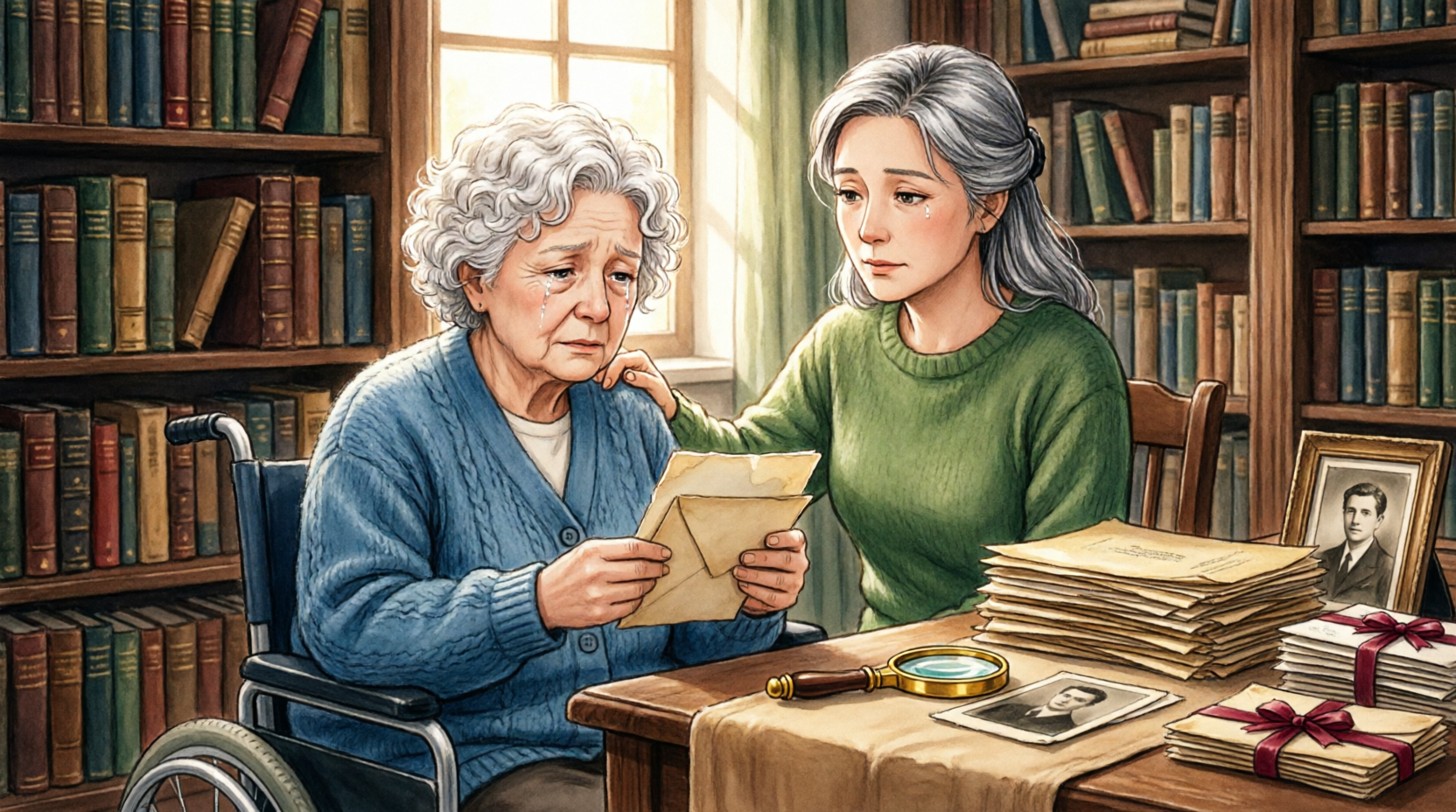
Over the next week, I found myself drifting into memories I hadn’t visited in years. Not the painful ones, but the quiet ones. Martin adjusting my blanket on cold mornings. Martin learning to paint watercolors beside me so I wouldn’t feel alone in my studio. Martin kneeling beside my wheelchair in the grocery store, holding a jar of pickles just out of reach, and whispering, “Tell me when you want it, my love. I’m not in a hurry.”
I had always thought of those moments as simple kindnesses. Now I saw them as devotion. As a man quietly honoring a life he believed was a miracle, even when the world had told him it was broken.
On a Tuesday, I asked Claire to help me dig through the attic again. We weren’t looking for anything in particular. We were just following the thread Martin had left behind. Beneath a stack of old tax returns and Christmas ornaments, we found a small filing cabinet I hadn’t noticed in years. Inside were manila folders, each labeled with a year and a name. Not mine. Not the children’s.
Arthur Jenkins.
My breath caught. I opened the first folder. Newspaper clippings. A faded photograph of a young man standing beside a rusted pickup truck, his shoulders squared, his eyes downcast. A copy of a community newsletter mentioning a “A.J.” who volunteered at the local youth center. A receipt for a donation to a spinal rehabilitation fund, dated 1978. Another in 1985. Another in 1999. Each one for exactly $200. The same amount, year after year, until the donations stopped in 2022.
Martin hadn’t just written letters. He had kept watch. He had tracked a man’s life from a distance, not out of obsession, but out of quiet solidarity. He had known Arthur never escaped the shadow of that November night. And instead of letting guilt consume them both, Martin had chosen to hold the space for forgiveness until the day came when I could step into it myself.
I ran my fingers over the faded receipt from 1999. The paper was brittle, the ink smudged from decades of handling. I thought of Arthur, wherever he was, probably wondering if the world had moved on without him. He never knew. He never knew that the girl he’d injured had built a life of love, that her husband had spent sixty-five years quietly anchoring his conscience, that his mistake had become the unlikely foundation of a family.
Claire sat beside me on the attic floor, her knees drawn to her chest. “Do you think he ever tried to reach out?” she asked softly.
“I don’t think he felt he had the right,” I said. “Guilt is a heavy thing. Shame is heavier. Martin understood that. He didn’t want to force forgiveness. He just wanted to leave the door open.”
She nodded slowly. “What do you want to do with all of this?”
I looked down at the folders, the clippings, the quiet evidence of a man’s lifelong penance. “I want to find where he lived. I want to see his grave. And I want to leave one of Martin’s letters there. Not for him. For me.”
The words surprised me as much as they did her. But they felt true. Forgiveness isn’t something you declare. It’s something you practice. And I was ready to begin.
PART 3
We left on a Thursday. The sky was the color of brushed steel, the roads slick with melting frost. Claire drove. I sat in the passenger seat with the wooden box on my lap, one hand resting on the lid, the other gripping the armrest as the miles unspooled. Seven hours. Three states. One destination.
Arthur’s town was smaller than I remembered, though I hadn’t been there since the trial in 1951. The courthouse was still there, its stone steps worn smooth by generations of footsteps. But the old brick wall where I’d been pinned was gone, replaced by a community garden with raised beds and a small plaque that read: Growth begins where roots are planted.
I didn’t cry. I just stared at it, feeling the decades fold inward like pages in a book finally closing.
We found the cemetery on the outskirts, tucked behind a row of aging pines. The iron gates were slightly rusted, the paths lined with fallen leaves that crunched beneath my tires. Claire wheeled me slowly, her hands steady on the handles, her presence a quiet anchor.
We found his plot without difficulty. A simple gray stone. A small bronze marker. A dried sprig of rosemary tucked into the base. Arthur Thomas Jenkins. 1932–2023. He carried his mistakes so others wouldn’t have to.
I sat in silence for a long time. The wind moved through the branches, carrying the scent of damp earth and woodsmoke. I reached into my coat and pulled out the last letter Martin had written, the one with the trembling handwriting, the one dated two years ago. I placed it carefully on the flat top of the stone.
“I brought you his words,” I whispered. “You never got to hear them. But I’m listening now.”
Footsteps crunched behind me. I turned to see an older woman standing a few feet away, her hands tucked into a wool coat, her eyes wide and uncertain. “I’m sorry,” she said quickly. “I didn’t mean to intrude. I just… I come out here on Thursdays. To tidy up. He was my uncle.”
Claire stepped closer. “I’m Claire. This is my mother, Eleanor. We knew him. In a way.”
The woman’s name was Miriam. Arthur’s niece. He had no children, but he had been a steady presence in her life: teaching her to change a tire, paying for her nursing school, leaving her his old pickup when he moved to a smaller apartment. She hadn’t known about the accident until years later, when she found a box of newspaper clippings in his attic. Articles about a paralyzed girl who became a painter. Exhibition reviews. A wedding announcement with a photograph of a smiling young couple. He had kept them all, folded neatly, tied with twine.
“He never talked about it,” Miriam said, sitting on a nearby bench as I wheeled closer. “But I found a journal once. Just a few pages. He wrote: I took her legs, but I hope God gave her wings instead. I hope she flies so high she never feels the ground I left her on.”
My throat tightened. I looked down at my hands, the hands that had painted canvases, held grandchildren, traced Martin’s face as he breathed his last. I had spent so long believing my life was a subtraction. But here was a man who had seen it as an addition. A man who had watched from afar, who had carried guilt like a second spine, who had tried, in his quiet, broken way, to balance a scale that could never truly be balanced.
“Did he ever try to reach out?” Claire asked gently.
Miriam shook her head. “He said shame is a heavier chain than guilt. Guilt makes you want to fix things. Shame makes you believe you don’t deserve to. He stayed away because he loved you too much to risk ruining the life you’d built.”
I closed my eyes. The wind carried the sound of distant traffic, the rustle of leaves, the quiet breathing of a woman who had loved a man I’d hated for decades. And in that moment, something inside me unclenched. Not all at once. Not with a dramatic crack. But slowly, like ice melting under a winter sun, leaving behind only water and earth and the promise of spring.
I reached into my coat pocket and pulled out a small, folded piece of paper. It wasn’t one of Martin’s letters. It was one of mine. I had written it the night before we left, my hand shaking, my heart full.
I handed it to Miriam. “Will you read it here, if you’d rather?”
She took it carefully, unfolded it, and began to read aloud:
Arthur, I don’t know if you can hear me. I don’t know if you believed in anything after that night. But I’m sitting here now, in the place where your name rests in stone, and I want you to know: I forgive you. Not because what happened was fair. Not because the years of pain were easy. But because love taught me how to let go. Martin spent his life writing to you to absolve you. I’m writing to tell you that you’re already free. Rest now. I’ll carry the rest.
Miriam’s voice broke on the last line. She pressed a hand to her mouth, tears falling freely. Claire reached for her hand. I sat quietly, feeling the weight of seventy years lift from my shoulders, not because the past had changed, but because I had finally stopped asking it to.
We stayed until the sun dipped below the tree line, painting the sky in streaks of apricot and violet. When we finally turned back toward the car, I didn’t look back at the grave. I didn’t need to. I had already said what I came to say. And for the first time in my life, I felt the road ahead not as something I was pulled along in, but as something I was choosing to travel.
PART 4
The house felt different when we returned. Not smaller. Not emptier. Just… open. As if the walls had been breathing out while I was gone, making room for whatever came next. Claire unpacked her suitcase, kissed my cheek, and went to her own home, leaving me to the quiet I no longer feared.
I wheeled back into Martin’s office the next morning. The drawer was still open. The letters were still there. But they no longer felt like secrets. They felt like seeds.
I spent the week sorting through them. Not to pack them away, but to preserve them. Claire helped me scan each page, careful not to crease the edges, archiving them in a simple wooden box lined with acid-free paper. I labeled it not with a date, but with a single word: Beginnings.
Because that’s what they were. Not an end. Not a betrayal. Not even a revelation. They were the quiet architecture of a love that refused to let tragedy have the final word. Martin hadn’t hidden these letters out of fear. He had hidden them out of reverence. He knew I wasn’t ready to carry forgiveness when the wound was still fresh. So he carried it for me, year after year, until the day came when I could hold it myself.
I began to paint again. Not the heavy, storm-colored canvases I’d done in the months after his passing, but lighter things. Landscapes with wide skies. Portraits of hands holding hands. A series of wheels, not as symbols of limitation, but as circles of motion, of return, of continuity. My granddaughter, Lily, came over on weekends and mixed my paints, her small fingers smudged with cerulean and gold. “Grandma,” she said one afternoon, “what are you painting?”
“Letters,” I said. “The ones we leave behind.”
She didn’t fully understand, but she nodded, as children do when they sense truth even if they can’t yet name it.
In early November, I gathered my family in the living room. Claire, her husband, the grandchildren, a few close friends. I didn’t give a speech. I simply placed the wooden box on the coffee table and opened it. I read them Martin’s first letter. Then the last. Then the one I had written to Arthur. The room was silent except for the crackle of the fireplace and the occasional sniffle. When I finished, Lily reached out and touched the edge of the box.
“Can we keep writing them?” she asked.
“Yes,” I said. “We can.”
We started a tradition. Not a grand one. Just a simple one. Every winter, on the anniversary of Martin’s passing, we gather. We read one of his letters aloud. We share a story we’ve been holding onto. We write one of our own—not to send, but to release. Grief, I’ve learned, isn’t a wall. It’s a river. You don’t stop it. You learn how to float.
I still miss him. Some days, the absence is a physical ache, a hollow space in the bed, a silence where his voice should be. But I no longer live inside the hollow. I live around it. I’ve planted a garden behind the house: hydrangeas for endurance, lavender for peace, a small maple tree near the fence where the soil catches the morning sun. I sit in my wheelchair beside it and watch the seasons turn. I listen to the wind. I remember.
Last week, I received a package in the mail. No return address. Inside was a small, leather-bound journal and a note: From Miriam. He would have wanted you to have it. Thank you for freeing him. Thank you for letting us know he mattered.
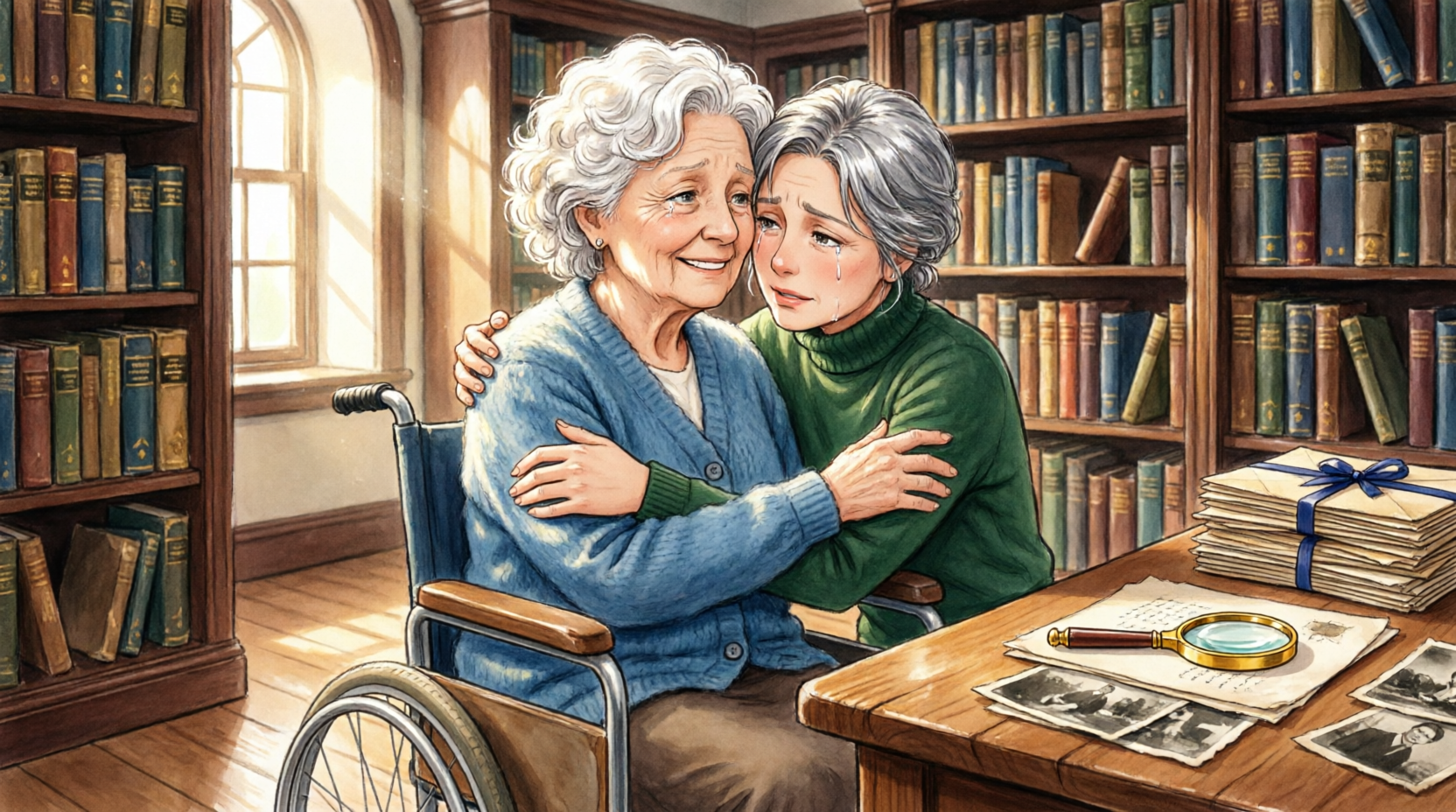
I opened the journal. The first page was blank except for a single line, written in Arthur’s shaky, elderly hand, preserved by Miriam: I hope she flies.
I closed it gently. I didn’t cry. I smiled.
Life without Martin never existed, just as I said all those months ago. But I see now that I was wrong about what that means. It doesn’t mean I’m trapped in the past. It means he is woven into the present. In the way I hold a teacup. In the way I forgive too quickly. In the way I look at my grandchildren and see his eyes. In the way I finally understand that love isn’t something you lose when someone dies. It’s something you learn how to carry differently.
I wheel back into the office sometimes. I don’t lock the drawer anymore. I leave it open. A quiet invitation. A testament. A reminder that the greatest tragedies can become sacred ground if you’re willing to kneel in them long enough to see what’s growing.
And on clear nights, when the moon spills through the window and the house is still, I sit at his desk, place my hands over the wood he smoothed for sixty-five years, and whisper into the dark:
“I’m still here, my love. And I’m finally walking with you.”
Not with my legs. Never with those. But with my heart. And that, I’ve come to realize, is the only way any of us ever truly moves forward.
END