I knew he was not the kind of man who exaggerated. He came off his porch before I had fully shut the door of my truck, crossing the quiet suburban street with a speed that did not match his age. He was thin, gray-haired, wearing a faded University of Tennessee sweatshirt and house slippers, and one hand was already raised as if he needed to stop me from taking another step toward my son’s front door. “You Daniel Harper?” he asked. “Yes.”
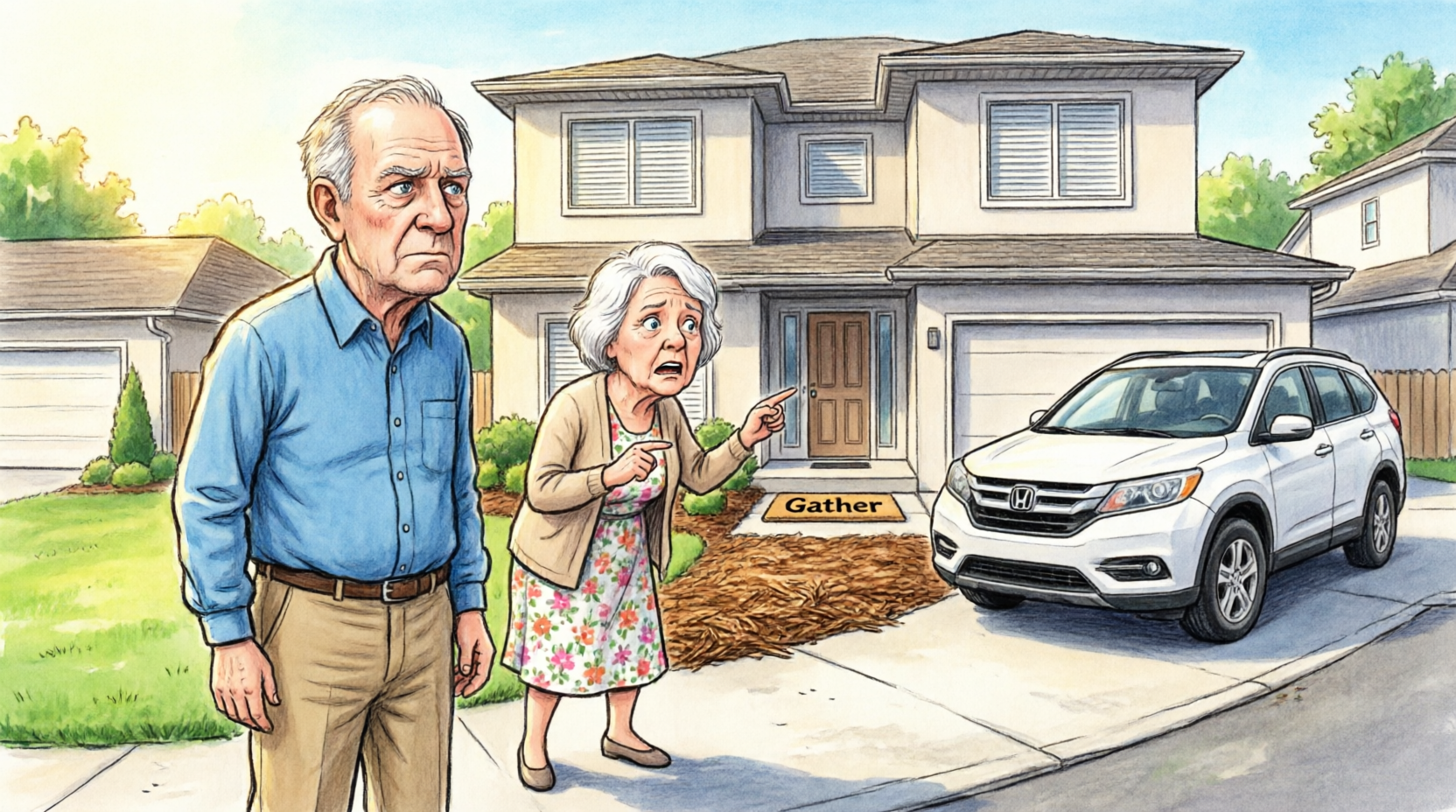
His eyes moved to the two-story brick house behind me, the one with fresh mulch around the shrubs, moving boxes still stacked in the garage, and my son’s silver SUV parked in the driveway. Then he looked back at me. “You need to get help here right now before you go inside that house.” For one second, the whole street seemed to go quiet. The wind moved through a row of young maple trees along the curb. Somewhere down the block, a dog barked once and stopped. My hand was still on the truck door. I remember the cold metal under my palm, the smell of rain coming off the pavement, and the terrible certainty that rose in me before I even understood why. “What happened?” I asked.
The man swallowed. His throat worked hard, but no words came out at first. I had spent thirty-one years in a profession that taught me how to read fear before people explained it. Real fear does not always shout. Sometimes it stands in a driveway wearing house slippers and looks ashamed it waited too long to cross the street. “Your wife,” he said finally. “Maggie. She’s inside. She tried to talk to me yesterday, but they pulled her back in before she could say much. She looked bad, Mr. Harper. Real bad.” I did not ask who “they” were. I already knew. My son Kevin and his wife, Brittany, had moved to Knoxville two months earlier after Kevin got promoted to regional director at a financial firm. Maggie had driven over from Nashville to help them get settled. She planned to stay two weeks. She packed a small suitcase, a casserole dish, two bags of groceries, and her ridiculous yellow rubber gloves because she said new houses needed “one deep clean before you could trust the corners.” She called me the night she arrived.
“Daniel,” she said, sounding happy and tired, “the kitchen is huge. You should see the pantry. Brittany says she doesn’t know where anything should go, so I’m making zones.”
“Zones,” I repeated.
“Don’t mock the zones. The zones keep civilization together.”
That was Maggie.
Forty-one years married, and she could still make a new pantry sound like a mission from heaven. She loved order, not because she was controlling, but because she believed a well-made home could steady people who were falling apart. When Kevin was little and my work kept me gone too much, Maggie was the one who made sure his socks matched, the school forms were signed, the birthday cupcakes arrived on time, and every broken place in our family looked whole enough for a child to grow inside it.
She texted me every morning.
Good morning, old man.
Sometimes with a heart. Sometimes with a coffee cup emoji our granddaughter had taught her to use. It was our habit. Had been for decades. Even when we were upset with each other, even when I worked overnight, even when she was in the hospital after her gallbladder surgery and could barely keep her eyes open, a message came.
Four days after she arrived in Knoxville, the messages stopped.
At first, I explained it away.
She was busy. She had forgotten to charge her phone. Kevin needed help with furniture. Brittany had her reorganizing closets. I called and got voicemail. I texted and watched the message sit unread. I called Kevin.
“She’s fine, Dad,” he said, too quickly. “Mom’s just worn out. She overdoes it, you know that.”
“Put her on.”
“She’s asleep.”
“At two in the afternoon?”
“She’s tired.”
Something in his voice tightened around that word.
Tired.
I knew my wife tired. I knew her bone-tired after three days of cooking for church events, her happy-tired after gardening, her worried-tired after Kevin’s teenage years, and her quiet-tired after funerals. None of those versions kept her from texting me good morning.
On the fifth day, I got in my truck and drove east.
The drive to Knoxville should have taken three hours. It took longer because I stopped twice without meaning to. Once at a gas station outside Crossville, where I sat with the engine running and told myself I was being dramatic. Once at a rest area where I called Maggie again and listened to her voicemail greeting just to hear her voice.
Hi, this is Maggie. Leave me a message unless you’re Daniel, in which case I probably know what you want and yes, there’s soup in the freezer.
I nearly broke right there between the vending machines and the map of Tennessee.
Then I got back on the road.
Kevin’s neighborhood was new, one of those subdivisions where every lawn looks professionally planned and every house seems slightly too large for the people inside it. Brick fronts, black shutters, wide driveways, porch columns pretending to be older than they were. It was the kind of place Brittany loved. Clean lines. Neutral colors. Nobody leaving tools or life in view.
When I turned onto Hawthorne Ridge Lane, I spotted Kevin’s house immediately. Not because I had been there before. Because Maggie had sent me a picture the first night, proud of the big front windows and the white rocking chairs she said made the porch “less cold.”
The rocking chairs were gone.
In their place were two black metal planters and a doormat that said simply: Gather.
I parked behind Kevin’s SUV, stepped out, and that was when the older neighbor crossed the street.
His name was Earl Whitaker. I learned that later.
In that first moment, he was only the man standing between me and a front door I suddenly feared opening.
“Tell me exactly what you saw,” I said.
He looked toward the house again. The blinds were closed in every front window.
“I saw your wife on the porch yesterday morning,” he said. “She was holding the railing like she might fall. I was getting my paper. I waved because I’d seen her hauling boxes all week, and she tried to cross over. She got as far as the driveway.”
His voice caught.
“What happened?”
“Your daughter-in-law came out. Smiling. Real pleasant. Put her arm around Maggie and said she needed to rest. But Maggie looked at me and said, ‘If Daniel comes, tell him I need my phone.’ Then they took her inside.”
My chest went cold.
“She said that?”
He nodded. “And this morning, I saw the young man leave with a folder and come back with two coffees. Your wife hasn’t been out. I called over there once. Nobody answered. I almost called for help myself, but I didn’t know her full name, and I didn’t want to make trouble if I was wrong.”
He looked ashamed.
“You’re not wrong,” I said.
I took out my phone and called for medical assistance before I walked to the door.
I did not care who thought I was overreacting.
When I knocked, nobody answered.
I knocked again.
The door opened with a soft click, and Brittany stood there wearing beige lounge pants, a cream sweater, and a smile that belonged in a home goods catalog. Her hair was pulled into a glossy ponytail. Her nails were pale pink. Behind her, the house smelled faintly of lemon cleaner and something sweet baking.
“Daniel,” she said, blinking as if I were a surprise guest and not the husband of the woman who had stopped answering calls. “You drove all the way here?”
“Where is Maggie?”
Her smile faltered, then returned. “She’s resting.”
“I want to see her.”
“Of course. I just think we should be careful not to overwhelm her. She’s been emotional.”
That word.
Emotional.
People use it when they want to make pain sound unreliable.
I stepped forward.
Brittany did not move at first.
Then she saw something in my face and stepped back.
The foyer was staged perfectly: a narrow table, a ceramic bowl, a gold-framed mirror, two woven baskets beneath the bench. Moving boxes were stacked along the hallway, but they had been lined up neatly, labels facing out. Kitchen. Primary closet. Guest room. Home office.
On the dining table, just beyond the entryway, sat a navy folder with legal tabs sticking out.
My eyes went to it.
Brittany noticed and shifted slightly, blocking my line of sight.
“Kevin is upstairs,” she said.
“Where is my wife?”
She drew a breath. “Guest room.”
I walked past her.
“Daniel,” she said behind me, sharper now. “Wait.”
I did not.
At the foot of the stairs, Kevin appeared.
My son.
Thirty-eight years old, tall, handsome in a fitted pullover and expensive watch, looking more irritated than afraid.
“Dad,” he said. “What are you doing?”
I stopped halfway up.
“That is not the question you ask when your father arrives after your mother disappears for four days.”
His face tightened. “She didn’t disappear. She’s resting.”
“Then move.”
“Dad, you need to calm down.”
I looked at him for a long second.
He had been a bright child. That is what hurt most about Kevin. Some betrayals come from people you once called gifted. He could read a room before he was ten. He knew when his mother was sad, when I was carrying work home in my shoulders, when teachers needed charm, when trouble required a joke. Maggie called him our sunshine boy. I called him the negotiator.
Now he was standing in front of me, using every skill he had been born with to keep me away from his mother.
“I am calm,” I said. “That is why you should move.”
For the first time, uncertainty crossed his face.
Then from upstairs came a sound.
Not a scream. Not a crash. A small, weak cough.
I went around him.
The guest room was at the end of the hall, the smallest room in the house despite the “Guest Suite” label on the moving box outside. The door was half open. Inside, the curtains were closed. A lamp glowed on the nightstand. The bed had no headboard yet, just a mattress on a metal frame. Several baskets of laundry were stacked against the wall. A pile of folded towels sat at the foot of the bed.
Maggie lay on top of the blanket wearing the same blue cardigan she had left Nashville in.
Her face was pale. Her lips were dry. Her hair, usually pinned neatly, was loose and damp at the temples. One hand rested on her stomach. The other was curled near her chest as if she had fallen asleep holding something that was no longer there.
“Maggie.”
Her eyelids fluttered.
For half a second, she seemed not to know where she was.
Then she saw me.
“Daniel,” she whispered.
I crossed the room and took her hand. It was too warm and too light in mine.
“What happened?”
Her eyes filled. “My phone.”
“I know.”
“I tried.”
“I know.”
Brittany’s voice came from the doorway. “She has been confused off and on. We were going to call you after she slept.”
I did not look back.
Maggie’s fingers tightened weakly. “Medicine.”
That one word brought the whole room into focus.
Maggie took blood pressure medication every morning and another pill at night. She had a pill organizer in her suitcase, labeled by day. I looked at the nightstand.
No organizer.
No phone.
No water glass except an empty one on the floor.
“Where are her medications?” I asked.
Kevin said, “Downstairs. We were keeping track so she didn’t double up.”
I turned then.
He was standing beside Brittany, both of them framed in the doorway like they had rehearsed concern.
My son would not meet my eyes.
Brittany did.
That told me something too.
“You took her phone and her medication?”
“Daniel,” Brittany said, soft and careful, “that sounds much harsher than it was.”
The faint sound of an engine stopped outside.
Medical help arriving.
Kevin looked toward the window.
“What did you do?” he asked.
“I called for help before I came in.”
His face changed.
Not relief.
Concern for himself.
Brittany’s hand moved to his arm, a small gesture, but I saw it. I had spent too many years watching people tell lies with their hands while their mouths stayed polite.
“You shouldn’t have done that,” she said.
“Why?”
“Because this is a family matter.”
Maggie’s eyes closed.
I leaned down. “Stay with me.”
“I’m tired.”
“I know, sweetheart. Help is here.”
The emergency team entered with professional calm. They asked questions. Kevin answered too quickly. Brittany answered too neatly. I interrupted only when the answers were wrong.
“She takes medication twice a day,” I said. “She has not had her phone. I do not know whether she has had water. I do not know whether she has taken her medication correctly because I have not seen the organizer.”
Brittany said, “We were managing it.”
A medic looked at her. “Who is ‘we’?”
No one answered.
Maggie was transported to the hospital.
I rode with her.
Kevin and Brittany followed in their SUV.
I did not speak to them in the emergency department. I stayed beside Maggie while nurses asked questions and doctors ordered tests. She was dehydrated, exhausted, her blood pressure unstable, her medication schedule disrupted enough to scare everyone who read the chart. They said stress and missed routine could make things dangerous very quickly at her age.
Her age.
Maggie was sixty-five. She walked three miles every morning when the weather cooperated. She volunteered at the library. She could reorganize a pantry faster than most people could find the cereal. But five days in that house had made her look ten years older.
When they moved her to a room for observation, she finally slept.
That was when I looked through the plastic bag containing her belongings.
A nurse had given it to me after Kevin produced Maggie’s suitcase from the house. Inside were clothes, a brush, her glasses case, her wallet, and the pill organizer.
Several compartments were unopened.
Several were empty on the wrong days.
At the bottom of the suitcase, tucked inside a folded nightgown, I found a napkin.
It was from the coffee shop near Kevin’s house.
On it, in Maggie’s shaking handwriting, were six words:
Daniel, please come. I need help.
I sat in the hospital chair with that napkin in my hand and felt something inside me become very quiet.
Not calm.
Quiet.
There is a difference.
At 2:18 that afternoon, Kevin came into the waiting area carrying two coffees.
Brittany was behind him with the navy folder from the dining table.
I looked at the folder first.
Kevin saw me look.
“Dad,” he said, “we need to talk before this becomes something it doesn’t have to be.”
“It already became something.”
He lowered his voice. “Mom came here to help. She overdid it. That’s all.”
“That is not all.”
Brittany sat across from me, placing the folder on her lap. “Daniel, I know this is upsetting. But Maggie has been anxious for a while. She worries about everything. Kevin and I were trying to organize the house and family paperwork so she wouldn’t feel so overwhelmed.”
“Family paperwork.”
“Yes,” she said. “Estate planning, beneficiary updates, healthcare authorizations, simple things everyone should review.”
I leaned back.
Eight weeks earlier, Kevin had called me while I was changing oil in Maggie’s car.
Dad, have you thought about updating your beneficiary designations? Britney’s an estate planner by training. She’d be happy to help you and Mom review everything.
The question sat wrong in my gut then.
Now the gut had a name for it.
“Open the folder,” I said.
Brittany hesitated. “This isn’t the time.”
“You brought it to a hospital.”
Her face tightened.
Kevin opened it.
Inside were forms with yellow signature tabs. Durable power of attorney. Medical authorization. Beneficiary review request. A draft letter to our pension administrator. A proposed family trust amendment. A document that would have made Kevin primary contact for certain financial decisions if Maggie was deemed unable to manage routine matters.
I picked up the top page.
Maggie’s name was typed in full.
Margaret Lynn Harper.
Signature line highlighted.
My son’s name underneath.
Kevin Andrew Harper.
Brittany said, “These are just drafts.”
“Drafts you brought to the hospital.”
“We were concerned,” she said.
“About her health?”
“Yes.”
“Then why was there no water by her bed?”
Kevin flinched.
“Why was her phone downstairs?”
No answer.
“Why did she write me a note on a napkin?”
Brittany’s eyes flickered.
Kevin looked at me. “What note?”
I took it from my pocket and placed it on the small table between us.
Daniel, please come. I need help.
The room went still.
Kevin stared at the napkin as if it had appeared from nowhere.
Brittany’s face changed only slightly, but enough.
That was when I knew she had seen it before. Maybe not this exact napkin. But the need behind it.
“Dad,” Kevin said, voice cracking now, “this looks bad.”
“No,” I said. “It looks clear.”
He rubbed both hands over his face. “You don’t understand the pressure we’ve been under.”
There it was.
Pressure.
Not apology. Not concern. Pressure.
I looked at my son, and for one painful second I saw him at seven years old, standing in the garage with a fishing pole too big for him, asking if Mom would pack sandwiches with extra pickles. I saw Maggie kneeling to tie his shoes before school. I saw her at his high school graduation, crying into a tissue while I pretended my eyes were dry. I saw every birthday cake she baked, every illness she sat through, every late-night call she answered even when he was grown.
Then I looked at the folder.
“What pressure?”
Brittany answered first. “The move was expensive. The house needed more than expected. Kevin’s bonus structure changed. We have temporary cash-flow issues.”
“Cash-flow issues,” I repeated.
Kevin looked at the floor.
“How much?”
He did not answer.
I turned to Brittany. “How much?”
She held my gaze. “Enough that we needed to plan responsibly.”
“Do not use responsible as a curtain.”
Her face hardened.
That was the first time she stopped performing softness.
Kevin whispered, “Two hundred and eighty thousand.”
The number entered the room slowly.
A hospital announcement crackled overhead. Somewhere nearby, a child laughed at a cartoon on a tablet. A nurse walked past carrying a paper cup. Ordinary life continued while my son confessed to building a crisis behind moving boxes and polite language.
“Debt?” I asked.
“Part debt,” he said. “Part bridge financing. Some investment losses.”
“Your investment losses?”
He said nothing.
Brittany closed the folder. “We were going to repay everything. We just needed stability.”
“With your mother’s signature.”
Kevin looked up sharply. “We weren’t taking anything from Mom.”
“No? Then why did you need her phone away from her?”
“I didn’t—”
“Why did Earl across the street know something was wrong before her own son called me?”
His face drained.
“Who is Earl?” Brittany asked.
“The man who saw what you hoped stayed inside.”
Brittany stood. “This conversation is becoming hostile.”
“No,” I said. “It is becoming documented.”
That word landed where I meant it to.
Documented.
People who manage stories hate that word.
I had already called our attorney, Sylvia Lane, from the hospital hallway. I had already sent her a photo of the napkin, the forms, the pill organizer, and Maggie’s unanswered messages. I had already asked the nurse to document that Maggie reported not having access to her phone. I had already gotten Earl Whitaker’s number and told him Sylvia would call.
By four o’clock, every account Kevin and Brittany had ever touched was frozen from convenience access. The emergency card was suspended. The automatic transfer that helped with their mortgage was paused. The education savings account for our granddaughter was moved under independent management. Our pension and beneficiary records were locked behind attorney approval. Any document naming Kevin or Brittany as agent was revoked before it could breathe.
I did not do it with shouting.
I did it with phone calls.
That is how power should move when it finally remembers its purpose.
At 4:27, Kevin’s phone buzzed.
Then Brittany’s.
Then Kevin’s again.
He looked down.
Brittany stepped closer, reading over his shoulder.
For the first time all day, their calm disappeared.
Kevin looked at me. “Dad.”
I said nothing.
“What did you do?”
I looked through the glass toward Maggie’s room.
“I made sure your mother never has to ask permission to call me again.”
Brittany’s face flushed. “You had no right.”
That sentence was so revealing I almost thanked her for it.
“No right,” I repeated.
“I mean, you’re emotional.”
“I am very emotional,” I said. “But Sylvia is not. The bank is not. The hospital chart is not. The napkin is not.”
Kevin sat down hard.
Brittany remained standing, one hand gripping the folder.
“You are going to ruin him,” she said.
I looked at my son. “He started without me.”
Kevin covered his face.
That was the first real sign of shame.
Not enough. But real.
Maggie woke around six.
She looked at me first, then at the water cup in her hand, then at the hospital room as if trying to remember which version of the world she had returned to.
“Daniel?”
“I’m here.”
Her eyes filled. “I tried to call.”
“I know.”
“They said I was being dramatic.”
“You are allowed to be dramatic.”
A faint smile touched her mouth, then disappeared. “Kevin?”
“In the waiting room.”
Her face tightened with grief.
“Did I do something wrong?” she whispered.
That question nearly broke me.
I took her hand carefully.
“No, sweetheart. You did what you always do. You helped. They took advantage of the helper.”
She closed her eyes, and tears slipped down her temples into her hair.
I did not tell her everything that night. She was too tired. But she told me enough between sleep and waking.
How the first day was normal. Maggie unpacked dishes, washed sheets, stocked the pantry. The second day, Brittany asked if she could “help” manage Maggie’s phone because everyone kept calling during work sessions. The third day, Kevin said they needed her to stay out of the way while a financial adviser came by because “Dad gets weird about paperwork.” The fourth day, Maggie asked to call me and was told she was overreacting, that I would only panic, that she needed rest. Her medication schedule got confused because Brittany moved the pill organizer to the kitchen “so we can keep track.”
Maggie tried to walk across the street.
Earl saw.
Brittany intercepted.
After that, Maggie was too weak to try again.
Each sentence was a stone placed on my chest.
By the time she fell asleep, I knew the old version of our family had ended.
The next morning, I met Earl Whitaker at the coffee shop near the hospital.
He arrived in the same Tennessee sweatshirt, carrying a yellow legal pad in a plastic folder. He apologized three times before sitting down.
“I should have called sooner,” he said.
“You crossed the street when I needed you to.”
His eyes filled.
On the legal pad, he had written dates.
Day one: older woman unloading boxes alone.
Day two: saw her carrying grocery bags; young woman on phone.
Day three: older woman on porch, seemed unsteady.
Day four: she tried to cross street, said “Tell Daniel I need my phone.”
Day five: husband arrived.
He had also written the time of the moving company truck, the visit from a financial consultant, and the moment Brittany carried a folder out to her car.
“I know this ain’t legal evidence or anything,” he said.
“It is more than you think.”
He pushed the folder toward me. “I’m widowed. My wife, Ruth, was the kind of woman who helped until there was nothing left in her. When I saw your Maggie, I saw Ruth. I couldn’t ignore it.”
I shook his hand with both of mine.
For the first time since arriving in Knoxville, I felt something other than rage.
Gratitude.
Sylvia Lane was at the hospital by noon.
She was seventy years old, sharp as a pin, wore red reading glasses, and had once told me that family paperwork is where love either becomes protection or a disguise. She reviewed everything in a quiet conference room: the forms, the note, the pill organizer, Earl’s log, Maggie’s chart, the texts on her phone once I found it in Kevin’s kitchen drawer.
That was where they had put it.
In a junk drawer beneath coupons, twist ties, and a tape measure.
Sylvia read the messages Kevin sent from Maggie’s phone to himself, drafts never finished.
Daniel worries too much.
Tell him I’m resting.
Don’t call yet.
She looked at me over her glasses.
“Daniel, this is not confusion. This is control.”
The word was clean.
Control.
Not misunderstanding. Not stress. Not family tension.
Control.
“What are our options?” I asked.
“First, Maggie’s medical and financial autonomy is protected immediately. Second, you and she document everything. Third, any support you have provided to Kevin is reviewed and converted into either formal debt, formal gift, or stopped entirely. Fourth, Maggie decides when or whether she speaks to him.”
“And the house?”
The Knoxville house had been their purchase, but I had helped with the down payment and signed a private family loan agreement Kevin insisted we did not need until Sylvia made me require it. At the time, I thought she was being overly cautious.
She slid a document from her folder.
“Your loan is secured by a recorded lien.”
I stared at her.
She smiled slightly. “You forgot?”
“I trusted you.”
“Good. Continue doing that.”
The lien meant Kevin and Brittany could not refinance, transfer, or sell without resolving what they owed us. It also meant the financial consultant visit Brittany arranged had likely been blocked by a fact she did not understand.
For the first time, the room tilted back in my favor.
Not because I wanted revenge.
Because Maggie needed a floor under her.
Kevin asked to see us that afternoon.
Maggie said no.
That was the first no.
Small. Hoarse. From a hospital bed. But hers.
Kevin stood outside the door, looking through the small rectangular window. I watched his face when the nurse told him.
He looked wounded.
Then angry.
Then ashamed.
All in three seconds.
Brittany did not come that day.
She sent an email instead.
Daniel,
This situation has been misinterpreted under stress. Kevin and I were trying to help Maggie manage her health and reduce confusion. Freezing accounts and involving attorneys escalates a private family issue unnecessarily. We hope you will reconsider before permanent damage is done.
Brittany
Sylvia read it and said, “Keep it.”
“Why?”
“People reveal themselves when they think they sound reasonable.”
Maggie stayed in the hospital three nights.
On the fourth morning, she was strong enough to sit in the chair by the window, wrapped in a blanket, sipping coffee she complained was “dishwater pretending to be medicine.” That was when I knew she was coming back to herself.
Kevin was allowed one visit before we returned to Nashville.
Maggie agreed on three conditions: Sylvia in the room, me beside her, and Brittany not present.
Kevin came in wearing yesterday’s shirt, unshaven, eyes red. He stood near the door like a man approaching a house he had already set on fire but still hoped to enter.
“Mom,” he said.
Maggie looked at him.
She had been practicing what to say. I knew because she had asked for a notepad and written three sentences, then crossed out two.
Now the paper rested in her lap.
“Why?” she asked.
Kevin’s face crumpled.
That was all she asked.
Not how could you. Not what were you thinking. Just why.
He looked at the floor. “We were drowning.”
Maggie closed her eyes.
Kevin rushed on. “Brittany’s consulting clients disappeared after the move. My bonus got deferred. We were behind on things. We thought if we could just organize the family finances—”
Maggie opened her eyes. “You mean ours.”
He swallowed.
“Yes.”
“You took my phone.”
“I thought if Dad heard you upset, he’d come charging in before we could explain.”
“He did anyway.”
A faint, bitter little smile crossed her face. Kevin flinched.
“I didn’t mean for you to get sick,” he whispered.
That sentence told the truth more than he knew.
Not that he meant harm. That he had accepted risk. That Maggie’s discomfort, confusion, and isolation had become acceptable as long as his plan stayed possible.
“You moved my medicine,” she said.
“Brittany said she could track it better.”
“Did you check?”
He did not answer.
Maggie looked out the window for a moment. Knoxville spread below in gentle hills, roofs, trees, traffic moving like nothing had happened.
Then she turned back.
“I raised you to know better than letting someone else mistreat your mother because confronting them was inconvenient.”
Kevin began to cry.
Quietly at first, then harder. He sat in the visitor chair and covered his face. For a moment, he was eight years old again, crying because he broke a neighbor’s window and thought apology could undo physics.
I felt the old father in me step forward.
Then I looked at Maggie.
She did not move toward him.
So neither did I.
That was the hardest thing I did that week.
Kevin left after signing the first acknowledgment Sylvia placed in front of him: no access to our accounts, no authority over Maggie’s medical or financial decisions, no further documents presented without counsel, full disclosure of debts within ten days.
He signed because he had no better option.
That is not the same as remorse.
But sometimes paperwork has to come before character catches up.
We returned to Nashville the next day.
Maggie cried when she saw our front porch.
Not loudly. She simply stood at the base of the steps, one hand on the railing, staring at the hanging fern she had asked me to water and knew I had probably overwatered. I expected her to go inside.
Instead, she sat on the top step.
I sat beside her.
“I thought I was helping,” she said.
“You were.”
“I thought if I worked hard enough, they’d see it.”
I looked at her hands, still bruised from the hospital IV, folded in her lap.
“Maggie, people who want to use you will always notice your work. They just won’t call it love.”
She leaned into me then, and for the first time since Knoxville, she cried fully.
I held her while the neighborhood moved around us. A child rode a bike. A delivery truck passed. Somewhere a lawn mower started. Ordinary life, which had never seemed so precious.
The next months were not clean.
Kevin and Brittany fought us through emails, then through silence, then through a lawyer who quickly discovered Sylvia was not a woman to be managed. Their finances were worse than Kevin admitted. The two hundred and eighty thousand was only the visible problem. Credit lines, private loans, renovation bills, leased furniture, a second car Brittany had hidden under her business, all stacked beneath the polished surface of that Knoxville house.
They tried to refinance.
The lien stopped it.
They tried to sell quickly.
The lien stopped that too.
They tried to pressure Maggie through emotional messages.
She stopped reading them without me or Sylvia beside her.
That was progress.
Eventually, Kevin agreed to a structured repayment plan tied to the sale of the house. Brittany resisted until her own attorney advised her that resisting reality was expensive. The house sold six months later. It did not sell for what they hoped. Houses rarely sell for fantasy. But it cleared our loan and forced Kevin and Brittany into a life measured by income instead of image.
They moved into a townhouse outside Maryville.
Smaller. Honest.
Brittany did not apologize.
Kevin did.
The first apology came too soon and meant too little. The second came in writing after three months of counseling. The third came in person at our kitchen table with Sylvia present because Maggie wanted a witness.
“I let my fear turn into permission,” he said.
Maggie looked at him. “Permission for what?”
“To let Brittany lead where I should have stood up. To treat your help like a resource instead of a gift. To ignore that you were scared because I was scared of what Dad would do when he found out the truth.”
I wanted to say something.
Maggie touched my hand under the table.
No.
So I stayed quiet.
She looked at our son for a long time.
“I love you,” she said. “That is not the question.”
Kevin nodded, tears in his eyes.
“The question,” Maggie continued, “is whether I can be safe around you.”
His face folded.
“I want to earn that back.”
“You will not earn it with words.”
“I know.”
“I hope you do.”
That was all she gave him.
And it was generous.
Earl Whitaker came to Nashville in the spring.
I invited him because Maggie insisted she needed to meet the man who crossed the street. He arrived in a clean button-down shirt, carrying a jar of homemade blackberry jam from his sister. He stood awkwardly in our foyer, as if unsure whether heroes were supposed to take off their shoes.
Maggie walked straight to him and hugged him.
He stiffened, then hugged her back.
“You saved me,” she said.
He shook his head. “Ma’am, I waited too long.”
“No,” she said. “You came in time.”
He cried then.
So did I.
We had lunch on the back patio. Maggie made chicken salad, deviled eggs, biscuits, and peach tea. Earl told stories about his late wife, Ruth, and how she once reorganized their neighbor’s pantry without permission and then apologized by baking three pies. Maggie laughed harder than I had heard her laugh in months.
Before he left, she pressed a blue folder into his hands.
Inside was a gift certificate for a local handyman company in Knoxville and a note.
For the porch repairs you mentioned.
From one stubborn helper to another.
Earl tried to refuse.
Maggie gave him the look.
He accepted.
By summer, Maggie was stronger.
Not the same. Stronger in a different way. She stopped answering every call immediately. She let people leave messages. She began volunteering again at the library, but only twice a week instead of five days because “helping should not eat a woman alive.” She put a sign by our kitchen phone that read:
If it is urgent, breathe first.
If it is guilt, wait.
If it is Kevin, sit down before answering.
She wrote that herself.
I framed it.
Our marriage changed too.
Not because we had been broken, but because crisis reveals habits. I realized how often I had let Maggie handle the emotional labor of our family alone. She realized how often she mistook being needed for being valued. We talked late into the night about Kevin’s childhood, my work absences, her endless efforts to compensate, and the way our son learned that Mom could always be stretched a little further and Dad would always arrive with solutions after the damage.
That was not all Kevin’s fault.
It was not all ours either.
Families are structures, and structures carry stress in patterns. Sometimes a crack appears in one room because the load was placed wrong years earlier.
I know that now.
A year after Knoxville, Kevin invited us to his counseling graduation session. I did not know such things existed, but apparently his therapist believed families sometimes need a room where people say what they usually edit.
Maggie agreed to go.
Brittany was not there. She and Kevin had separated by then. Quietly, without drama, after she decided the smaller life he was building did not fit the future she wanted. I will not pretend I was sad. I will also not pretend that her leaving fixed everything. Kevin had to face the parts of himself that had agreed with her long before she spoke aloud.
In that session, he looked at Maggie and said, “I thought because you always helped, you didn’t mind being used.”
Maggie closed her eyes.
When she opened them, her voice was calm.
“I minded. I just thought love meant not saying so.”
Kevin cried.
So did I.
Not because the sentence healed everything.
Because it told the truth.
Truth rarely fixes the past, but it gives the future a usable map.
Today, Kevin lives in a rented duplex with a small yard. He works a steady job, no title impressive enough for cocktail parties, no bonuses large enough to pretend with, but steady. He calls us on Sundays. Sometimes Maggie answers. Sometimes she lets it ring and calls back later. He never complains about that.
He has repaid half of what he owed under the agreement. The rest comes monthly. Small payments. Real ones.
Maggie keeps every receipt in a folder labeled Kevin — Repair, Not Rescue.
I love that woman.
As for Earl, he still lives across from the Knoxville house, though new owners moved in after Kevin sold it. He calls Maggie once a month. They talk about gardens, neighbors, and the strange way one brave sentence on a sidewalk can change the course of a family. He says he still watches the street more closely now. Maggie tells him that is not nosy; it is citizenship.
And me?
I still remember the moment he crossed that road.
The way he pointed at me.
The fear in his face.
The words that saved my wife from spending one more night in a room where her phone was hidden, her medicine confused, and her kindness turned against her.
“You need to get help here right now before you go inside that house.”
I did.
But the help did not end when the medical team arrived.
It continued in hospital notes, bank locks, attorney letters, neighbor logs, signed acknowledgments, hard conversations, and the painful work of refusing to call every old pattern love.
Maggie is in the garden as I write this, planting marigolds along the fence because she says bright flowers make a house tell the truth. Her phone is beside her in the dirt, fully charged. Her pill organizer is on the kitchen counter, untouched by anyone but her. Her laugh comes through the open window, light and stubborn and alive.
Two months ago, I drove to Knoxville to check on my wife.
I thought I was going to bring her home.
I did.
But first, I had to learn how close we had come to losing her inside a house full of people who called it help.