My son Noah was five years old when I learned silence could be taught. Before that day, I believed silence was something inside him. A missing switch. A neurological wall. A private room in his mind I had not found the key to yet. For five years, I had lived around that silence the way some families live around a chronic illness.
We adjusted everything. We learned his gestures. We softened our voices. We labeled drawers with pictures. We kept cups on low shelves and night-lights in the hallway and a small laminated emotion chart taped to the refrigerator.
Not “Mama.” Not “water.” Not “no.”
When he wanted juice, he pointed. When he was tired, he leaned against my leg. When he was afraid, he found my sleeve with two small fingers and held on until whatever frightened him passed. I used to tell people that Noah spoke in a language made of touch. It sounded poetic when I said it. It also kept me from falling apart.
Daniel and I had been married seven years by then.
He was the kind of husband people praised in waiting rooms because he showed up with folders and snacks and a calm expression.
He remembered appointment times.
He carried Noah’s backpack.
He knew which clinic validated parking and which speech therapist kept animal stickers in the bottom drawer.
He told every specialist the same thing.
“We just want to help our son.”
He sounded devoted.
I believed he was.
That is the part I replay most now, not because it excuses me, but because it explains how deeply a person can sleep beside a danger they have mistaken for stability.
I trusted Daniel with the insurance passwords.
I trusted him to drive when I was too nervous.
I trusted him to sit beside Noah during evaluations when I had to fill out forms.
I trusted him with my exhaustion.
That was the greatest access I ever gave him.
By Noah’s fifth birthday, the Carter family binder had become thicker than some textbooks.
There were referral letters from pediatricians.
There were hearing charts.
There were speech therapy invoices.
There was a Boston developmental clinic packet dated March 18 at 9:15 a.m., printed on cream paper with a coffee stain near the staple because I had cried while filling it out.
One intake form said developmental delay.
Another said selective mutism.
A third suggested autism spectrum evaluation, possible trauma response, or an unspecified neurological barrier.
Every answer came dressed as a question.
Every question cost money.
Daniel paid the invoices from our joint account and never complained where anyone could hear.
At night, though, he sometimes stood in Noah’s doorway with his arms crossed.
“Maybe you baby him too much,” he said once.
I looked up from folding Noah’s pajamas.
“He’s five.”
“I know how old he is, Emily.”
His tone was flat enough to make the room feel smaller.
Parents of children with unexplained needs say that a lot.
We use tired as a blanket to cover things that look too ugly in daylight.
Daniel had rules for Noah that I did not always understand.
Noah was not allowed to bang toys together.
He was not allowed to shriek in play, even soundlessly.
He was not allowed to interrupt Daniel when Daniel was on the phone, even by tugging at his sleeve.
“He has to learn boundaries,” Daniel would say.
I argued sometimes.
I lost more often than I want to admit.
Not because Daniel shouted.
Because Daniel did not shout.
He made disapproval feel like weather.
Cold.
Constant.
Something you eventually dressed around.
When our pediatrician retired, I cried in the parking lot after the final appointment.
Dr. Silver had known Noah since he was born.
She had held him at two weeks old when he wore a yellow knit hat and had milk crust in the corner of his mouth.
She had watched him miss every spoken milestone.
She had written more referrals than I could count.
Before we left, she gave me the name of Dr. Ethan Reeves, a developmental specialist newly affiliated with a Boston clinic.
“He is careful,” she said.
That was the word she used.
Not brilliant.
Not famous.
Careful.
I did not know then that careful would save us.
The appointment was scheduled for a Tuesday morning.
Daniel drove.
Noah sat in the back seat with his dinosaur backpack against his knees and his fingers wrapped around the seat belt strap.
Rain had stopped an hour earlier, and the city still smelled damp when we stepped out of the parking garage.
The clinic lobby had gray chairs, a children’s table with blunt crayons, and a fish tank with one orange fish hiding behind plastic grass.
Noah stared at the fish until the nurse called his name.
Dr. Reeves’s office smelled faintly of disinfectant and coffee.
The exam table paper crinkled beneath Noah’s knees.
Morning light came through the blinds in white bars and fell across the floor.
Dr. Reeves greeted Noah first.
Not me.
Not Daniel.
Noah.
He crouched slightly and held up one hand without moving closer.
“Hi, Noah. I’m Dr. Reeves.”
Noah looked at him, then at Daniel.
Daniel smiled.
Noah lifted two fingers in a tiny wave.
Dr. Reeves noticed the direction of his eyes.
I noticed Dr. Reeves noticing.
That was the first time my stomach tightened.
The doctor asked questions about history, therapy, hearing, sleep, diet, sensory reactions, and routines.
I answered most of them.
Daniel corrected small details.
“He prefers blue cups,” I said.
“Only at home,” Daniel added.
“He sleeps with a whale plush.”
“Not every night.”
“He hums sometimes in his sleep.”
Daniel’s pen stopped tapping.
I felt him look at me.
Dr. Reeves looked down at his notes.
Then he made the request that changed everything.
“I’d like Daniel to wait outside.”
Daniel’s smile barely moved.
“Noah gets nervous without me.”
Dr. Reeves smiled politely.
“That is exactly why this is important.”
The room went still.
The nurse looked at the chart.
I looked at Daniel.
Noah looked at the floor.
Daniel hesitated only a second, but in that second his face showed something I had rarely seen in public.
Irritation.
Not worry.
Not confusion.
Irritation.
Then he stood, kissed the top of Noah’s head, and said, “Be good.”
Noah’s shoulders lifted toward his ears.
The door closed behind Daniel.
The sound was soft.
Noah flinched anyway.
I wanted to scoop him up and leave.
Instead, I stayed because Dr. Reeves had not looked surprised.
The examination lasted nearly an hour.
Dr. Reeves checked Noah’s hearing with simple sound cues.
He examined his mouth and throat.
He asked him to stack blocks.
Noah stacked them.
He asked him to match colors.
Noah matched them.
He asked him to touch his nose, then point to the door.
Noah did it immediately.
He asked him to hand the yellow card to me and the red card to the doctor.
Noah did that too.
Everything was clean.
Too clean for the foggy explanations I had been given.
Noah was not confused.
He was not unreachable.
He was watching every adult in the room with the practiced caution of someone twice his age.
Dr. Reeves wrote very little.
That frightened me more than a full page would have.
Then a nurse in the hallway dropped a metal tray.
The crash was violent in the small clinic.
It ricocheted off tile and glass and cabinets.
Noah’s pencil snapped against the paper.
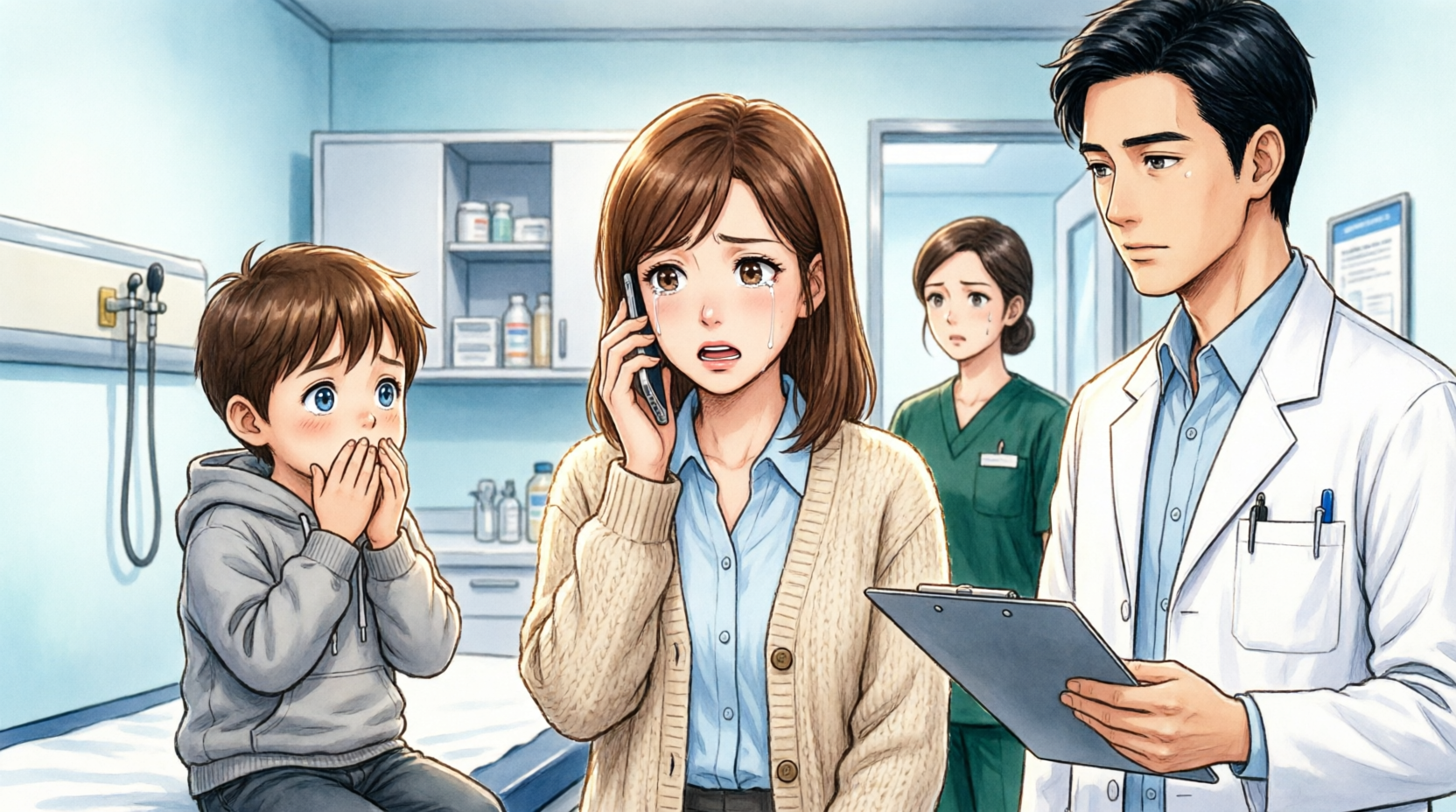
He covered his mouth with both hands.
His eyes went wide and wet.
Dr. Reeves froze.
I turned toward Noah.
He was not looking at the hallway.
He was looking at the door Daniel had walked through.
The doctor’s voice changed.
“Noah,” he said gently, “you’re safe.”
Noah shook his head once.
Small.
Terrified.
Dr. Reeves asked the nurse to sit with Noah for a moment and stepped into the hallway with him.
I could see their shapes through the glass panel.
The nurse bent slightly.
Noah clutched the paper cup she gave him.
Dr. Reeves returned alone.
His clipboard was still in his hand.
Too still.
The office smelled suddenly sharper, all antiseptic and panic.
The wall clock ticked with a cruelty I had never noticed in clocks before.
He closed the door.
“Mrs. Carter,” he said carefully, “your son’s silence is not caused by a medical condition.”
I stared at him.
“Physically and neurologically, he is completely healthy.”
My face went cold.
“What do you mean?”
“He can speak.”
The words landed without entering me.
“No.”
Dr. Reeves did not argue.
He waited.
“No, that’s not possible.”
His voice lowered.
“Your son is not mute. He has been conditioned to remain silent.”
Conditioned.
It sounded like something done to an animal.
It sounded like bells and punishments and a hand teaching fear before language had a chance.
I gripped the edge of the chair so hard my fingers hurt.
“Who would teach a child that?”
Dr. Reeves paused.
I think he hated the answer before he gave it.
“When the nurse dropped the tray,” he said, “Noah flinched, covered his mouth, and whispered very clearly, ‘Please don’t tell my dad.’”
There are sentences that split your life into before and after.
That was mine.
For five years, I had mourned a voice that existed.
For five years, my son had carried it like contraband.
For five years, the person sitting beside me in waiting rooms may have been the reason Noah believed words were dangerous.
I stood too quickly.
The chair scraped the floor.
My hands were shaking so badly I nearly dropped my phone.
Daniel’s name sat on the screen under my thumb.
It looked ordinary.
That made it worse.
Dr. Reeves said my name once, not to stop me, but to steady me.
“Emily.”
I pressed call.
Daniel answered on the second ring.
“Hey,” he said casually. “How did it go?”
I could see Noah through the office window.
He sat beside the nurse with both hands around a paper cup.
His little sneakers were planted on the floor.
He was staring at my phone.
“Emily?” Daniel said.
I could not make my voice work.
Dr. Reeves reached slowly toward the desk phone and pressed a button.
The speaker clicked.
Daniel’s voice filled the office.
“What did he say?”
I closed my eyes.
Behind my eyelids, I saw every appointment Daniel insisted on attending.
Every form he completed for me.
Every time he answered for Noah.
Every time Noah’s eyes flicked to him before making even the smallest choice.
Dr. Reeves slid a yellow observation sheet toward me.
At the bottom, beside Caregiver Response Pattern, he had written three words.
Father-controlled inhibition.
My throat tightened.
Daniel heard the paper move.
“What was that?” he asked.
I opened my eyes.
“What did you do to him?” I asked.
The line went silent.
Not disconnected.
Silent.
That was how I knew.
An innocent person fills silence with outrage, confusion, denial, questions.
Daniel filled it with calculation.
Then his voice came back, lower.
“Put the doctor on.”
Dr. Reeves did not move.
“No.”
That one word came from me.
It surprised all of us.
Daniel laughed once.
It was thin and ugly.
“Emily, you are emotional. You always get like this after appointments.”
Noah slid off the chair in the hallway.
The nurse caught his elbow gently.
Daniel continued.
“Do not let that man put ideas in your head.”
The nurse looked through the glass.
Her face changed.
Noah dropped to his knees and crawled under the small side desk beside her station.
Not ran.
Crawled.
As if making himself smaller had saved him before.
Dr. Reeves’s expression hardened.
He spoke toward the phone.
“Mr. Carter, this call is now part of my clinical documentation.”
Daniel stopped breathing for half a second.
I heard it.
So did the doctor.
“I don’t consent to that,” Daniel said.
“You are on speaker in a medical office after a child made a disclosure indicating fear of a caregiver,” Dr. Reeves replied. “My next step is not dependent on your consent.”
The words were professional.
His face was not.
His face looked like a man watching a door finally open onto the room he had suspected was there.
Daniel said my name again.
This time it sounded like a warning.
“Emily.”
I looked through the glass at the desk where my son was hiding.
For the first time in five years, I understood that Noah’s silence had never been empty.
It had been full of survival.
I hung up.
The moment the call ended, I walked into the hallway and lowered myself to the floor.
The clinic carpet smelled faintly of dust and disinfectant.
I did not reach for Noah.
Dr. Reeves had told me with his eyes not to corner him.
So I sat a few feet away and placed both palms on the carpet.
“Noah,” I said, and my voice broke on his name, “you are not in trouble.”
Nothing happened.
The nurse stood back.
Dr. Reeves stayed near the doorway.
I could see Noah’s small shoes under the desk.
Then I heard it.
A breath.
Not a word.
Not yet.
Just a breath that sounded like he was deciding whether the world was safe enough to enter.
I waited.
My knees hurt.
My hands shook.
I did not move.
Finally, from under the desk, Noah whispered, “Mommy?”
I covered my mouth because the sound nearly destroyed me.
Not because it was beautiful, although it was.
Because it was small.
Hoarse.
Careful.
A voice used so rarely it sounded like a bird released inside a closed room.
“Yes,” I whispered. “I’m here.”
He did not come out immediately.
He asked one more question.
“Daddy mad?”
Dr. Reeves closed his eyes for one second.
The nurse turned away and wiped her cheek.
I wanted to say no.
I wanted to give him the soft lie parents use when truth is too heavy for a child.
Instead, I gave him the first safe truth I could.
“Daddy is not here.”
Noah’s fingers appeared first.
Then his forehead.
Then his eyes.
He crawled out slowly and climbed into my lap like he was returning from somewhere very far away.
I held him without squeezing too hard.
Every instinct in me wanted to crush him against my chest and promise that nothing would ever hurt him again.
But promises are dangerous when you have already failed to see the hurt inside your own house.
So I said only what I knew I could do next.
“You’re staying with me.”
Dr. Reeves made reports that day.
He used calm words because systems require calm words.
Suspected emotional abuse.
Coercive control.
Child disclosure.
Caregiver fear response.
He documented Noah’s whispered statement, the tray reaction, the behavioral testing, the phone call, and Daniel’s demand to speak to him.
The nurse wrote her own statement.
I signed forms with a pen that kept slipping in my hand.
At 12:38 p.m., I called my sister Rebecca from the clinic bathroom.
I had not told her half of what our life had become because I did not have language for it.
When she answered, I said, “I need you.”
She did not ask for proof.
She said, “Where are you?”
That sentence saved a part of me too.
By 1:17 p.m., Rebecca was in the clinic parking lot.
By 2:05 p.m., Noah and I were in her car with his dinosaur backpack, the Carter family binder, and a folder Dr. Reeves had sealed with his office label.
I did not go home first.
That may be the only decision from that day I do not second-guess.
Daniel called eleven times.
Then he texted.
You are overreacting.
Then:
Bring my son home.
Then:
You are making a mistake you cannot undo.
I photographed every message.
Rebecca drove while I sent copies to myself, to her, and to the caseworker whose number Dr. Reeves had given me.
Forensic action sounds cold when people describe it later.
In the moment, it feels like building a bridge while the river is rising.
I documented everything because panic would not protect Noah.
Proof might.
That night, Noah slept in my sister’s guest room with a dinosaur night-light glowing near the outlet.
I lay on the floor beside his bed.
Around 3:42 a.m., I woke to the sound of him whispering.
At first, I thought he was crying.
Then I realized he was naming things.
“Wall.”
“Lamp.”
“Blanket.”
“Mommy.”
Each word came out like he was touching it with one finger to see whether it would burn him.
I cried silently into the carpet.
The next weeks were not clean or cinematic.
There was no single scene where everyone believed me and Daniel vanished from our lives.
There were emergency hearings.
There were interviews.
There were supervised visits requested and denied.
There were people who asked why I had not known.
That question is a blade no one thinks they are holding.
I asked it of myself every hour.
Why had I not seen Noah’s fear as fear?
Why had I mistaken obedience for temperament?
Why had I let Daniel answer so many questions?
Dr. Reeves told me something during one follow-up that I still keep folded inside me.
“Children adapt to the world adults give them,” he said. “That does not mean the adults were right. It means the child was trying to survive.”
Noah began working with a trauma-informed child therapist.
Not to force speech.
That mattered.
Everyone agreed that his voice belonged to him.
The goal was safety.
Words could come later, or not, at his pace.
But once Noah understood Daniel would not walk through the therapy room door, language began appearing in small, astonishing pieces.
He said “blue cup.”
He said “too loud.”
He said “I don’t like phone.”
He said “Mommy stay.”
The first time he laughed out loud, truly out loud, Rebecca dropped a plate in the kitchen and then stood there crying while Noah laughed harder because the sound had startled her.
Months later, the court reviewed Dr. Reeves’s documentation, the nurse’s statement, the phone call notes, Daniel’s messages, and the testimony of the specialists who re-evaluated Noah after he was separated from his father.
The judge did not use dramatic language.
Courts rarely do.
But he said the pattern was clear.
He said Noah’s fear response was significant.
He said contact would remain restricted pending continued assessment and safety planning.
Daniel stared straight ahead while the order was read.
He did not look at Noah.
Noah sat beside me with a small stuffed whale in his lap and one hand wrapped around my thumb.
When we stepped outside, the courthouse doors were heavy and the sunlight made him blink.
He looked up at me and whispered, “Home?”
I bent down.
“Yes,” I said. “Home.”
But home did not mean the old house anymore.
Home became Rebecca’s guest room for a while.
Then a small apartment with white curtains, a blue cup on the low shelf, and no phone buzzing on the kitchen counter like a warning.
Home became a place where sound was allowed.
Noah still had quiet days.
Trauma does not disappear because a judge signs paper.
Some mornings he woke up and used gestures instead of words.
Some nights loud noises sent him under a table before either of us could stop it.
But now, when that happened, no one punished him for being afraid.
We sat nearby.
We waited.
We let him come back.
A year after the appointment with Dr. Reeves, Noah stood in our kitchen while rain ticked softly against the window glass.
The refrigerator hummed.
The cartoons flashed blue across the living room rug.
All the old sounds were there.
But this time, Noah was there too.
He held up a drawing of three stick figures: him, me, and Aunt Rebecca.
Above us, in uneven letters, he had written SAFE.
Then he looked at me and said, clearly, “Mommy, look.”
I did.
I looked at the picture.
I looked at his face.
I looked at the child I had thought was trapped behind silence and understood the truth I should have known from the beginning.
Some children are not quiet because they are empty.
Sometimes they are quiet because silence is the only room they have been allowed to survive in.
And sometimes, when the door finally opens, the first voice you hear is not a miracle.
It is evidence.
It is survival.
It is a child coming home to himself.