I read Mariela’s message three times, sitting on the edge of the bed in my hotel suite, with my hospital gown folded over a chair and my pre-op test results spread across the table. “You’re about to find out exactly what you signed.” That didn’t sound like a desperate sister. It sounded like someone who had been waiting a long time to spring a trap. Valeria took my phone and took a screenshot.“Don’t reply to her,” she told me. “First, let’s protect you legally.” I wanted to focus on my surgery, on the tumor, on the anesthesia—on anything other than the forged signature that had just surfaced in a primary mortgage file. But life doesn’t ask you when it’s a convenient time to fall apart. Valeria called a real estate attorney and a handwriting expert. I called the bank, requested certified copies of everything, and placed a formal fraud alert on the account, stating that I disavowed the signature and any co-signing obligations. The representative tried to speak to me in a rehearsed, manual-reading tone.
“Ms. Torres, your formal consent appears right here.”“A fraud appears right here,” I replied. “And if you come after me for collection before doing a proper investigation, your bank will be named in the criminal complaint too.” Mariela started calling non-stop. Then my mom. I only answered my mom, because I still had that absurd habit of explaining my pain just so I wouldn’t inconvenience anyone else. “Gaby, your sister is completely frantic. She says you’re throwing her out of her home.” I felt my eyes burn. “Mom, tomorrow they are opening up my skull. I asked her for three nights, and she sent me to a hotel because of bacteria.” My mom went dead silent. “Yes, but Mariela has payments to make…” “Payments that I covered for three years. And there’s a forged signature with my name on it. Did you know about that too?”
Mariela clenched her jaw. “I asked you for space, I didn’t deny you help.”
“You told me I was covered in bacteria.”
“Oh, Gaby, don’t be so dramatic. You’ve always been oversensitive.”
I pulled the copies from the loan file and laid them on the bed. “And is this oversensitivity too? My forged signature? My name listed as a primary co-signer?”
For the first time, Mariela went pale. Not enough to confess, but enough to drop the act.
“You knew I needed backing.”
“I didn’t sign anything.”
“We talked about it.”
“That’s a lie.”
“You always said you wanted to help me out.”
“Helping you out doesn’t mean letting you forge my signature so the bank can hold me liable for your apartment.”
Valeria was recording quietly but firmly from her phone. Mariela noticed her and lowered her voice. “If you take legal action, Mom is going to find out that Dad also signed things to help me out before he passed away.”
I felt the room tilt. My dad had passed away two years ago, after selling his truck and canceling his own dental procedures to “support the girls,” as he used to say.
“What things?”
Mariela realized she had said too much. She grabbed her purse. “Just make this month’s payment and we’ll figure it out later.”
“No.”
“Then the bank is going to come after you.”
“Let them. I’m going after the forgery.”
My surgery was the next morning. I went into the operating room afraid, but also with a strange sense of clarity. For years, I thought my money was keeping my sister on her feet. Now I understood that it had only fed her shamelessness. The operation went well. The tumor was benign, the surgeon smiled with exhaustion, and Valeria cried more than I did. Mariela didn’t show up. She sent a text: “I hope you’re doing well, but don’t forget the apartment situation is still pending.” I handed the phone to Valeria and closed my eyes.
Three days later, still with a pounding headache and a bandage that made me feel fragile just to breathe, we received the preliminary report from the handwriting expert: the signature did not match my handwriting. The criminal complaint was filed for identity theft, forgery, and financial fraud. The bank immediately froze the internal collection process. That was when Mariela changed her strategy. She showed up at the hotel with my mom, weeping.
“I didn’t mean to hurt you,” she sobbed. “The loan officer told me it was just a formality. He said since you were my sister and you were already helping me, it wasn’t a big deal.”
My mom was deathly pale. “Gaby, please, don’t put her in jail.”
I looked at both of them from the armchair. One terrified of losing her apartment; the other terrified of losing a daughter. And what about me? I had been on the verge of losing myself without either of them ever asking if I even needed a glass of water.
“Mom,” I said slowly, “Mariela didn’t just make a mistake on a signature. She hid a life-altering debt from me, she threatened me while I was sick, and she denied me a couch to rest on while using my hard-earned money to pay for her luxury lifestyle.”
Mariela wiped away her tears. “I was under so much pressure.”
“I was too. And yet, I didn’t forge your name to pay for my brain surgery.”
There was nothing left to say after that. That afternoon, Valeria received an email from the bank with the full payment history. For thirty-six months, my wire transfers had been cataloged internally as a “co-signer contribution.” Not as a sister’s help. Not as a personal loan. Someone had structured it that way from the very beginning. And at the bottom of the email was the name of the loan officer who had processed everything: Ethan Vance, Mariela’s on-and-off boyfriend—the same guy she used to claim was “just helping her out with investment advice.” When I saw his name, I remembered a Christmas when he asked me for a copy of my ID “to update family insurance records for your parents.” I reached up to touch my head bandage. The trap didn’t start with the mortgage. It started much earlier, back when I still believed that giving documents to family couldn’t be turned into a weapon against me.
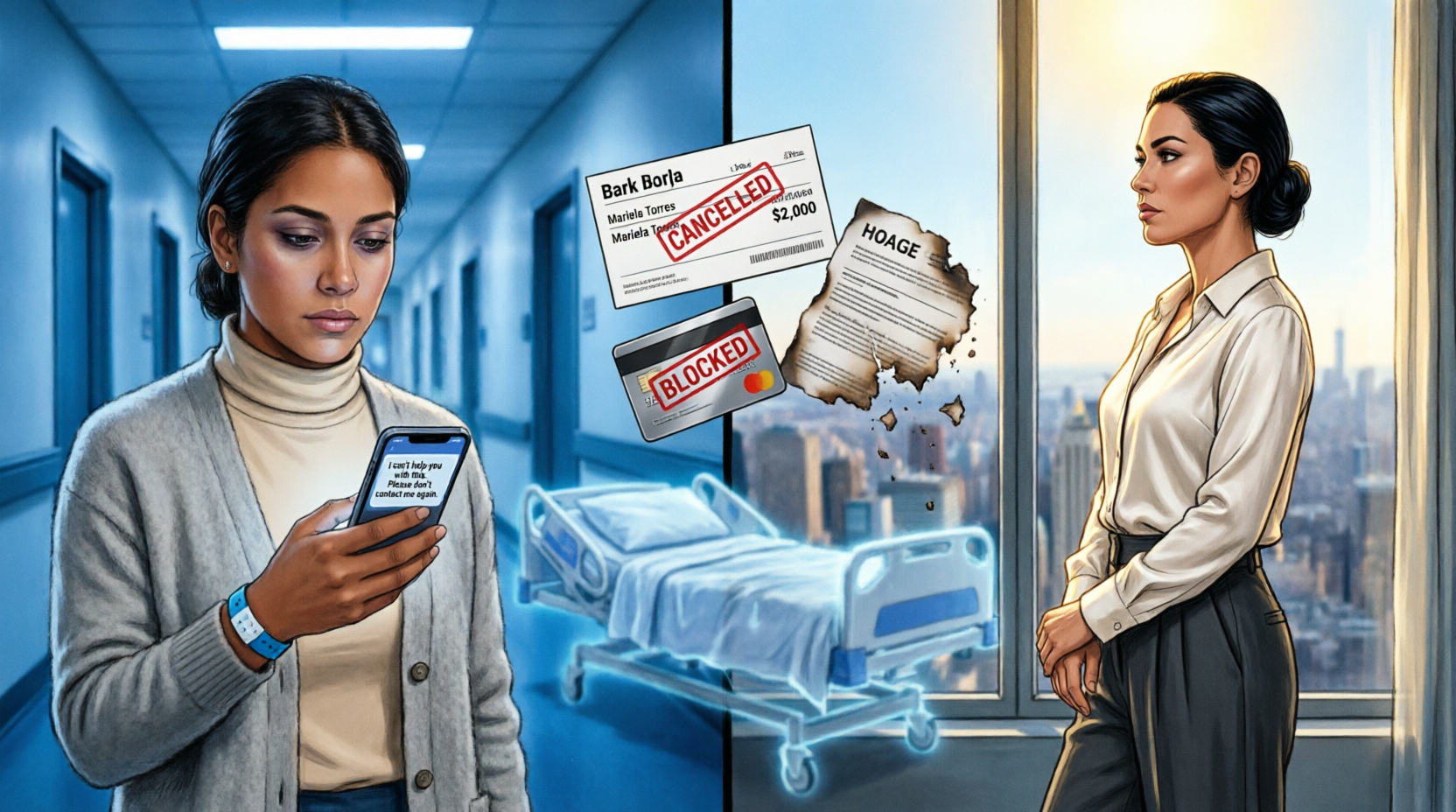
Part 3
The recovery was grueling. It wasn’t like a movie—there was no soft background music or immediate, healing hugs. My head throbbed whenever I stood up, walking to the bathroom exhausted me, and there were days when the sunlight coming through the window felt like it was splitting my skull open. But every time I thought about dropping the charges just to avoid “breaking up the family,” Valeria would remind me of one cold fact: Mariela had three years to tell me the truth. She didn’t do it while I was blindly paying. She didn’t do it when I got sick. She only cried when the bank stopped receiving my money.
Ethan Vance was subpoenaed first. The bank tried to protect itself by claiming everything had gone through standard regular channels, but the copies, the emails, and the forensic document examination ripped a gaping hole in their defense. Ethan had received the paperwork directly from Mariela’s email account and validated my alleged signature without ever conducting a required face-to-face interview. Text messages also surfaced where he told her: “As long as Gaby keeps paying, she won’t check a thing.” That sentence cut deep because it was completely true. I hadn’t checked. Not out of stupidity, but because I trusted the wrong person with a blind devotion that I mistook for virtue, when it was actually a total abandonment of myself.
It took my mom a long time to truly understand. In the beginning, she kept begging me to “settle this between sisters.” Later, when she saw the printed messages, the threats, and the way Mariela had even weaponized my late dad’s memory to pressure me, she went completely silent for weeks. One afternoon, sitting next to my recovery bed back home in Houston, she told me: “I think I helped her become this way, too.”
I didn’t answer right away. It was a heavy admission. “We all helped her, Mom. Me with money. You with excuses. Dad with sacrifices. But she was the one who decided what to do with all of it.” My mom wept in silence. I didn’t rush to hug her. Not out of cruelty, but because I also needed to learn not to run and comfort everyone else when I was the one who was bleeding.
Mariela lost the apartment a few months later. Not because I wanted to see her out on the street, but because there was no longer anyone left to finance a lifestyle she could never afford. The bank restructured part of the debt after discovering the internal fraud, but she couldn’t cover even the adjusted payments. She had to sell her furniture, her designer handbags, her high-end lighting fixtures, and everything she used to call an “aesthetic investment.” For the first time in her life, I watched her face a consequence without anyone stepping in to take the blow for her. She sent me a long text message: “I hope you’re happy. You took my home away from me.” I replied with a single line: “No, Mariela. I just stopped paying for the home you claimed you built yourself.”
The legal battle didn’t end with immediate jail time or television drama. Ethan Vance was fired and placed under a federal regulatory investigation for bank fraud. The lending institution officially acknowledged the internal compliance failures and formally released me from any co-signing liabilities. Mariela accepted a legal plea agreement to admit to the forgery and signed a legally binding order prohibiting her from ever using my personal data, accounts, or identification documents again. She also signed a promissory note to owe me a small, symbolic fraction of what I had paid over the years. I know I might never collect it in full. But the paperwork mattered. Not for the money, but because for the first time in my life, my sacrifices were no longer invisible.
The surgery changed me far more than I ever expected. I used to think the tumor was the epicenter of my fear, but once it was removed from my head, it left behind an open space to look closely at everything else I had allowed to grow around me: guilt, exhaustion, automated transfers, boundaries crossed without permission, and sacrifices that went completely unthanked. I started therapy. I canceled all authorized user cards. I changed every single password. I locked my personal documents inside a home safe. It sounds cold, but to me, it felt like finally learning how to lock the windows during a heavy storm.
A year later, I flew back to New York City for my annual follow-up scan. This time, I didn’t book a hotel out of desperate necessity, but for pure pleasure. I requested a corner suite with a view, bought an expensive coffee, and walked slowly through Manhattan without ever steering toward Mariela’s old street. She was living in a tiny apartment in a different borough and working at a retail design store. My mom told me she didn’t speak with that loud, commanding voice anymore. I don’t know if that was humility or just sheer exhaustion. It wasn’t my place to judge.
We met up once, at a quiet coffee shop near the hospital. Mariela arrived wearing no makeup, her hair tied back, her hands visibly nervous. “I’m sorry,” she said. “Not just for the money. For treating you like your life was somehow less urgent than mine.” I looked at her for a long moment. I wanted to feel a rush of relief, but I felt something much more peaceful: distance. “Thank you for saying that,” I replied. “I’m still figuring out what to do with it.” She nodded. She didn’t reach out for a hug. That was the most decent thing she had done in years.
Afterward, my mom and I went to leave flowers at my dad’s grave. Standing in front of his headstone, I told him—as if he could hear me—that I was no longer paying off other people’s debts just to prove my love. My mom took my hand tightly. “Your father would be so proud of you.” I looked at the marble stone and thought that maybe he really would be. Not because I had fought with Mariela, but because I had finally understood a truth that he never quite managed to learn: you don’t keep a family standing by letting one person completely break down.
Today, I still help out, but with written, clear boundaries, and absolutely zero guilt. If someone in my circle needs financial assistance, I ask exactly how much, what it’s for, what the timeline looks like, and what the repayment agreement is. Some people say I became distrustful. I say I became a survivor. My surgical scar is completely hidden beneath my hair, but I know exactly where it is. Every time my fingers brush past it, I remember the night my sister denied me a place to sleep out of fear of my hospital bacteria, all while her entire apartment was breathing on my dime. And it doesn’t hurt the same way anymore. Because that surgery didn’t just remove a physical tumor from my head. It also cut out the toxic idea that loving your family means allowing them to hollow you out until you are left without a voice, without savings, and without a single safe place to heal in peace
PART4 “The Insurance Papers”
Three weeks after my surgery, I finally returned home to Houston.
Everyone expected me to rest.
To recover quietly.
To focus on healing.
Instead, I became obsessed with paperwork.
Not because I wanted revenge.
Because I suddenly understood something terrifying:
I had trusted people with my identity more than I trusted myself.
Valeria practically moved into my apartment during recovery. Every morning she arrived with coffee, legal folders, and the kind of calm energy that kept me from spiraling completely.
One afternoon, she sat cross-legged on my living room floor surrounded by stacks of printed records from the bank investigation.
Then she went still.
I noticed immediately.
“What?”
Valeria frowned at one document.
“This account number looks familiar.”
I leaned forward carefully, my head still aching if I moved too fast.
“What account?”
She handed me the paper.
Insurance billing statements.
Old ones.
Five years old.
The address listed was my parents’ house.
The policy holder:
Gabriela Torres.
I blinked slowly.
“I never opened a life insurance policy.”
Valeria’s expression darkened.
“That’s what worries me.”
A cold feeling crawled through my stomach.
She kept digging through the records.
Then found another one.
And another.
Old credit inquiries.
Medical financing applications.
A secondary emergency credit line.
All connected to my name.
My Social Security number.
My information.
But not my handwriting.
I sat there silently while the room seemed to tilt around me.
“This didn’t start with the apartment,” I whispered.
Valeria looked at me carefully.
“No,” she said softly. “I think the apartment was just the biggest thing they did.”
The word they hurt more than expected.
Because until now, some part of me still wanted to believe Mariela acted alone.
I called my mother that night.
Not angry.
Just exhausted.
“Mom… did Dad ever sign paperwork for Mariela?”
Long silence.
Too long.
Then:
“Your father helped when she got into trouble sometimes.”
I closed my eyes.
“What kind of trouble?”
“She said creditors were calling her,” Mom admitted quietly. “Your father didn’t want her future destroyed.”
I felt tears burning behind my eyes immediately.
“Did he know she was using my information too?”
“No!” my mother answered too fast. “At least… I don’t think so.”
That pause destroyed me more than certainty would have.
Because suddenly I remembered things I ignored for years.
Dad asking casually for copies of my ID.
Mariela borrowing documents “for paperwork.”
Ethan smiling too easily during holidays.
Not one big betrayal.
Tiny ones.
Repeated quietly until they became normal.
Valeria interrupted my thoughts softly.
“Gabriela…”
I looked up.
She held another document now.
Different logo.
Different company.
LifeShield Assurance.
Policy holder:
Gabriela Torres.
Beneficiary:
Mariela Torres.
My stomach dropped instantly.
“What the hell is that?”
Valeria swallowed slowly.
“It’s a life insurance policy.”
Silence.
Then quietly:
“…under your name.”
PART5
“The Beneficiary”
I stared at the life insurance paperwork for so long that the words stopped looking real.
Beneficiary:
Mariela Torres.
Policy value:
$750,000.
My hands started shaking.
“I never signed this.”
Valeria nodded carefully.
“I know.”
The date hit me next.
The policy had been opened four years earlier.
Right around the time Mariela first started claiming she was “struggling financially” with the apartment.
A terrible thought crossed my mind.
“What if she planned all of this from the beginning?”
Valeria didn’t answer immediately.
Because neither of us was ready for the answer.
I forced myself to keep reading.
Monthly premiums had been paid automatically from an account connected to Ethan Vance’s brokerage firm.
My chest tightened painfully.
Not random fraud.
Organized fraud.
Careful fraud.
I whispered:
“Oh my God…”
Valeria sat beside me gently.
“Listen to me carefully, Gaby. A life insurance policy alone doesn’t mean somebody planned physical harm.”
“But it means somebody used my identity for years without me knowing.”
That silence said enough.
I suddenly remembered something strange from years earlier.
A family barbecue.
Ethan laughing while asking:
“You really trust your sister with everything, huh?”
At the time I thought it was teasing.
Now it sounded like mockery.
I rubbed my surgical scar unconsciously.
And for the first time since surgery…
I felt genuinely unsafe.
Not physically.
Emotionally.
Like my own life had been quietly converted into paperwork behind my back.
That night, Mariela called again.
I almost ignored it.
Almost.
But I answered.
“What now?”
She sounded tired instead of angry this time.
“You froze my life.”
I laughed softly.
“No, Mariela. I stopped financing it.”
She sighed dramatically.
“You always make everything sound worse than it is.”
My grip tightened around the phone.
“You forged my signature.”
“It wasn’t like that.”
“There’s a life insurance policy in my name.”
Silence.
Real silence.
Then:
“Oh… that.”
That.
Like she was discussing parking tickets.
I felt sick instantly.
“What do you mean ‘that’?”
“It was Ethan’s idea,” she muttered. “He said families do this kind of thing all the time.”
Families.
I closed my eyes.
“You made yourself beneficiary.”
“You weren’t supposed to find it yet.”
The sentence froze my blood completely.
Yet.
I whispered:
“What does that mean?”
Mariela suddenly sounded defensive again.
“You always assume the worst about me.”
I almost laughed at the absurdity.
“You insured my life without permission.”
“It was just financial protection!”
“For WHO?”
Silence again.
Then finally:
“You don’t understand pressure the way I do.”
That line hit somewhere old inside me.
Because my entire life…
Mariela’s stress mattered more than everyone else’s exhaustion.
I hung up without answering.
Minutes later, Valeria received another report from the forensic accountant helping us.
She opened the email.
Then slowly looked up at me.
“Gabriela…”
I already hated her tone.
“What now?”
“There are additional credit accounts.”
My stomach dropped.
“How many?”
Valeria swallowed hard.
“Seven.”
PART 6
“Seven Accounts”
Seven.
I kept repeating the number in my head like maybe it would shrink if I heard it enough times.
Seven accounts.
Not one forged mortgage.
Not one insurance policy.
Seven separate financial accounts connected to my identity.
I sat completely still at my kitchen table while Valeria printed the report slowly beside me.
The printer sounded unbearably loud.
Page after page after page.
Store credit lines.
Emergency loans.
Personal financing applications.
Most were years old.
Some were already closed.
Others still active.
I felt nauseated.
“How did I never know?”
Valeria answered carefully.
“Because your credit score stayed strong.”
I frowned weakly.
“What?”
“You kept paying everything on time,” she explained softly. “Your income covered the damage before consequences reached you.”
That sentence hurt in a very specific way.
Because it summarized my entire role in the family.
Absorb pressure quietly.
Prevent collapse silently.
I suddenly remembered being twenty-three years old and wiring rent money to Mariela while eating instant noodles for two weeks afterward.
At the time she cried and promised:
“I’ll never forget this.”
Apparently she forgot immediately.
Valeria pointed toward one account highlighted in yellow.
“This one worries me most.”
I looked down.
Joint emergency medical credit line.
Opened six years ago.
Secondary authorized contact:
Carlos Torres.
My father.
I stopped breathing for a second.
“Dad knew about this?”
Valeria looked uncertain.
“Maybe partially.”
My chest tightened painfully.
No.
Not Dad.
I could survive Mariela betraying me.
Even Ethan.
But not my father.
Then another memory surfaced suddenly.
Dad sitting at the kitchen table late at night surrounded by papers.
Rubbing his forehead.
Looking exhausted.
I remembered asking:
“Everything okay?”
And him smiling too quickly.
“Just family responsibilities, mija.”
At the time I thought he meant bills.
Now I wasn’t sure anymore.
Tears blurred my vision.
“What if he was trying to fix her messes the whole time?”
Valeria stayed quiet.
Which was answer enough.
Then my phone buzzed.
Mom.
I answered slowly.
“Hi.”
Her voice sounded fragile.
“Your sister came by.”
I closed my eyes immediately.
“What does she want now?”
“She says you’re destroying the family.”
Of course.
Not the forgery.
Not the fraud.
Not the manipulation.
Me.
I whispered tiredly:
“The family was already broken, Mom. I just stopped pretending not to see it.”
Silence.
Then softly:
“There’s something I never told you about your father.”
Every muscle in my body tightened.
“What?”
My mother started crying quietly.
And then she said the sentence that changed everything:
“Your father emptied part of his retirement fund because of Mariela’s debt.”
“The Family Debt”
My mother cried so hard I could barely understand her at first.
I sat frozen at the kitchen table gripping the phone while Valeria quietly stopped printing documents beside me.
“How much?” I whispered.
Silence.
Then:
“Almost everything.”
The room felt suddenly too small.
My father spent forty years working maintenance shifts at a shipping warehouse.
Forty years.
Early mornings.
Back pain.
Missed vacations.
Cheap coffee in thermoses.
And he emptied his retirement savings.
For Mariela.
I pressed my fingers against my forehead carefully, trying not to trigger the lingering headaches from surgery.
“When?”
“About three years before he died.”
Exactly when Mariela got the apartment.
Of course.
Mom kept crying softly.
“She said she was drowning, Gabriela.”
The old familiar guilt tried crawling into me again.
Mariela suffering.
Mariela desperate.
Mariela needing rescue.
But this time something inside me resisted.
Because suddenly I saw the pattern clearly.
Every emergency in our family had eventually become my father’s burden…
or mine.
Never hers.
I whispered:
“How much debt was she hiding?”
Mom hesitated too long.
That terrified me more than the answer.
Finally:
“I don’t know everything.”
Valeria looked up sharply across the room.
My stomach tightened.
“You knew there was more?”
“She told us not to worry,” Mom admitted weakly. “She always said Ethan had investment plans coming.”
Investment plans.
That man turned manipulation into a business model.
I stood up too quickly and immediately regretted it when dizziness slammed into me.
Valeria rushed forward.
“Easy.”
I sat back down slowly.
Weak.
Exhausted.
Angry in a way that felt older than this situation.
Because suddenly childhood memories started rearranging themselves inside my head.
Mariela crying after maxing out a credit card in college.
Dad quietly paying it.
Mom saying:
“Your sister is under stress.”
Mariela wrecking her car.
Dad selling tools from his garage.
Mom whispering:
“You know how emotional she gets.”
And me?
I became “the reliable one.”
The calm one.
The understanding one.
The one who never asked for much.
Not because I was stronger.
Because I learned early that being easy to sacrifice made everyone else more comfortable.
That realization hurt more than the forgery.
Valeria sat beside me carefully.
“You okay?”
“No.”
For once…
I answered honestly.
That night I couldn’t sleep.
I kept replaying small family moments differently now.
Dad delaying dental surgery.
Mom hiding overdue utility notices.
Mariela posting rooftop brunch photos while claiming financial hardship.
How long had everyone been pretending?
At 2:13 AM, another email arrived from the forensic accountant.
Subject:
ADDITIONAL LIABILITY REVIEW.
I opened it immediately.
And froze.
One paragraph highlighted in yellow:
Several debt consolidations appear connected to payments made by Carlos Torres approximately fourteen months before his death.
I stopped breathing.
Fourteen months.
Dad was already sick by then.
Already exhausted.
Already struggling.
Attached beneath the report sat scanned bank withdrawals.
Retirement liquidation records.
My father’s signature.
My chest tightened painfully.
Then I noticed something else.
Recipient account holder:
MARIELA TORRES.
Amount transferred:
$84,000.
I stared at the number in horror.
Dad didn’t just help her.
He emptied himself for her.
PART 8
“The Responsible Child”
I drove to my mother’s house the next morning.
Not because I felt calm.
Because I felt dangerously close to falling apart.
The house looked exactly the same:
faded flower pots,
wind chimes near the porch,
Dad’s old gardening gloves still hanging beside the garage.
That nearly destroyed me before I even walked inside.
Mom opened the door slowly.
The moment she saw my face, she started crying again.
“I didn’t know how bad it became,” she whispered.
I wanted to believe her.
Part of me still did.
But another part kept thinking:
You knew enough.
The kitchen smelled like coffee and cinnamon, exactly like my childhood.
I suddenly hated how comforting it felt.
Mom sat across from me wringing her hands nervously.
“She always made us feel like disaster was around the corner,” she admitted quietly.
“Mariela?”
Mom nodded.
“She’d cry. Panic. Say people were after her financially.”
I leaned back slowly.
“And Dad kept rescuing her.”
Mom’s eyes filled with guilt.
“Your father couldn’t tolerate seeing his daughters struggle.”
The sentence sat bitterly inside me.
Because somehow…
I had struggled constantly too.
Just silently.
I asked carefully:
“Did either of you ever worry about me?”
Mom looked shocked.
“Of course we did.”
“No,” I said softly. “I mean really worry.”
Silence.
I watched realization slowly cross her face.
Painful realization.
Because I was the child who solved problems before anyone noticed them.
Good grades.
Extra shifts.
Paid my own bills early.
Never called crying.
Responsible children become invisible very easily.
Mom whispered:
“You never needed as much.”
That line hurt more than shouting ever could.
I laughed weakly.
“I had a brain tumor, Mom.”
Her face collapsed instantly.
“Oh, Gabriela…”
But I wasn’t trying to punish her anymore.
I just needed her to finally see me clearly.
Then Mom stood suddenly and walked toward the hallway closet.
When she returned, she carried an old metal box.
Dad’s document box.
I recognized it immediately.
He kept warranties, tax records, insurance papers inside.
Mom placed it carefully on the table.
“I found these after he died,” she whispered. “I didn’t know what they meant.”
Inside sat folders stuffed with overdue notices.
Loan statements.
Collection letters.
All connected to Mariela.
My stomach twisted harder with every page.
Dad had been drowning quietly for years.
Then I found a handwritten note clipped beside one loan statement.
Dad’s handwriting.
Messy.
Rushed.
Don’t tell Gabriela. She already carries too much.
I covered my mouth immediately.
Mom started sobbing again.
And for the first time since this nightmare began…
I cried with her.
PART 9
“The Emergency”
The note stayed in my head for days.
She already carries too much.
I kept hearing Dad’s voice when I read it.
Tired.
Gentle.
Apologetic.
And somehow that hurt even worse.
Because he knew.
He knew I was carrying everyone already.
And still…
the weight kept getting placed on me anyway.
Valeria helped organize the growing mountain of financial records across my apartment dining table.
By now the story looked uglier than simple fraud.
It looked like survival built entirely around one person never hearing the word “no.”
Mariela.
Every emergency became collective.
Every consequence became negotiable.
Every sacrifice became someone else’s responsibility.
Especially mine.
Valeria highlighted another timeline on her laptop.
“Look at this.”
I leaned closer carefully.
Hospital bills.
Short-term loans.
Late mortgage notices.
All clustered around specific periods.
“What am I looking at?”
“Patterns,” Valeria said quietly.
She pointed toward one year in particular.
The same year Dad liquidated retirement money.
“That year Mariela reported three separate financial emergencies to your parents.”
I frowned.
“What kind?”
Valeria read slowly:
“Medical issue.”
“Threatened eviction.”
“Business investment collapse.”
Something about it bothered me instantly.
Mariela always had catastrophes.
Constantly.
But somehow she still managed:
designer clothes,
vacations,
expensive dinners,
social media perfection.
The math never made sense.
Then suddenly I remembered something strange.
A Thanksgiving dinner years earlier.
Dad looked pale.
Quiet.
Distracted.
Mariela disappeared into the hallway crying dramatically after dinner.
Ten minutes later Dad left with her.
Mom whispered:
“Your sister’s having a hard time.”
When they returned hours later, Dad looked devastated.
At the time I assumed family argument.
Now…
I wasn’t so sure.
Valeria interrupted my thoughts carefully.
“There’s another thing.”
I already hated hearing that sentence.
“What now?”
She turned the laptop screen toward me.
Emergency medical loan application.
Applicant:
Mariela Torres.
Co-financial reference:
Carlos Torres.
Status:
Approved.
Amount:
$32,000.
I frowned immediately.
“Medical?”
Valeria nodded slowly.
“But there’s no hospital record attached.”
A cold feeling spread through me.
“Meaning?”
“Meaning the emergency might not have existed.”
Silence.
I stared at the screen.
Dad may have emptied savings for fake crises.
Not survival.
Manipulation.
My chest physically hurt.
Then my phone buzzed.
Mariela.
I almost ignored it.
Almost.
But I answered.
“What.”
For once…
she sounded small.
Not dramatic.
Not furious.
Just tired.
“I lost my apartment officially today.”
Silence.
Part of me wanted satisfaction.
Instead I mostly felt grief.
Grief for how preventable all of this once was.
Mariela whispered:
“Mom won’t stop crying.”
I closed my eyes slowly.
“She’s grieving Dad too.”
Silence.
Then softly:
“You think I killed him.”
That sentence stunned me completely.
Because beneath all the manipulation…
for the first time…
I heard genuine fear….