I made it halfway across the reception hall before my mother finally found her voice. “Meredith.” Not my child. Not sweetheart. Not are you hurt? Just my name, sharp and embarrassed, like I had spilled wine on the carpet instead of been shoved into a fountain by my own father.
I stopped near the terrace doors, water dripping from the hem of my emerald dress onto the polished marble floor. A waiter stood frozen beside a tray of champagne. His eyes flicked from my soaked hair to my bleeding elbow, then to the crowd behind me, as if he was silently asking whether anyone else was seeing what he was seeing.
They were. They simply did not care. My mother crossed the room quickly, her face tight with fury. Not at him. At me. “Go upstairs,” she hissed. “Fix yourself before you ruin the photographs.” I looked down at my hands. They were trembling. Not from fear. From cold.
“You watched him do it,” I said.
Her lips thinned.
“Don’t make this dramatic.”
Something inside me almost laughed.
A grown man had used a microphone to humiliate his daughter at a wedding, then shoved her into a fountain in front of two hundred guests, and I was the one making things dramatic.
Behind my mother, Allison stood near the head table, one hand pressed delicately to her chest, her veil glowing under the chandelier light.
Bradford Wellington IV stood beside her, looking uncomfortable but silent.
Of course he was silent.
Men like Bradford had been raised to avoid unpleasantness, especially when it did not threaten their inheritance.
My father remained near the fountain, microphone still in hand.
He looked irritated now.
Not ashamed.
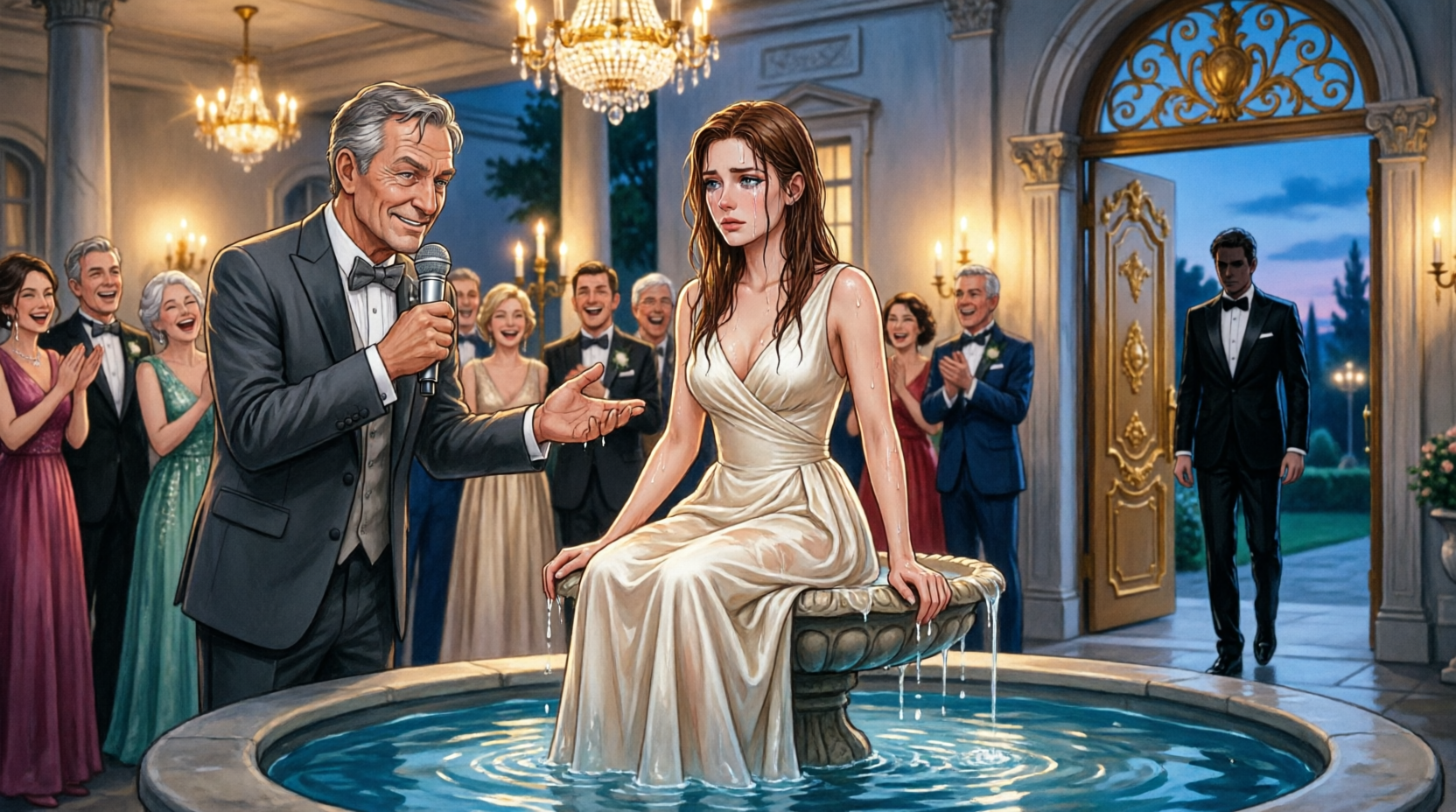
I had ruined his timing.
The crowd was beginning to shift uneasily, laughter dying into whispers. People could enjoy cruelty when it looked controlled. They became nervous when the target stopped behaving like a victim.
“Meredith,” my mother said again, lowering her voice. “You will not ruin your sister’s wedding.”
I lifted my eyes to hers.
“Mom, he pushed me into a fountain.”
“You embarrassed him.”
There it was.
The Campbell family constitution, spoken aloud at last.
My pain was never the problem.
My reaction to it was.
A strange calm moved through me.
Maybe it was shock.
Maybe it was the cold.
Maybe it was the knowledge that the life I had built outside their control was already crossing Boston in a black car with diplomatic plates.
Whatever it was, it straightened my spine.
“I’m going to change,” I said.
My mother exhaled, relieved that I was finally obeying.
Then I added:
“And after that, I’m leaving.”
Her expression hardened.
“You will stay until the cake cutting.”
“No.”
The word was quiet.
It landed harder than shouting.
My mother stared at me as if I had spoken a foreign language.
“You don’t tell me no.”
“I just did.”
For a moment, all I could hear was water dripping from my dress.
Then my father’s voice cut through the room again.
“Let her go, Patricia.”
He was smiling once more, but this time the smile was thinner.
“If Meredith wants to run away, let her. She’s always been better at disappearing than belonging.”
A few nervous chuckles scattered through the room.
Not many.
Good.
Some of them were finally sober enough to recognize ugliness without a punchline.
I looked at him.
My father.
Robert Campbell.
The man whose approval I had chased so long that I had mistaken exhaustion for love.
“You’re right,” I said.
That made him blink.
“I am very good at disappearing.”
I took one step toward him.
My wet heels clicked softly against the marble.
“But you should have wondered where I disappeared to.”
His smile faded.
Before he could answer, the ballroom doors opened.
Not the terrace doors behind me.
The main doors.
The ones that led from the hotel lobby into the reception hall.
At first, no one understood what they were seeing.
A hotel manager entered quickly, pale-faced and nervous.
Behind him came two security men in dark suits.
Then a third.
Then a fourth.
The room shifted.
Conversations stopped.
The string quartet near the corner faltered mid-note.
My father frowned, annoyed.
“What is this?”
The hotel manager ignored him.
His eyes searched the room.
Then he saw me.
Soaked.
Bleeding.
Standing barefoot now because one heel had finally slipped from my foot.
His face changed.
“Mrs. Vale?”
The name moved through the room like a match dropped into dry leaves.
Mrs. Vale.
Not Miss Campbell.
Not poor Meredith.
Not the disappointing daughter without a date.
Mrs. Vale.
My mother’s head snapped toward me.
Allison’s smile vanished completely.
And my father, for the first time that afternoon, looked uncertain.
Before anyone could speak, another figure appeared in the doorway.
Tall.
Dark suit.
No tie.
Black overcoat open from the rush of travel.
His hair was slightly disordered, like he had run his hands through it too many times on the drive from the airport.
Beside him walked a woman in a navy federal uniform and two men wearing discreet earpieces.
But I only saw him.
Julian.
My husband stopped at the entrance.
His eyes found me instantly.
The room disappeared from his face.
All business, all control, all practiced diplomatic calm vanished.
For one second, he looked like a man who had arrived too late to stop something unforgivable.
Then he moved.
Fast.
The security men moved with him, but he was already ahead of them.
“Meredith.”
My name in his voice nearly broke me.
Not because it was loud.
Because it was gentle.
He reached me in the middle of the ballroom, took off his overcoat, and wrapped it around my shoulders without asking permission, because he knew I was too cold to pretend I wasn’t.
His hands paused at my arms.
He saw the scrape near my elbow.
The bruise already darkening at my shoulder.
The water in my hair.
His jaw locked.
“What happened?”
I could have lied.
I could have protected them one last time.
I could have said I slipped, because that was what Campbell women were trained to do.
Make violence sound like an accident.
But I was done.
“My father pushed me into the fountain,” I said.
The room went silent.
Julian did not turn immediately.
That was the frightening part.
He looked at me first.
Really looked.
Checked my face, my arms, my eyes.
“Are you dizzy?”
“No.”
“Did you hit your head?”
“My shoulder and elbow. Not my head.”
His hand rose to my cheek, then stopped just short, careful not to touch the streaked makeup or the cold water unless I wanted him to.
That restraint was why I loved him.
My family mistook control for power.
Julian understood that power was knowing exactly when not to use it.
Only after he was certain I could stand did he turn around.
His gaze moved across the crowd and landed on my father.
“Robert Campbell?”
My father lifted his chin.
He was trying to recover.
I could see him assembling himself, piece by piece.
The courtroom posture.
The old Boston confidence.
The sneer dressed as politeness.
“And you are?”
My mother made a small sound.
She had begun to understand before he did.
Julian did not answer immediately.
The woman in the navy uniform stepped forward.
“Ambassador Julian Vale,” she said clearly. “Special Envoy to the North Atlantic Security Council.”
A ripple passed through the reception hall.
Bradford Wellington IV straightened.
His father, seated two tables away, slowly set down his wine glass.
My father’s face changed.
Not much.
But enough.
He knew the name.
Of course he did.
The Vale name did not appear in society pages often.
It appeared in financial briefings, international policy reports, defense contracts, energy negotiations, and closed-door meetings where men like Robert Campbell only dreamed of being invited.
Julian did not care about the ripple.
His eyes stayed on my father.
“I’m also Meredith’s husband.”
This time, the sound in the room was not a ripple.
It was a break.
Aunt Vivian gasped.
Cousin Rebecca whispered, “Husband?”
Tiffany’s mouth fell open.
Allison took one full step backward, as if the word had physically struck her.
My mother looked at my left hand.
The ring was there.
It had always been there.
A slender diamond band, elegant and old, worn beside a plain gold wedding ring.
For three years, they had never asked.
They had only assumed no one could have chosen me.
My father stared at Julian.
“That’s impossible.”
Julian’s expression did not move.
“It isn’t.”
“I would have known.”
“No,” I said quietly.
Everyone looked at me.
I pulled Julian’s coat tighter around my shoulders.
“You would have used it.”
My father’s mouth opened.
Closed.
Opened again.
My mother stepped forward, face pale.
“Meredith, what is this?”
I looked at her.
“My husband.”
“But you never told us.”
“No.”
“Why?”
That question almost made me laugh.
Instead, I let the truth stand between us.
“Because look what you did when you thought I had no one.”
My mother flinched.
Good.
I hoped it hurt.
Not enough to destroy her.
Just enough to make denial uncomfortable.
My father recovered first, as always.
“This is absurd,” he said sharply. “Whatever private arrangement Meredith has made, it does not excuse her behavior today.”
Julian’s eyes narrowed.
“Her behavior?”
“She caused a scene.”
“She was assaulted.”
“She was being hysterical.”
Julian took one step forward.
The security men did not move, but the air changed.
My father noticed.
So did everyone else.
“My wife,” Julian said, each word controlled, “was publicly humiliated, physically shoved, injured, and left standing in freezing water while your guests applauded.”
My father’s face reddened.
“You don’t understand our family.”
“No,” Julian said. “I understand it perfectly.”
Then he looked at the photographer, who still had his camera hanging from his neck.
“You took pictures?”
The photographer went pale.
“I—I was hired for the wedding.”
Julian’s voice remained calm.
“Do not delete anything.”
The photographer nodded quickly.
My father barked, “Those are private event photographs.”
The woman in the navy uniform spoke again.
“Any images documenting an assault may be requested by law enforcement or counsel.”
That was when Allison finally moved.
“Daddy,” she whispered.
Not because she cared that I had been hurt.
Because the word law enforcement had entered her wedding reception.
My father turned toward her, and for one brief second I saw the panic beneath his fury.
Image.
Always image.
Never love.
Never truth.
Just image.
Bradford’s mother rose from her chair.
She was tall, silver-haired, and severe in the way only very wealthy women can be when deciding whether another family has become socially contagious.
“Robert,” she said coldly, “is there a reason your daughter’s husband was not seated with the family?”
My mother’s face collapsed.
The question was not moral.
It was social.
And somehow, that made it more dangerous to them.
My father forced a laugh.
“This is a misunderstanding.”
I looked at the fountain.
At the floating petals.
At the champagne glasses.
At the guests who had laughed because laughing had seemed safer than objecting.
Then I looked back at him.
“No,” I said. “It’s not.”
Julian turned toward me.
“We’re leaving.”
I nodded.
My mother reached for my arm.
“Meredith, wait.”
Julian’s hand moved instantly, blocking without touching her.
“Do not grab her.”
My mother froze.
Her eyes filled with tears.
For once, they did not work on me.
“You can’t just walk out,” she said.
“I can.”
“But Allison is your sister.”
I looked at Allison.
Her white dress shimmered beneath the chandelier.
Her face was tight with humiliation, but still beautiful.
Still perfect.
Still the daughter they had chosen.
And yet, for the first time, she looked afraid of being left alone with what they had built around her.
“Allison watched,” I said.
My sister’s lips parted.
“I didn’t know he was going to push you.”
“But you smiled when he mocked me.”
Her eyes flashed.
“You always make everything about you.”
There she was.
The real Allison beneath the lace.
I felt nothing.
That was new.
For years, her cruelty had hurt because I kept searching for a sister inside it.
Now I understood that blood does not guarantee witness.
Sometimes strangers see you more clearly than family ever will.
“You’re right,” I said. “Today is about you.”
Allison lifted her chin slightly, as if she had won.
Then I continued.
“So enjoy the wedding you laughed through while your sister stood bleeding in a fountain.”
The color left her face.
Julian placed his hand lightly at my back.
Not pushing.
Just there.
A reminder that I no longer had to cross rooms alone.
We started toward the doors.
No one stopped us.
Not my mother.
Not Allison.
Not my father.
But when we reached the entrance, his voice followed me.
“You’ll regret this.”
I turned around.
The whole room held its breath.
My father stood near the fountain, still wearing his expensive tuxedo, still surrounded by flowers, money, and witnesses.
But he looked smaller now.
Not because Julian was powerful.
Not because security stood between us.
Because the truth had entered the room, and truth does not bow to men like Robert Campbell.
“No,” I said.
My voice was steady.
“I regret waiting this long.”
Then I walked out.
The hallway outside the ballroom was quiet.
Too quiet.
The moment the doors closed behind us, my legs almost gave out.
Julian caught me before I hit the wall.
“I’m here,” he said.
That was all.
Not calm down.
Not don’t cry.
Not it’s over.
Just:
“I’m here.”
And that was when I finally broke.
Not in the ballroom.
Not in the fountain.
Not under the laughter.
I broke in the quiet hallway, wrapped in my husband’s coat, while hotel staff rushed around us and security formed a careful wall between me and the family I had survived.
Julian held me like something precious.
Like something worth protecting.
Like someone chosen.
And behind the closed ballroom doors, the Campbell family began to understand that the woman they had spent a lifetime humiliating had not arrived alone.
She had simply arrived before the consequences.