I was eight months pregnant when my mother decided dinner mattered more than my labor. The kitchen smelled like rosemary, hot grease, and carrots sweating under my knife. The tile under my bare feet had gone cold, though the oven had been running for nearly an hour. Behind me, my sister Jessica’s bracelets kept making that bright little clinking sound every time she lifted her glass.
I remember that sound more clearly than I remember my own breathing. My name is Emily Sanders, and before that evening I still believed family could be cruel without being dangerous. I thought my mother, Margaret, could be sharp-tongued and selfish and still come through when life turned serious. I thought my sister could be jealous and mean and still know where the line was.
I was wrong about both of them. My husband, Michael, had been sent to Seattle for a short construction contract, and I was supposed to stay with my mother for only a few weeks. He hated leaving so close to my due date, but the work was temporary, the money was necessary, and Margaret had promised him I would not be alone. She said it with one hand on my shoulder and the other already reaching for my spare house key. That was Margaret.
She knew how to look maternal when someone useful was watching. Ryan, our three-year-old son, came with me because Michael said it would be better for him to be around family. Ryan adored Michael, missed him terribly, and carried a little plastic dinosaur in his pocket every day because Michael had told him dinosaurs were brave even when they were scared.
For the first few days at Margaret’s house, I tried to make it feel normal. I folded Ryan’s pajamas into the dresser in my childhood room. I put my prenatal folder on the nightstand. I kept Michael’s emergency contact sheet in the side pocket of my purse, along with my hospital registration card. At 34 weeks, then 35, I told myself every ache was ordinary. The baby moved constantly, a little rolling pressure under my ribs, and I would press my palm there and whisper that her father was coming home soon.
Michael called every night from Seattle.
He always asked if my mother was treating me well.
I always said yes.
It was not exactly a lie at first.
Margaret fed us.
She gave Ryan the little guest room next to mine.
She drove me once to a prenatal appointment, though she complained the entire way that pregnant women today acted like birth had been invented yesterday.
Jessica came by almost every evening.
She was thirty, unmarried, always polished, always carrying some new complaint about how everyone else got attention too easily.
When I was pregnant with Ryan, she had joked that motherhood made women boring.
When I got pregnant with our daughter, she said two children sounded like a punishment.
I laughed those comments off because sisters say things, and because old habits are hard to break.
Jessica had once been the girl who slept in my bed during thunderstorms.
She had once borrowed my sweaters without asking and cried into my pillow after her first breakup.
She had once held Ryan at the hospital and said he looked like a tiny old man with Michael’s nose.
I had given her trust because history makes trust feel automatic.
That is what betrayal uses first.
It does not have to break into your life.
You already opened the door.
The day everything happened was a Thursday.
Margaret had invited several women from church to dinner, the kind of dinner she treated like a performance review for her soul.
By noon, she had polished the water glasses twice.
By three, she had ironed linen napkins and corrected the angle of the flowers in the center of the dining table.
By five, the roast chicken was in the oven, potatoes were warming in a covered dish, and I was chopping carrots at the counter because Margaret said she needed “one useful pair of hands.”
Ryan sat at the kitchen table coloring a dinosaur blue.
He told me green was too angry.
I smiled at that, even though my back had been aching since lunch.
Pregnancy had made pain familiar enough that I no longer trusted my first reaction to it.
I told myself it was pressure.
I told myself it was the baby shifting.
Then the first contraction hit.
It was not a tightening.
It was a fist closing through my entire middle.
The knife stopped halfway through a carrot, and I had to put one hand flat on the counter to keep from bending forward.
The oven clock read 5:41 p.m.
I remember the green numbers because they were the only things in the room that looked calm.
“Mom,” I said. “I think something’s wrong.”
Margaret did not turn around.
She was standing by the dining table, adjusting forks until they lined up like silver soldiers.
“Not now, Emily,” she said.
Another wave built low in my body, heavier than the first.
I swallowed and tried to breathe the way the childbirth class videos had taught me.
“Mom,” I said again. “I think I’m in labor.”
That made her turn.
Not quickly.
Not with concern.
She looked annoyed, as if I had spilled something on her table runner.
“The hospital?” she said flatly. “Dinner comes first.”
For a second, I laughed.
It came out weak and strange.
I laughed because the alternative was to understand that my mother meant what she had just said.
“Mom, I’m serious,” I said. “It’s time.”
Jessica was leaning in the doorway between the kitchen and dining room, one shoulder against the frame, arms folded.
She had arrived early to help, which meant she had poured herself a drink and criticized my swollen ankles.
Now she smiled like the whole scene had been arranged for her private entertainment.
“You’re always dramatic, Emily,” she said. “Not every stomach cramp is a national emergency.”
Ryan looked up from his coloring page.
Children hear tone before they understand words.
His crayon hovered over the paper, and his face changed in that tiny way a child’s face changes when fear arrives before language.
“Mommy?” he whispered.
I opened my mouth to answer him.
Then my water broke.
Warm fluid ran down my legs and spread across the tile.
The sound of it hitting the floor was soft, almost delicate, and somehow that made it worse.
The kitchen went silent except for the oven fan and Jessica’s bracelets.
I looked down at the tile.
Then I looked at my mother.
There are moments when a person’s face tells you the truth more clearly than any confession could.
Margaret was not confused.
She was not scared.
She was inconvenienced.
“I need the car keys,” I said. “Now.”
My voice sounded steadier than I felt.
Inside, I was counting.
Hospital bag in the back of the SUV.
Prenatal folder in the console.
Michael’s emergency contact sheet behind the visor.
Route to the hospital, twelve minutes if traffic was clear.
Margaret looked toward the dining room.
“My guests will be here in twenty minutes.”
I stared at her.
Even then, part of me tried to make mercy out of that sentence.
Maybe she meant she would call an ambulance after she moved the food.
Maybe she meant she was overwhelmed.
Maybe some buried mother in her would surface once the next contraction came.
Then Jessica walked to the chair where my purse sat.
She opened it.
She lifted my keys between two fingers.
The metal caught the kitchen light.
“Maybe your baby can wait until dessert,” she said.
I moved toward her, but pain folded me in half.
It was so sudden and so violent that I had to clutch the counter with both hands.
My knuckles went white.
My jaw locked.
I would not scream, not with Ryan watching.
When I straightened, Jessica was already moving toward the front door.
“Jessica,” I said.
She did not stop.
At 5:46 p.m., she stepped outside with my keys.
At 5:47, Ryan screamed.
That scream pulled me through the hallway faster than I thought my body could move.
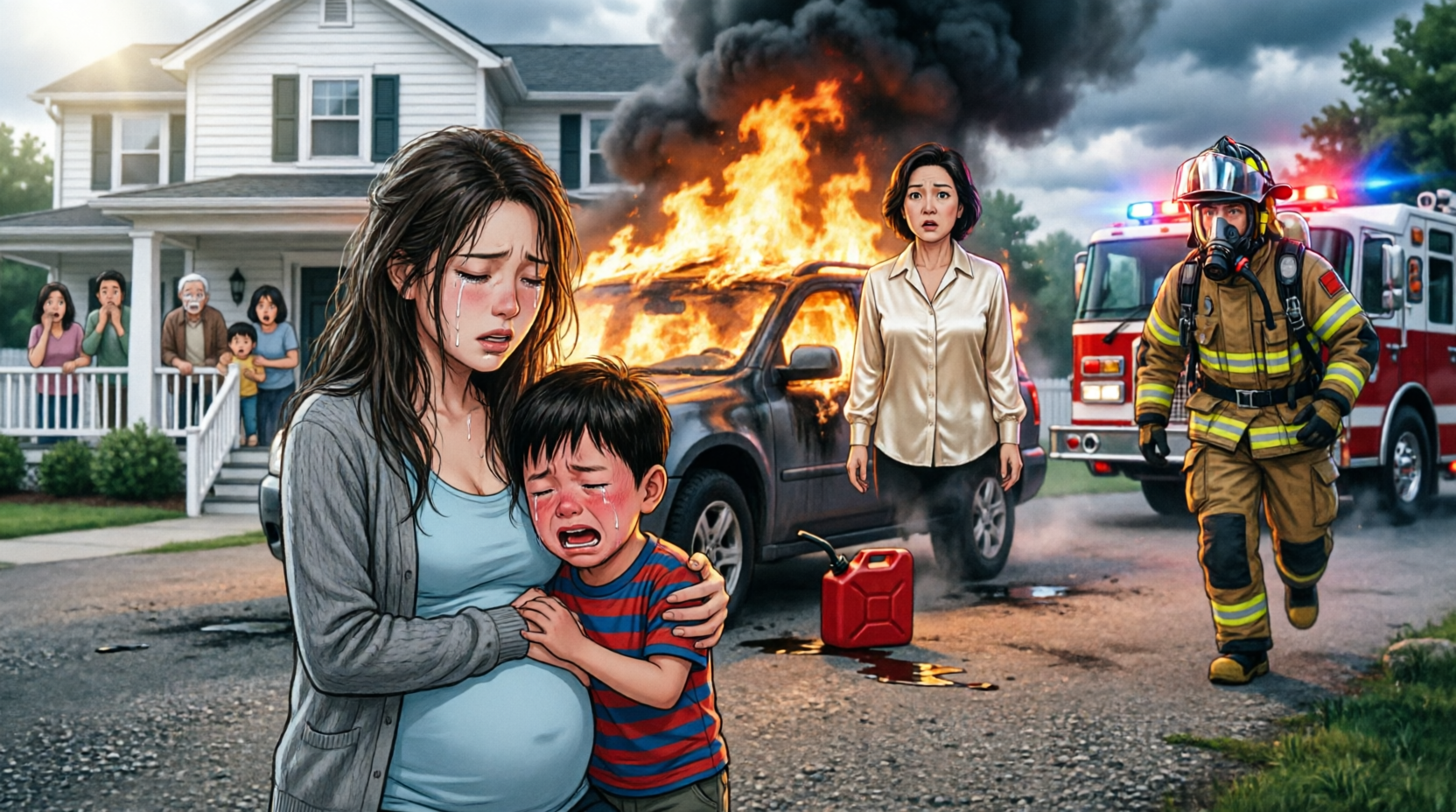
I reached the front door and saw my sister in the driveway holding a red gas can.
My SUV was wet down the side.
Gasoline shone on the paint in oily streaks.
For one frozen second, my brain refused to identify the scene.
It tried to make it something else.
A spill.
A mistake.
A threat she would not actually finish.
Then Jessica struck the lighter.
The flame was tiny in her hand.
Almost pretty.
Then it touched the SUV, and the whole side of the vehicle came alive.
Fire ran upward in a bright orange sheet.
Heat slammed into my face from twenty feet away.
The smell of gasoline and melting plastic filled my throat so fast I gagged.
Ryan was crying behind me.
Margaret stepped onto the porch.
She did not grab my arm.
She did not shout for help.
She looked at the burning car, then at my belly, and said, with total disgust, “Another useless human? What’s the point?”
I do not know which hurt more.
The words, or how certain she sounded saying them.
A car slowed at the curb.
Then another.
Margaret’s church friends had begun arriving.
One woman stood beside the walkway with a covered casserole in both hands.
Another remained half out of her car, one foot still inside, staring as if the driveway had become a stage and she had forgotten her line.
The neighbors’ curtains shifted.
Somebody gasped.
Nobody moved.
That silence became its own cruelty.
The fire crackled.
The porch light hummed.
A napkin from Margaret’s perfect dinner table fluttered through the open doorway and landed near my foot.
I dropped to my knees in the gravel.
One hand went over my belly.
The other reached blindly for something to hold on to.
The gravel bit into my skin through my dress, and another contraction tore through me so hard the edges of my vision went white.
Ryan ran to me.
He was three years old.
He should have been hiding behind an adult.
Instead, he grabbed my fingers with both of his tiny hands and pressed himself against my side.
“Mom,” he said, his voice shaking, “it’s okay. I’ll protect you.”
That sentence broke something in me that pain had not touched.
My son should never have had to be brave because grown women chose to be monsters.
The car made a deep popping sound.
Then another.
Someone finally shouted to call 911.
Someone else yelled that the fire was spreading.
Jessica backed away from the driveway, and for the first time, her smile flickered.
The gas can lay near her feet like evidence.
Margaret started talking immediately.
“She panicked,” she said to the women on the lawn. “Emily panicked. The car just caught somehow.”
That was the first time I understood she was already building the lie.
Not later.
Not after the shock wore off.
Right then, while I was on my knees in labor and my son was crying into my sleeve.
Cruel people do not always lose control.
Sometimes control is the whole point.
The first siren came from far away.
Then headlights swept across the houses, and a fire truck turned hard onto the street.
Red light washed over Margaret’s white porch columns, Jessica’s face, the wet shine of gasoline on the driveway, and Ryan’s little hands locked around mine.
A firefighter jumped down before the truck had fully settled.
“Everybody back!” he shouted.
Another firefighter knelt beside me and asked how far apart the contractions were.
I tried to answer.
All I could say was, “My baby. Please. My baby.”
He looked at my belly, then at the burning SUV, then at the people standing around us.
His expression changed.
Margaret stepped forward, voice suddenly soft and respectable.
“She gets dramatic,” she said. “She frightened herself. We were just about to take her in.”
Jessica nodded too quickly.
Then Mrs. Allen, one of the church ladies, made a small broken sound.
She was holding her phone.
Her hand shook as she turned the screen toward the firefighter.
“I recorded it,” she whispered.
Those three words changed the yard.
On the screen was Jessica with the gas can.
Jessica with the lighter.
Margaret on the porch while I was on my knees.
Margaret saying the words she would spend the rest of her life wishing had stayed inside her mouth.
The firefighter’s face hardened.
He told Mrs. Allen not to delete anything.
Then he told another responder to request police.
Jessica said, “No, wait.”
It was the first honest panic I had ever heard in her voice.
Margaret grabbed my wrist.
Her fingers were cold.
“Emily,” she whispered. “Tell them it was an accident.”
I looked at her hand on me.
I looked at Ryan, still pressed against my side, trying to be stronger than any child should ever need to be.
Then I looked at the firefighter and said, “She lit the car. My mother refused to help me. I need a hospital now.”
The ambulance arrived minutes later.
I remember the ceiling inside it more than I remember the street.
White panels.
Bright lights.
A paramedic’s gloved hand taking my pulse.
Ryan crying because they would not let him climb onto the stretcher until one of the responders gently lifted him in and buckled him beside me.
Someone called Michael from my phone.
He answered on the second ring.
I heard only pieces of the conversation.
Labor.
Fire.
Hospital.
Police.
Then the paramedic held the phone to my ear.
“Emily?” Michael said.
His voice cracked on my name.
“I’m here,” I whispered.
“I’m coming home,” he said. “I’m coming right now.”
Our daughter was born after midnight.
She was early, small, and furious at the world.
Her first cry filled the room like a verdict.
The nurse laughed softly and said, “That is a strong little girl.”
I cried then.
Not delicately.
Not prettily.
I cried with my whole body because she was alive, because Ryan was asleep in a chair with a hospital blanket over him, because Michael was somewhere between Seattle and us, trying to get home, and because my mother had looked at my labor and seen an inconvenience.
At 7:18 a.m., Michael walked into the hospital room.
He looked like he had aged years overnight.
He went first to the bassinet.
Then to Ryan.
Then to me.
He did not ask me to explain.
He had already seen the video.
Mrs. Allen had given it to the responding officer, and by morning the police report included witness statements, the fire department’s incident notes, and the first damage estimate for the SUV.
The hospital intake form listed stress-related early labor.
The police report listed suspected arson.
The video showed the rest.
Proof matters when people start rewriting cruelty as confusion.
By midmorning, Margaret and Jessica were at the hospital.
They were not allowed into my room at first.
I heard Margaret crying in the hallway.
I heard Jessica saying she had not meant for it to go that far.
That sentence became the anthem of people who discover consequences too late.
Not “I am sorry I hurt you.”
Not “I could have killed you.”
Only “I did not mean for it to go that far.”
When the officer asked if I wanted them kept away, I looked at Michael.
His face was calm in a way that scared me more than anger would have.
“What do you want?” he asked.
For once, nobody else’s comfort entered the room before mine.
“I want them to see what they almost cost us,” I said.
So they were allowed to stand in the doorway with an officer present.
Margaret’s eyes were swollen.
Jessica’s mascara had run.
They looked smaller than they had on the porch.
Not softer.
Just smaller.
Margaret saw the baby in the bassinet and covered her mouth.
Jessica started sobbing before anyone spoke.
“Emily,” Margaret said. “Please. We’re sorry. We were upset. We didn’t understand.”
I was holding my daughter then.
She weighed so little that every breath felt precious.
Ryan sat beside me on the bed, one hand resting on my blanket, guarding me in his sleep-heavy way.
“You understood,” I said. “You just didn’t care until other people saw you.”
Margaret flinched.
Jessica whispered, “Please don’t ruin our lives.”
Michael laughed once.
It was not a happy sound.
“You set my pregnant wife’s car on fire while my son watched,” he said. “You did that. Not Emily.”
The officer asked if I wanted to make a formal statement.
I said yes.
My voice shook, but I said yes.
Over the next weeks, everything became documents.
Hospital records.
Fire department findings.
Witness statements.
Insurance photographs.
A police report with times, names, and the words I had been too stunned to say clearly in the driveway.
Michael came home and never returned to that Seattle contract.
He told his supervisor the truth, and the company transferred him to a local site until I recovered.
For a while, I hated needing help.
Then I learned that real love does not make you apologize for surviving.
Ryan had nightmares about fire for months.
He slept with his blue dinosaur under his pillow and asked every night if cars could burn by themselves.
We told him the truth in words a child could carry.
No, buddy.
Cars do not do that by themselves.
Aunt Jessica made a dangerous choice.
Grandma made a cruel one.
And none of it was your job to fix.
He still asked if he protected me.
Every time, I said yes.
Because he did.
Not because a three-year-old should have had to save anyone, but because in the worst moment of my life, he gave me something to hold on to when the adults around me gave me nothing.
Margaret and Jessica begged us for forgiveness many times after that morning.
Letters arrived.
Voicemails stacked up.
Messages came through relatives who suddenly wanted peace once accountability had entered the conversation.
I did not answer most of them.
Forgiveness, I learned, is not a door other people get to pound on until you open it.
Sometimes it is a lock you install after the fire.
The legal process moved slowly, as it always does.
Jessica faced charges connected to the fire.
Margaret faced consequences of her own through the investigation and through the church community she had cared so much about impressing.
Mrs. Allen’s video made it impossible for either of them to turn the story into a misunderstanding.
That mattered.
Not because public shame heals anything.
It does not.
But truth needs witnesses when liars are already rehearsing.
Months later, our daughter grew round-cheeked and loud.
Ryan learned to sleep without checking the window first.
Michael replaced the SUV, though I never again left hospital papers in a car without keeping copies in my phone.
I kept the blue dinosaur coloring page, the one Ryan had been working on before everything broke open.
The corner is bent.
One edge still smells faintly like smoke, or maybe memory only tells me that.
Sometimes I look at it and think about the kitchen.
The rosemary.
The cold tile.
The sound of Jessica’s bracelets.
I think about my mother saying dinner came first.
I think about my son saying he would protect me.
An entire yard taught him that adults could stand still in the face of danger.
But he also learned something else.
He learned that silence is not safety.
He learned that truth can be spoken while your voice shakes.
And he learned that a family is not proven by blood, by dinners, by church smiles, or by who claims the title first.
Family is proven in the moment someone needs help.
That night, my mother and sister failed that test in front of everyone.
My three-year-old son passed it with both tiny hands wrapped around mine.