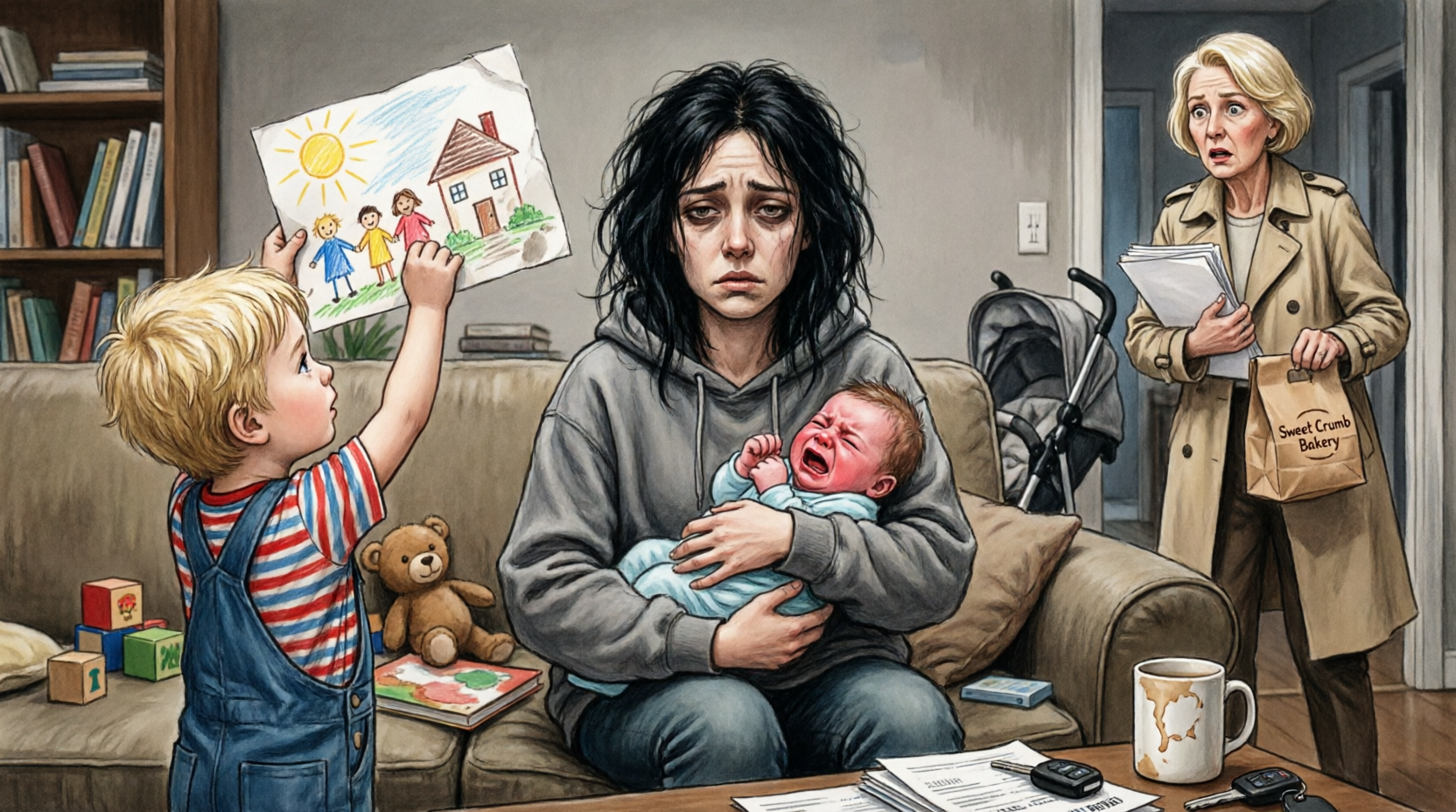
The doorbell rang on a gray Tuesday afternoon while I was trying to warm a bottle with one hand and keep my eight-month-old son from chewing on the edge of my sweatshirt with the other. Milo was teething and miserable. Ruby, my four-year-old, was on the living-room rug building a tower out of faded plastic blocks and narrating some elaborate princess rescue to herself.
The house smelled like formula, damp laundry, and cinnamon applesauce from the pouch she had crushed into the couch that morning. I had not slept more than three hours in a row in months. My hair was twisted into a knot that had started as a ponytail two days earlier, and I was still wearing yesterday’s sweatshirt because finding a clean bra had somehow fallen below keeping tiny humans alive on my list of priorities.
When I opened the door, I nearly forgot how tired I was. Diane Caldwell stood on my porch with a bright, practiced smile, a diaper bag over her shoulder, and a white paper bag in her hand that smelled like fresh cinnamon rolls. Diane always looked put together, even in weather that made everyone else look wilted. Blonde bob smooth against her jaw. Pearl earrings. Camel coat. Lipstick that never smudged.
She looked like a woman arriving for a curated family visit, not a surprise drop-in. ‘Surprise,’ she said, breezing past the awkwardness she had not yet noticed. ‘I was in the neighborhood and thought I’d come see my grandbabies.’ My stomach tightened on instinct. Diane was not the kind of woman who just happened to be nearby.
She believed in calendars, confirmations, and arriving exactly seven minutes early. The word surprise sounded wrong in her mouth. Still, Ruby had already spotted her and squealed, so I stepped aside. ‘Come in.’ Diane kissed Ruby’s hair and reached for Milo’s foot the way she always did. ‘There’s my girl.
And my sweet little man.
Where’s Eric? At work?’
That simple question almost undid me.
For three weeks I had been rehearsing how to tell people my husband had walked out.
Every version sounded either pathetic or vicious.
Too weak and they would pity me.
Too blunt and they would accuse me of poisoning the family.
I had not planned to have the conversation while balancing a teething baby and trying not to cry in front of a woman who had spent ten years treating her son like the one person in the world who could do no wrong.
‘He’s not here,’ I said.
Diane’s smile stayed frozen in place.
‘Not here where? Did he run to the store?’
I swallowed and heard my own voice turn formal.
‘Diane, can we sit down?’
She stepped into the living room and looked around.
I watched her notice everything.
The stroller half-folded near the couch.
The unopened mail on the side table.
The clean laundry piled in baskets because I had not gotten around to folding it.
Then her eyes landed on the shelf above the television.
The frame there was empty.
Until two days earlier, it had held our wedding photo.
I had taken it out because looking at Eric’s face smiling back at me while I bounced our son alone at two in the morning made me sick.
Diane turned toward me.
‘Why
is that frame empty?’
My hands began to shake.
I adjusted Milo higher on my hip, mostly so she would not see it.
‘Eric moved out,’ I said.
‘Three weeks ago.’
Diane blinked once.
Slowly.
‘What do you mean, moved out?’
I decided, right then, that I was too tired to protect anyone from the truth.
‘He left.
He’s living with someone else.
He started seeing her before he moved out.’
The whole room seemed to stop breathing.
Ruby’s blocks clicked together on the floor.
Milo made a wet little fussing sound into my shoulder.
Diane stared at me as though I had started speaking a different language.
‘That’s impossible,’ she whispered.
‘Eric wouldn’t do that.’
I walked to the coffee table and picked up the printed screenshot I had kept there for days, partly as proof and partly because I needed to look at it when I felt myself wondering whether I had imagined the cruelty of what he had done.
I held it out.
‘He wrote this to me the night he left,’ I said.
‘He said he deserves happiness and that I’m too much stress.’
Diane took the paper with stiff fingers.
Her eyes moved over the message.
I watched the color drain from her face in real time.
Then she looked up.
And instead of grief or horror, I saw anger.
Directed at me.
She folded the screenshot once.
Then again.
As if the right crease could erase it.
‘What did you do?’ she asked.
It was such a small question, but it hollowed me out.
Not, what did he do.
Not, is this true.
Just a clean, immediate search for my fault.
I stared at her.
She glanced around the room again, but differently now.
Her eyes moved over the bottles drying beside the sink, the spit-up cloth on the armchair, the toys scattered under the coffee table, the dark circles under my eyes, the sweatshirt with dried formula near the collar.
I could almost hear the verdict forming in her mind.
The house was chaotic.
I was worn down.
Therefore I must have failed him.
‘Marriage is hard after babies,’ she said.
‘Men can feel shut out.
Overlooked.
Things get tense.’
I felt heat climb up my neck.
‘Tense?’
She straightened.
‘Eric has always been loyal.
Responsible.
If something broke in your marriage, it didn’t happen in a vacuum.’
I laughed then, a sharp sound that did not feel like laughter.
‘He missed Milo’s pediatrician appointment because he was with another woman.
He stopped answering his phone after nine every night.
He told me I cried too much and needed too much.
Then he packed a suitcase while Ruby was napping and left me with two children and a mortgage.’
Diane’s jaw tightened.
‘You’ve been overwhelmed since the baby.’
I looked at her in disbelief.
‘So the affair was postpartum too?’
Milo began to cry in earnest, rubbing his gums against my shoulder.
Ruby went still on the rug, sensing the storm.
Diane lowered her voice, which somehow made it crueler.
‘You don’t know what things were like for him.’
That was when something inside me, already cracked and fraying, finally snapped.
I reached for the unopened bank envelope on the table and put it in her hand.
‘Read the date,’ I said.
‘He
moved half our savings two days before he left.’
She did not open it.
She did not want more proof.
She wanted the world to return to the version that kept her son innocent.
Then Ruby stood up and said, in the quietest voice in the room, ‘Daddy has a blue house now.’
Everything stopped.
Diane turned toward her so slowly it frightened me.
‘What did you say, sweetheart?’
Ruby shrugged.
‘Daddy’s blue house.
With the lady who makes pancakes.’
The words hit me in the chest.
There had been one Tuesday in particular, five weeks earlier, when Eric picked Ruby up from preschool because I had taken Milo to the doctor for an ear infection.
He came home late.
Ruby said she had already eaten.
He told me traffic had been terrible and he had grabbed fast food.
I had believed him because my baby was feverish and I was too tired to interrogate anything.
I crouched beside Ruby, my pulse roaring in my ears.
‘When did you go to Daddy’s house?’
‘When you said he was working late,’ she answered.
‘The lady had yellow flowers.
Daddy said it was a secret because Mommy gets sad and Grandma talks too much.’
Diane made a sound I had never heard from her before.
Not outrage.
Not denial.
Something wounded.
Ruby, unaware of the damage she had just done, suddenly brightened.
‘Wait.’ She ran down the hallway and came back with a crumpled drawing from her preschool backpack.
She held it up proudly.
‘I drew it.’
Diane took the picture.
A blue apartment door.
A tiny round table.
Yellow flowers in a vase.
A stick figure with Eric’s dark hair.
A woman in a green dress.
Ruby smiling in one corner with a pancake bigger than her head.
‘What’s the lady’s name?’ Diane asked.
‘Miss Tessa,’ Ruby said.
‘Daddy said she’s special.’
Diane went white.
Then, with trembling hands, she opened her purse and pulled out a folded receipt.
She stared at it, then at the drawing, then back at the receipt.
‘I paid the deposit on that apartment,’ she whispered.
I felt the room tilt beneath me.
‘What?’
Her voice sounded thin and far away.
‘Two months ago Eric told me he needed a temporary furnished place near the office.
He said a client backed out and he could use it when he was too tired to commute.
He said it was practical.’ She looked up at me, horror finally wiping out the last of her denial.
‘I helped him hide.’
For a long moment neither of us spoke.
Then Diane took a breath that seemed to hurt her.
‘Tell me everything.’
So I did.
I told her about the perfume that was not mine on his jackets.
The way he turned his phone face down whenever it lit up.
The late meetings that became overnight conferences that somehow required his good cologne and not his laptop charger.
The night I asked him directly whether there was someone else and he stared at me with flat, exhausted contempt and said I was too dramatic to have a rational conversation.
I showed her the bank alert.
The mortgage reminder.
The message where he said he deserved happiness.
The pediatrician bill he had promised to cover and never paid.
By the time
I finished, Diane looked ten years older than when she had walked in.
She called Eric three times from my kitchen.
He did not answer.
On the fourth attempt he sent a text that said he was in a meeting.
Diane stared at the message.
Then she set her phone down with terrifying care.
‘I’m going to his apartment,’ she said.
I should have stopped her.
Maybe a wiser person would have.
But I was running on rage and formula and heartbreak, and for the first time in weeks I was not the only person carrying the weight of what he had done.
That evening, just after dark, my phone rang.
It was Diane.
Her voice was low and controlled in the way people sound right before they break.
‘What color did Ruby say the flowers were?’
‘Yellow,’ I said.
There was a pause.
Then, ‘I’m at the door.’
She did not hang up, and I did not tell her to.
I stood in my dim kitchen while Milo slept in the swing and Ruby colored at the table, and listened to my mother-in-law knock on the door of the apartment she had accidentally paid for.
A woman answered.
I heard Diane say, very calmly, ‘I’m Eric Caldwell’s mother.’
Then another voice, younger than I expected, uncertain.
‘Oh.
He said his family knew.’
My hand tightened around the phone.
Diane’s tone changed.
‘His wife does not know where he lives.
His son is eight months old.
His daughter is four and has been told to keep your apartment a secret.’
The silence on the other end lasted long enough for me to imagine the woman’s face changing.
To picture the exact second the lie split open.
Then a man’s voice came from farther inside.
Eric.
‘Tessa, who is it?’
I heard footsteps.
Then shock.
Then anger, all in quick succession.
‘Mom? What are you doing here?’
Diane did not raise her voice, which somehow made what she said even worse.
‘I should ask you that.
In the apartment I paid for.
With the woman you told your daughter to hide.’
There was movement, a muffled curse, Tessa asking what she meant, Eric saying it was not what it sounded like, which is the sort of sentence only liars say when something sounds exactly like what it is.
Later, Diane told me what she saw when Eric stepped aside.
My Dutch oven on Tessa’s stove.
Ruby’s pink sippy cup in the sink.
The gray throw blanket from our couch folded over the arm of another woman’s chair.
He had not just built a new life.
He had furnished it with pieces of the old one.
Tessa, it turned out, had been told the marriage was over long before she met him.
That we were living separately.
That the children were adjusting.
That I was vindictive and unstable and determined to punish him for leaving a dead relationship.
Diane looked at her and said, ‘My grandson was born eight months ago.
Were you with him then too?’
That was the moment Tessa understood.
She told Eric to get out.
According to Diane, he actually tried to pivot.
Tried to say everyone was emotional.
Tried to suggest they should all sit down and discuss it like adults.
Tessa threw his overnight bag at
him.
Diane took photos of the apartment, the household items, the children’s things, and the lease paperwork sitting on the kitchen counter with his name on it.
Then she told him he had until morning to return every cent he had taken from our joint account that still remained, or she would walk into my lawyer’s office herself.
He called me forty minutes later.
I let it ring until voicemail picked up.
He left three messages.
In the first, he sounded angry.
In the second, wounded.
In the third, strangely tender, the way men sound when they realize charm might work better than intimidation.
He said he never meant to hurt me like this.
He said things had gotten complicated.
He said Diane had blown everything up.
As if Diane were the disaster.
The next morning, he came to the house.
I almost did not open the door.
But Diane was already there, standing beside him on the porch like a witness the truth had dragged into daylight.
Eric looked rumpled and tired and furious at being uncomfortable.
Not guilty.
Not broken.
Just inconvenienced.
He started talking before I said a word.
‘Can we not do this in front of the kids?’
Diane answered before I could.
‘You involved the children the moment you asked Ruby to keep your secret.’
He flinched.
It was the first honest reaction I had seen from him in weeks.
Then he looked at me and tried the softer voice.
The one he used when he wanted to be forgiven without confessing.
‘I know I handled this badly.
But things have been hard between us for a long time.’
I stood there with the door half open, Milo on my hip again, just like the day before.
Only now I was not shaking.
‘You do not get to call this handling something badly,’ I said.
‘You lied to me, lied to your mother, lied to that woman, drained our savings, and taught our daughter to carry your secret.’
He opened his mouth, but Diane stepped in front of him.
‘I raised you better than this,’ she said.
‘And if I didn’t, that will be my shame to live with.
But you will not stand on this porch and make yourself the victim.’
She handed me a folder.
Inside were copies of the lease, the transfer receipt from the money he had moved, photos from the apartment, and a signed statement from Diane saying she had unknowingly paid the deposit under false pretenses and that Eric had abandoned the marital home.
She had also enclosed a cashier’s check.
For the mortgage.
I looked up at her.
‘Diane, I can’t take this.’
Her face crumpled for the first time since I had known her.
‘That money is for my grandchildren to stay in their home this month.
Don’t refuse it because I failed to see my son clearly soon enough.’
Eric tried one last time.
He said we could still work something out privately.
He said lawyers would make everything uglier.
He said Ruby needed both parents.
I thought about the blue apartment.
The pancakes.
The secret.
The way he had let a four-year-old become part of his deception because it was convenient.
That was the moment something in me closed for good.
‘Ruby needs one honest
parent more than she needs two pretending,’ I said, and shut the door.
The divorce was not easy, but it was clean in the way truth can sometimes force things to be.
Diane’s statement helped my attorney secure temporary custody, emergency support, and documentation that he had abandoned the home.
Tessa ended things with him within days.
Apparently betrayal loses some of its sparkle when you realize you were not chosen over a marriage; you were simply folded into a lie already in progress.
Eric moved into a short-term rental across town.
His calls shifted from apologetic to resentful to self-pitying.
He told anyone who would listen that the situation had spiraled because his mother overreacted.
Diane did not speak to him for six weeks after that.
When she finally did, she told him that rebuilding anything with his children would begin with the truth and continue only if he stopped asking other people to pay for the consequences of his choices.
As for Diane and me, we did not become best friends overnight.
Real life does not work that way.
But something honest began where denial had been.
She started coming by every Thursday with groceries or casseroles or just an extra pair of hands.
She asked before giving advice.
She never again used the phrase men can feel shut out around me.
The first time she apologized, she cried so hard Ruby climbed into her lap to pat her cheek.
Months later, when the paperwork was signed and the house was finally quiet in a new way, I found Ruby drawing at the kitchen table.
Blue doors.
Yellow flowers.
Then she paused, picked up a darker crayon, and scribbled over the whole page until nothing beneath it showed.
I asked her what she was doing.
She said, very seriously, ‘Making it not a secret anymore.’
That was when I understood the part that would stay with me longest.
Not the affair.
Not even the abandonment.
It was the ease with which Eric had handed a child a burden she was too young to name.
People always say the biggest red flag is the lying.
But I think it is something worse: when someone is willing to make innocence carry the weight of their choices.
I still think about the look on Diane’s face when she realized the blue apartment belonged not just to her son’s betrayal, but to her own blindness too.
I do not know whether forgiveness is a virtue in stories like ours or just another way women are taught to survive the damage men leave behind.
I only know this: Eric lost me long before the divorce papers were signed.
He lost me the moment he taught our daughter that love meant silence.