The relationship between my sister-in-law, Victoria, and me had always been a masterclass in psychological warfare, a silent battlefield where the weapons were not guns or knives, but passive-aggressive remarks and weaponized condescension. Victoria was the quintessential Suburban Queen, a woman whose entire existence was a meticulously curated gallery of imported marble kitchen islands, designer tennis skirts crisp enough to cut glass, and a perfectly white, orthodontist-crafted smile that never, under any circumstances, reached her cold, calculating eyes. To the world—the country club board, the elite PTA, the high-society charity gala circuit—she was the flawless matriarch of our affluent zip code. She was the woman who remembered everyone’s birthdays, who hosted catered luncheons with effortless grace, and who seemed to juggle motherhood and status with enviable ease. But to me, she was a predator wearing Chanel. She possessed a terrifying, reptilian ability to identify a person’s deepest insecurities and exploit them with the surgical precision of a seasoned sociopath. For years, I endured her backhanded
compliments. I swallowed the subtle, insidious ways she made me feel like a charity case in my own family. “Oh, Elena, I just love how you don’t care about fashion at all,” she would say, eyeing my practical work clothes while adjusting her Cartier bracelets. Or, “It’s so brave of you to raise a boy in that tiny little neighborhood. It builds character, I suppose.” I stayed silent strictly for the sake of my older brother, Arthur. Arthur was a good, hardworking man, but he was entirely, hopelessly blinded by the glare of her polished facade. He thought he had married a modern-day
Grace Kelly; he didn’t realize he was sleeping next to a viper. But when she called me on a blistering Tuesday morning in mid-July, her voice dripping with an uncharacteristic, sugary sweetness, my internal alarms immediately began to blare. The heat outside was already shimmering off the asphalt, a heavy, oppressive blanket over the city, and the tone of her voice felt just as suffocating.
“I’ve been thinking, Elena,” Victoria cooed through the speaker of my phone. The sound was like expensive honey poured directly over broken glass—sweet, but inherently dangerous. “Chloe has been absolutely pining for a playdate with little Leo. I realize I’ve been a bit caught up with the charity galas and the summer committees lately, and I’ve been feeling just awful about it. I’d love to make it up to you both. I’m taking Chloe to the Oakhaven Country Club for a pool day, and I’d adore it if Leo joined us. I’ll even treat them to lunch at the clubhouse afterward. They have those artisan chicken fingers he likes.”
I gripped my phone so tightly my knuckles turned a stark, bloodless white. My six-year-old son, Leo, was my entire universe. He was a brilliant, empathetic, wildly imaginative bundle of boundless energy. The mere thought of him spending hours under Victoria’s manicured claws felt inherently wrong. My maternal intuition, a deeply primal force honed by years of protecting my child as a single mother, was screaming at me to decline, to make up an excuse about a dentist appointment or a lingering summer cold.
Yet, as I stood in my kitchen agonizing over the phone, I looked across the living room. Leo was sitting on the rug, playing with his action figures. He had overheard his cousin’s name. His face, usually so animated, illuminated with a pure, unadulterated joy. He adored his eight-year-old cousin Chloe, who was a sweet, timid girl—a stark contrast to her domineering mother.
My resolve crumbled under the weight of his hopeful smile. I didn’t want my own dark cynicism, my own complicated history with Victoria, to rob him of a glittering summer memory. It was just a few hours at a heavily staffed country club pool. What could possibly happen?
“Fine,” I whispered, fighting against the heavy, sinking feeling in my gut. “Noon. Please make sure he wears his floaties near the deep end. He’s a good swimmer, but he gets tired quickly. And please, have him back by five.”
“You’re an absolute angel!” she chirped, the fake enthusiasm grating against my eardrums before the line went dead.
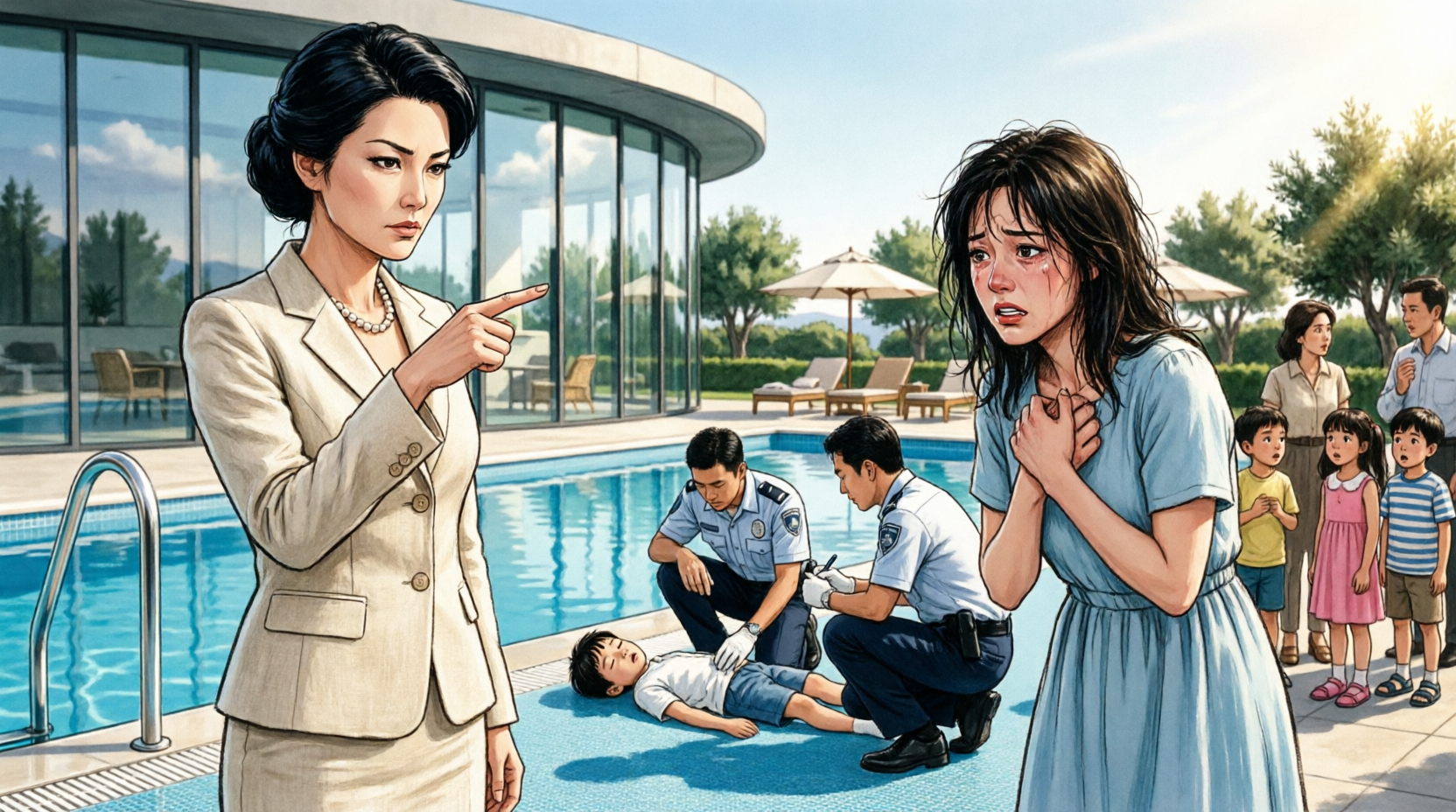
When she arrived to pick him up an hour later, Victoria looked every bit the doting, wealthy aunt. She stepped out of her sleek, black Range Rover wearing a flowing, designer linen cover-up and oversized Tom Ford sunglasses. She ruffled Leo’s curls, her heavy diamond rings flashing blindingly in the midday sun, and promised me, with a wide, cinematic smile, that they would have the “best day ever.”
PART ONE: THE GEOMETRY OF A LIE
The folded paper trembled between my fingers, not from my hands shaking, but from the sheer, quiet weight of what it represented. I stood in the morning light of my own kitchen, the radiator hissing its familiar, tired rattle, and read the adult handwriting for the third time. Do not tell Gideon. He will leave if he knows. The slant was sharp, practiced, deliberate. The ink had bled slightly into the cheap school paper where it had been pressed too hard. This was not a child’s scrawl. This was a directive. A rule. A boundary drawn by an adult who understood exactly what fear could do to a seven-year-old’s nervous system.
Beside the note lay the sealed school envelope. My name was written on it. Not Gideon. Not Stepfather. Dad. The word sat there like a quiet detonation. I had spent twenty years in emergency medicine learning how to read trauma before people named it. I knew the difference between a fall and a grip. I knew the chemical smell of antiseptic on over-scrubbed skin. I knew the half-second delay before a lie settled into place. But I had never expected to need that training in my own home. I had never expected the patient to be the little girl I had promised to protect.
Lumi stood near the island, one hand resting on the countertop, her sweater sleeve still pulled halfway up her forearm. The marks were visible in the pale morning light: four distinct ecchymoses on the lateral aspect, one larger contusion on the medial side. The spacing matched adult finger pads. The angle suggested a standing adult gripping a seated child’s upper arm. Capillary rupture consistent with manual restraint, not accidental impact. I did not need a textbook to confirm it. I needed to stop treating it like a family matter and start treating it like a crime scene.
Maris’s phone continued to vibrate on the counter. Her voice had come through sweet and sharp, the kind of tone that used warmth as a delivery system for control. Put Lumi on. But I was done handing over children to people who weaponized silence. I placed the phone face down, kept the voice recorder app running, and knelt until my eyes were level with Lumi’s.
“Open the envelope,” I said gently.
Her fingers trembled as she reached for it. She had learned early that paper could be dangerous. That notes could be threats. That adults used words to build walls and then blamed children for hitting them. I did not rush her. I let her feel the space. Let her know she was not performing. Let her know she was safe.
She tore the seal carefully. Inside were three documents. The first was a formal request for a mandatory parent-teacher conference, dated October 10. Subject: Concerning behavioral shifts and unverified allegations regarding new household dynamics. Request for immediate meeting with both legal guardians and school counseling staff. The second was a printed email from Maris to the principal, dated October 8. Subject: Urgent – Safety Concern Regarding Stepfather. I am writing to formally request that the district be made aware of my growing concerns regarding Gideon’s behavior around Lumi. He has displayed inappropriate intensity, excessive questioning, and a pattern of isolating her from peers. I fear for her emotional safety and request that any future interactions be supervised or delayed pending professional evaluation. The third was a handwritten note on school stationery, signed by a counselor I recognized from a previous community outreach visit. Ms. Donovan, per your request, we have drafted the initial referral. Please note that without documented evidence of harm or a formal report from a licensed professional, the district cannot act on allegations alone. We recommend you consult legal counsel before proceeding.
I laid the papers on the counter. My pulse remained at seventy-two beats per minute. My hands did not shake. I had spent my career watching abusers use bureaucracy as a shield. They filed preemptive reports. They coached children. They built narratives out of omission and called it concern. They assumed the system would swallow quiet adults and spit out compliant victims. They were wrong. But only if you moved first.
“Lumi,” I said, pulling my phone from my pocket. “Do you trust me?”
She nodded.
“Good. I’m going to make a call. You’re going to finish your tea. When I’m done, we’re going to pack a bag. Not because we’re running. Because we’re preparing. And preparation is how we stay safe.”
I dialed a number I had saved three years ago, after a case that had taught me how easily the system swallowed children who cried in silence. It rang twice before a voice answered, calm, authoritative, familiar.
“Vance.”
“Linnea. It’s Gideon.”
A pause. Then, warmer: “Gideon. It’s been a while. You calling from the hospital?”
“No. I’m calling from home. I need a consult. Not medical. Legal. And child advocacy.”
I heard a chair scrape. Papers shifting. The sound of someone switching into professional gear.
“Talk to me.”
I laid out the facts. Chronologically. Without embellishment. The bruise geometry. The note. The school envelope. The preemptive referral. The pattern of behavioral conditioning: flinching at loud noises, apologizing for non-mistakes, delayed responses to her mother’s name, the phrase all men leave because I’m too much trouble. The forced sedation attempts I’d suspected but hadn’t confirmed. The emotional isolation. The coaching.
Linnea listened. She did not interrupt. When I finished, she exhaled slowly.
“Gideon. That’s not just emotional abuse. That’s coercive control with documented grooming for a custody trap. If she’s already filed a referral with the school, she’s building a paper trail. She wants you to react. She wants you to look volatile. She wants the district to see a ‘concerned mother’ and a ‘defensive stepfather’ and let the system swallow you.”
“I know,” I said. “That’s why I’m not reacting. I’m documenting. I’m securing. And I’m calling you before she gets home.”
“Smart,” she said. “Do not let her near the child. Do not engage in conversation without recording. Do not leave the house alone with her. I’m pulling up your county’s child advocacy center contact. I’ll have Dr. Aris Thorne meet you at the clinic in forty minutes. Pediatric trauma specialist. Forensic documentation expert. He’ll do a non-invasive physical exam, map the bruising, take photographs, and generate a clinical report. That report will override the school’s referral. It will become the primary document.”
“What about the school?”
“I’ll call them. I’ll flag the referral as potentially retaliatory and request an immediate hold on any meetings until a forensic pediatric assessment is complete. They’ll comply. Districts hate liability.”
“And Maris?”
Linnea’s voice hardened. “She’ll arrive angry. She’ll arrive polished. She’ll arrive with a narrative. Do not argue with the narrative. Present the evidence. Let the evidence argue for you.”
“I will.”
“Gideon. One more thing. If she tries to leave the house with the child before the assessment, you do not physically intervene. You call 911. You state clearly: I am holding a seven-year-old in protective custody pending a forensic pediatric exam. The biological mother is attempting to remove her from the residence. I am requesting immediate police presence and child welfare intervention. Do you understand?”
“Yes.”
“Good. I’m on my way. Keep the phone on speaker. Keep the child calm. And Gideon?”
“Yeah.”
“You’re not alone in this.”
The line clicked off.
I turned to Lumi. She had finished her tea. Her small hands were folded in her lap. Her eyes were clear.
“Who was that?” she asked.
“Someone who helps children stay safe,” I said. “We’re going to a clinic. A doctor will look at your arm. He’ll ask you questions. You don’t have to be brave. You just have to be honest. Can you do that?”
She swallowed. Nodded.
“Will Mom be mad?”
“Probably,” I said. “But anger is not authority. And authority is not truth.”
I helped her pack a small bag. A spare sweater. Her toothbrush. A pair of socks. A small notebook she kept under her pillow. I did not pack toys. I did not pack distractions. I packed what she would need to feel grounded. When she zipped the bag, she looked up at me.
“Gideon?”
“Yes, sweetheart.”
“Thank you for not pretending.”
The words landed in my chest like a stone dropped into still water. I knelt again. I did not touch her. I let her see my face. I let her read the truth in it.
“I will never pretend again,” I said. “Not with you. Not about this. Not ever.”
At 10:42 a.m., headlights swept across the kitchen window.
Tires crunched on the gravel driveway.
Car doors opened. Closed.
Footsteps approached the porch.
Maris was early.
She always was when she sensed control slipping.
I stood. I placed my phone on the counter. I turned on the voice recorder app. I set it beside the school envelope. I walked to the front door. I did not open it. I waited.
Three knocks. Sharp. Authoritative. The kind that expect immediate compliance.
I opened the door.
Maris stood on the porch. She wore a charcoal coat, tailored trousers, leather boots that clicked against the wood. Her hair was pinned back. Her makeup was flawless. Her eyes were cold.
Behind her, in the passenger seat of her car, sat a man in a dark suit. He did not look at me. He looked at his phone. He was not here as a friend. He was here as a witness. Or a shield.
Maris stepped forward without invitation. “Where is she?”
“Inside,” I said. “With me.”
“I want her now.”
“No.”
Her jaw tightened. “Gideon, do not make this difficult. You’re having an episode. I can see it. You’re overreacting to a child’s imaginary fears. You’re twisting a simple misunderstanding into a crisis. Give me my daughter.”
I did not move. I did not raise my voice. I kept my hands visible. I kept the door open just enough to let the morning air flow between us.
“Maris,” I said, “I have the note. I have the school referral. I have the bruises documented. I have called a forensic pediatric specialist. I have notified the county advocacy center. I have recorded this conversation. You will not take her. You will not enter this house. You will stand on my porch and listen.”
Her eyes flicked to the phone on the counter. She saw the recording app running. Her face did not change. But her shoulders shifted. Just a fraction. The posture of a predator recalculating.
“You think you’ve won,” she said quietly.
“I think I’ve finally seen,” I said. “There’s a difference.”
Behind her, the man in the suit finally looked up. He closed his phone. He stepped onto the porch.
“Mrs. Donovan,” he said smoothly, “I’m Arthur Vance, legal counsel. I’d like to speak with Mr. Gideon before this escalates further.”
I looked at him. I looked at Maris. I looked past them, down the street, where a blue sedan was turning onto the driveway. Linnea’s car.
“I’m not speaking to anyone,” I said, “until the child is examined. Until the evidence is logged. Until the system stops rewarding the performance and starts protecting the victim.”
Maris’s smile returned. Thin. Sharp. Dangerous.
“Gideon,” she said, “you have no idea what you’ve just started.”
“I know exactly what I’ve started,” I said. “I’ve started telling the truth.”
The blue sedan pulled to a stop. Linnea stepped out. She wore a navy blazer, carried a leather portfolio, and moved with the quiet certainty of someone who had done this a hundred times.
She did not look at Maris. She looked at me.
“Assessment team is en route,” she said. “Clinic is ready. Let’s get her in the car.”
Maris took one step forward. “You cannot take my child.”
Linnea stopped. She turned. Her eyes were flat. Unyielding.
“Mrs. Donovan,” she said, “you filed a referral alleging emotional risk. The district has placed it on hold pending forensic review. Until that review is complete, the child remains in protective observation with the reporting adult. That’s the law. You can argue with it in court. Not on a porch.”
Maris’s breath came out in a sharp, controlled hiss. She looked at me. Really looked. Past the nurse’s calm. Past the stepfather’s restraint. To the man who had finally stopped absorbing the poison.
“You’ll regret this,” she whispered.
“No,” I said. “I’ll sleep.”
Linnea opened the passenger door. I helped Lumi into the seat. She buckled herself. She did not look back at Maris. She looked at me.
“Will you come?” she asked.
“I’ll be right behind you,” I said.
I closed the door. I walked back to the porch. I did not say another word to Maris. I stepped past her. I got into Linnea’s car. I started the engine. I drove away from the house that had been a stage. Toward the place where the truth would finally be documented.
The road ahead was clear. The sky was pale. The air was cold.
For the first time in six years, I was not driving toward a crisis.
I was driving toward a resolution…………………………….