My family kicked my seven-year-old daughter and me out during Christmas dinner, and for a few seconds, I actually thought I had misheard them.The dining room was too bright for a sentence that ugly. The chandelier shone over my mother’s holiday plates, the candles burned beside the cranberry dish, and the Christmas tree blinked red and gold behind my sister Eliza’s shoulder.
Outside, the porch flag tapped against the window in the wind. Inside, my child sat beside me counting peas on her plate, one by one, like she was trying to stay small enough not to be noticed. Eliza had always known how to make cruelty sound like confidence. She leaned back in her chair, lifted her chin, and said, “You should leave and never return.” Nobody corrected her. Nobody laughed nervously or told her to stop.
My father looked down at his plate. Connor, Eliza’s husband, kept chewing. My mother folded her napkin with that careful little motion she used whenever she wanted to look calm in a room she had just made cruel. Then she added, “Christmas is so much better without you.”
That was the sentence that changed everything. Not because it was the worst thing my mother had ever said to me. It wasn’t. It was the first time she said it in front of Mia. My daughter turned her face toward me, not toward them, and in that one small movement I saw the whole shape of my life from the outside. She knew where safety was supposed to be. She knew it was not at that table.
I had spent years convincing myself that my family was difficult but loving, blunt but loyal, harsh because they were stressed, cold because that was just how they were raised. Daniel never believed that.
My husband had been gentle about it at first.
He would clear the plates after dinner, wait until Mia was asleep, and say, “Rachel, this isn’t normal.”
I used to defend them because I did not know who I would be if I stopped.
Eliza had always been the bright one in my mother’s eyes.
When she cried, people gathered.
When she snapped, people called it passion.
When she failed, somebody found a reason.
I was the useful one.
I drove Dad to appointments.
I picked up things from the pharmacy.
I remembered birthdays, mailed checks, brought side dishes, washed dishes, smoothed over arguments, apologized first, and pretended not to notice that love in that house always came with a receipt.
Then Daniel died.
A worksite incident took him from us six months after he told me, again, that my family had trained me to survive neglect and call it respect.
After the funeral, I moved through the house like sound had gone missing.
Mia asked bedtime questions I could barely answer.
She wanted to know if heaven had night-lights.
She wanted to know if Daddy could see her school drawings.
She wanted to know why grown-ups kept telling her he was in a better place when the best place had been at our kitchen table.
Grief made everything quieter, but it did not make my family kinder.
They came for the funeral.
They ate the casserole.
Eliza cried loudly enough that people comforted her in the hallway.
Mom told me I looked tired, as though widowhood were poor presentation.
Dad patted my shoulder twice and said Daniel had been “a good provider.”
That word stayed with me.
Provider.
I did not understand how literal it had been until three weeks later, when I opened Daniel’s office drawer and found the folder.
It was labeled in his handwriting.
Rachel decides.
Inside were bank portal printouts, transfer histories, confirmation emails, and a ledger with my parents’ names and Eliza’s name written in clean columns.
There were renewal schedules.
There were monthly entries.
There were three unsigned continuation authorizations prepared by Park & Leland, the estate office Daniel had used before he died.
At 9:00 every first Friday, Daniel and I had sent my parents help.
I had known about some of it.
I had not known about all of it.
Daniel had quietly covered gaps because he knew I loved my parents, and he loved me enough not to make me beg them to be grateful.
The ledger was not dramatic.
That was what made it worse.
Line after line.
Date.
Amount.
Purpose.
Confirmation number.
No accusations.
No speeches.
Just proof.
Mom had accepted help while calling me selfish.
Dad had accepted help while staying silent when I was insulted.
Eliza had accepted help while treating my life like a warning label.
I sat at Daniel’s desk for a long time with the folder open in front of me.
Mia was asleep down the hall with one of his old T-shirts tucked under her cheek.
I remember the lamp buzzing.
I remember the cold coffee beside my elbow.
I remember thinking that paperwork could be more honest than people.
Not anger.
Worse than anger.
Clarity.
I did not cancel anything that night.
I did not call my mother and demand an apology.
I did not forward the ledger to Eliza with some sharp message I could later regret.
I put everything back in the folder and waited.
Part of me still wanted a family.
That is the embarrassing truth.
Even after everything, I wanted one Christmas where my daughter was welcomed without condition.
I wanted my mother to put a cookie in Mia’s hand and mean it.
I wanted Dad to look up from his plate.
I wanted Eliza to stop competing with a life I had never entered as a contest.
So on Christmas, I brought the three continuation authorizations with me.
I placed them in envelopes before we left our house.
Mom.
Dad.
Eliza.
I wrote the names in black marker because my hand was shaking too much for anything fancy.
I told myself I would give them out after dinner.
Maybe I would say Daniel had wanted them protected.
Maybe I would say I was willing to continue the support because family should not be a scoreboard.
Maybe I would say nothing at all and let mercy do the talking.
In the back seat, Mia held a wrapped ornament she had made at school.
It was lopsided, covered in too much glitter, and tied with red yarn.
The tag said, For Grandma, because Christmas is family.
I nearly turned the car around when I saw it.
Instead, I drove.
My mother’s house looked perfect from the street.
Snow sat along the driveway.
The porch light was on.
A small flag moved in the wind.
From outside, it looked like warmth.
Inside, the turkey smelled rich and buttery.
Cinnamon candles burned on the sideboard.
Eliza arrived already annoyed that we were there, though she hugged me for my mother’s benefit and kissed the air near Mia’s hair.
Connor shook my hand like we were business contacts.
Dad said, “You made it,” without looking especially glad that we had.
Mia gave my mother the ornament before dinner.
Mom said, “How sweet,” and placed it on the side table without opening it.
I watched Mia notice.
That is what people forget about children.
They notice the smallest rejections.
They may not have words for them yet, but their bodies keep the score.
Dinner began politely enough.
My mother asked about Mia’s school.
Eliza interrupted to talk about a trip she wanted to take.
Connor complained about work.
Dad carved turkey.
I poured water for Mia and reminded myself not to flinch at every tone.
Then Eliza made a comment about me “still being sensitive.”
I let it pass.
Mom said grief had made me withdrawn.
I let that pass too.
Connor joked that single mothers always acted like the world owed them a parade.
That one almost got me.
For a second, I pictured my hand closing around the water glass.
I pictured standing up and telling him exactly what Daniel had done for the people at that table.
I pictured every face turning toward the truth.
But Mia was beside me.
I breathed through my nose and stayed still.
Restraint is not the same as weakness.
Sometimes restraint is the last locked door before a room burns down.
Eliza watched me swallow the insult and mistook it for permission.
She put down her fork and said, “Honestly, Rachel, maybe you and Mia should just go.”
The room quieted.
I looked at her.
She smiled.
“You should leave and never return,” she said.
Then my mother added the sentence that finally ended my childhood.
“Christmas is so much better without you.”
I asked Eliza to say it again.
I do not know why.
Maybe I needed to hear it without the shock.
Maybe I needed my mother to have one final chance to stop it.
Maybe I wanted Mia to know that when people reveal themselves, you should make sure you are listening.
Eliza repeated it.
Dad said nothing.
Connor chewed.
Mom smoothed her napkin.
Mia looked at me.
That was when I stopped being their daughter first.
I became her mother only.
“Mia,” I said, “go get your coat and your little backpack.”
She obeyed immediately.
No questions.
No tears.
Just relief.
That relief broke something in me more cleanly than rage ever could have.
When she left the room, Eliza said, “Good. That’s settled.”
Connor laughed under his breath.
Mom told me not to make it harder than it had to be.
I stood.
Nobody expected that.
They expected tears, maybe a speech, maybe the old Rachel who would apologize just to reduce the temperature of the room.
I walked into the kitchen.
The envelopes were still in the cupboard beside the holiday platters, exactly where I had tucked them before dinner.
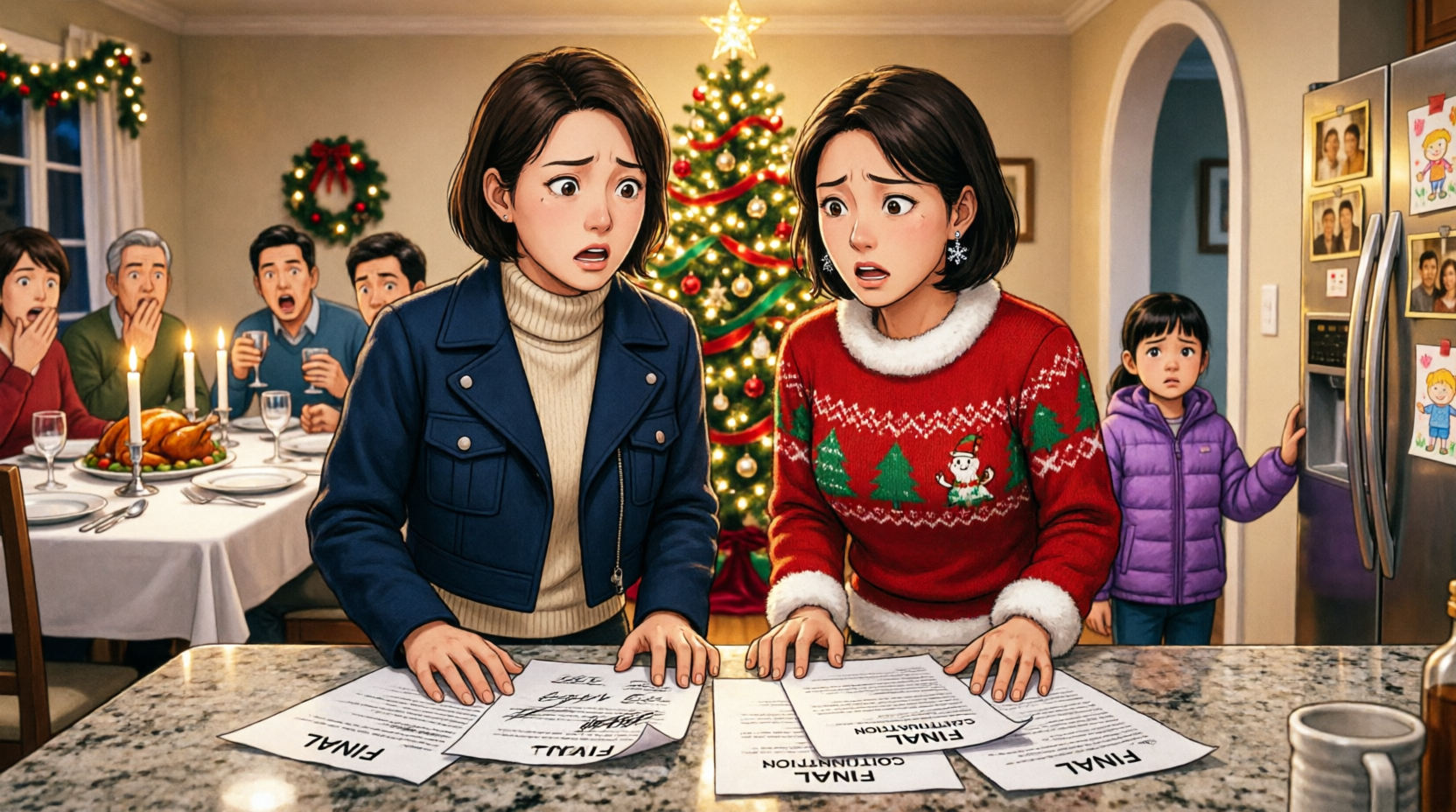
I took them out and set them on the counter.
Mom.
Dad.
Eliza.
For a few seconds, nobody understood.
Then Dad’s eyes lifted.
That was the first sign.
He did not know what I had brought, not exactly, but some part of him recognized the shape of consequence.
Eliza asked if they were Christmas cards.
Connor made a little sound like he was amused.
Mom laughed too fast.
I picked up my mother’s envelope.
“This is not guilt,” I said.
My voice sounded calm even to me.
“This is consequences.”
Then I tore it in half.
My mother’s face changed.
Not enough for regret.
Enough for fear.
I picked up Dad’s envelope.
He stood so quickly his chair knocked the rug.
“Don’t,” he said.
That word told me everything.
I tore his too.
Connor stopped smiling.
Eliza stepped toward me then, no longer amused.
“Stop acting crazy,” she snapped.
I picked up her envelope last.
She reached for it, but I moved it out of her reach.
I did not slap her hand.
I did not shout.
I did not give her the satisfaction of making me look unstable in the room where she had been cruel.
I simply tore the envelope cleanly down the middle before her fingers touched it.
The sound was small.
The effect was not.
Three piles of paper sat on the counter.
Three names.
Three torn chances.
Mia appeared in the hallway wearing her coat, her backpack crooked on one shoulder.
Her eyes were wide, but she was not surprised.
That made my next step easy.
I took her hand and walked out.
The cold struck our faces hard enough to make Mia gasp.
Snow crunched under our shoes.
Behind us, through the dining room window, I saw Mom pick up one strip.
Dad moved closer.
Eliza grabbed another piece and pressed the torn edges together.
Then all three of them saw the printed line.
Continuation Authorization.
Dad lifted a strip toward the kitchen light and looked through the window at me.
His mouth formed two words.
Don’t cancel.
I read them before he managed to say them.
Mia’s hand tightened in mine.
Then her little ornament slipped out of her backpack and fell into the snow.
The tag flipped over under the porch light.
For Grandma, because Christmas is family.
My mother saw it through the window.
For the first time all night, she looked less polished than human.
Her hand went to her mouth.
Eliza called my name.
Not gently.
Urgently.
There is a difference.
“Rachel,” she shouted through the glass. “Come back inside.”
Connor had picked up one of the torn strips by then.
He read it, looked at Eliza, and said something I could not hear.
Whatever it was, it made her spin on him.
Dad sank into a kitchen chair.
My phone vibrated in my coat pocket.
The caller ID said Park & Leland.
I had scheduled the call two days earlier because I knew myself.
I knew that if my family was kind, I might sign.
I knew that if they were cruel, I needed a witness to my own decision before guilt got clever.
I answered.
The estate associate asked if I was ready to confirm the authorizations.
I looked at Mia.
Her cheeks were pink from the cold.
Her eyes were still on the ornament in the snow.
Behind the glass, my family looked like people watching a door close from the wrong side.
“Yes,” I said into the phone.
My voice did not shake.
“Do not renew them.”
The associate repeated the instruction back to me.
That was part of their process.
I confirmed again.
No renewal.
No continuation.
No further monthly assistance through Daniel’s estate accounts.
Eliza’s mouth moved behind the window.
Mom came to the door then, finally.
She opened it and the warm air spilled out around her.
“Rachel,” she said, and my name sounded different in her mouth when money was attached to it.
I bent down, picked up Mia’s ornament, and brushed snow off the tag.
Mom saw the words up close.
For a moment, I thought she might apologize to Mia.
Not to me.
I had already stopped expecting that.
Just to Mia.
Instead she looked past the ornament and whispered, “You can’t do this to us tonight.”
There it was.
Us.
Not her granddaughter standing in the cold.
Not the daughter she had told to leave.
Us.
I put the ornament in Mia’s backpack.
“I didn’t do it tonight,” I said.
“You did.”
Dad appeared behind her.
His face had gone gray.
“Rachel,” he said, “we didn’t know what was in those envelopes.”
“Yes, you did,” I said.
He flinched.
Maybe they did not know every line.
Maybe they did not know the expiration schedule.
Maybe they did not know Daniel had left the final decision to me.
But they knew help had been coming.
They knew I had been quiet about it.
They knew their comfort rested on the same person they had just humiliated in front of her child.
Eliza pushed past Mom into the doorway.
“Don’t be ridiculous,” she said, but her voice had lost its shine.
“I’m not,” I said.
Connor stood behind her, holding a torn piece of paper he had no right to understand and every reason to fear.
Mia leaned into my side.
I felt her tremble.
That ended the conversation.
I opened the car door and helped her into her booster seat.
Mom kept talking.
She said I was emotional.
Dad said we should discuss it after Christmas.
Eliza said I was punishing everyone because I could not take a joke.
Connor said nothing.
That was the smartest thing he did all night.
I shut Mia’s door.
Then I turned back.
For years, I had imagined the perfect speech.
I thought it would be long.
I thought I would list every birthday forgotten, every insult swallowed, every time they made me earn a place that should have been mine by love alone.
But when the moment came, I only had one sentence left.
“You taught my daughter she was unwanted at your table,” I said.
The porch went quiet.
“That is the last thing you teach her.”
I got in the car.
Mia did not cry until we reached the end of the street.
It came out small at first.
Then her shoulders started shaking.
I pulled over near the row of mailboxes because I could not drive with that sound in the back seat.
I climbed into the back and held her as best I could over the booster straps.
She asked, “Did I do something wrong?”
I had known pain before.
I had buried my husband.
I had opened bills with shaking hands.
I had slept on the bathroom floor because grief made the bedroom feel too large.
But nothing hurt like hearing my child ask whether grown people’s cruelty had been her fault.
“No,” I told her.
I said it again and again until her breathing slowed.
“No, baby. You did nothing wrong.”
We went home.
I made grilled cheese because it was the only thing she wanted.
We ate at our small kitchen table in pajamas while snow tapped the windows.
She hung the ornament on our tree.
Not Grandma’s.
Ours.
Later that night, my phone filled with calls.
Mom.
Dad.
Eliza.
Connor.
Mom texted that I had misunderstood.
Dad texted that Daniel would not want this.
Eliza texted that I was destroying the family.
That one almost made me laugh, because some families only notice the foundation when the person holding it up finally steps away.
I did not answer.
The next morning, Park & Leland emailed the confirmation summary.
No renewal.
No continuation authorization.
Effective at the scheduled expiration.
I saved the PDF.
I printed one copy for my records.
Then I put it in Daniel’s folder behind the original ledger.
Rachel decides.
For the first time since finding that folder, the label did not feel like a burden.
It felt like a door.
Over the next week, my parents tried different approaches.
My mother left voicemails that began with crying and ended with accusation.
My father asked for “one adult conversation.”
Eliza sent messages so long they looked like essays and so empty they said almost nothing.
Connor called once and hung up when I answered.
I responded one time by email.
I wrote that all future financial questions should go through Park & Leland.
I wrote that I would not discuss money in front of Mia.
I wrote that contact with my daughter would require an apology to her first, not a performance for me.
Nobody liked that.
That was how I knew it was clear.
In January, Mia asked if we were still a family.
I told her yes.
Then I pointed to our kitchen table.
I pointed to her drawings on the fridge.
I pointed to Daniel’s old hoodie hanging by the back door because neither of us was ready to move it.
“Family is where you are safe,” I told her.
She thought about that for a while.
Then she asked if we could make pancakes for dinner.
So we did.
Months later, my mother mailed Mia a card.
There was no money inside.
No apology either.
Just a careful sentence about hoping she was doing well.
Mia read it once and handed it to me.
“Can I go play now?” she asked.
I said yes.
Children learn rejection, but they also learn relief.
They learn who reaches for them when a room goes cold.
They learn who tells them the truth.
They learn who leaves the table with them.
That Christmas, my family thought they were kicking out a widow and her little girl.
They thought I would cry, apologize, and keep paying to be tolerated.
They thought my silence meant I had no power.
They were wrong.
My daughter had looked at me because she knew where safety was supposed to be.
So I became it.
And when I tore those envelopes, I was not destroying my family.
I was finally refusing to let my child inherit the same hunger I had mistaken for love.