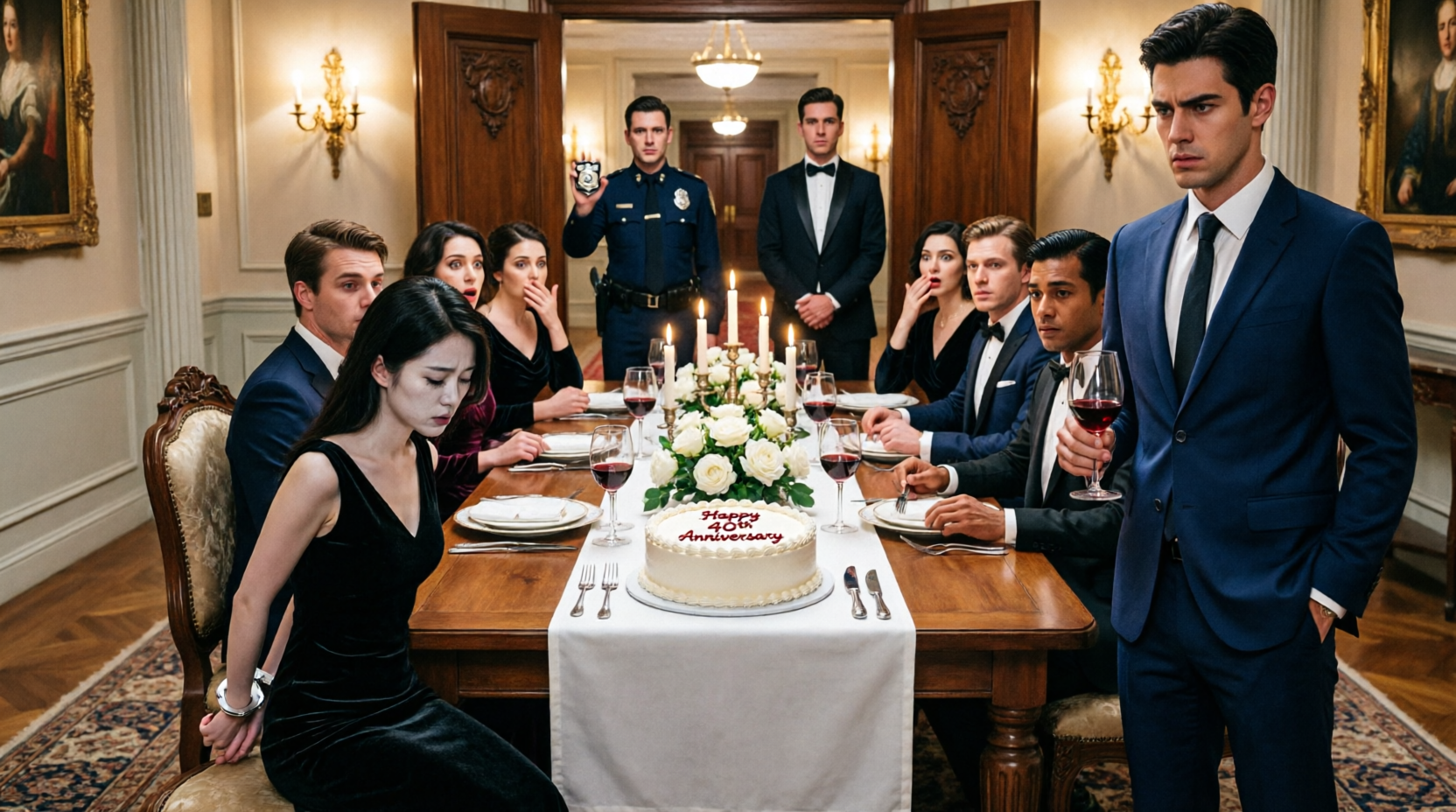
I remember the moment most clearly for its silence.
Not the accusation. Not the handcuffs. Not even the little burst of laughter that followed when my brother decided he had finally found the perfect way to reduce me to something manageable in front of an audience.
What I remember most clearly is the silence afterward.
Our parents’ fortieth anniversary dinner had been planned for weeks in the careful, fragile way family events are always planned when nobody in the family knows how to be honest without drawing blood. My mother had chosen the restaurant because it was small and warm and “felt intimate,” which in her language meant dim enough to hide tension and expensive enough that everyone might behave. She had called each of us personally. She had made a point of saying she wanted all her children at one table, which was also her way of admitting she knew the table itself was the risk.
The place sat on a side street downtown, all amber lamps and polished wood and waiters who spoke softly because the room did most of the work for them. There was a small bar near the entrance, three frosted windows looking onto the street, and a dining room arranged around an old brick wall hung with black-and-white photographs of the city from a century ago. The kind of restaurant where anniversaries happened at one table and quiet affairs began at another and everyone pretended not to notice either one.
I arrived late.
I usually arrived late, or that was the family story. The truth was simpler and much less personal. My work trained me to arrive without spectacle and leave without asking anyone to mark it. Timing, in my world, was rarely social. It was tactical, dictated by traffic patterns, movement schedules, secure calls, clearance windows, and the kind of quiet deadlines that never sound legitimate to people who believe importance should be visible from the parking lot. Over the years, my family had turned my habit into a flaw. To them, I was not discreet. I was aloof. Not careful. Secretive. Not tired. Arrogant.
Families are very good at naming what they do not understand in ways that protect their pride.
When I stepped into the restaurant, my mother saw me first.
She had chosen a dark blue dress and pearls she only wore on holidays or funerals, which was fitting because with my family the difference between the two was often just the menu. Relief softened her face when she spotted me near the entrance. She gave me a small wave, not enough to interrupt the room, just enough to tell me there was still an empty chair and that she had been afraid for a moment there might not be.
My father nodded from the far end of the table, glass in hand, his face composed in that familiar way that always made it seem as though he had appointed himself master of ceremonies for his own household. My aunts and cousins and in-laws were arranged around the table in loose rings of obligation. Some were already on their second drinks. One cousin had his phone out under the tablecloth glow, hiding bad manners in plain sight.
And there was Daniel.
My older brother sat near the center, where he always liked to sit, in a dark shirt with his police jacket draped over the back of his chair like a flag. He wasn’t technically on duty, but he wore pieces of the job everywhere, even when he wasn’t wearing the whole thing. The jacket was there for effect. A reminder. A way of placing his authority in the room before he ever opened his mouth.
Daniel had always been the visible kind of power.
He was five years older than me, broad-shouldered, loud enough to be heard even when he wasn’t speaking, the sort of man who entered a room assuming it would bend around him simply because it usually had. As children, teachers had called him a natural leader. Coaches had called him tough. My father had called him solid, which in our house was the highest form of praise. When he joined the police department, the family treated it as confirmation of what they had always believed: Daniel was the son who made sense in the world. He wore authority outside his body where everyone could admire it.
I slipped into the empty chair across from him.
“Look who finally showed up,” he said, lifting his glass in mock salute.
A few people laughed.
It was harmless enough, the kind of line he’d used on me all our lives. He jabbed, the family laughed, and the room reset itself around the assumption that I would absorb it because I always had.
I smiled faintly and reached for the water nearest my place setting. The glass was cold. My hands were colder.
Dinner resumed.
The first course arrived, then the second. My mother kept trying to pull the conversation toward safe territory—childhood stories polished by repetition, recipes, an update on a cousin’s new condo, the anniversary trip she and my father were planning but likely would never take because my father liked planning more than leaving. People laughed at the familiar points. My aunt told the same story about Daniel breaking his arm at thirteen and refusing to cry. My father pretended to be offended when my mother reminded everyone he had once burned down the grill because he thought lighter fluid was the solution to all engineering problems.
I spoke when spoken to. Asked questions when the silence required it. Smiled at appropriate places. To anyone outside the family, I probably looked polite and reserved. To my relatives, I looked exactly as I always looked—present but not accessible, participating in a language they had long ago decided I preferred not to speak.
That decision had become its own tradition.
At one point, my aunt asked me what I’d been doing lately.
“Work’s been busy,” I said.
It was the same answer I always gave, not because I enjoyed being mysterious, but because it was the only answer available. A career built on clearance, compartmentalization, and operational silence does not translate well across bread baskets. You learn quickly that telling partial truths only invites stranger questions, and telling full truths is often not permitted. So you become economical. You say federal work. You say travel. You say long week. People who love you understand the boundary or at least respect it. People who need your life to make them comfortable start inventing what must lie behind the door.
Daniel leaned back in his chair and studied me over the rim of his glass.
“Yeah,” he said slowly. “About that.”
The tone shifted.
Only families notice shifts like that in time to flinch. Outsiders hear a sentence. Families hear a floorboard give way.
He stood up with his drink still in his hand, and for a second the table adjusted itself around him as if expecting a toast. My mother smiled automatically. My father sat a little straighter. One cousin reached for his phone under the table and then thought better of it.
Daniel did not raise his glass.
Instead, he looked directly at me.
“You know what’s funny?” he said to the table. “For years, my little brother’s been telling everyone he works federal.”
A few heads turned toward me.
I didn’t move.
Daniel smiled, and there it was—that look he got when he thought he had found the line that would make the whole room his.
“So,” he continued, “I did a little checking.”
The words landed lightly for everyone else.
For me, they landed with weight.
Daniel went on. “And guess what? No record. No listing. No federal directory. No agency personnel file I can pull, no active status anywhere that says he’s any kind of federal agent.”
My cousin laughed first.
“Wait, seriously?”
Daniel nodded, enjoying the attention now. “Seriously.”
I set down my fork.
The waiter passing behind my chair slowed almost imperceptibly, then kept going. My mother’s smile thinned. My father frowned, but not at Daniel. At me. As if I had created the awkwardness simply by being the subject of it.
For years, my family had handled my work by building theories around it.
Maybe I was a clerk.
Maybe I did contract administration and liked letting people think it was something more interesting.
Maybe “federal” meant post office and I was too proud to say so.
Maybe I had washed out of something important and clung to the language because admitting ordinary work felt like failure.
Maybe I said less because there was less to say.
None of them were correct. But families do not require accuracy when contempt is more entertaining.
“Daniel,” my mother said, her voice light and warning at once. “This isn’t necessary.”
He didn’t even look at her.
“Oh, I think it is,” he said. Then, to the table, “Impersonating a federal officer is actually a crime.”
That got a bigger reaction.
Not outrage. Interest.
Someone murmured, “No.”
Someone else chuckled because the idea of me secretly being ridiculous pleased them more than the possibility that Daniel might be overstepping.
Daniel reached into his pocket.
At first I thought he was pulling out his phone. Another prop. A screenshot, maybe. A search result. Something childish and visible.
Instead he pulled out a pair of handcuffs.
For half a second, even I thought it had to be a joke.
Then he stepped around the table.
“Daniel,” my mother said again, but this time I heard the wrong thing in her voice. Not alarm. Anticipatory embarrassment. The kind people feel when they believe something dramatic is about to happen to someone else and are already arranging themselves emotionally to survive the fallout without losing face.
He came up behind my chair.
I could smell his aftershave.
“Relax,” he said loudly enough for nearby tables to hear. “Lucky for you, there’s an actual cop in the family.”
The first cuff closed around my wrist before I moved.
The second clicked through the slat of the chair.
Cold metal bit skin.
There is a particular sound handcuffs make when they close—a final, efficient little bite of steel. Most people hear threat in it. I heard training. Timing. Sequence. The mechanical confirmation that a line had been crossed and could not now be uncrossed by pretending harder.
Applause broke out from two of my cousins.
Someone whistled.
My aunt covered her mouth, half scandalized and half entertained. My father looked stunned but still did not tell Daniel to stop. My mother said my name once, softly, like she was practicing concern rather than feeling it.
I sat very still.
Humiliation is a strange thing. It begins loud, because there are always witnesses, but inside your own head it becomes very quiet very fast. The room around me blurred into pieces—the candlelight reflected in wineglasses, the soft scrape of someone’s chair leg against the floor, a waiter frozen three tables away holding a tray of steak knives, my own pulse turning harder instead of faster.
I looked up at Daniel.
“Take them off,” I said calmly.
He grinned.
“Relax. I’ll take you down to the station and sort it out.”
More laughter.
That was when I said it.
Not loudly. Not theatrically. Just clearly enough for him to hear and for the words to exist in the room.
“You just unlawfully detained a federal agent.”
The table erupted again.
Daniel threw his head back and laughed. “Oh, that’s good,” he said. “Stick with the story.”
I did not argue.
There was no point.
Because clipped inside the lining of my jacket, beneath the lapel and out of sight, was a matte-black device the size of two stacked matchbooks. It was not glamorous. It did not blink or chirp or look like anything Hollywood would assign to a man with my clearance. Its purpose was not drama. It existed for a single operational reason: if I was forcibly restrained, unresponsive to motion challenge, or unable to manually clear a silent distress prompt within a defined window, a signal was transmitted.
When Daniel clicked the first cuff onto my wrist, the device registered the restraint pattern immediately.
By the time the second cuff locked to the chair, the signal had gone out.
Somewhere else in the city, a system had already reacted.
I knew that.
Daniel didn’t.
Minutes passed.
That was the worst part for the room. A joke can survive anything except duration. If I had shouted, struggled, or pleaded, people would have known how to metabolize it. They would have assigned roles, sorted sides, told themselves a family melodrama was underway and they were lucky enough to be near it. But I simply sat there, calm and upright, the cuff chain short enough to prevent movement but long enough to make the scene uglier.
The laughter thinned.
The room adjusted.
Nearby diners stopped pretending not to look.
Daniel noticed it too.
“All right,” he said finally, tugging once at the chain. “You’ve made your point.”
I met his eyes.
He reached toward his pocket for the key.
And then the restaurant door opened.
Three people entered.
They weren’t loud. They didn’t rush. They did not arrive with the theatrical force most civilians expect from authority because actual authority, when it is competent, rarely has to perform. They moved with quiet purpose, taking in the room in one sweep—the exits, the tables, the line of sight, the hands, the faces. One of them, a man in a dark coat, came directly toward us.
He stopped at the table and showed a badge.
“Evening,” he said.
The room went still.
His gaze moved from me to the cuffs to Daniel.
“Which one of you is Officer Daniel Mercer?”
My brother blinked.
“I am.”
The agent nodded once.
“You’re going to unlock those cuffs.”
Daniel straightened.
“This is a misunderstanding.”
“I’m sure it is.”
He extended a hand, palm up.
“The key.”
Daniel’s hand went to his pocket, but slower now.
Up close, I could see his confidence cracking in layers. First annoyance, then confusion, then the specific fear men like him feel when the hierarchy they thought they controlled shifts one level above them without warning.
The key rattled slightly against the metal when he unlocked the second cuff.
Then the first.
Steel fell away from my skin.
I stood and rubbed the red mark around my wrist once. It stung. My hand had already started to go numb where the pressure hit the joint.
Another of the agents, a woman I knew as Reyes, stepped slightly to my left.
“You all right?” she asked quietly.
“I’m fine.”
She looked at the marks anyway. Professionals always do.
The first agent turned back to Daniel.
“Officer,” he said, tone still even, “detaining a federal officer without jurisdiction creates a serious situation.”
My brother opened his mouth. Closed it. Looked at me, then at the badge, then toward our parents as if someone might step in and restore the reality he preferred.
No one did.
I spoke before the agent escalated.
“It was a family misunderstanding,” I said.
Reyes glanced at me.
So did the man with the badge.
They both understood what I was doing and why. Not because it would save Daniel entirely—by that point the signal, the response, and the facts already existed in multiple systems—but because public escalation in the restaurant would widen the blast radius to include my parents, every civilian in the room, and whatever operational coverage remained around my presence in the city.
The agent studied me for one long second.
Then he gave a short nod.
“Understood.”
He turned back to Daniel, said something too low for the table to hear, and handed him a card.
Daniel took it with fingers that had started to lose certainty.
The agents stepped away.
They did not linger. They did not explain. They did not reassure the room. They just removed their attention, which in some ways was more frightening than keeping it there. Then they turned and left the way they had entered, carrying quiet with them.
No one laughed this time.
My mother stared at the tablecloth. My aunt found tremendous interest in her wineglass. My cousins, who had applauded the cuffs, suddenly looked like men who had been caught clapping at the wrong part of a funeral. My father sat frozen, jaw set, eyes fixed not on me but on Daniel, as if the disaster might still somehow be contained if nobody admitted what had actually happened.
Daniel remained standing beside my chair.
The police jacket still hung on the back of his seat. The handcuffs lay open on the table like something obscene and small.
For years he had believed the story he told about me.
Tonight, it had collapsed in front of everyone.
I picked up my jacket.
“Happy anniversary,” I said to my parents.
No one tried to stop me.
As I walked toward the door, I could feel every eye in the room on my back. But behind me the table stayed silent.
Not the awkward silence from before.
Something heavier.
The car waiting outside belonged to the government, but nothing about it advertised that fact. Dark sedan. Clean lines. Nothing flashy. Reyes drove. The senior man from the restaurant sat in the passenger seat. I slid into the back, closed the door, and for the first time since the cuffs went on, let my shoulders loosen.
The city moved past the window in wet amber streaks.
For a minute, no one spoke.
Then Reyes glanced at me in the mirror.
“You should ice that when we get you back.”
“It’s fine.”
“No,” she said. “It’s not.”
Fair enough.
The man in the passenger seat—Cole, supervisory on the task force cover we were running that week—looked at a tablet, then at me.
“We have to file the response,” he said. “There’s no way around that.”
“I know.”
“He ran your name through state and federal systems multiple times over the last several months,” Cole added. “That’s already triggering internal notifications because of your current assignment posture. Tonight just turned curiosity into misuse.”
I stared at the back of his seat.
“How many times?”
“Enough.”
That was not an answer. Which meant the number was bad.
I leaned my head back and closed my eyes briefly.
In some ways, the handcuffs themselves were not the deepest cut. Humiliation is survivable. Public embarrassment burns, but it fades. The deeper wound was the planning. The fact that this had not been a spontaneous drunken stunt from a brother feeling theatrical over dessert. Daniel had been looking. Searching. Building a case in his head. Running me through whatever systems he could reach until his own ignorance felt like proof of my dishonesty.
I opened my eyes.
“Do you know what he expected to find?”
Cole’s mouth shifted.
“Probably nothing.”
“Exactly.”
That was the problem.
Daniel had not searched because he was worried.
He had searched because he wanted me to be a liar.
The sedan took a turn too fast for the rain and corrected cleanly. Reyes was angry. I could always tell when she was angry by the smoothness of her driving.
“You want to talk about it?” she asked.
“No.”
“All right.”
Then, because silence can harden into something dangerous if left alone too long, she said, “For what it’s worth, I liked the line.”
“What line?”
“You just unlawfully detained a federal agent.”
Despite myself, I laughed once. Dryly.
The sound startled me.
I spent most of my life being the quieter brother.
That wasn’t how my family described it. They said withdrawn. Secretive. Difficult to read. But quietness was the actual thing. Daniel arrived in the world loudly and never reconsidered the strategy. I arrived observing. He took space by assumption; I learned to measure rooms before entering them. He fought first, apologized later if at all. I watched patterns. Listened longer than people liked. Spoke only once I had a structure in mind.
As children, these differences became family mythology almost immediately.
Daniel was the future policeman at age ten because he liked ordering kids around during street hockey games and was broad enough to win most arguments by standing. My father admired that kind of certainty. He called it grit. He called it command presence. He called it the ability to take charge.
I read manuals for fun, took radios apart to see how they worked, and once spent three weeks teaching myself enough Russian from a library cassette program that I could make it through a newspaper paragraph with a dictionary. My mother called that “interesting” with the strained smile women use when they want to praise a child without encouraging whatever made the child strange in the first place.
At fourteen, Daniel got into a fight protecting a friend in the school parking lot. He broke the other kid’s nose and came home with a split lip and our father nearly glowing with pride while pretending to disapprove. At fourteen, I built a shortwave receiver from scavenged parts and spent whole nights listening to the world speak just beyond ordinary hearing. My father walked into my room once at midnight, saw wires and books and maps spread across the floor, and said, “You need to get outside more.”
This was how it worked in our house.
Visible force translated cleanly.
Quiet capability did not.
I did not resent Daniel for that, not then. Resentment requires you to believe the score is being kept fairly. Children rarely do. They just adapt. I learned that if I wanted peace, I should not ask my family to understand the things that made me feel most alive. Daniel learned that if he spoke with enough confidence, understanding was optional.
By the time I left for college, he had already become the son people mentioned first.
Good old Daniel. Solid Daniel. Daniel in uniform. Daniel who stayed near home. Daniel who didn’t make you work too hard to feel proud.
I went where the work took me.
My official path can be described in bureaucratic language without technically lying: federal service, intelligence support, interagency operations, protective work, task force assignments, long periods of travel, even longer periods of silence. The version that mattered never fit into a holiday update anyway. After 9/11, a lot of young men did what I did in one form or another. Some because of fury. Some because of fear. Some because they were searching for a story larger than the one they had inherited. In my case it was all three, braided together with the quieter truth that I had found, at last, a world where precision mattered more than performance.
I was good at it.
Very good, eventually.
Good enough that my work became less publicly legible as the years went on.
That is a thing no one explains to civilians. The better you become in certain federal roles, the less your life resembles anything they can verify over coffee. Your name stops appearing in the places ordinary people think to check. Titles flatten. Human resources records route differently. Assignments blur. Sometimes even the people who love you only ever get the broadest possible noun. Federal. Government. Task force. Travel. Security. Some of it sounds evasive because it is. Evasion is not deception when disclosure itself is a hazard.
I told my family as much truth as I could.
It was never enough.
At first they seemed faintly impressed by the mystery. My mother would say, “He works in Washington,” with the soft excitement of a woman who enjoyed having a son in an important city even if she didn’t understand what he did there. Daniel would clap me on the shoulder and ask if I was finally ready to admit I spent most of my time doing paperwork. My father would ask for something he could tell the guys at the club, just one clear title, and I’d give him the same answer every time: federal work, Dad.
The problem was not that they lacked details.
The problem was that Daniel hated invisible authority.
If he couldn’t see it, rank it, compare it to his own, or show it off, he distrusted it. And if he distrusted it, he eventually needed to puncture it. He could not tolerate ambiguity in someone close to him. Especially not me.
At first he turned the question into a running joke.
“So what are you this week,” he’d ask at Thanksgiving, “Jason Bourne or a tax auditor?”
At Christmas: “If you ever actually get a badge, you’ll show us, right?”
At our cousin’s wedding: “He says he works federal, but I’m telling you, the kid sells toner to the IRS.”
Everyone laughed because Daniel was easy to laugh with and I made it easy for them by never correcting too hard.
That, too, became part of the story. My refusal to explain myself got interpreted as proof that there wasn’t much there.
Over time, though, the joking hardened.
He started asking more pointed questions. Agency names. Office locations. Personnel contacts. The kind of specifics nobody in my life needed unless they were trying to build a test. Twice he asked to see my credentials “just to settle the mystery.” Once, after too much whiskey at my parents’ house, he asked whether I was embarrassed that he was the only one in the family with a real badge.
I told him the same thing every time.
“I’ve told you what I can.”
Which only deepened the offense.
Because in Daniel’s world, boundaries from other people felt like theater. He believed access was normal and refusal was personal.
The first text from my mother came before the sedan reached the secure garage.
Are you all right?
The second came thirty seconds later.
You should have told us Daniel didn’t know.
I stared at the screen.
Not I’m sorry. Not what were we thinking. Not your brother had no right. Just that curious, reflexive redirection mothers sometimes perform when one child detonates and the other survives: the survivor becomes responsible for not having anticipated the blast.
I did not answer.
My father’s message came next.
Call me. Your brother could lose his badge over this.
That one I actually laughed at.
Not because it was funny. Because it was so perfectly itself.
I had arrived at their anniversary dinner in good faith and left in handcuffs. Daniel had publicly accused me of committing a crime. He had used police restraints in a private restaurant to stage a humiliation in front of family and strangers. And within an hour my father’s first concern was Daniel’s badge.
Of course it was.
At headquarters, the night stretched into reports.
Distress trigger.
Response time.
Civilians present.
Unauthorized restraint.
Subject identified as local law enforcement officer.
Potential compromise considerations.
Paperwork is the tax you pay for both heroism and stupidity. In this case, no one had been heroic.
Cole finished his portion, then sat across from me in an interview room that smelled faintly of old coffee and dry erase markers.
“Internal Affairs has already been notified,” he said. “Because of the database queries.”
I leaned back in the chair.
“How bad?”
He looked at the report in front of him. “Seventeen accesses over six months. Different systems. Some outside his case authority. One of them hit a restricted channel because your file architecture isn’t normal.”
There it was. The number.
Seventeen.
Not one impulsive search. Not a drunken night at a laptop. Months.
“What happens now?”
“Best case?” Cole said. “Suspension, IA review, possible loss of badge. Worst case, depending on how aggressive his department and DOJ feel, misuse charges, unlawful detention issues, potential federal exposure if they decide to care about the classification adjacency.”
“And if I say I don’t want to push?”
He gave me a look that was more tired than unsympathetic.
“You can ask for restraint. You can decline to amplify. You can characterize the restaurant piece as a family situation. What you can’t do is make the audit trail disappear.”
He was right.
That was always the trouble with real systems. Unlike families, they had memory.
I slept four hours in a safe apartment downtown and woke to twenty-one missed calls.
My mother.
My father.
An aunt.
Two cousins.
Daniel from a number I had blocked years earlier.
Daniel again from an unknown number.
Then a voicemail from my father delivered in the tone he used when he believed reason itself belonged to him.
“Call your brother. He’s suspended. This has gone too far.”
Gone too far.
As if the problem were not the cuffs, but the consequences.
I ignored the calls and went to work.
Compartmented operations do not pause because your family chooses dinner over dignity. The city still moved. The assignment still existed. Threat assessments still needed eyes. Intelligence still had to be read before it metastasized into whatever waits at the far end of carelessness. I spent six hours in a secure room reviewing chatter tied to the reason I was in Chicago at all, which I will not spell out even now because habits that keep you alive do not evaporate for literary neatness.
At noon my supervisor asked me to step into her office.
Eleanor Grant had the face of a woman who had long ago misplaced any interest in drama. She closed the door, held up a file, and said, “I assume this is the family event.”
I nodded.
She dropped the file onto her desk.
“Your brother’s department reached out through liaison channels wanting to know whether we’d consider characterizing the restaurant incident as a misunderstanding.”
I almost admired the speed.
“What did you tell them?”
“That our personnel do not misunderstand handcuffs.”
I sat down.
Grant studied me for a moment. She knew enough about my family to understand the outline if not the specifics. People who work under high clearance learn one another’s silences as much as their stories.
“You want my advice?” she asked.
“Yes.”
“Don’t save him from lessons he arranged for himself. You can choose not to pursue extra pain. That’s different from lying.”
I looked at the red marks still faintly visible around my wrist.
She followed my gaze.
“You know what gets me?” she said. “Not that he doubted you. People doubt what they can’t verify. That’s human. What gets me is that he wanted an audience.”
Yes.
That was exactly it.
If Daniel had truly believed I was lying and cared about the truth, there were a hundred private ways to ask. He could have called me. Cornered me in a driveway. Said brother to brother, tell me what’s real because I don’t understand and I’m tired of feeling like you’re speaking in fog. I might not have told him much, but I would have respected the question.
Instead he chose a dinner table.
Our parents’ anniversary.
An audience.
Theatrics.
Steel.
He didn’t want clarity.
He wanted me lowered.
By evening Daniel managed to reach me from a number I didn’t know.
I answered because part of me, some damaged durable part, still hoped for the impossible. A real apology. A crack in him. Something.
He skipped hello.
“You need to call them.”
I waited.
“Internal Affairs,” he said. “My chief. Whoever. Tell them it was a joke that went sideways.”
A joke.
“What part?” I asked. “The database searches or the cuffs?”
Silence on the line.
Then, “I was trying to protect the family.”
I closed my eyes.
“From what?”
“From you lying to everybody.”
“I wasn’t.”
“How the hell was I supposed to know that?” he exploded. “There’s no record. No office. No title. You walk in and out of family events like you’re above everyone, say ‘federal’ like it should mean something, then disappear. Dad asks what you do and you shrug. Mom worries you’re mixed up in something. I check, there’s nothing. What was I supposed to think?”
There it was.
Not concern. Not care. Injury.
He had felt excluded from my reality and converted the feeling into prosecution.
“You were supposed to ask,” I said quietly.
“I did ask.”
“No. You taunted. That’s different.”
He breathed hard into the phone.
“You let those people come in there and make me look like an idiot.”
I nearly hung up.
Not you handcuffed me.
Not I was wrong.
Not I’m sorry.
You let them make me look like an idiot.
“Daniel,” I said, more tired than angry now, “the restaurant wasn’t the first time you decided how my life had to look in order to count. It was just the first time there were witnesses outside the family.”
He said nothing.
Then, smaller and uglier, “If I lose my badge because of this—”
“If?”
He swallowed whatever came next.
“Can you help me or not?”
That was the moment I understood the conversation had nothing left in it worth saving.
“I already did,” I said. “If I hadn’t de-escalated at the restaurant, you would have been arrested that night.”
And then I hung up.
The calls intensified after that.
My mother cried on voicemail.
My father lectured.
A cousin texted, Family should never involve outsiders.
An aunt wrote, Daniel was wrong but surely not malicious.
Someone else—God knows who—sent, He always looked up to you, you know.
That one made me sit down in the hallway outside the ops room and laugh until a junior analyst passing by asked if I was all right.
Daniel had not looked up to me.
He had looked at me the way men look at locked doors they resent.
Three days after the anniversary dinner, my mother finally said the one thing that got me to answer.
Please come Sunday. Your father wants everyone here. We need to talk before this ruins us.
Ruins us.
Not ruins Daniel.
Not ruins his job.
Us.
I almost didn’t go.
I should have known better. Families rarely gather to tell the truth voluntarily. More often they gather to redistribute consequences. To gently slide blame toward the person most capable of absorbing it. To perform a version of reconciliation that preserves hierarchy while calling itself peace.
But some part of me needed to see their faces without candles and waiters and public embarrassment in the room. I needed to know whether anyone, now that the performance had collapsed, could say aloud what had happened.
Sunday afternoon, I drove to my parents’ house in the suburbs and sat in the car for a full minute before going in.
The house was exactly as it had been for years. Brick colonial. Two front planters my mother rotated seasonally. Brass knocker my father polished every spring. Curtains half-drawn. The same home where Daniel had always been the son entering through the front door like a parade and I had always been the one taking off shoes quietly near the side hall so as not to interrupt whatever mood had already established itself.
My mother opened the door before I knocked.
She looked older than she had a week earlier.
Not dramatically. Just worn down around the edges, as if the muscles in her face had spent the last three days trying to hold up a ceiling that kept cracking anyway.
“Thank you for coming,” she said.
I nodded and stepped inside.
My father was in the den. Daniel was there too.
He stood when I entered, then seemed to think better of it halfway through and sat back down. He looked terrible. Not theatrically terrible. Actually terrible. Skin gray with bad sleep. Hair uncombed. A bruise of stubble across his jaw. The swagger had drained out of him, leaving something restless and rawer behind. Beside his chair sat a leather folder thick enough to be strategy or surrender.
My father gestured at the armchair opposite them.
“Sit.”
No one offered coffee.
That, oddly, was what made it feel honest.
I sat.
The room held for a moment in the old dangerous way. My father in his chair near the window. My mother perched on the sofa edge. Daniel across from me with the folder. Family portraiture arranged around conflict.
My father went first.
“This has to stop.”
I almost smiled.
Of course.
Not this has to be faced.
Not Daniel, what were you thinking.
Not son, I failed you.
This has to stop.
He meant the fallout. The investigations. The consequences still moving through institutions he did not control.
I folded my hands.
“What exactly is ‘this’?”
My mother spoke before he could.
“Daniel made a terrible mistake.”
There it was. Mistake. Singular. Portable. Something you step in by accident, not build over months of resentment and seventeen database queries.
“But you know your brother,” she rushed on. “He thought—”
“I know exactly what my brother thought.”
Silence.
My father’s jaw tightened.
“Internal Affairs interviewed him,” he said. “They’re talking suspension without pay. Maybe worse. They’re making it sound like he abused his access.”
“He did.”
My mother closed her eyes.
“Please,” she whispered. “Can we not do this like that?”
“How would you prefer?”
She looked at me, and in her face I saw something I had not let myself look at too directly before: the years of choosing comfort over truth because truth threatened the shape of the family she knew how to perform. She was not a cruel woman by instinct. That was what made her complicity so durable. She did not attack. She softened. Redirected. Appealed to understanding until understanding became a weapon turned only one way.
“He thought you were lying,” she said.
I held her gaze.
“And that made handcuffing me at your anniversary dinner reasonable?”
“No.”
“Did you tell him to stop?”
Her mouth opened. Closed.
The room answered for her.
No.
Daniel leaned forward suddenly.
“I didn’t mean for it to get that far.”
I turned to him.
“What part?”
He blinked.
“The database searches,” I said. “The decision to bring handcuffs? The public announcement? The moment you clicked the first cuff? The second one? Which part surprised you?”
His hands tightened on the leather folder.
“I thought you’d finally tell the truth.”
“I did tell the truth.”
“You gave us nothing.”
I felt something in me go still.
There it was again. The family indictment made formal. Not that I lied. That I failed to provide them enough of myself in a form they found satisfying.
“I gave you the truth available to you,” I said. “You decided it didn’t count because you couldn’t verify it over dinner.”
Daniel stood.
“Do you know what it’s like,” he said, voice rising, “to sit there for years while everyone wonders what the hell you do and you won’t say anything? Dad asks. Mom asks. Aunts ask. And every time you say federal work and go quiet like that should be enough. It makes everybody feel stupid.”
No.
It made him feel stupid.
That distinction mattered.
“Everybody?” I asked.
He faltered.
My father leaned in.
“You have to understand how it looked.”
I laughed then, once, softly, because at least he had chosen the right verb.
Looked.
Of course. We were back in the kingdom of surfaces. The only terrain where my father had ever felt fully authoritative.
“How it looked,” I repeated. “You mean you preferred the version of reality where I was pretending to be important because that was easier than accepting your assumptions might be wrong.”
“That’s not fair.”
“No?” I asked. “What was fair about any of it?”
Daniel yanked the folder open and pulled out papers.
“Here,” he said, as if documents would finally make him the reasonable one. “These are statements my department lawyer drafted. If you sign one, say it was family horseplay and you didn’t identify yourself clearly, they might reduce—”
I stared at him.
He stopped.
Even my father looked embarrassed then.
You never truly know how far someone has fallen inside himself until you watch him slide paperwork across a coffee table asking you to help rewrite the scene where he humiliated you.
“You brought me a statement?” I asked.
Daniel’s color rose.
“It’s a formality.”
“No,” I said. “It’s a request that I lie.”
“It’s not lying if—”
“It is exactly lying.”
He stood there breathing hard, face burning, lawyer’s paper in his hand like a child caught offering counterfeit money.
My mother began to cry.
Not because of me. Not exactly. Because the room she had tried so hard to maintain had finally become impossible to furnish.
“Please,” she said. “Please, both of you.”
I looked at Daniel.
“If I had wanted to destroy you,” I said quietly, “I would have let the agents arrest you in the restaurant.”
His face changed.
That got through.
I continued before anyone could redirect.
“If I had wanted maximum damage, I would have documented everything publicly. I would have made a statement about abuse of authority and misuse of law enforcement databases and let every civilian witness in that dining room give an affidavit. I would have asked for federal referral the same night.”
No one spoke.
“I didn’t,” I said. “I kept it contained. I described it as a family misunderstanding because I did not want Mom and Dad’s anniversary remembered as the night their older son got arrested between the appetizers and dessert.”
My mother was openly crying now.
My father stared at me as though he had just discovered a room in his own house he had somehow never noticed before.
Daniel sat down slowly.
I could see him trying to recalibrate the situation in real time. That was always his strategy under stress. If dominance failed, reinterpretation. If reinterpretation failed, outrage. If outrage failed, victimhood.
It arrived on schedule.
“You’re enjoying this.”
The accusation was so predictable it almost eased something in me.
“No,” I said. “I’m exhausted by it.”
He looked away.
For a while the room held the old family habit of waiting for me to make things easier.
I didn’t.
Finally my father spoke, but the authority had gone out of him.
“What exactly do you do?” he asked.
The question startled all of us.
Not because it was new. Because it was, for the first time, honest.
No sarcasm.
No challenge.
No club-room curiosity.
No implicit demand that I translate myself into something presentable.
Just a father asking what his son’s life had actually been while the family told stories over it.
I considered the answer.
There are things I cannot say.
Things I will never say to anyone outside the rooms built for them.
But there was enough truth I had always withheld—not because they were entitled to it, but because I was tired of protecting them from the discomfort of not knowing.
“I work federal,” I said.
Daniel gave a short broken laugh, but no one joined him.
“I know,” I said, looking at him. “That line was always funny to you.”
Then I turned back to my father.
“I work in operations where being easy to find is a liability. I work cases that don’t show up in employee directories and assignments that don’t get discussed at barbecues. Sometimes I’m in one city and the paperwork says another. Sometimes the only safe answer I can give is the one I’ve always given.”
I let that sit.
“I never lied to you. I just refused to satisfy your curiosity at the expense of my work.”
My father said nothing.
So I continued, because some truths arrive late and demand room once opened.
“You know what the worst part of that dinner wasn’t?” I asked.
No one answered.
“It wasn’t the cuffs.”
That surprised them.
“It wasn’t even Daniel accusing me. It was that nobody stopped him before the metal closed. Mom, you smiled because you thought it was a joke at my expense. Dad, you watched and waited to see what would happen. My cousins applauded. Nobody at that table trusted me enough to ask one simple question before enjoying the show.”
I looked at my mother.
“That’s the part I won’t forget.”
She covered her mouth with both hands.
Daniel stared at the floor.
My father took off his glasses and set them down, which was the closest he ever came to looking unguarded.
For the first time in my life, the room did not rush to repair itself around Daniel’s discomfort.
That silence mattered.
After a while Daniel spoke again, but much more quietly.
“I was angry,” he said.
I waited.
He kept his eyes on the rug.
“Every time you came home, people looked at you differently. Like there was something there they couldn’t reach. They asked me because I’m the one with a badge, and I had nothing to tell them. I ran you because I thought if I found the truth, I’d finally stop feeling…” He stopped.
“Feeling what?”
He swallowed.
“Like I was the only one who had to be obvious all the time.”
That was not an apology.
But it was closer to truth than anything else he had offered.
I thought about us as boys. Daniel tackling visibility like it was a sport. Me learning to live in edges, in inference, in the safety of being underestimated until the moment it mattered. He had been rewarded his whole life for being legible. I had been useful because I often wasn’t. We were shaped by different incentives and then told to understand each other without translation.
“None of that gave you the right,” I said.
“I know.”
“You don’t get to arrest your brother because you feel outside his life.”
“I know.”
This time I believed he knew it now, if not before.
My father looked between us and said the one sentence I never expected to hear from him.
“I should have stopped it.”
The words sat in the room like fragile glass.
My mother lowered her hands.
My father did not repeat himself. He never did with difficult truths. But once was enough. Once was more than I had ever had from him in all the years Daniel’s certainty was treated as a family asset and my quiet was treated as a family inconvenience.
I stood.
My mother rose instinctively. “Are you leaving?”
“Yes.”
She looked stricken. “Can’t we—”
“No.”
The word came out gentle, not hard.
“Not today.”
Daniel stood too, but did not step toward me.
“What happens now?” he asked.
I put on my jacket.
“What happens now,” I said, “is what was already happening before this conversation. Internal Affairs finishes what they need to finish. I don’t add to it. I don’t erase it. And after that, you live with whatever your own choices cost.”
His face went flat with fear.
“So you won’t help me.”
I looked at him.
“I already helped you,” I said. “You just keep confusing help with immunity.”
No one followed me to the door.
That mattered too.
Not because I wanted pursuit. Because for the first time, they let me leave without asking me to carry the family on my back like unpaid labor.
Outside, the air was colder than it looked. I stood on the front walk for a moment and breathed it in until my lungs hurt.
The next months unfolded without drama and with all the violence of bureaucracy.
Daniel was suspended, then investigated, then offered a narrow corridor through which he could avoid the worst formal charges by resigning before the department finished making public examples of all the things he had misused. Misuse of law enforcement databases. Conduct unbecoming. Unlawful off-duty detention. Administrative dishonesty during initial inquiry. The department cared especially about the searches. Departments can forgive many sins more easily than they forgive stupidity that leaves a traceable trail in their own systems.
He took the deal.
Badge gone.
Pension damaged.
Name not quite ruined citywide, but marked enough that the old easy confidence would never again fit cleanly on his face.
My mother called three times in the first month. I answered once. She cried, apologized in circles, asked if I was eating properly, asked if I hated them, said she did not know what she had been thinking that night. I told her I didn’t hate her. That was true. Hatred requires more energy than distance, and distance was what I needed.
My father wrote one letter.
Not an email. A real letter in his uneven careful handwriting.
He did not apologize elegantly. He was not built for elegant apology. What he wrote was simpler and therefore, for him, much harder.
I was wrong about what I saw in that room. I was wrong to trust Daniel’s certainty over your restraint. I do not expect forgiveness because I don’t think that is how this works. But I am sorry.
I read it three times and put it in a drawer.
That was all.
As for Daniel, he tried twice to reach me after resigning.
The first time he left a voicemail that began like apology and ended like resentment, which was so perfectly him I deleted it before the last sentence finished. The second time he caught me by accident outside a federal building after what I assume was a truly pathetic amount of effort. He looked older. Smaller in the shoulders. Civilian clothes now. A man whose identity had recently been stripped of its favorite costume.
“I said I was sorry,” he told me.
“You were also angry I didn’t save your job.”
He rubbed a hand over his mouth.
“You could have.”
“Probably.”
That landed hard enough that he stopped moving.
For a while we stood there with traffic passing behind us and no script left between us.
Then he said, quietly, “Did you ever think maybe I just wanted to know you?”
It would have been a better question from anyone else.
“Daniel,” I said, “you don’t handcuff someone you want to know.”
He winced as if I had struck him.
I got into the waiting car and left him there.
A year passed.
I stayed away from most family gatherings. Thanksgiving happened without me. Christmas too. My mother kept sending photographs of tables set for too many people, trees lit in rooms I knew better than the people sitting in them. She never wrote guilt into the messages outright. Just left little openings. We missed you. Quiet this year. Your father overcooked the roast. Tyler from next door got into Michigan State. Life going on, if you were wondering.
Life does go on. That is both mercy and insult.
Daniel picked up some consulting work through a friend of a friend, private security and training seminars, nothing glamorous, nothing that let him pretend to be what he had been. My father stopped mentioning him with pride and started mentioning him with concern, which I suppose is a form of moral progress in men of his generation.
My mother changed in smaller ways.
The next time I saw her in person—at a hospital, not a holiday, because real families still become visible around illness even when everything else has gone wrong—she did not ask what I did. She asked whether I was safe. Not curious. Not fishing. Just safe. It was the most respectful question she had ever asked me.
I told her yes.
She nodded as if that was enough.
It almost was.
On the exact date of my parents’ forty-first anniversary, I drove out to their house in the evening without telling anyone I was coming.
The sky was low and silver. Rain threatened but never committed. Their porch light was on. Through the front window I could see the dining room set for two, not fifteen. No cousins. No aunts. No theatrical speeches. Just my parents at the table with candles and food that would probably go half uneaten because age and disappointment both reduce appetite.
I knocked once and waited.
My mother opened the door and simply stared at me.
Then she said, “You’re just in time. Your father ruined the potatoes.”
Which was, in our family, a kind of grace.
I went in.
Dinner was quiet.
Not strained. Not warm exactly. Just honest in its limits. My father poured wine. My mother asked if I wanted more chicken. No one asked me about work. No one joked about agencies or badges or directories. My father talked about the garden and admitted the hydrangeas were losing a battle against the soil. My mother mentioned a cousin’s wedding invitation they’d received and likely would decline. At one point, she touched the edge of her glass and said, almost to herself, “It’s strange what silence sounds like after a year.”
I knew what she meant.
There is the silence of humiliation.
The silence of cowardice.
The silence of all the people who laugh because they think a joke is safe.
And then there is the silence that follows truth, when the room finally has to carry what it has learned.
I left before dessert.
At the door my mother touched my sleeve lightly.
“I should have stopped him,” she said again.
“Yes,” I answered.
She nodded.
No defense. No tears. No request that I soften it for her.
That was the first real thing between us in years.
I drove back to the city under a sky that finally gave in to rain, and for the first time since the restaurant I realized that the story I would keep from that night had changed shape.
I still remembered the cuffs.
Still remembered the sound of the metal.
Still remembered the laughter and the little bright cruelty in Daniel’s face when he thought he had finally found the lever that would move me.
But those were not the parts that stayed deepest.
What stayed was the silence after.
The one in the restaurant when the lie collapsed.
The one in my parents’ den when no one could argue with truth anymore.
The one that settled over the family afterward when the old story about me stopped working and nothing easy rose to replace it.
People think vindication is noisy.
Sometimes it isn’t.
Sometimes it arrives in the sudden absence of all the things other people used to say about you when you weren’t willing to explain yourself. Sometimes it arrives when the person who tried to define you publicly is forced to sit inside the echo of his own failure. Sometimes it arrives when your family, deprived of the version of you that made them comfortable, finally has to confront the possibility that the mystery was never arrogance.
It was discipline.
It was duty.
It was a life they were not entitled to narrate.
My brother once believed he could make me legible by humiliating me.
Instead he exposed himself.
And what I remember most clearly, even now, is that after all the accusation and laughter and steel, after the badges and the red marks and the ruined career and the long year that followed, the truest thing left in the room was silence.
Heavy.
Earned.
And, at last, theirs.