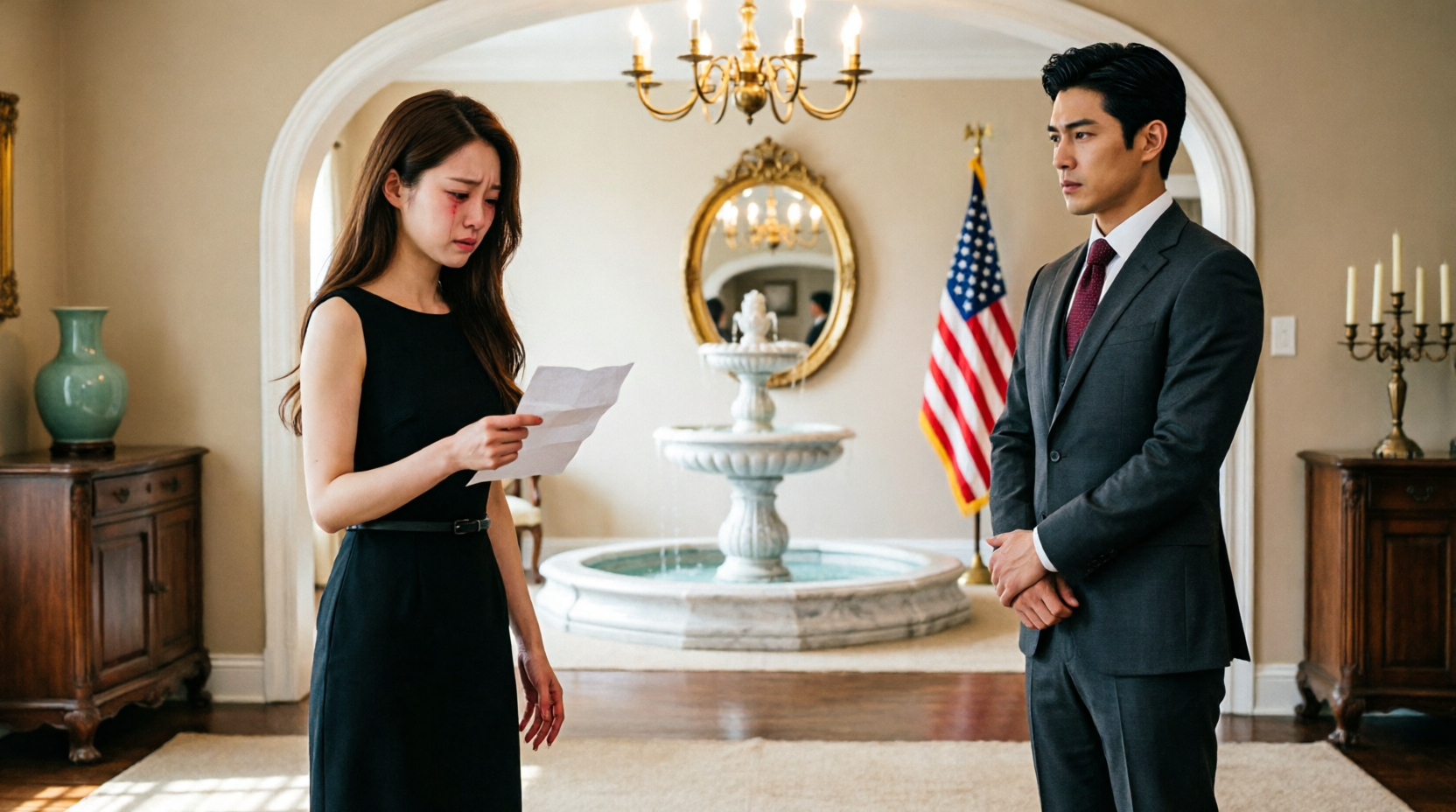
After My Mom’s Funeral, I Told My Husband I Inherited $47M—Then I Overheard His Phone Call
THREE DAYS AFTER MY MOTHER’S FUNERAL, THE LAWYER TOLD ME I’D INHERITED EVERYTHING:
$47M, 3 LUXURY VILLAS, AND A WINE EMPIRE BRINGING IN $25M A YEAR. I RUSHED HOME TO TELL MY HUSBAND. BUT WHEN I WALKED IN, I OVERHEARD HIM ON THE PHONE – AND WHAT HE SAID MADE MY BLOOD RUN COLD.
A note before the story: thank you for being here with me through this whole journey. Stories like this connect us, don’t they? If you’re reading, I’d still love to know where you’re reading from. This story blends truth with creative elements for emotional and educational impact. The names and settings are fictionalized, but the message is meant to stay with you.
After my mother’s funeral, I returned to the estate still numb with grief. Three days later, the lawyer read her will. She left me a $47 million trust, three properties, and the entire vineyard she had built from scratch. I thought losing my mother would be the hardest part.
But when I stepped back into the house, I overheard my husband whispering on the phone with a woman.
Not just any woman.
My sister.
His voice was cold, almost gleeful.
“The old woman’s finally gone. All the property belongs to her now, and soon it’ll be ours.”
I stood there stunned.
And in that moment, I made a decision.
One that would shatter their entire plan.
The chapel smelled like lilies and regret.
I sat in the front row of St. Helena’s with my hands folded in my lap, staring at the closed casket draped in white roses, my mother’s favorite. Margaret Sullivan. Seventy years old. Stage four pancreatic cancer. Three months from diagnosis to this.
The priest’s voice droned on about eternal rest and the grace of God, but I couldn’t focus. My chest felt hollow, like someone had scooped out my lungs and left me with just enough air to pretend I was fine.
I wasn’t fine.
Eight months earlier, I had buried my first husband, David. Head-on collision on Highway 29, just ten minutes from our house. The police said he hadn’t suffered.
I never believed them.
And now my mother.
Two funerals in less than a year.
I was thirty-four years old, and I had already worn black more times than I could count.
Garrett squeezed my hand. My second husband. We had been married for ten months, a whirlwind courthouse ceremony after he spent six months helping me heal. He was a financial adviser—or so he said. Tall, clean-cut, with the kind of smile that made you believe he genuinely cared.
I had wanted to believe it.
“You’re doing great,” he whispered, his breath warm against my ear. “Just a little longer.”
I nodded, even though I didn’t feel great.
I felt like I was drowning.
The reception was held at our estate in Napa Valley. One hundred forty-two acres of rolling vineyards. A sprawling Mediterranean-style house with terracotta tiles and arched windows framing the hills. My mother had built the place from nothing. Sullivan Vineyards. A wine empire worth twenty-five million dollars a year in revenue.
And now it was mine.
People filled the living room—friends, distant relatives, business associates—all holding little plates of cheese and crackers and murmuring condolences that sounded rehearsed.
“I’m so sorry for your loss.”
“She was an incredible woman.”
“If there’s anything we can do…”
I smiled. Nodded. Thanked them.
My face felt like a mask.
Sienna, my younger sister, stood near the fireplace with a glass of white wine in her hand. She looked thinner than the last time I had seen her. Sharp collarbones. Hollow cheeks. Eyes darting around the room like she was waiting for someone to call her out.
She had been struggling with cocaine for two years. Rehab twice. Relapsed twice.
Our mother had tried everything—therapy, interventions, cutting her off financially.
Nothing worked.
Sienna caught my eye and raised her glass in a silent toast. I tried to smile back, but something about the way she looked at me—detached, almost calculating—made my stomach twist.
By six o’clock, the guests were gone.
The house felt too quiet. Too big.
I changed out of my black dress and into jeans and a sweater, pulled my hair into a loose bun, and headed downstairs.
Garrett was in the kitchen, pouring himself a glass of scotch. He had loosened his tie and rolled up his sleeves.
“You okay?” he asked, sliding the glass across the counter toward me.
I shook my head.
“I just want to sleep for a week.”
“I get it.”
He kissed my forehead.
“Why don’t you rest? I’ll handle the cleanup.”
I wanted to argue, but exhaustion won. I grabbed the scotch and headed for the stairs.
Halfway up, Garrett’s phone rang.
I paused on the landing, one hand on the railing.
His voice drifted up from the kitchen, low and casual.
“Yeah, it’s done. She’s finally gone.”
I froze.
“The old lady left everything to Eliza. One hundred thirty-five million. Once I get access to those accounts, we’re set.”
My heart slammed against my ribs.
I crept back down the stairs, careful to avoid the creaky third step. The scotch glass trembled in my hand.
“No, she doesn’t suspect a thing.”
Garrett laughed, and it was a sound I had heard a thousand times before.
Now it felt foreign.
Wrong.
“She’s upstairs right now, probably crying into her pillow. Give me two weeks. Once the estate-transfer paperwork goes through, we disappear. Bali, maybe. Or the Maldives. Somewhere with no extradition.”
I pressed myself against the wall, my phone clutched in my free hand. My fingers fumbled for the voice-memo app. I hit record and prayed the microphone would catch him.
“Sienna’s on board. She’s desperate, owes some dealer a hundred grand. She’ll do whatever I say.”
Sienna.
My sister.
I bit down on my lip so hard I tasted blood.
“Yeah. I’ll call you tomorrow. Just keep your mouth shut until this is over.”
The line clicked off.
I stood there for a long moment staring at the recording timer on my screen.
Three minutes and forty-two seconds.
Proof.
I didn’t go upstairs.
Instead, I slipped out the back door and walked into the garden, where the evening smelled like rosemary and jasmine. The sun was setting over the hills, the sky painted in amber and lavender.
That was when I saw them.
Garrett and Sienna standing near the stone fountain at the edge of the property.
They were close.
Too close.
Sienna’s hand rested on his forearm. Garrett leaned in and said something I couldn’t hear. She laughed—not the nervous laugh I was used to hearing from her. This one was light. Comfortable.
I moved closer, staying behind the hedges lining the path.
“Two more weeks,” Garrett said. “Then we file the paperwork.”
“And if she asks questions?” Sienna’s voice was tight and anxious.
“She won’t. She’s too busy grieving.”
He brushed a strand of hair from her face.
“Trust me.”
Sienna nodded and bit her thumbnail.
“I just… I need this to be over. Matteo’s threatening me. If I don’t pay him soon—”
“You’ll get your money,” Garrett cut in. “Once Eliza signs everything over, you’ll have enough to disappear. Start fresh. Isn’t that what you wanted?”
She didn’t answer. She just stared at the ground.
Garrett kissed her forehead—the exact same way he had kissed mine an hour earlier—then turned and walked back toward the house.
Sienna stayed there, arms wrapped around herself, looking small and broken.
I remained hidden until she finally went inside.
Then I sat down on the bench by the fountain and stayed there for a long time, my phone still recording in my pocket while the sky deepened from gold to purple and the first stars appeared.
My mother was gone.
My sister was conspiring with my husband.
And I had no idea what they were planning.
But I knew it was bigger than money.
I stopped the recording and stared at the screen.
I could have confronted them right then. Walked inside, hit Play, demanded answers.
But something held me back.
If I confronted them now, they would deny it. Twist it. Gaslight me until I questioned what I had heard.
No.
I needed more.
I needed everything.
So I walked back into the house.
Garrett was in the living room scrolling through his phone. He looked up and smiled when he saw me.
“Hey. Thought you were resting.”
“I needed some air.”
I kept my voice steady. Calm.
“I’m going to bed now.”
“Want me to come up?”
“No. I just… I need to be alone tonight.”
He nodded, stood, and kissed my cheek.
“I love you.”
I forced a smile.
“I love you too.”
Then I climbed the stairs, went into our bedroom, locked the door, sat on the edge of the bed, and listened to the recordings again.
Once I get access to those accounts, we’re set.
Sienna’s on board.
Two more weeks.
I opened my laptop and started searching.
Trust attorneys.
Private investigators.
Estate protection laws.
I didn’t know exactly what Garrett and Sienna were planning, but I was going to find out.
And when I did, I was going to make sure they regretted ever trying to take what was mine.
Three days after the funeral, I sat in Harrison Whitfield’s office, staring at the mahogany desk between us.
The room smelled like old books and lemon polish. Sunlight filtered through the blinds, laying long shadows across shelves lined with leather-bound law books.
Harrison sat across from me, silver-haired and composed in a navy suit, reading glasses perched on his nose. He had been my mother’s attorney for thirty years and her friend even longer.
Garrett sat to my right, his hand on my knee in what was supposed to feel like comfort.
It felt heavy.
Possessive.
Sienna slouched to my left, arms crossed, one leg bouncing restlessly. She looked worse than she had at the funeral. Pale. Shadows under her eyes. A thin sheen of sweat on her forehead despite the air-conditioning.
Withdrawal, I realized.
She hadn’t used in three days, and her body was screaming for it.
Harrison cleared his throat and folded his hands over a thick stack of documents.
“Thank you all for coming,” he said. “I know this is difficult. Margaret asked me to handle her estate personally, and I intend to honor that. What we’re doing today is an informal review of her will, preliminary to the formal probate process. But she wanted her wishes made clear to the family immediately.”
He opened the folder in front of him.
“Margaret Anne Sullivan, of sound mind and body, executed this last will and testament on June tenth of this year, two months before she died.”
She had known.
My chest tightened.
Harrison adjusted his glasses.
“To my daughter, Eliza Marie Sullivan Pierce, I leave the entirety of my trust fund, forty-seven million dollars, held in an irrevocable living trust established in 2012. This trust bypasses probate and transfers directly to Eliza upon my death.”
Garrett’s hand tightened on my knee.
I didn’t look at him.
Harrison continued.
“I also leave to Eliza the following properties: the Napa Valley estate and vineyard, assessed at twenty-eight million dollars; the Carmel beachfront residence, assessed at twelve million dollars; and the San Francisco commercial office building, assessed at fifteen million dollars.”
Sienna shifted in her seat. I heard her suck in a breath.
“Additionally,” Harrison said, “Eliza will assume full ownership of Sullivan Vineyards LLC, including all assets, revenue streams, and business operations, valued at approximately twenty-five million dollars annually.”
Then he glanced at Sienna.
“To my daughter, Sienna Marie Sullivan, I leave the sum of five hundred thousand dollars, held in a restricted account to be managed by a financial trustee until Sienna completes a certified rehabilitation program and maintains sobriety for a minimum of twelve consecutive months.”
Silence.
Then Sienna shot to her feet so fast the chair screeched across the hardwood.
“Five hundred thousand? That’s it? While she”—she jabbed a finger at me—“gets everything?”
Harrison remained calm.
“Your mother included a detailed explanation in the will. She documented your struggles with substance abuse, two failed rehabilitation attempts, and significant financial mismanagement over the past three years. She believed this was the most responsible way to—”
“Responsible?” Sienna cut him off, voice pitching high. “She wrote me off. She gave up on me.”
“Sienna,” I started.
She whirled on me.
“Don’t.”
Her eyes were wild, wet with tears.
“Don’t you dare pretend you care. You got everything. The house, the money, the precious legacy.”
She spat the last word like poison.
Garrett stood and put a hand on her shoulder.
“Sienna, sit down. This isn’t helping.”
She shoved him off.
“Don’t touch me.”
Harrison rose too, voice firm but not unkind.
“Miss Sullivan, I understand this is painful, but your mother’s decision was made with your best interests in mind. The restricted account ensures that you’ll have financial support once you’re healthy. That was her hope.”
Sienna let out a bitter laugh.
“Her hope. Right.”
She snatched up her purse and headed for the door.
“I’m done. I’m done with all of this.”
The door slammed behind her.
For a moment no one moved.
Then Garrett sighed and turned to me, his face arranged into concern.
“I should go check on her. Make sure she’s okay.”
“She needs space,” I said quietly.
“I know, but…”
He kissed the top of my head.
“I’ll be right back.”
He left, closing the door softly behind him.
And then it was only Harrison and me.
The silence stretched.
Harrison took off his glasses, rubbed the bridge of his nose, and looked at me with an expression I couldn’t quite name. Sadness. Worry. Something deeper.
“How are you holding up?” he asked.
I didn’t know how to answer.
“I’m managing.”
He nodded slowly.
“Your mother loved you very much, Eliza. Everything she did, every decision she made, it was to protect you.”
“I know.”
“Do you?”
I looked up sharply.
Harrison leaned forward, elbows on the desk.
“Margaret came to see me six months ago. She was already sick by then, though she hadn’t told you yet. She said she needed to make sure her affairs were in order. But she also said…”
He hesitated.
“She said she was worried about you.”
My stomach twisted.
“Worried why?”
“She didn’t give me specifics. She just said she had concerns about people close to you. People who might not have your best interests at heart.”
Once I get access to those accounts, we’re set.
I heard Garrett’s voice again in my head.
“Did she say who?” I asked carefully.
Harrison shook his head.
“No. But she left something for you. Something she wanted you to see alone.”
My pulse jumped.
“What is it?”
“Not here. Not now.”
He glanced toward the door as if checking whether we were still alone.
“Come back tomorrow. Ten o’clock. And Eliza?”
His eyes held mine.
“Come alone.”
I wanted to ask more.
Demand answers.
But the door opened, and Garrett stepped back inside.
“Sienna’s calmed down,” he said. “She’s waiting in the car.”
He looked from Harrison to me.
“Everything okay?”
“Fine,” I said quickly. “Harrison was just wrapping up.”
Garrett smiled, but it never reached his eyes.
“Good. Let’s get you home. You’ve had a long morning.”
Harrison stood and extended his hand to me.
“I’ll see you soon, Eliza.”
I shook it, and his grip was firm.
Steady.
A silent promise.
We drove home in silence. Garrett kept glancing at me like he was waiting for me to say something. I stared out the window, watching the vineyards roll past.
Forty-seven million dollars. Three properties. A company worth twenty-five million a year.
Everything my mother had built.
And Garrett thought he could take it.
I didn’t know what my mother had left for me in Harrison’s office.
But I knew one thing with absolute certainty.
She had seen this coming.
And she had prepared me for it.
The next morning, I told Garrett I needed time alone.
“A spa day,” I said. “Some space to process everything.”
He didn’t question it. He only kissed my forehead and said he’d see me at dinner.
I drove to Harrison’s office in silence, hands gripping the steering wheel too tightly.
He was waiting for me when I arrived. He closed the door behind me and locked it.
That detail alone made my stomach clench.
“Sit down, Eliza,” he said gently.
I sat.
He opened a drawer and pulled out a small tablet, setting it between us. The screen was black.
“Your mother recorded this six months ago,” he said quietly. “February tenth. Two weeks after her diagnosis. She asked me to keep it sealed until after her death and to show it to you privately.”
My throat tightened.
“What is it?”
“She wanted to explain. She wanted you to understand why she made the decisions she did. And she wanted to warn you.”
He pressed Play.
The screen flickered to life.
And there she was.
My mother.
Sitting in the study at home, the one with the floor-to-ceiling bookshelves and the bay window overlooking the vineyard. Sunlight streamed in from the left, catching the silver in her hair. She looked thinner than I remembered. Cancer had already started taking pieces of her. But her eyes were sharp. Clear. Determined.
She folded her hands in her lap and looked straight into the camera.
Straight at me.
“Eliza.”
Her voice broke something open in my chest.
“If you’re watching this, I’m gone. And I’m so sorry, baby. I’m so sorry I couldn’t stay longer.”
Tears blurred my vision. I blinked them away.
Then she said the words that changed everything.
“I need you to know the truth about Garrett.”
My breath caught.
Her expression hardened.
“Two months ago, I had our family accountant run a full audit of the estate. I do this every year—routine financial planning. But this time something didn’t add up. There were withdrawals from your joint accounts you never authorized. Small amounts at first. Five thousand here. Ten thousand there. Spread out over two years.”
She paused.
“Eight hundred fifty thousand dollars, Eliza. He stole eight hundred fifty thousand dollars from you.”
The room tilted.
I gripped the edge of Harrison’s desk.
“He funneled it through offshore accounts in the Cayman Islands. Shell companies. Fake names. I hired a private investigator, a woman named Dr. Paige Thornton, and she confirmed what I suspected.”
She inhaled slowly.
“Garrett Pierce isn’t the only name he has used. In one set of records, he appears as Garrett Michael Caldwell. In others, he operates under entirely different identities. He has been investigated by the SEC for securities fraud in three different states. He posed as a financial adviser, defrauded at least twenty clients out of millions, and disappeared before they could prosecute. Then he found you.”
Her voice softened, full of grief.
“He targeted you, Eliza, after David died. When you were vulnerable. When you needed someone to help manage the estate. He saw an opportunity, and he took it.”
I pressed a hand over my mouth to choke back a sob.
“I wanted to tell you,” she said, eyes glistening. “God, I wanted to tell you the moment I found out. But I was scared. Scared that if I confronted him, he’d hurt you. Scared that if I went to the police, he’d run and you’d never get justice. So I did the only thing I could think of. I changed my will. I made the trust irrevocable in your name alone so he couldn’t touch it. I thought I’d have more time. Time to build a case. Time to protect you properly.”
She looked down at her hands.
“But the cancer…”
Her voice broke.
“I ran out of time.”
Silence filled the screen except for the sound of her breathing.
Then she looked back up, and her whole face went hard as steel.
“Harrison has all the evidence. Bank records. PI reports. Everything. But Eliza, you need to be careful. If Garrett realizes you know, he’ll escalate. Men like him don’t just walk away from one hundred thirty-five million dollars.”
She paused again, and when she spoke next, her voice dropped to almost a whisper.
“And baby, I don’t trust your sister either.”
My heart stopped.
“I don’t know if she’s involved. I don’t know how deep it goes. But Paige saw her meeting with Garrett multiple times over the past six months. Lunches. Coffee. Conversations that lasted hours. I wanted to believe she was just lost, just struggling. But my gut tells me it’s more than that.”
Her eyes filled with tears.
“I’m sorry. I’m so sorry you have to carry this alone. But you are stronger than you know. You’re my daughter. You’re a fighter. Don’t let them take what’s yours. Don’t let them win.”
She reached toward the camera as if she could touch me through it.
“I love you, Eliza. I will always love you, and I will always be with you.”
The screen went black.
I sat there frozen, staring at the empty screen.
Harrison didn’t move. Didn’t speak.
Finally, I whispered, “Does he know? Does Garrett know you have this?”
“No,” Harrison said. “Margaret kept it completely confidential. Not even her accountant knew.”
“What about the SEC? If they’re investigating him?”
“They don’t have enough yet,” he said gently. “White-collar cases take years. Garrett is good at covering his tracks. The PI report gives us a head start, but it isn’t enough for a criminal conviction. Not yet.”
I looked at him.
“So what do I do?”
He reached into the drawer and pulled out a small black USB drive. He placed it in my palm.
“This contains everything. Financial records. Screenshots of offshore accounts. PI surveillance photos. Witness statements from some of his previous victims. It isn’t enough to arrest him on its own, but it’s enough for you to protect yourself.”
I closed my fist around it.
“Your mother wanted you to have options,” Harrison said. “You can go to the police. You can file for divorce. You can confront him. Or”—his eyes met mine—“you can investigate further. Gather more evidence. Build a case that’s airtight.”
I stared at the USB.
Eight hundred fifty thousand dollars.
A fake identity.
Twenty defrauded clients.
My sister meeting with him in secret.
And my mother gone, leaving me breadcrumbs.
“I need more,” I said quietly.
Harrison nodded.
“Then we’ll get it.”
I stood, slipped the drive into my purse, and thanked him. He only said the same thing one more time.
“Your mother loved you. Everything she did, she did to keep you safe.”
I walked out of that office with her voice still ringing in my ears.
Don’t let them win.
I wouldn’t.
I didn’t know exactly how yet.
But I knew one thing.
Garrett thought he was playing me.
He had no idea I was about to flip the board.
For the next week, I became someone I barely recognized.
A woman who ordered surveillance equipment online using a prepaid Visa card.
A woman who installed hidden cameras in her own home while her husband was at work.
A woman who hired a private investigator to follow the man she had promised to love and trust.
I didn’t feel guilty.
I felt awake.
The cameras arrived in unmarked boxes. Three of them, ordered from a site that specialized in discreet home security.
I unpacked them on the kitchen counter while Garrett was at his office downtown.
Or at least that was where he said he was going every morning at nine.
A smoke-detector camera for the living room.
A USB-charger camera for his office.
A book-spine camera for the wine cellar, tucked between two volumes of The Art of War.
Ironic, I thought as I slid it into place.
They were tiny. Unnoticeable. Wi-Fi enabled. Video only, no audio. I couldn’t risk violating California’s wiretapping laws, even in my own house. But I didn’t need sound. I needed to see what Garrett did when he thought I wasn’t watching.
I synced them to a private cloud account he didn’t know existed, accessible only from my phone.
Then I tested each one from the guest bedroom upstairs.
Living room: clear view of the sofa and front door.
Office: his desk, computer, filing cabinet.
Wine cellar: the entire room, including the entrance and the panic room hidden behind the rack.
Perfect.
Then I heard the garage door open.
My heart slammed into my ribs.
I shut the laptop, shoved it under the bed, and walked downstairs as calmly as I could.
Garrett was in the kitchen loosening his tie and smiling.
“Hey, babe. How was your day?”
I forced a smile.
“Quiet. Yours?”
“Boring meetings.”
He kissed my cheek.
“I picked up takeout. Your favorite.”
He set the bags on the counter.
Pad Thai. Spring rolls. Mango sticky rice.
A week earlier, I would have melted at the gesture.
Now all I could think was: what does he want?
The next morning, I drove to Sonoma to meet Dr. Paige Thornton. Harrison had given me her contact information along with the USB.
“Your mother trusted her,” he had said. “You can too.”
We met at a quiet café far enough from Napa that no one would recognize me.
Paige was already there when I arrived. Mid-forties. Short brown hair. Sharp gray eyes that seemed to catalog everything in the room. Black blazer, jeans, tablet on the table.
She stood when she saw me and extended her hand.
“Eliza. I’m sorry for your loss.”
Her grip was firm.
Professional.
“Thank you.”
I sat across from her and ordered a coffee I would never drink.
Paige didn’t waste time.
“Your mother hired me six months ago. She suspected your husband was stealing from you. I confirmed it. Offshore accounts. Shell companies. Falsified documents. Everything is in the report Harrison gave you.”
“I saw it.”
“Good.”
She turned the tablet toward me. A photo filled the screen.
Garrett and Sienna at an outdoor café in St. Helena.
Close.
Too close.
His hand on hers.
My stomach twisted.
“This was taken three weeks ago,” Paige said. “I have twelve more like it. Different locations. Same behavior.”
I stared at the image.
“My sister.”
“How long?” I asked, my voice barely steady.
“At least six months. Possibly longer. Your mother didn’t want to tell you until she had proof.”
I closed my eyes.
Paige’s voice softened.
“I know this is hard. But if you want me to keep digging, I will. Fifteen-thousand-dollar retainer. I’ll track his movements, document everything, and report back weekly. Cash or check, your choice. No paper trail if you don’t want one.”
I opened my purse, pulled out the cashier’s check I had withdrawn from my trust fund that morning, and slid it across the table.
“I want everything,” I said. “Every meeting. Every phone call you can document. Every place he goes. I want to know what he’s planning.”
Paige took the check and nodded once.
“You’ll have it.”
That night, I sat in the study with my laptop and pulled up our joint bank-account statements.
I had been avoiding them. Letting Garrett handle the finances because he was the expert.
Because I trusted him.
God, I had been stupid.
I scrolled through two years of transactions.
Investment transfer, $8,500.
August third.
Investment transfer, $6,200.
July third.
Investment transfer, $10,000.
June third.
Every month like clockwork.
Always labeled investment transfer.
Always on the third of the month.
I cross-referenced the account numbers with the offshore records on my mother’s USB.
They matched.
He had been stealing from me for two years.
Right under my nose.
I sat back, hands shaking, staring at the screen.
Eight hundred fifty thousand dollars.
And he was still doing it.
Garrett was different that week. Attentive. Affectionate. Almost performative.
He brought me coffee in bed.
Cooked dinner three nights in a row.
Bought me flowers—white roses, my favorite.
One evening, he gave me a massage while we watched a movie I didn’t care about.
“You seem tense,” he murmured, hands kneading my shoulders. “You okay?”
“Just tired,” I lied.
“I know. Losing your mom… it’s a lot.”
He kissed the top of my head.
“But I’m here. You know that, right? I’m not going anywhere.”
I smiled even though my skin crawled.
Love bombing.
That was what it was.
A manipulation tactic.
Make me feel safe. Loved. Dependent.
So I wouldn’t question him when he finally asked me to sign over control.
My mother’s voice echoed in my head.
Men like him don’t just walk away from $135 million.
“I know,” I whispered. “Thank you.”
He smiled, kissed my temple, and turned back to the movie.
I watched his reflection in the TV screen.
Calculating.
Cold.
He wasn’t my husband.
He was a predator.
And I was his prey.
Five days after I hired Paige, she sent me an email.
Subject line: Update #1.
I opened it in the guest bedroom with the door locked and my heart pounding.
Three photos were attached.
The first: Garrett and Sienna at a café in downtown Napa, laughing, her hand on his forearm.
The second: Garrett leaning in, whispering something in her ear while she smiled with her eyes closed.
The third: them kissing.
Not a peck.
A real kiss.
The kind you give someone you’re in love with.
I stared at the screen until my vision blurred.
My husband.
My sister.
Paige’s note at the bottom read: They met three times this week. Same café, same table. Pattern suggests ongoing relationship. Let me know if you need more.
I closed the laptop, went into the bathroom, and stared at myself in the mirror.
My mother had tried to warn me.
Now I had proof.
Garrett wasn’t just stealing my money.
He was planning to take everything.
And Sienna was helping him.
I didn’t cry.
I didn’t scream.
I just stood there with my hands gripping the sink and made a decision.
They thought I was weak.
Grieving.
Naive.
Easy to manipulate.
They had no idea what I was capable of.
I pulled out my phone and texted Paige.
Keep going. I need everything.
Her reply came thirty seconds later.
You got it.
I slipped the phone into my pocket, walked downstairs, and found Garrett in the kitchen pouring wine.
“Hey,” he said, smiling. “Want a glass?”
I smiled back.
“Sure.”
He handed me the glass and kissed my cheek.
I sipped and watched him over the rim.
He had no idea I was about to destroy him.
I had been avoiding the wine cellar since my mother died. Too many memories. The two of us walking between the rows of bottles while she taught me about vintages and terroir. The way her face lit up when she found something rare.
The last time we had been down there together, she pulled a 1982 Château Margaux from the rack and said, “This one is special, Eliza. We’ll open it when we have something to celebrate.”
We never did.
So when Garrett asked me to grab a bottle of 1995 Opus One for dinner, I had no choice.
I stood at the top of the cellar stairs with my hand on the light switch and my heart pounding for no reason I could name.
Just go down.
Get the bottle.
Come back up.
I flipped the switch and descended.
The air was cool and damp, heavy with oak and earth. Rows of bottles stretched in ordered lines, organized by region and vintage according to my mother’s precise system.
I found the Opus One easily.
Third row.
Eye level.
But as I reached for it, something caught my eye two rows over.
1982 Château Margaux.
The bottle my mother had mentioned.
The bottle we were supposed to open together.
I walked toward it slowly, pulse quickening.
It was sitting slightly forward, as if someone had pulled it out and shoved it back carelessly. The wax seal around the cork—deep red, embossed with the château crest—was cracked.
Not the slow cracking of age.
Fresh cracking.
I lifted the bottle carefully and turned it under the dim light.
There.
A tiny puncture in the wax just below the seal.
Barely visible unless you were looking for it.
My stomach dropped.
I set the Opus One on the ground and carried the Margaux upstairs like evidence.
Three days later, I sat in my car outside a private toxicology lab in Oakland, two hours from Napa.
I had called ahead, paid cash, and told them I suspected contamination in an expensive bottle of wine and wanted it tested before I drank it.
The receptionist hadn’t asked questions.
I walked inside, handed over the bottle wrapped in a brown paper bag, and signed a waiver acknowledging this was a private request, not yet connected to a legal case.
“Results in seventy-two hours,” the technician said, handing me a receipt.
I nodded and left.
Then I spent the next three days barely sleeping.
The call came on a Tuesday afternoon.
I was in the study pretending to answer emails while Garrett was at his office—or wherever he really went during the day.
My phone rang.
Unknown number.
“Mrs. Pierce?” a woman said. Her voice was clinical. Calm.
“Yes.”
“This is Dr. Amy Caldwell from the toxicology lab. We have your results.”
I held my breath.
“Ma’am, we found ethylene glycol in the sample you provided.”
The room tilted.
“What?”
“Ethylene glycol. It’s an antifreeze compound. The concentration in the wine was approximately forty milligrams per liter. Enough to cause serious harm if consumed.”
I gripped the edge of the desk so hard my knuckles turned white.
“How… how much would someone need to drink for it to…”
My voice broke.
“To cause death?”
Dr. Caldwell’s tone softened.
“A standard five-ounce pour would contain enough to cause acute kidney failure within twenty-four to seventy-two hours, especially in someone with a compromised immune system.”
My mother.
Stage four cancer.
Her immune system had been shattered already.
“Is there any way to detect it after someone swallows it? After someone dies?”
“If they’re tested within seventy-two hours of ingestion, yes. After that, ethylene glycol metabolizes into oxalic acid and other compounds. It becomes nearly impossible to detect in a standard autopsy, especially if the victim had underlying health conditions.”
Three weeks.
My mother had died three weeks after drinking that wine.
“Thank you,” I whispered.
“Ma’am,” Dr. Caldwell said gently, “if you suspect poisoning, I strongly recommend contacting law enforcement.”
I hung up.
Then I sat there staring at the wall.
Garrett had poisoned her.
He had injected antifreeze into a bottle of wine, let her drink it, and watched her die slowly.
And because she had cancer, no one questioned it. Kidney failure. Just another complication.
He had gotten away with it.
My hands shook as I opened my laptop and typed: ethylene glycol poisoning symptoms.
The results loaded.
Stage one: thirty minutes to twelve hours. Intoxication-like symptoms. Nausea. Vomiting.
I remembered my mother complaining of nausea the night after she drank the wine. I had assumed it was chemo.
Stage two: twelve to twenty-four hours. Metabolic acidosis. Rapid heart rate.
She had been hospitalized two days later. The doctor said her heart was struggling.
Stage three: twenty-four to seventy-two hours. Acute kidney failure.
She had been on dialysis for a week before she died.
I closed the laptop.
He had planned every step.
And I had sat beside her bed holding her hand, never knowing.
I went back to the wine cellar.
This time I didn’t hesitate.
I walked straight to the rack where the Margaux had been and ran my hands along the wall behind it, searching for something I didn’t yet know how to name.
Then I felt it.
A loose stone.
Small. Easy to miss.
I pried it out carefully.
Behind it, folded into a narrow gap, was a piece of paper.
My heart stopped.
I unfolded it with trembling hands.
My mother’s handwriting.
Eliza, if something happens to me suddenly, check the 1982 Château Margaux. I think Garrett tampered with it. I’ve felt strange since drinking it—kidney pain, nausea, confusion. The doctors say it’s the cancer, but my instincts say otherwise. I know my body. This isn’t right. I’m documenting everything—symptoms, dates, times. If I don’t make it, you’ll know the truth.
There’s a panic room behind the wine rack. Code 1982. Use it if you’re ever in danger.
I pray you never need it.
I love you, baby. Fight back.
Mom.
I sank to the floor with the letter in my fist and sobbed.
She had known.
She had known.
And even while she was dying, she had still been trying to protect me.
I don’t know how long I sat there. Eventually I stood, wiped my face, and looked at the rack.
Code 1982.
I ran my fingers along the bottles until I saw it—four bottles of 1982 Château Margaux arranged on the top shelf in a deliberate pattern.
I pulled them out in order.
First bottle.
Ninth bottle.
Eighth bottle.
Second bottle.
1-9-8-2.
A soft click echoed through the cellar.
The panel behind the rack slid open.
I stepped back, heart hammering.
Behind the false wall was a small steel door with a keypad. I typed 06-14-1962.
My mother’s birthday.
The lock released.
Inside was an eight-by-ten-foot room with emergency lighting, oxygen tanks, a laptop, a satellite phone, a small safe, and a note taped to the laptop screen.
If you’re reading this, I was right. Stay safe. Use everything here. Trust Harrison. Don’t let them win.
I opened the laptop.
Files.
Documents.
Photos.
Evidence.
She had left me everything.
I went back upstairs, locked the cellar door behind me, and sat at the kitchen table.
Garrett would be home in two hours.
I had proof now.
He had murdered my mother.
He had stolen nearly a million dollars from me.
He was sleeping with my sister.
And he still thought I had no idea.
I pulled out my phone and texted Paige.
We need to meet tomorrow. I have something you need to see.
Her reply came immediately.
I’ll be there.
I set the phone down and stared at the Opus One Garrett had asked for, still sitting on the counter.
He wanted me to pour it at dinner. Smile. Laugh. Pretend everything was fine.
I could do that.
I had been doing it for weeks.
But now I knew the truth.
And I was going to make sure he paid for it.
The footage arrived two weeks later.
An encrypted email from Paige with a subject line that made my stomach drop.
You need to see this.
I was alone in the study. The house dark and silent around me. Garrett had gone to bed an hour earlier. I had told him I needed to finish some work.
I opened the email.
Five attachments.
Each labeled with a date.
I clicked the first.
September 7, St. Regis Hotel, San Francisco, 6:47 p.m.
Security footage.
Black and white.
The lobby entrance.
Garrett walked in first in the navy suit he told me he had worn to a client meeting. Sienna followed a few steps behind in a black dress I had never seen before.
They didn’t touch.
Didn’t look at each other.
But they walked to the elevator together.
The time stamp jumped.
7:02 p.m.
Elevator doors closing. Garrett’s hand on the small of Sienna’s back.
10:34 p.m.
Same elevator.
Both stepping out.
Sienna’s hair mussed.
Garrett adjusting his tie.
I closed the first file and opened the second.
September 11.
Same hotel.
Again.
Then the third.
September 15.
Again.
Three times in two weeks.
I sat back nauseated.
I had known.
I had known since Paige’s first report.
But seeing them walk into that hotel together and leave hours later made it real in a way photos never had.
My sister.
My husband.
Then I clicked the fourth attachment.
An audio file.
Two minutes, eighteen seconds.
I pressed Play.
Static. Cars. Distant voices.
Then Garrett’s voice.
“Sienna, babe, I told you—once Eliza signs the estate transfer, we’ll have access to everything. Then we disappear. Bali. Maldives. Anywhere you want.”
A pause.
Sienna’s voice, lower and anxious.
“What if she doesn’t sign?”
“She will. She trusts me. And if she doesn’t…”
He laughed.
“Let’s just say I have a backup plan.”
“Garrett…”
“Relax. Everything’s under control. You’ll get your money. Matteo will leave you alone. We’ll be free.”
The audio cut off.
I played it again.
And again.
Once Eliza signs the estate transfer.
I have a backup plan.
My hands shook.
He was planning something.
Something worse than theft.
Worse than an affair.
He was planning to get rid of me.
The fifth attachment was a report.
Prepared by Dr. Paige Thornton, licensed private investigator.
Date: September 19, 2025.
Subject: Sienna Marie Sullivan.
Summary: surveillance conducted over two weeks confirms an ongoing relationship between Garrett Pierce and Sienna Sullivan. Evidence includes three documented visits to the St. Regis Hotel in San Francisco. Overheard phone conversation on September 8 indicates conspiracy to obtain estate-transfer signatures. Financial motive confirmed.
Sienna Sullivan owes $120,000 to Matteo Ruiz, a known cocaine distributor with ties to organized crime. Debt incurred over eighteen months. Ruiz has issued threats of violence if payment is not received within thirty days. Deadline: October 12, 2025.
Recommendation: this case has escalated beyond civil fraud. Evidence suggests potential for violence. I strongly recommend contacting federal authorities immediately. Local police lack jurisdiction and resources for interstate fraud, offshore accounts, and organized-crime connections.
I read it twice.
Sienna owed a drug dealer one hundred twenty thousand dollars.
And Garrett was using that debt to control her.
He had promised her money if she helped him get mine.
And if I didn’t cooperate, he had a backup plan.
I thought about the poisoned wine.
The ethylene glycol.
My mother’s kidneys shutting down.
He had done it before.
He would do it again.
The next morning, I drove to Sonoma to meet Paige at the same café.
She looked tired, dark circles under her eyes, coffee cup empty in front of her.
“Did you watch everything?” she asked.
I nodded.
“And I need to go to the FBI.”
Paige leaned back and exhaled.
“Good. Because this is way beyond what I can handle. Wire fraud. Conspiracy. Possible murder. That’s federal territory.”
“Will they believe me?”
“You have a lab report showing ethylene glycol in the wine. You have surveillance footage of an affair. You have a recorded phone call where your husband talks about a backup plan after stealing nearly a million dollars from you. Yes, Eliza. They’ll believe you.”
I stared at my hands.
“What about Sienna?”
Paige’s expression softened.
“She’s in deep. And she’s being manipulated. The FBI will see that. It doesn’t mean she won’t face charges. She’s complicit. But they’ll focus on Garrett. He’s the mastermind.”
I nodded, throat tight.
“There’s something else,” Paige added quietly. “Matteo Ruiz isn’t someone you play games with. If Sienna doesn’t pay him by October twelfth, he’ll hurt her. Maybe worse. If you go to the FBI, that might complicate things for her. Just be prepared.”
I thought about Sienna—the girl who used to braid my hair, who cried at our mother’s funeral, who was now sleeping with my husband and helping him steal my life.
“She made her choice,” I said.
Paige didn’t argue.
That afternoon, I called Harrison.
“I need you to connect me with the FBI.”
“Are you sure?” he asked. “Once you do this, there’s no going back. This becomes a federal investigation.”
“I’m sure. He killed my mother, Harrison. And he’s planning to kill me.”
Silence.
Then:
“I’ll make the call.”
Three days later, I sat across from an FBI agent in a windowless conference room in downtown San Francisco.
The building was cold and sterile—gray walls, fluorescent lights, the faint hum of ventilation. I had passed through a metal detector, signed in at the front desk, and been escorted up fourteen floors by a young agent who didn’t say a word.
Harrison sat beside me, briefcase on his lap.
Across the table were two men.
The first extended his hand.
“Mrs. Pierce, I’m Special Agent David Reeves, FBI White Collar Crime Unit. This is Agent Marcus Cole, SEC Enforcement Division.”
I shook their hands.
Reeves had sharp gray eyes and close-cropped hair starting to silver at the temples. Cole was younger, glasses perched on his nose, a tablet already open in front of him.
“Thank you for coming in,” Reeves said. “I know this isn’t easy. Before we begin, I want you to know that everything you tell us today is confidential. This room is secure, and you’re not in any trouble. You’re here because we believe you have information that can help us.”
I swallowed.
“Harrison said you’ve been investigating my husband.”
Reeves and Cole exchanged a glance.
“We have,” Reeves said. “For eight months.”
The room tilted.
“Eight months?”
He nodded.
“Your husband—or rather, the man you know as Garrett Pierce—has been on our radar since January. But we didn’t know he was Garrett Pierce until you came forward.”
“I don’t understand.”
Reeves leaned forward.
“The person we’ve been investigating goes by the name Michael Grant.”
I stared at him.
“Michael Grant?”
“He presents himself as a financial adviser,” Reeves continued. “In reality, he’s a con artist. Over the past five years, he has defrauded at least twenty-two victims out of twelve million dollars.”
“Twelve million?”
Cole tapped his tablet, and a chart appeared on the screen mounted on the wall behind them.
A web of names, dates, account numbers, offshore accounts in the Cayman Islands, Switzerland, Singapore. Shell companies. Fake credentials.
“He’s good,” Cole said quietly. “Very good. But we’ve been tracking him.”
“Michael Grant and Garrett Pierce are the same person?” I whispered.
“Yes,” Reeves said. “Michael Grant is one of the names he uses in his fraud operations. Garrett Pierce is the name on your marriage certificate. Other aliases appear in different files. He changes identities depending on the target.”
I gripped the edge of the table.
He wasn’t just stealing from me.
He had been doing this for years.
To dozens of people.
“Who are the victims?”
Cole pulled up another screen, most of the names redacted, but the numbers visible beside them.
$480,000.
$620,000.
$1.2 million.
“Mostly widows,” Cole said. “Recent divorcees. People who’ve just come into money and don’t know how to manage it. He targets vulnerable people, gains their trust, convinces them to invest with him, then funnels the money offshore and disappears.”
I thought about David. The accident. How lost I had been. How Garrett had appeared six months later, offering help.
“He targeted me.”
“Yes,” Reeves said. “You fit his pattern perfectly. Widow. Inherited wealth. Grieving. He saw an opportunity.”
My stomach turned.
“But here’s the problem,” Reeves continued. “Securities fraud is a federal crime. We can prosecute him for that. The maximum sentence is ten to fifteen years. With a good lawyer, he could be out in five.”
“Five years?” I repeated. “He stole twelve million dollars.”
“I know. But white-collar sentencing is complicated. Unless we can prove additional charges—something more serious—he won’t serve the time he deserves.”
“Like murder,” I said.
Reeves didn’t blink.
“Like murder.”
I pulled the USB drive from my purse and slid it across the table.
Then the toxicology report.
Then Paige’s surveillance photos.
“My mother died three weeks before I married Garrett,” I said, voice steady. “She had stage-four cancer, but I think he poisoned her. There’s ethylene glycol in a bottle of wine she drank. The lab confirmed it.”
Cole scanned the report and passed it to Reeves, who read it twice.
“This is enough to open a murder investigation,” he said. “But it’s not enough to convict.”
“Why not?”
“Because the ethylene glycol is in the bottle, not in your mother’s body. She died three weeks after drinking it. By then the poison had metabolized. There’s no way to prove she ingested it. And even if we could, we’d still need proof Garrett was the one who put it there. No fingerprints. No witnesses. No confession.”
“He did it,” I said. “I know he did.”
“I believe you,” Reeves said. “But belief isn’t evidence. A defense attorney would tear this apart. Reasonable doubt. Circumstantial evidence. Unless we have something concrete.”
“A confession,” Harrison said quietly.
Reeves nodded.
“Exactly.”
I looked between them.
“You want him to admit it on tape?”
“Yes,” Reeves said. “If we can get him to confess on audio or video, clearly and unambiguously, then we have first-degree murder, conspiracy, fraud—the whole thing. We can put him away for life.”
“How?”
Reeves leaned back.
“We set a trap.”
Cole turned the tablet toward me again.
“This is a proposal for a federal wiretap. If you agree to cooperate, we’ll install monitoring devices in your home, track his communications, and create scenarios where he’s likely to reveal his plans.”
“You mean I’d have to keep living with him?”
“For a short time. Yes.”
Reeves didn’t soften it.
“I won’t lie to you, Mrs. Pierce. This is dangerous. If he suspects you know, he could escalate. But we’ll have agents watching. Twenty-four-seven surveillance. If anything goes wrong, we intervene immediately.”
I thought about the panic room.
The letter my mother left.
The poisoned wine.
Garrett had killed her.
And he would kill me if he had the chance.
“What do I have to do?”
Reeves met my eyes.
“Act normal. Don’t let him know you’re investigating. We’ll handle the rest.”
Harrison put a hand on my arm.
“Eliza, you don’t have to do this. We can pursue other options.”
I looked at Reeves.
“I’ll do it.”
He nodded once.
“Then let’s get started.”
Within forty-eight hours, the FBI moved with a precision I hadn’t thought possible.
On Tuesday morning, I sat in Reeves’s office while he made calls, his voice calm and clinical as he walked a federal judge through the warrant application.
Probable cause.
Imminent threat.
Interstate wire fraud.
Conspiracy to commit murder.
By noon, he hung up and looked at me.
“Judge Caldwell approved both warrants—residence, vehicle, phone, and your sister’s apartment. We install tomorrow. Nine a.m. Can you get him out of the house for three hours?”
“Yes.”
Wednesday morning, I told Garrett I needed space.
“I’m still processing everything,” I said over coffee, keeping my voice soft. “My mom, the estate. I just… I need a day to myself.”
He frowned, but it was all concern and sympathy on the surface.
“Of course, babe. I actually have a client meeting in the city anyway. I’ll be gone most of the day.”
I smiled.
“Thank you.”
He kissed my forehead and left at 8:45.
At 9:02, black vans rolled into the driveway.
Four men in plain clothes—jeans, polos, no visible badges—moved through my house like surgeons.
I stood in the front yard, arms crossed, watching through the windows while Reeves stood beside me.
“They’ll be done in two hours,” he said. “You won’t even know the devices are there.”
“What if Garrett finds them?”
“He won’t. These aren’t the kinds of bugs you see in movies. They’re smaller than a pill, wireless, encrypted. We’ve used this tech for years.”
Through the window, I watched one of the techs unscrew the base of Garrett’s desk lamp. He pulled out a tiny silver disc no bigger than a watch battery and pressed it into the hollow space before reassembling the lamp.
Another crouched beside the smart TV in the living room with a laptop.
“What’s he doing?” I asked.
“Hacking the firmware,” Reeves said. “Your TV already has a camera and microphone. We’re just repurposing them.”
I felt sick.
This was my home. The place my mother had built.
Now it was a surveillance trap.
But it had to be.
By 11:30, the vans were gone.
Reeves walked me through the house and pointed everything out.
“Office lamp. Living-room TV. Kitchen smoke detector—that one’s backup. His car under the dashboard. Everything monitored twenty-four-seven. Everything recorded, transcribed, and flagged for keywords.”
“What about his phone?”
“Already done.”
He pulled out his tablet and showed me Garrett’s text messages, call logs, GPS data.
“He clicked a phishing link this morning. Fake bank-security alert. Looked legitimate. Now we have full access.”
I stared at the screen.
Garrett’s last text to me read: Heading into the city. Client meeting at 11. Love you.
A lie.
His GPS showed he was at a café in St. Helena.
Fifteen minutes from home.
Not San Francisco.
I looked at Reeves.
“He’s not at a client meeting.”
“No.”
He pulled up a photo time-stamped ten minutes earlier.
Garrett and Sienna sitting across from each other at an outdoor table. Her hand on his.
I closed my eyes.
“We’re watching him,” Reeves said quietly. “Every move.”
That afternoon, he trained me.
We sat in a conference room at the FBI office, just the two of us, a recorder on the table.
“This is going to be hard,” he said. “Maybe the hardest thing you’ve ever done. You’re going to go home and pretend everything is normal. You’re going to smile, laugh, sleep in the same bed as a man who murdered your mother.”
I swallowed.
“I’m not going to sugarcoat it. If you break, if you confront him, if you let him see you know, this whole operation falls apart. Worse, he could hurt you.”
“I understand.”
“Do you?”
He leaned forward.
“Because here’s what I need you to understand, Eliza. You are not his wife right now. You’re an undercover operative. You’re playing a role. The woman he married—the one who trusted him—she’s gone. You are someone else now.”
I met his gaze.
“I can do this.”
“I believe you. But follow these rules.”
He slid a page across the table.
Rule one: compartmentalize your emotions. You are an actress.
Rule two: never confront him. Let him talk naturally.
Rule three: if he gets physical, press the panic button immediately.
Rule four: document anything unusual. Text me using code words.
Rule five: time limit. October 8. We pull you out regardless.
Then he reached into his pocket and placed a silver locket on the table.
Inside was a tiny red button.
“This is your panic button,” he said. “Press it for three seconds, and we’ll have agents at your door in under five minutes. It also streams live audio and GPS. Wear it at all times.”
I put it on.
It felt heavier than it looked.
“One more thing,” Reeves said. “We need him to talk about the estate transfer. That’s when he’ll reveal his plan. So if he brings it up, don’t shut him down. Let him explain. Ask questions. Act like you’re considering it.”
“You want me to pretend I’ll sign over my inheritance?”
“Exactly.”
I thought of my mother.
The panic room.
The letter.
Don’t let them win.
“Okay,” I said. “I’ll do it.”
Garrett came home at six.
I was in the kitchen chopping vegetables for dinner when I heard the garage door open. My heart slammed into my ribs.
You’re an actress, I reminded myself. Play the role.
He walked in, tie loose, smiling.
“Hey, babe. How was your day?”
I turned and smiled back.
“Quiet. Peaceful. I needed it.”
“Good.”
He kissed my cheek.
“What are we making?”
“Stir-fry. Your favorite.”
He poured himself a glass of wine and leaned against the counter watching me cook, and I felt everything at once—the microphone in the lamp ten feet away, the camera in the TV across the room, the tracker in his car.
The FBI was watching.
I wasn’t alone.
That night I made an excuse.
“I’m exhausted,” I said as I climbed into bed. “I think I’m coming down with something.”
Garrett frowned, touched my forehead, and said, “You do feel warm. Get some rest.”
Then he turned off the light.
I lay there in the dark staring at the ceiling.
He was two feet away.
The man who had poisoned my mother, stolen nearly a million dollars from me, and was planning to kill me.
I touched the locket at my throat.
Three seconds.
Five minutes.
I could survive this.
I had to.
A week into the surveillance, Garrett made his move.
It started over breakfast.
I was pouring coffee when he slid a stack of papers across the kitchen table.
“What’s this?” I asked, keeping my voice light.
“Estate-planning documents,” he said with a smile. “I’ve been thinking we should put everything in both our names. Joint ownership. It just makes sense. Tax purposes. And if something happens to one of us, the other is protected.”
I stared at the stack.
A fifty-page transfer agreement.
My mother’s trust.
The properties.
The business.
Everything.
My hand tightened around the coffee pot.
“I… I don’t know, Garrett. This is my mother’s legacy.”
He reached across the table and took my hand. Too firm.
“I understand. But we’re married, Eliza. What’s yours is mine. What’s mine is yours. That’s how marriage works.”
I pulled my hand back gently and sat down to buy time.
“Let me read through it first. I want to understand what I’m signing.”
His jaw tightened for half a second.
Then the smile came back.
“Of course. Take your time. Just not too long, okay? Harrison needs these filed by the end of the month.”
He kissed the top of my head and left for work.
I sat there staring at the papers while my heart pounded. The lamp on the counter ten feet away held a microphone smaller than a pill. The FBI had heard every word.
That afternoon, Garrett came home early.
I was in the living room pretending to read when he walked in with his tie loose and his face tight.
“Have you looked at the documents?”
“I’m still reading.”
“Eliza.”
His voice had an edge I had never heard before.
“It’s been six hours. How much reading do you need to do?”
I set the book down and kept my tone calm.
“It’s complicated. I want to make sure I understand.”
“What’s there to understand?”
He crossed the room and loomed over me.
“You sign. We’re married. This is what married people do.”
“I just need a few more days.”
His fist slammed down on the coffee table.
I flinched.
“Are you saying you don’t trust me?”
His voice was low.
Dangerous.
My heart hammered against the locket at my throat.
Three seconds.
Five minutes.
Not yet.
“No,” I said, letting my voice tremble. “No, of course I trust you. I’m sorry. I just… This is overwhelming. My mom just died. I’m still grieving.”
He stared at me while I watched anger and calculation war behind his eyes.
Finally he stepped back, ran a hand through his hair, and slid the mask back on.
“I’m sorry,” he said more softly. “I didn’t mean to push. I know you’re going through a lot. Just think about it, okay? We’re a team. I’m trying to protect us.”
I nodded.
“I will. I promise.”
He kissed my forehead.
“Good. Take a few days. But Eliza…”
He tilted my chin up until I had to meet his eyes.
“We need to do this soon.”
“I know.”
He left the room.
I sat there with my hand pressed to my chest, feeling my pulse race.
The TV across from me held a camera.
The FBI had seen everything.
An hour later, I was upstairs when I heard the garage door open.
Then close.
I walked to the bedroom window and looked down.
Garrett’s car was still in the garage, but he was sitting inside it with the door shut, his phone to his ear.
My stomach dropped.
Thirty seconds.
A minute.
Two.
Then he got out and walked back inside.
“Babe,” he called up the stairs. “I’m going for a run. Be back in an hour.”
“Okay,” I called back.
The front door closed.
Ten minutes later, my phone buzzed.
Unknown number.
Secure line. Answer.
I pressed Call.
“Eliza.” Reeves’s voice. Calm. Clinical. “We recorded a phone call from Garrett’s car twenty minutes ago. You need to hear this.”
“What did he say?”
“I’m sending it now. Audio file encrypted. Listen, then call me back.”
The line went dead.
A notification popped up.
I opened the file and pressed Play.
“Sienna, we have a problem.” Garrett’s voice was clear. Unmistakable.
“What happened?” Sienna sounded anxious.
“She’s stalling. I brought up the estate transfer. She said she needs time.”
“Garrett, Matteo’s deadline is in eleven days.”
“I know. We need to move faster. If she doesn’t sign by next week, we go to plan B.”
A pause.
Then Sienna again, quieter.
“Plan B?”
“You mean the wine cellar? Just like Margaret.”
The room spun.
“An accident,” Garrett continued. “Carbon dioxide. She’ll pass out. We call 911 too late. No one questions it. I’ve done it before. It works.”
I stopped the recording and sat on the edge of the bed with my hands shaking.
I’ve done it before.
He had admitted it.
He had killed my mother.
And he was planning to kill me.
I called Reeves back.
“Did you hear it?” he asked.
“Yes.”
“That’s our confession. Conspiracy to commit murder. Admission of prior murder.”
“Then arrest him,” I said, my voice breaking. “Arrest him now.”
“We can’t. Not yet. The recording is powerful, but a defense attorney will argue plan B and wine cellar are vague. They’ll say he was speaking metaphorically. We need more. We need him to try.”
I closed my eyes.
“You want him to try to kill me.”
“We want him to reveal his method and take action that proves intent. Then we stop him before he succeeds.”
“How?”
“We set the trap. You’ll go to the wine cellar. He’ll follow. We’ll have agents in position. The moment he makes a move—locks you in, tampers with ventilation, anything—we intervene. Arrest on the spot for attempted murder. Combined with the recording, he’ll never see daylight again.”
“And if something goes wrong?”
“It won’t. You’ll have the panic button. We’ll have eyes on you every second. But Eliza”—his voice softened—“if you don’t want to do this, we’ll find another way. I won’t force you to be bait.”
I thought about my mother.
The letters.
The panic room.
Fight back.
“Go on,” I said.
“Soon. Within forty-eight hours. We’ll coordinate everything. I’ll call you tomorrow with details.”
“Okay.”
“Eliza. You’re doing the right thing.”
I hung up and sat there in the dark.
Downstairs, the front door opened.
Garrett’s voice drifted up.
“Babe? I’m back.”
I stood, wiped my face, walked to the bathroom, splashed cold water on my cheeks, and looked at myself in the mirror.
You are not his wife.
You are an undercover operative.
I went downstairs.
Garrett was in the kitchen drinking water, flushed from his run. He smiled when he saw me.
“Hey. You okay?”
I smiled back.
“Yeah. Just tired.”
“Have you thought more about the papers?”
“I have.”
I stepped closer and touched his arm.
“You’re right. We’re a team. I’ll sign them. Just give me until the weekend. I want to read everything one more time.”
His face lit up.
“Really?”
“Really.”
He pulled me into a hug. I let him hold me, counted to five, then pulled away.
“I’m going to bed early tonight. Long day.”
“Of course. I’ll be up soon.”
I went upstairs, locked the bedroom door, sat on the floor with my back against the wall, and let myself shake.
Two days.
In two days, Garrett would try to kill me.
And I would let him.
Two days before everything exploded, Agent Reeves pulled me into a safe house.
It was an hour north of Napa, tucked into the hills of Sonoma—a nondescript ranch house with blackout curtains and no visible address. I parked where he told me to, on a gravel turnoff hidden by oaks, then walked the last hundred yards.
Harrison was already there beside his car.
“You okay?” he asked.
I wasn’t.
But I nodded.
Inside, the place looked like a war room. A long conference table filled the center of the room, covered in maps, photographs, and laptops. Three other agents stood around it. Two men and one woman, all in plain clothes, earpieces visible. Tactical vests hung on the backs of chairs.
Reeves gestured toward a seat.
“Sit. We don’t have much time.”
I sat with Harrison beside me.
Reeves slid a mug shot across the table.
A man in his fifties with graying hair and hard eyes.
“Frank Delgado,” Reeves said. “Funeral director. Licensed in California. Also has a record—fraud, falsifying death certificates. Two prior suspensions. Reinstated in 2022.”
I stared at the photo.
“Who is he?”
“Your husband’s accomplice.”
Reeves pulled out a printout of intercepted text messages.
Garrett to Frank: 50,000 cash. You know what to do.
My stomach turned.
“We detained Frank yesterday,” Reeves said. “Picked him up at his office in Vallejo. Gave him a choice—cooperate and testify against Garrett, and we reduce his charges. Or refuse and we charge him with conspiracy to commit murder. He chose option one.”
“So he’s helping you.”
“Yes. And we’re replacing him.”
I blinked.
“Replacing him?”
“One of our agents will pose as Frank when Garrett calls for body disposal. Our agent will answer. Garrett will talk. We’ll record it. That gives us the final piece.”
He turned a laptop toward me.
A map of the estate.
Red dots were marked across the property.
“Sunday evening, six p.m. You’ll suggest opening a special bottle of wine. Something that requires going to the cellar. Garrett will follow. That’s when it happens.”
He zoomed in on the cellar.
“He’ll lock the door, reverse the ventilation, and pump carbon dioxide into the room. We know that because of the recording from his car. He said, ‘Just like Margaret.’ This is his pattern.”
I nodded, my hands clenched in my lap.
“But you won’t be there,” Reeves said. “You’ll use the panic room. The one your mother built. You’ll enter through the wine rack—code 1982—and escape through the tunnel to the gardener’s shed.”
He pointed to another red dot.
“Two of our agents will be waiting in the shed. They’ll extract you immediately. You’ll be off the property within three minutes.”
“And Garrett?”
“He’ll be upstairs watching the camera feed from his office. He’ll think you collapsed. He’ll wait twenty or thirty minutes to make sure you’re dead. Then he’ll call Frank. Our agent will answer. Garrett will say something incriminating, and we’ll have him.”
The map blurred for a second in my vision.
“What if something goes wrong?” I whispered.
“It won’t.” Reeves didn’t hesitate. “We’ve run dozens of operations like this. No cooperating witness lost in a controlled sting. You’ll have the panic button, agents within fifty yards, and an escape route Garrett doesn’t know exists.”
“But what if he checks the body? What if he doesn’t call Frank? What if he just leaves me there?”
“He won’t. He knows a body in a wine cellar raises questions. He needs it gone. That’s why he hired Frank. He’ll call. And if he doesn’t, we still have attempted murder. But Eliza”—his tone shifted—“we need that call. That’s the difference between fifteen years and life without parole.”
I closed my eyes.
Fifteen years.
Life without parole.
My mother’s face rose in my mind.
Fight back. Don’t let them win.
“I understand.”
Reeves slid a document across the table.
Ten pages of federal legal language.
“This is a voluntary-participant waiver. It confirms that you understand the risks, that you’re participating voluntarily, and that we’ve explained the safety measures. Harrison needs to review it.”
Harrison pulled it closer and scanned it line by line.
After five minutes, he looked at me.
“It’s standard. You’re acknowledging this is dangerous. The FBI will take reasonable precautions, but they can’t guarantee your safety. If something happens and they follow protocol, you can’t sue them. If they don’t follow protocol, the waiver doesn’t apply.”
I looked at Reeves.
“Have you ever had an operation fail?”
“Not like this. We’ve had suspects abort plans. We’ve had delays. We’ve never lost a cooperating witness in a controlled sting.”
I picked up the pen.
My hand shook.
Harrison put his hand over mine.
“You do not have to do this.”
“We can go another way. Civil suits. Fraud charges. It won’t be life in prison, but—”
“No.”
I pulled my hand free.
“I want him to pay for what he did to my mother. I want him in prison for the rest of his life.”
I signed the waiver.
October 3, 2025.
Harrison signed as witness.
Reeves took the folder and filed it away.
“Okay,” he said. “Sunday evening. Six p.m. Are you ready?”
I thought of my mother.
The panic room.
The tunnel.
The way she had prepared an escape route before I knew I would need one.
“When do your agents deploy?” I asked.
“Tomorrow night. They’ll pose as landscapers, a cable repair crew, utility contractors. By Sunday afternoon, they’ll all be in position. You won’t see them, but they’ll be there.”
Harrison rose, came around the table, and pulled me into a hug.
“Your mother would be proud of you,” he whispered.
That night, I drove home alone.
Garrett was in the living room watching television when I walked in.
“Hey, babe. Where were you?”
“Therapy,” I lied. “Dr. Harper. I needed to talk about everything.”
He stood and kissed my forehead.
“How are you feeling?”
“Better,” I said.
Actually, I was thinking: this Sunday, let’s open a special bottle of wine. Something meaningful. Something to… moving forward.”
His eyes lit up.
“Really?”
“Yeah. Maybe that 2005 Caymus. The one Mom was saving.”
“I’d love that.”
He smiled, warm and convincing.
The mask was perfect.
But I could see through it now.
“Sunday evening,” I said. “Six o’clock.”
“It’s a date.”
I went upstairs, locked the bedroom door, and stared at the calendar.
Two days.
In two days, my husband would try to kill me.
And I was going to let him.
It happened on a Sunday evening.
The house was quiet. Garrett had cooked dinner—steak, roasted vegetables, a bottle of pinot noir opened an hour earlier. We ate by candlelight in the dining room, his hand reaching across the table now and then to squeeze mine.
“This is nice,” he said. “Just us.”
“It is.”
“Have you thought more about the estate paperwork?”
“I have.”
I kept my tone light.
“I’ll sign tomorrow. I promise.”
His face lit up.
“Really?”
“Really.”
I stood and started clearing plates.
“Actually, I was thinking we should celebrate. That 2005 Caymus you mentioned.”
He grinned.
“I’d love that. I’ll go get it.”
“I can.”
I touched his shoulder.
“You cooked. Let me.”
He kissed my hand.
“Okay. But hurry back.”
I walked toward the cellar door, my heart hammering so hard I thought he could hear it.
The silver locket pressed against my chest.
Three seconds.
Five minutes.
Not yet.
The cellar stairs descended into cool darkness. I flipped the light switch. Fluorescent bulbs buzzed to life, illuminating rows of bottles, oak barrels along the far wall, and the heavy steel door at the top of the stairs.
Then I heard footsteps behind me.
I froze.
“Eliza.”
Garrett’s voice was casual.
Warm.
I turned.
He stood at the top of the stairs, silhouetted against the light from the hallway.
“Yeah?”
“I’ll help you find it.”
He started down.
I forced a smile.
“It’s okay. I know where it is.”
But he kept coming.
And when he reached the bottom, he didn’t look at me.
He looked at the door.
Then he turned, walked back up the stairs, and I heard it.
The lock.
The heavy steel bolt sliding into place.
My breath stopped.
“Garrett?”
My voice shook.
“What are you doing?”
His voice came through the intercom speaker mounted on the wall.
Calm.
Cold.
“I’m sorry. This is the only way.”
Then came a hiss.
The ventilation system.
Only wrong.
Air pressure shifted.
My ears popped.
I ran to the door and pounded on it.
“Garrett! Garrett, open the door!”
Nothing.
The hissing grew louder.
CO2.
He was pumping carbon dioxide into the cellar.
I screamed and slammed my fists against the steel.
“Garrett, please! I can’t breathe!”
I wasn’t acting anymore.
The panic was real.
I counted to thirty, forcing myself to breathe shallowly. Carbon dioxide is heavier than air. It sinks first. I had maybe three minutes before it rose high enough to take me down.
I turned and ran to the wine rack on the east wall.
Found the four bottles of 1982 Château Margaux on the top shelf.
My mother’s voice in my head.
It’s not just a vintage, baby. It’s your way out.
I pressed the first bottle.
Click.
The ninth.
Click.
The eighth.
Click.
The second.
Click.
A mechanical hum answered.
The panel behind the rack slid open.
A steel door.
A keypad.
I typed 06-14-1962.
My mother’s birth date.
The door unlocked.
I pulled it open and stumbled inside.
The panic room was small, lit by emergency strips along the ceiling. Oxygen masks hung from hooks. A laptop sat on a metal shelf. A safe rested in one corner. And taped to the laptop screen was a folded piece of paper.
I ripped it free.
My mother’s handwriting.
Eliza, if you’re reading this, I was right. He tried. I’m so sorry. I couldn’t stop him before, but I could prepare you. The tunnel leads to the shed. Fifty feet. Crawl straight. Don’t stop. Trust Harrison. Trust the FBI. Finish this. You are stronger than you know. You are my daughter. Don’t let them win.
I love you forever.
Mom.
I pressed the letter to my chest and sobbed once, hard.
Then I shoved it into my pocket and looked around.
On the far wall was a metal panel at waist height.
I pulled it open.
A tunnel.
Dark. Narrow. Emergency lights every ten feet.
I grabbed an oxygen mask, slung the strap over my shoulder, and crawled in.
The tunnel was only three feet high. I moved on my hands and knees. Emergency lights cast long shadows ahead of me. My breath echoed. My palms scraped raw against cold concrete.
Fifty feet.
I counted in my head.
Ten.
Twenty.
Thirty.
My knees ached.
Forty.
Then I saw light.
A trapdoor.
I pushed it up.
Fresh air hit my face.
I pulled myself into the gardener’s shed.
Moonlight streamed through the windows. Tools hung on the walls. A workbench. A tarp. And two men in black tactical gear crouched by the door.
“FBI.”
One rushed forward and caught me as I collapsed.
“You’re okay,” he said. “You’re safe. We’ve got you.”
I pressed the panic button at my throat.
Three seconds.
The agent lifted a radio.
“Target secured. Victim extracted. Stand by for arrest.”
I sat on the floor shaking while he handed me water.
“Is he…?”
My voice cracked.
“Did he call Frank?”
The agent listened to his earpiece and nodded.
“He’s on the phone now. Our agent is recording everything.”
Upstairs, Garrett sat in his office staring at the laptop screen.
The wine-cellar camera feed.
The rack where I had been standing.
Nothing moving.
Twenty-five minutes.
He exhaled slowly, closed the laptop, and pulled out his phone.
He dialed.
“Frank, it’s done. I need you here in twenty minutes.”
A pause.
“Wine cellar. Carbon dioxide. She’s been down for twenty-five minutes. No pulse. I need the van. Discreet.”
Another pause.
“Exactly. Cash on delivery. Fifty thousand. And, Frank—no paperwork. Cremation tonight.”
He hung up.
Then he stood, descended the cellar stairs, and shut off the CO2 system. He opened the DVR panel, ejected the hard drive, crushed it under his heel, pulled alcohol wipes from his pocket, wiped down the control panel, the door handle, the intercom button, slipped on latex gloves, and rearranged the wine bottles near the rack to make it look like I had simply been searching.
He stepped back, satisfied.
A tragic accident.
That was the story he intended to tell.
A ventilation malfunction.
A grieving widow in the wrong place at the wrong time.
He locked the cellar door behind him and waited for Frank.
Twenty minutes later, headlights swept across the circular drive.
A black van.
Garrett smiled.
Then the van doors burst open, and six agents in FBI vests came out with weapons drawn.
His smile vanished.
He turned to run and froze.
Reeves stood in the hallway behind him.
“Garrett Pierce,” he said, badge raised. “FBI. You’re under arrest for the attempted murder of Eliza Sullivan Pierce.”
Garrett’s face went white.
“I… I don’t know what you’re talking about.”
“Hands behind your back.”
Two agents dropped him to his knees and cuffed him.
Reeves leaned down.
“We have everything. The recording. The camera footage. The call to Frank. And your wife.”
Garrett jerked his head up.
“What?”
“She’s alive. And she’s going to watch you go to prison for the rest of your life.”
They dragged him outside.
I stood in the driveway wrapped in a blanket, watching as they shoved him into the back of an FBI car.
He saw me.
His eyes went wide.
I said nothing.
I just watched the door slam.
Reeves walked over and handed me a bottle of water.
“You did it,” he said quietly.
I nodded, unable to speak.
Then Harrison appeared beside me and pulled me into his arms.
“It’s over,” he whispered. “It’s finally over.”
I looked at the house.
My mother’s house.
The place she had built.
The place she had protected me from even after death.
“Yeah,” I whispered. “It’s over.”
But it wasn’t.
Twenty minutes after I crawled out of that tunnel, I was sitting in the back of an unmarked SUV wrapped in a thermal blanket that couldn’t stop the shaking.
Through the tinted window, I watched my own death unfold.
Frank Delgado’s black van—the one Garrett had paid fifty thousand dollars to make me disappear—rolled into the estate’s circular drive.
But Frank wasn’t inside.
The FBI had arrested him three hours earlier, and he had cooperated almost immediately.
Now two undercover agents in funeral-home uniforms climbed out, calm and efficient.
Reeves sat beside me with a tablet in his hands, streaming footage from the hidden cameras around the property.
“Watch,” he said.
Onscreen, Garrett stood on the terrace with a tumbler of scotch in his hand. He didn’t approach the van. Didn’t offer to help. He just stood thirty feet away staring at the ground like he couldn’t bear to look at what he had done.
The agents opened the back doors and pulled out a black body bag.
It was heavy—eighty pounds of sand and weights, plus my cashmere coat, the one Garrett had given me the previous Christmas.
They laid it on a gurney with solemn professionalism.
Garrett’s shoulders dropped.
Relief.
He thought I was dead.
He believed it completely.
“Son of a bitch,” I whispered.
“He’s not even pretending to grieve,” Reeves said. “Most people, even guilty ones, put on a show. He can’t even manage that.”
The van pulled away, carrying my body to an FBI evidence facility in Oakland.
Garrett watched it go.
Then he turned and walked back into the house.
Two minutes later, Reeves’s tablet pinged.
“Audio.”
He tapped the screen.
Garrett’s voice filled the SUV, bright and buoyant.
“It’s done. She’s gone. We’re free.”
Sienna’s response came through speakerphone, muffled but clear enough.
“Are you sure? What if—”
“I’m sure,” Garrett interrupted. “Frank just left. No witnesses. No evidence. In two weeks, the estate transfers to me as surviving spouse. We can start liquidating the buildings, sell the company, and then we leave.”
“And then we leave,” Sienna echoed.
“And then we leave,” Garrett said. “Cayman Islands, baby. New names. New life. Just like we planned.”
Then I heard a champagne cork pop.
He was celebrating.
Reeves turned off the audio and looked at me.
“You okay?”
I wasn’t.
I felt hollow and scraped raw.
But I nodded anyway.
“Good,” he said. “Because we need you to stay dead.”
The safe house was a two-bedroom ranch in Sonoma, sixty miles north of the estate, far enough that Garrett would never spot me by accident. Technically it was in a different jurisdiction, which gave the FBI more flexibility.
The furniture was generic. The walls were beige. But the windows were bulletproof, and there were three agents stationed outside twenty-four hours a day.
Harrison was waiting inside, pacing by the fireplace.
When he saw me, he crossed the room and hugged me hard.
“Thank God,” he said, his voice cracking. “When Reeves called and said you were out…”
“I’m okay,” I said.
Though I wasn’t sure I believed it.
He pulled back and studied my face.
“No, you’re not. And you don’t have to be.”
Reeves cleared his throat.
“We need to talk timeline.”
I sank onto the couch, exhaustion hitting me all at once.
“How long do I have to stay dead?”
“Ten to fourteen days,” Reeves said. “Garrett thinks he’s safe now. He’ll get sloppy. He’ll talk to Sienna. Maybe brag to someone else. We need him to confess on tape to killing your mother and planning to steal the estate.”
“But you arrested him,” I said, confused.
“We detained him for attempted murder,” Reeves corrected. “That gets us seven to ten years in California, maybe fifteen if we’re lucky. But if we can tie in premeditated murder of Margaret, plus wire fraud, securities fraud, and conspiracy, that becomes life without parole. Federal. No early release.”
I stared at him.
“You let him go.”
“We didn’t have a choice. His lawyer was already screaming entrapment. We had to release him on a technicality—insufficient evidence to hold him overnight. But we’ve got round-the-clock surveillance now. Every call. Every text. Every conversation. He’s going to hang himself, Eliza. We just need time.”
“Ten to fourteen days,” I repeated, my voice distant.
Harrison crouched in front of me.
“I know this is hard. But think about what we’re building. Garrett killed your mother. He tried to kill you. He stole from twenty-two other women before you. If we don’t do this right, he walks in a decade and does it again.”
I closed my eyes.
Saw my mother’s face.
Heard her voice.
Don’t let him win.
When I opened my eyes, Reeves was holding out a garment bag and a manila envelope.
“We need to make sure no one recognizes you. If Garrett thinks you’re alive, this falls apart.”
Inside the garment bag was a wig.
Dark brown. Chin-length. Blunt-cut.
The envelope contained thick-framed glasses, a California driver’s license in the name Rebecca Torres, five thousand dollars in cash, and a cheap burner phone.
“You’ll stay here,” Reeves said. “No contact with anyone except me, Harrison, and Agent Cole. No social media. No internet searches about yourself. As far as the world is concerned, Eliza Sullivan died in a tragic accident on October 4.”
“What about the funeral?”
Harrison exchanged a glance with Reeves.
“We’ll stage one. Closed casket. Garrett will attend, and we’ll record every word.”
I imagined him standing at my fake funeral, lying to people who had loved me.
“Good,” I said. “Let him dig his own grave while he’s at it.”
That night, I stood in the bathroom of the safe house and cut my hair.
Harrison had offered to find a stylist.
I needed to do it myself.
Needed to feel like I was in control of something.
The scissors were dull. The result uneven. But when I put on the wig and glasses, I didn’t recognize the woman staring back at me.
Rebecca Torres looked tired.
Ordinary.
Forgettable.
Eliza Sullivan was dead.
I pressed my palms against the sink and let myself cry.
For my mother.
For the life Garrett had stolen.
For the woman I had been three months earlier, who believed her husband loved her.
When the tears finally stopped, I washed my face and walked back into the living room.
Reeves was on his laptop reviewing surveillance footage. He looked up as I entered.
“Garrett just texted Sienna. He’s meeting her tomorrow at a restaurant in the city. Neutral ground. He thinks if there are agents around, we’ll be at the next table.”
“What’s he going to say?”
“We’ll find out,” Reeves said. “My guess? He’s going to celebrate. And when people celebrate, they get careless.”
I sat beside him and stared at the frozen image of Garrett on the screen.
My husband.
My mother’s killer.
The man who had shared my bed and plotted my death.
“I’m a ghost now,” I said quietly.
Reeves glanced at me.
“You okay with that?”
I thought about my mother’s letter. The panic room she built. The tunnel she made sure I could escape through. She had known this moment was coming. She had prepared me for it.
“Yeah,” I said. “Let’s see what the living confess to the dead.”
Five days after my death, Garrett threw me a funeral.
I watched it from sixty miles away on the beige couch in the FBI safe house, a laptop open on the coffee table. Reeves had set up a live feed from six hidden cameras around the estate—angles covering the terrace, the garden, the library where guests mingled with wine glasses and hushed voices.
I wore the brown wig and thick glasses even though no one could see me.
I needed the distance.
“You don’t have to watch this,” Reeves said quietly.
“Yes, I do.”
On the screen, forty people gathered on the terrace where my mother’s memorial had been held just eight weeks earlier. The same white chairs. The same view of the vineyards rolling toward the hills.
But there was no casket this time.
No urn.
Just an enlarged photograph of me on an easel, laughing in the wind on a trip to Sonoma two years earlier, back when I still thought my life was real.
Garrett stood beside the picture in a black suit, his face carefully arranged into devastation.
He had practiced that expression.
Perfected it.
“Friends,” he began, his voice breaking. “Thank you for being here. Eliza would have…”
He paused, pressed a hand to his mouth, let his shoulders shake.
Several women in the front row dabbed at their eyes.
“She would have wanted something small. Intimate. She hated being the center of attention.”
That part was true.
Everything else was a lie.
He told them our love story.
How we had met at a charity gala.
How I had made him believe in second chances after his difficult past.
He quoted poetry I had never heard him read.
He described quiet mornings and shared dreams that had never happened.
And through all of it, Sienna sat in the front row holding his hand.
My sister.
Wearing black. Hair pulled back. Playing the role of loyal family.
When Garrett’s voice cracked again, she squeezed his fingers and whispered something I couldn’t hear.
Comfort.
Solidarity.
I wanted to drive my fist through the screen.
“Easy,” Reeves murmured.
The service lasted thirty minutes. A family friend read a poem. One of my mother’s business partners shared a story about the two of us at a wine auction. Garrett accepted condolences with measured humility.
Then the guests moved inside for food and wine.
My wine.
From the cellar where he had tried to kill me.
Reeves tapped the keyboard and switched feeds.
“Garden. Southeast corner. Two minutes ago.”
The new angle showed Garrett and Sienna standing near the roses, far enough from the house that no guest could hear them.
A microphone hidden in the garden lights picked up every word.
“I can’t believe it worked,” Garrett said.
He wasn’t crying now.
He was grinning.
“No autopsy. No police investigation. Frank handled everything.”
Sienna glanced toward the house.
“Are you sure she’s dead? Did you check her pulse?”
“I watched the camera for twenty-five minutes,” Garrett said, irritation slipping into his voice. “She didn’t move. Didn’t breathe. Frank confirmed it when he picked up the body.”
“But what if—”
“She’s dead, Sienna.”
He grabbed her wrist and pulled her close.
“Stop spiraling. It’s over.”
She searched his face, then nodded.
“Okay. Okay.”
A beat.
“When do we get the money?”
Garrett smiled—really smiled.
“Harrison scheduled the estate-transfer meeting for next week. I sign as surviving spouse. One hundred thirty-five million becomes ours. We liquidate the buildings, sell the company, and we’re in Grand Cayman by Thanksgiving.”
“What about the investigation?” Sienna asked. “The SEC?”
“Michael Grant disappears when Eliza dies,” Garrett said. “New identities. New accounts. They’ll never find us.”
Sienna laughed then, bright and shaky.
“We’re actually going to do this.”
“We already did,” he said.
Then he kissed her.
Right there in my mother’s garden.
While forty people drank wine inside the house and mourned a woman they thought was dead.
I closed the laptop.
The room went silent except for the hum of the refrigerator.
Reeves didn’t speak immediately.
Then:
“That’s it. Confession to murder. Confession to fraud. Conspiracy to steal the estate. We’ve got him.”
“You had him since the wine cellar,” I said flatly. “Why did I have to watch that?”
“Because you needed to see it,” Harrison said gently. “See who he really is. See that you were never wrong to doubt him.”
I stood and walked to the window, staring out at the Sonoma hills.
Somewhere sixty miles south, Garrett was laughing with people who thought he loved me, drinking toasts to my memory, planning which Caribbean island to buy with my life.
“When do we arrest him?”
“Next week,” Reeves said. “At the estate-transfer meeting. We let him sign the fraudulent documents—identity theft, wire fraud, forged signatures. Then we add it to the stack. Attempted murder. Conspiracy. Securities fraud. Fraud. Theft by deception. He’s looking at life without parole. Sienna too. Accessory to murder. Conspiracy. Fraud. Twenty-five years minimum.”
I watched the sun drop toward the horizon, painting the sky orange and gold.
Five days earlier, I had crawled through a tunnel to escape my own death.
Now I was a ghost watching my husband bury me.
“He thinks he won,” I said quietly.
Harrison came to stand beside me.
“Let him think that. For now.”
Behind us, Reeves rewound the footage, isolating the garden conversation. Garrett’s voice filled the room again.
“She’s dead. It’s over.”
I turned back and looked at the frozen image on the laptop—Garrett and Sienna kissing in the roses.
“It’s not over,” I said. “Not even close.”
Eight days after my funeral, Garrett and Sienna celebrated my death with champagne.
I watched from the safe house as a new camera feed loaded onto Reeves’s screen.
The apartment was sleek and modern—floor-to-ceiling windows overlooking the Bay Bridge, white leather furniture, a kitchen that looked like it had never been used.
I had never seen the place before.
“How long have they been using this apartment?” I asked.
“Lease started three years ago,” Reeves said. “Rented under the alias Michael Grant. Paid in cash, six-month increments. We got a warrant and installed surveillance yesterday.”
Three years.
The entire length of their affair contained in nine hundred square feet of lies.
Onscreen, Garrett unlocked the door and stepped inside with Sienna close behind him. He still wore the suit from my memorial, tie loosened, jacket slung over one shoulder.
Sienna kicked off her heels and collapsed onto the sofa.
“God, I thought they’d never leave.”
Garrett crossed to the kitchen, opened the refrigerator, and pulled out a bottle of Dom Pérignon.
My champagne.
The one I had bought for Sienna’s birthday two years earlier.
The crystal flutes I had given her as a housewarming present when she moved to the city.
He poured two glasses and handed one to her.
“To freedom,” he said, raising his glass. “To one hundred thirty-five million. To us.”
Sienna clinked her flute against his.
Her smile was shaky.
“I still can’t believe she’s really gone.”
“What about the bottle?” she asked after a moment. “The Margaux. The one you used on Margaret?”
Garrett laughed, low and pleased.
“Genius, right? Ethylene glycol metabolizes completely in seventy-two hours. By the time she died, the autopsy only showed kidney failure from cancer. I injected it three weeks before she passed.”
My stomach lurched.
I pressed a hand over my mouth.
“And Eliza poured it herself,” Sienna whispered.
“Poetic justice,” Garrett said. He took a long sip. “Margaret thought she was so smart changing the will and cutting me out. But she didn’t account for one thing. I don’t quit. I don’t lose.”
Sienna set her glass down.
“Can I ask you something? About the baby?”
Garrett’s expression flickered—annoyance, maybe impatience.
“That was eighteen months ago, Sienna. We’ve been over this.”
“I know, but…”
Her voice cracked.
“Eliza drove me to the clinic. She held my hand in the waiting room. She told me I was brave.”
Tears slid down her cheeks.
“And the whole time I was aborting your child.”
I couldn’t breathe.
Couldn’t move.
The room tilted.
Reeves touched my shoulder.
“Eliza—”
“No,” I said hollowly. “Just… don’t.”
Onscreen, Garrett crossed to the sofa and pulled Sienna into his arms.
“We couldn’t have a baby while I was still married to her. You know that. Timing wasn’t right.”
“But you promised,” Sienna said against his chest. “You said once we had the money—”
“And we will,” Garrett interrupted. “New life. New names. New family. Everything we planned. But first, we had to get rid of her.”
Sienna pulled back.
“Do you feel guilty? Even a little?”
Garrett considered the question for all of a second.
Then shook his head.
“Guilt is for people who had a choice. I didn’t. Margaret was going to destroy me. Report me to the SEC. Freeze the assets. Send me to prison. And Eliza…”
He shrugged.
“She would have figured it out eventually. I saw the way she looked at me after the will reading. She was suspicious.”
“So you killed her,” Sienna said softly.
“So I freed us,” Garrett corrected.
Then he cupped her face in both hands and kissed her forehead.
“Three years we’ve been sneaking around. Three years of stolen weekends and lies. Those were the best three years of my life, Sienna. And now we get forever.”
She kissed him then, desperate and hungry, and I looked away.
Reeves paused the feed.
“That’s eighteen minutes of voluntary confession. Murder of Margaret Sullivan by ethylene glycol poisoning. Conspiracy to murder you. Admission of a three-year affair. Admission of the abortion. Financial fraud. Combined with the estate-transfer signatures he’ll give us next week, we have everything.”
I stared at the frozen frame on the screen.
Garrett and Sienna curled together on the white sofa. Champagne glasses abandoned on the table.
My champagne.
My sister.
My husband.
“She drove me to the clinic,” I said numbly. “I remember. She said it was a bad breakup. That the guy didn’t want the baby. I bought her soup afterward. I sat with her all night.”
Harrison, who had been sitting silently in the armchair, looked up.
“Eliza, you couldn’t have known.”
“I held her hand,” I said. “While she was pregnant with his child.”
The room was silent again.
Finally Reeves spoke.
“We move next week. Let him sign everything. Let him finalize the theft. Then we arrest both of them. Federal charges. No bail. No plea deals.”
“What’s he looking at?”
“Life without parole,” Reeves said. “Murder one. Attempted murder. Conspiracy. Wire fraud. Securities fraud. Identity theft. He’ll die in prison. Sienna gets twenty-five to thirty years.”
I rose and walked to the window.
Somewhere sixty miles south, Garrett and Sienna were still celebrating, still drinking my champagne, still believing they had won.
“I want to be there,” I said.
“When you arrest him.”
Reeves hesitated.
“Eliza, that’s not protocol.”
“I want to see his face,” I said. “I want him to know I’m alive. I want him to understand he lost.”
Whatever Reeves saw in my expression stopped him from arguing.
“We’ll make it work,” Harrison said quietly.
I looked back out at the hills.
Eight days earlier I had crawled through a tunnel covered in dust and terror.
Now I was standing in a safe house watching my husband confess to crimes I could barely have imagined.
The ghost was ready to come back to life.
Twelve days after my death, Garrett walked into Harrison’s office to steal my life.
I watched from the adjacent conference room, standing behind a one-way mirror with Agent Reeves and two other federal agents. The mirror was new, installed three days earlier when Harrison moved the estate-settlement meeting to a nondescript office complex two blocks from the federal courthouse.
Everything in that room had been staged.
The desk.
The leather chairs.
The sixty pages of documents stacked in a manila folder.
The trap.
Garrett looked good.
Rested.
He wore a navy suit I had bought him for our anniversary. Fresh haircut. Polished shoes.
He shook Harrison’s hand with warm gratitude, the perfect picture of a grieving widower trying to hold himself together.
“Thank you for expediting this,” Garrett said as he sat down. “I know probate usually takes months.”
“Given the circumstances,” Harrison replied carefully, “I thought we could streamline the process.”
He slid the first document across the desk.
“This is the trust-transfer form. Forty-seven million from the Margaret and Eliza Sullivan Irrevocable Trust, transferring to you as surviving spouse and sole heir.”
Garrett picked up the paper. I watched his pupils widen ever so slightly.
Greed.
Naked and raw.
“And the real estate?” he asked.
Harrison passed over three more forms.
“The Napa estate, the Carmel house, the San Francisco commercial building. Full ownership within ten business days, pending probate court approval.”
“Which is a formality,” Garrett said.
It wasn’t a question.
“In cases like this, yes,” Harrison lied smoothly.
“Especially with no contested will. No other living relatives except Sienna.”
“She already received her five hundred thousand,” Harrison said. “The bulk of the estate passes to you.”
Beside me, Reeves murmured into his radio.
“Subject is reviewing trust documents. Stand by.”
I pressed my palms to the glass and watched Garrett skim the pages.
He wasn’t really reading.
He was hunting numbers.
Forty-seven million.
Twenty-eight million.
Fifteen million.
The valuation of Sullivan Vineyards.
The life-insurance payout.
Everything my mother and I had built reduced to dollar signs in his eyes.
Harrison slid the final document across the desk.
“And this is the beneficiary-change form for Eliza’s life-insurance policy. Five million dollars, currently held in escrow, payable to you upon filing of the death certificate.”
Garrett’s smile widened.
“When will that clear?”
“Two weeks. Maybe three.”
All lies.
The death certificate was fake.
Issued by a medical examiner working with the FBI.
The insurance company had already been notified of the fraud investigation.
But Garrett didn’t know any of that.
He only saw five million more dollars.
“Where do I sign?”
Harrison handed him a cheap ballpoint pen.
Nothing remarkable.
But I knew exactly what it meant.
Evidence.
Every signature Garrett made with that pen was being recorded by three hidden ceiling cameras—his face, his hand, the papers.
“Initial here, here, and here,” Harrison said.
Garrett signed without hesitation.
Garrett Michael Pierce.
“This line states that you are the surviving spouse and sole heir.”
Sign.
Garrett Michael Pierce.
“This form transfers the trust funds to your personal account. Sign and date.”
Garrett Michael Pierce.
October 16, 2025.
Page after page.
Sixty pages of fraud committed in blue ink.
Reeves spoke quietly into his radio.
“We have eighteen counts of wire fraud, six counts of identity theft, four counts of conspiracy to commit theft. Arrest teams confirm ready status.”
Responses whispered back through the channel.
Team one ready.
Team two in position.
Team three standing by.
Garrett reached the final page and looked up.
“That’s it?”
“That’s it,” Harrison said. “The estate is yours.”
Garrett sat back and exhaled slowly.
“You know, Harrison, Eliza always said you were the best attorney in the state. I’m glad she was right.”
He looked back down at the trust-transfer form.
“It should have been mine from the beginning.”
“How do you mean?” Harrison asked, voice neutral.
“Margaret never liked me. Thought I wasn’t good enough for Eliza. Tried to get her to sign a prenup. Tried to freeze me out of business decisions. But Eliza trusted me. She put my name on the accounts. Gave me access.”
He smiled.
“She made this so easy.”
I dug my nails into my palms to keep from storming through the door.
Reeves touched my shoulder.
“Sixty seconds.”
Harrison gathered the signed documents and slipped them into a leather portfolio.
“I’ll file these with the probate court tomorrow morning. You should see the first transfer of liquid assets from the trust within ten business days.”
Garrett stood and extended his hand.
“Thank you, Harrison. For everything.”
Harrison shook it.
“Eliza would have wanted this handled properly.”
“She was a good woman,” Garrett said.
His voice was flat.
Almost bored.
“She deserved better than what happened.”
What happened.
As if my death had been some tragic accident beyond his control.
He turned toward the door with the portfolio tucked under his arm.
Harrison waited until Garrett’s hand touched the knob.
Then he said:
“Garrett.”
Garrett glanced back.
“Yes?”
“One more thing. The FBI would like a word.”
The door swung open.
But Garrett didn’t walk out.
Agent Reeves walked in, flanked by four federal agents in tactical gear, weapons holstered but visible.
Garrett froze.
The color drained from his face.
“Garrett Michael Pierce,” Reeves said, pulling out his badge. “You are under arrest for wire fraud, identity theft, conspiracy to commit theft, attempted murder, and the murder of Margaret Sullivan. You have the right to remain silent.”
Garrett’s mouth opened and closed.
He looked at Harrison.
Then Reeves.
Then at the one-way mirror, as if he could somehow sense me on the other side.
“This is a mistake,” he said. “Eliza is dead. I’m her husband. I have every right—”
“Eliza Sullivan is alive,” Reeves cut in. “And she’s been watching you the entire time.”
Garrett’s eyes went wide.
“That’s impossible. I saw her—”
The conference-room door opened.
And I stepped through.
For ten seconds, no one moved.
No one spoke.
Garrett stood frozen in the center of Harrison’s office, the leather portfolio still under his arm, his mouth slightly open, his face the color of old paper.
His eyes locked on mine, and I watched him try to process what he was seeing.
Dead women don’t walk through doors.
Dead women don’t wear black dresses and their mother’s pearls and stare at you with eyes full of cold, deliberate rage.
But I did.
“No,” Garrett whispered.
He stumbled backward against the desk.
“No. You’re dead. I saw—”
I said nothing.
I only looked at him.
Counted silently.
One.
Two.
Three.
His hand went to his chest, pressing against his sternum.
“I watched the van take your body. Frank confirmed—”
Four.
Five.
Six.
“This is a trick,” he said, voice rising. “Some kind of—”
Seven.
Eight.
Nine.
At ten seconds, I spoke.
My voice came out quiet.
Steady.
Calm.
“You saw what you wanted to see, Garrett. A dead woman. A clear path to my money. Freedom.”
The door opened again, and two agents escorted Sienna into the room.
She was still wearing the dress from that morning. Mascara smudged. Hair disheveled.
When she saw me, she screamed.
A raw, jagged sound that bounced off the walls.
“Oh my God. Oh my God, no.”
“Yes,” I said.
I turned to her, and she flinched like I had struck her.
“I’m alive, Sienna. Surprise.”
She looked wildly between Garrett and me, then at the agents.
“I don’t understand. The funeral, the body—”
“Sand and weights,” I said. “The body bag you watched them carry out of the estate was filled with eighty pounds of sand and my coat. The funeral director you thought Garrett paid off? FBI informant. The medical examiner who signed my death certificate? Working with them too. Every piece of it was a trap.”
Garrett shook his head and backed toward the window.
“You can’t do this. I’m your husband.”
“You tried to murder me,” I interrupted.
My voice cracked on the last word, and I hated that even then, after everything, he could still make me feel anything at all.
“You locked me in the wine cellar and pumped carbon dioxide through the vents. You watched me on camera while I suffocated. You called a funeral director to dispose of my body.”
“I—”
He looked at Harrison. Then Reeves.
“This is entrapment. My lawyer will—”
“Your lawyer can explain why entrapment doesn’t apply when you commit multiple felonies on your own initiative,” Reeves said. He pulled out a second set of cuffs. “Garrett Michael Pierce, you are under arrest for the murder of Margaret Sullivan, the attempted murder of Eliza Sullivan, conspiracy to commit murder, wire fraud, securities fraud, identity theft, and conspiracy to commit theft. Anything you say can and will be used against you.”
“This is insane!” Garrett shouted.
He lunged toward me.
Two agents stepped between us instantly.
“You bitch,” he spat. “You set me up.”
“No,” I said quietly. “You set yourself up. I just gave you the rope.”
Reeves snapped the cuffs around his wrists.
Garrett tried to jerk away, but the agents held him fast.
“You think you’re so smart. You think this is over. I’ll fight this. I’ll prove—”
“You can’t prove anything,” I said. “We have eighteen minutes of recorded confession from your penthouse. You admitted to killing my mother with ethylene glycol. You admitted to trying to kill me. You admitted to the affair, the abortion, the fraud. Every word, Garrett. We have everything.”
The color drained from his face again.
“The penthouse…” he breathed.
“Federal warrant,” Reeves said. “Issued eight days ago. Everything you said and did there—recorded and admissible.”
Sienna made a strangled sound.
I turned to her.
She was crying now—ugly, gasping tears.
“Eliza, please. I’m your sister.”
“You stopped being my sister the day you helped him poison our mother.”
My voice was empty now.
Flat.
“I held your hand at that clinic, Sienna. I sat with you all night. I made you soup. I told you everything would be okay. And the whole time you were aborting his child.”
She crumpled.
Literally collapsed to the floor with her hands over her face.
“I’m sorry. I’m so sorry. I didn’t mean—”
“Yes, you did,” I cut in. “You meant all of it. Every lie. Every stolen moment. Every dollar you planned to take.”
I crouched until we were eye level.
“You knew what he was. You knew what he had done. And you helped him anyway.”
Agent Cole stepped forward with another pair of cuffs.
“Sienna Sullivan, you are under arrest for conspiracy to commit murder, accessory to murder after the fact, wire fraud, and conspiracy to commit theft. You have the right to remain silent.”
She didn’t resist.
She just knelt there sobbing while he cuffed her hands behind her back.
Garrett was still yelling—a constant stream of threats, denials, curses—but I wasn’t listening anymore.
I watched the agents lead them both toward the door.
Garrett thrashing.
Sienna stumbling.
And something inside me cracked wide open.
It was over.
The plan had worked.
They were caught.
So why did I feel like I was breaking apart?
The door closed behind them.
The room fell silent.
Harrison appeared at my side and put a gentle hand on my shoulder.
“Eliza.”
I opened my mouth to answer, and a sob came out instead.
Then another.
Then I was crying in deep, wrenching waves that shook my entire body, and Harrison pulled me into his arms and held me while I shattered.
“It’s over,” he murmured. “It’s over. You did it.”
But it didn’t feel over.
It felt like grief—for my mother, for the sister I had loved, for the marriage that had never been real.
It felt like loss.
Sharp.
Total.
I cried until there was nothing left.
Until my throat was raw and my eyes burned.
When I finally pulled back, Harrison handed me an old-fashioned handkerchief embroidered with his initials.
I wiped my face and took a breath.
“What happens now?”
“Now,” Reeves said from across the room, “they’re booked, arraigned, and held without bail. The U.S. Attorney prosecutes. Trial begins in three months. You’ll testify.”
Then he held my gaze.
“And then you get your life back.”
I looked down at the handkerchief in my hands. HW. Harrison Whitfield. The man my mother had trusted to protect me when she could no longer do it herself.
“I don’t know what my life looks like anymore,” I admitted.
“Then you get to figure it out,” Harrison said softly. “Without him. Without fear. On your own terms.”
I nodded slowly, folded the handkerchief, and pressed it against my chest like a talisman.
Outside the window, the sun was setting over San Francisco.
Gold and orange and impossibly bright.
Somewhere in the city, Garrett and Sienna were being booked into the federal system, photographed, fingerprinted, and locked into holding cells.
And I was standing there.
Alive.
I took a breath.
“Okay,” I said. “Let’s finish this.”
One month after the arrests, the trial began.
I sat in the front row of Courtroom 6A in the San Francisco federal building, Harrison on one side, Dr. Harper—my therapist—on the other.
The room was full.
Journalists with notebooks.
Sketch artists.
Twenty-two fraud victims who had flown in from around the country.
A line of spectators stretching out into the hall.
The jury sat in two rows to my left—twelve faces I had studied for three days. Eight women. Four men. Mid-twenties to late sixties.
They held my life, my mother’s memory, in their hands.
Garrett sat at the defense table in an orange jumpsuit with his wrists cuffed to a chain around his waist. He had lost weight. His face was hollow and unshaven, nothing like the polished man who had once kissed me goodbye every morning.
Beside him, his public defender shuffled papers with the tired look of a man who already knew he had lost.
Sienna sat at a separate table with her own attorney, a sharp-eyed woman in a gray suit who had tried and failed to negotiate a plea deal.
My sister didn’t look at me.
Hadn’t looked at me once in three days.
Federal prosecutor Sarah Mitchell stood and approached the jury.
She was in her fifties, silver hair pinned into a tight bun, voice sharp enough to cut glass.
“Ladies and gentlemen,” she began, “over the next hour you are going to watch an eighteen-minute video. In it, you will hear Garrett Pierce confess in his own words to murdering Margaret Sullivan by poisoning her wine with ethylene glycol. You will hear him describe in detail how he tried to murder Eliza Sullivan by locking her in a wine cellar and flooding it with carbon dioxide. You will hear him brag about a three-year affair with the victim’s sister. And you will hear him celebrate stealing one hundred thirty-five million dollars.”
She paused and let that settle over the room.
“This is not a circumstantial case. This is not a he-said, she-said case. This is a confession. Voluntary. Recorded. Undeniable.”
She nodded to the bailiff.
The lights dimmed.
A screen descended.
And then I watched it again.
Garrett raising a champagne glass in that penthouse and saying, “To freedom. To one hundred thirty-five million. To us.”
The jury sat in total silence.
When he admitted to injecting ethylene glycol into the 1982 Margaux, a woman in the front row pressed her hand over her mouth.
When Sienna cried about the abortion and Garrett dismissed it—That was eighteen months ago—one of the male jurors shook his head with his jaw clenched.
Eighteen minutes.
Every word I had heard in the safe house now playing in open court.
When the video ended, the room stayed silent.
Mitchell didn’t fill it.
She let Garrett’s own voice convict him.
His lawyer stood and moved to suppress the evidence.
“Your Honor, my client had a reasonable expectation of privacy.”
“Motion denied,” Judge Carver said. “The FBI obtained a federal warrant based on probable cause. The recording is admissible. Move on, counselor.”
There was nowhere else to go.
On the second day, I testified.
The prosecutor led me through the entire timeline—the overheard phone call after my mother’s funeral, the hidden cameras, the poisoned wine bottle, the cellar trap, the tunnel.
My voice shook when I described hearing Garrett call Frank Delgado to come dispose of my body.
But I didn’t cry.
I had promised myself I wouldn’t cry on the stand.
When the prosecutor finished, Garrett’s lawyer stood for cross-examination.
“Miss Sullivan, isn’t it true that you entrapped my client? That you staged an elaborate scheme to make him look guilty?”
“No,” I said. “Your client was guilty. I just gave him the opportunity to prove it.”
“You manipulated—”
“I survived,” I cut in.
My voice was sharper now.
“Your client tried to murder me. I escaped. The FBI built the case. Everything Garrett did—every signature he forged, every lie he told—was his choice.”
The lawyer tried two or three other angles. Judge Carver shut them down one by one.
When I stepped off the stand, Harrison squeezed my hand.
On the third day, the victims testified.
Twenty-two women and three men—widows, divorcees, retirees—stood one after another and described how Garrett had stolen their savings, their children’s college funds, their futures.
A woman from Portland named Caroline broke down crying.
“He took four hundred thousand dollars. That was my late husband’s life-insurance money. I trusted him.”
The jury looked at Garrett as if he were something filthy they had scraped off their shoes.
Closing arguments were short.
The defense had nothing.
The prosecution had everything.
The jury deliberated for two hours.
When they came back, the forewoman stood.
“On the charge of murder in the first degree in the death of Margaret Sullivan, we find the defendant, Garrett Michael Pierce, guilty.”
Garrett’s head dropped.
“On the charge of attempted murder of Eliza Sullivan, guilty.”
“On eighteen counts of wire fraud, guilty.”
“On six counts of identity theft, guilty.”
“Guilty.”
“Guilty.”
“Guilty.”
Over and over.
Sienna’s verdict came next.
Guilty on nine counts.
Conspiracy.
Accessory after the fact.
Fraud.
Sentencing was held four weeks later, on December 16.
The courtroom was quieter then.
No press.
Just the people who mattered.
Judge Carver read the sentence without emotion.
“Garrett Michael Pierce, you are hereby sentenced to life imprisonment without the possibility of parole, plus sixty years to run concurrently, and ordered to pay eighteen million dollars in restitution to your victims.”
Garrett lurched to his feet.
“This is bullshit! She set me up! She—”
Two marshals forced him back into his seat.
“Sienna Sullivan,” the judge continued, “you are sentenced to twenty-five years in federal prison, eligible for sentence reduction after twenty years with good behavior, and ordered to pay two million dollars in restitution.”
Sienna just cried.
Then the judge looked at me.
“Miss Sullivan, would you like to make a statement?”
I stood.
My hands were shaking, but my voice held.
“Justice doesn’t erase grief. It doesn’t bring back the people we’ve lost or undo the harm that has been done. But it matters. It tells survivors that their pain is real. That they are not alone. That someone will fight for them.”
I looked at the fraud victims in the gallery.
At Caroline, still crying.
At Harrison, who had fought for my mother.
At Dr. Harper, who had helped me begin rebuilding.
“To every survivor watching this,” I said, “you are not alone. Fight. Survive. Win.”
The courtroom erupted in applause.
Quiet at first.
Then stronger.
Judge Carver didn’t stop it.
Garrett was led away still shouting.
Sienna stumbled after the marshals, sobbing.
And I walked out into the December morning free.
One month after sentencing, I stood in the wine cellar and didn’t feel afraid.
The room looked nothing like it had in October. The steel door was gone, replaced by French doors that opened onto the garden. The ventilation system Garrett had turned into a weapon had been stripped out and rebuilt with safety overrides and emergency exits. The racks remained, but now they framed a bright, open tasting room with reclaimed-wood tables, soft lighting, and a bronze plaque mounted on the wall.
Margaret Sullivan.
Guardian. Survivor. Architect.
1962–2025.
I ran my fingers over the raised letters.
“We did it, Mom,” I whispered.
Behind me, Harrison cleared his throat.
“The caterers just arrived. The gala starts in an hour.”
I turned.
He stood in the doorway in a navy suit with a folder tucked under one arm—the quarterly report for the Sullivan Foundation.
In just one month, we had grown faster than either of us expected. Three hundred twelve people had reached out for help—survivors of domestic violence, financial fraud, elder abuse. We had distributed more than twenty thousand dollars in emergency grants, connected forty-seven people with pro bono attorneys, and funded six months of therapy for thirty-two survivors.
“Are you ready?” Harrison asked.
I looked around the room.
The legacy tasting room, we called it now.
It had once been a tomb.
Now it was a sanctuary.
“Yeah,” I said. “I’m ready.”
The gala was smaller than I had first imagined. Sixty guests instead of two hundred. I didn’t want spectacle.
I wanted community.
Survivors sat at round tables with donors, board members, and therapists. Dr. Paige Thornton stood near the bar talking to a cybersecurity expert about a new workshop series—Digital Safety for Survivors. Harrison moved from table to table with effortless warmth, shaking hands, making introductions, proving once again why my mother had trusted him.
I stood at the front of the room with a microphone in one hand and Juniper at my feet.
I had adopted him three weeks earlier. A three-year-old golden retriever, abandoned twice—once as a puppy, once the year before. We understood each other. Juniper and I. We were both learning how to trust again.
“Thank you all for being here,” I began.
My voice echoed softly in the vaulted room.
“Three months ago, I walked out of a courtroom after watching the man who murdered my mother get sentenced to life in prison. People asked me what I was going to do next. And honestly, I didn’t know.”
I glanced at the bronze plaque.
“My mother spent the last months of her life building a case against the man who was poisoning her. She hid evidence, created escape routes, and prepared me for a fight I didn’t know was coming. She didn’t survive. But she made sure I would.”
A few people wiped their eyes.
“The Sullivan Foundation exists because of her. Because she believed that survival isn’t the end of the story. It’s the beginning. This room, this foundation, is for every person who has been lied to, stolen from, or hurt by someone they trusted. You are not broken. You are not weak. And you get to decide what comes next.”
Applause filled the room—warm, genuine, steady.
I stepped back from the microphone and gestured toward a woman seated near the front.
“Clare, would you like to share?”
Clare stood slowly.
She was in her forties, sharp-eyed, wearing a red dress that looked like armor. Three weeks earlier she had walked into our office with nothing but a restraining order and sixty dollars. Now she had a job, an apartment, and a lawyer helping her file for divorce.
“I didn’t think I’d survive,” she said. “I thought he killed the part of me that knew how to fight. But I’m standing here. And that means I won.”
The room broke into applause again.
Clare smiled—a fierce, real smile—and sat down.
After the gala, I walked through the vineyard with Juniper at my side. The winter sun was setting, staining the sky gold and rose. The vines were dormant, bare branches waiting for spring. But the land was alive beneath them, healing, preparing for new growth.
Everything my mother had built.
Everything Garrett had tried to destroy.
Still here.
Still growing.
Still mine.
I stopped at the edge of the property and looked out over the valley.
Somewhere in a federal prison in Colorado, Garrett was serving the first year of a life sentence.
Sienna was in a federal facility in Northern California.
Twenty-three years left on her term.
I had not spoken to either of them since sentencing.
I had no intention of ever doing so.
My phone buzzed.
A text from Dr. Harper.
Proud of you. See you Tuesday.
Twice a week I sat in her office and worked through the grief, the anger, the complicated wreckage of loving and losing people who had hurt me. It was slow. Hard. But I was learning that healing didn’t mean forgetting.
It meant choosing, every day, to keep going.
Juniper nudged my hand with his nose, tail wagging.
I scratched behind his ears.
“Come on, buddy. Let’s go home.”
We walked back toward the house, the lights from the tasting room glowing warm in the dusk. I could hear laughter. Voices. The clink of glasses. People who had survived. People who were rebuilding.
I wasn’t ready to date.
I wasn’t sure when—if ever—I would trust someone that way again.
But I had this.
My foundation.
My work.
My dog.
My therapist.
My friends.
I had mornings in the vineyard and evenings by the fire.
I had a life that was mine.
At the door, I paused and looked back one more time at the valley, at the vines, at the hills and the sky bleeding orange and purple.
“You’re not broken,” I said aloud.
To myself.
To Clare.
To every survivor who had ever walked through those doors.
“You’re not weak. You get to decide what happens next. Take back your name. Rebuild your life. Protect your peace.”
Juniper barked once, impatient.
I smiled, opened the door, and stepped inside.
The house was full of light and laughter.
And the future I was building—one day at a time—was safe.
Free.
Home.
And to you reading this story, remember this.
God gave me three chances to walk away.
The first was when I overheard Garrett’s phone call after my mother’s funeral. It was as if something whispered: pay attention.
The second was when I found the poisoned wine bottle. Evidence, hidden in plain sight.
The third was in that wine cellar when I found the panic room my mother had built. The escape route existed before I even knew I would need it.
Don’t be like the version of me who almost ignored the signs.
Don’t rationalize lies.
Don’t wait until you’re trapped to realize the person you trusted most wants to destroy you.
Family betrayal taught me this: sometimes the people closest to you are the ones quietly planning your ruin. Not strangers.
The sister who held your hand.
The husband who kissed you good night.
Trust your instincts.
If something feels wrong, investigate.
Protect yourself legally.
Financially.
Spiritually.
And understand this too: family revenge isn’t really about getting even.
It’s about reclaiming what was stolen.
Your safety.
Your dignity.
Your future.
Betrayal leaves scars.
But scars prove you survived.
And justice—real justice—isn’t hatred.
It’s the cold, clear truth finally being seen for what it is.
If this story moved you, stay with that feeling. Leave your thoughts, your experience, or simply a sign that you were here. And if someone else needs a story like this—one about survival, truth, and taking your life back—pass it on.
Some stories blend truth with fiction for emotional and educational impact.
But always—always—prioritize your peace.