Part 1
My name is Emily Johnson, and if you had asked me a year and a half ago whether I trusted my husband, I would have said yes so fast it would have sounded automatic.
That is the humiliating part of betrayal. It does not arrive in a stranger’s face. It arrives wearing the face you have kissed before bed, the voice that has asked whether you wanted tea, the hands that once held your ultrasound photo like it was something sacred.
I was thirty-two, living in Charleston with my husband, David, in a warm little apartment with creaky floors, a narrow galley kitchen, and windows that looked out over a street lined with old oaks and hanging Spanish moss. I worked as an editor for a regional publishing company. David worked in logistics for a medical supply firm. We had been married five years. We had tried for a baby for almost three.
When I finally got pregnant, I cried alone in the bathroom first because I wanted those ten seconds to belong only to me. Then I ran into the kitchen in my socks, still holding the test in one hand, and David actually laughed and cried at the same time, which made me laugh too. He picked me up, spun me once, and said, “We did it.”
For a while, it felt exactly like the beginning of the life I had imagined.
The only splinter in it was his mother.
Linda Mercer had disliked me from the first day she met me. She never said it directly, because women like Linda prefer damage you can’t quote later. She did it with little smiles and polished concern.
“Emily’s lovely,” she would say to David, right in front of me, “though she does have such a strong personality.”
Or, “You work so hard, sweetheart. I just hope when the baby comes, Emily will understand her priorities need to change.”
Or my personal favorite, delivered while she ran one finger over the top of my bookshelf and examined the dust that wasn’t there: “I suppose when you don’t grow up in a proper home, some habits are harder to learn.”
My mother had raised me and my younger brother alone after my father died. Linda knew that. She liked knowing where to press.
David always defended her in the same helpless, useless way.
“She doesn’t mean it like that.”
“You know Mom.”
“She’s from a different generation.”
I got so tired of hearing that phrase I began to hate entire generations by association.
Still, when I got pregnant, Linda changed so suddenly it should have unsettled me more than it did. She started calling to ask how I felt. She offered soups. She sent links about bassinets and baby baths. She even showed up one Saturday with two tiny white onesies folded in tissue paper, as if she had always been the kind of woman who delighted in other people’s happiness instead of measuring it for weakness.
I wanted peace badly enough that I accepted the change.
Pregnancy itself was not terrible. I had the usual first-trimester nausea, an iron deficiency that left me tired and cold, and swollen ankles by the sixth month, but nothing dramatic. I worked until the start of month seven. David came to the first few appointments, kissed my forehead when I napped on the couch, and rubbed my back at night when the baby kicked low and hard.
Then he got busier.
Or said he did.
He started checking his phone more often. He missed two appointments in a row and blamed work both times. He still acted affectionate, still asked whether I’d taken my vitamins, still talked about paint colors for the nursery, so I told myself not to be suspicious of a man simply being distracted.
That was my first mistake. Maybe my tenth. I’ve stopped counting.
The night everything broke began at my cousin Sarah’s birthday dinner.
It was at a little café downtown with string lights over the patio and lemon slices floating in sweating water pitchers. There were maybe fifteen of us. A chalkboard by the hostess stand advertised blackberry cake and shrimp bisque. The whole place smelled like butter, coffee, and baked bread. Under ordinary circumstances I would have loved it. Seven months pregnant, my back aching and my rings tight on my fingers, I mostly wanted my own bed and two pillows under my knees.
I had told Sarah I might skip it.
She called me that afternoon and said, “Please come. I haven’t seen you in weeks. I want to see the belly in person, not just in blurry photos.”
David overheard and immediately said, “We should go. It’ll be good for you to get out.”
The way he said it was light, but firm. A little too firm.
At the café he stayed beside me, but not with me. He kept looking at his phone, half smiling at something on the screen, then locking it when I glanced over. Once, when Sarah’s husband came by with a tray of sparkling cider for a toast, David stood up too fast and said, “I’ll get Emily’s. She doesn’t need anything too sugary.”
He came back with a tall glass of pomegranate spritzer over ice.
“Try this,” he said. “It’ll help. You look pale.”
I took a few sips because my mouth was dry and because my husband handing me a drink was not, at that point, something I knew to fear.
About an hour later, I started feeling wrong.
Not just tired. Not just pregnant-tired, that heavy, dampened kind of exhaustion where your body feels a size too large and your skin doesn’t seem to fit right. This was sharp and slippery. My vision developed floating black dots at the edges. My face felt hot. Then cold. When Sarah leaned across the table to show me photos from a beach trip, I realized I could no longer focus on her eyes.
“David,” I whispered. “I need to go.”
He barely looked up. “Already?”
“I’m serious.”
He exhaled through his nose, glanced around like I was interrupting something, then finally stood. “Okay. Let’s go.”
I remember the taxi ride only in pieces—the smell of stale air freshener and old vinyl, the blur of streetlights, my own hand clamped over the handle above the door. By the time we got home, the cool night air on the sidewalk felt like something I couldn’t quite reach. Our apartment elevator had been broken for days, and climbing the stairs felt like walking underwater.
On the third-floor landing, I gripped the rail so hard my knuckles ached.
“David,” I said. “Something is wrong.”
He was one step above me, keys in hand, impatient. “You’re exhausted. That’s all.”
Inside the apartment, I made it as far as the couch. The living room lamp was on, throwing a soft amber pool over the coffee table, yesterday’s mail, the folded baby blanket my mother had mailed from North Carolina. I remember staring at that blanket because it was the one steady thing in the room.
“Call an ambulance,” I said.
He took out his phone, but before he could dial, the intercom buzzed.
He frowned. “Who would—”
Then Linda’s voice came tinny through the speaker. “David? It’s me. I was nearby and thought I’d stop in.”
He let her up.
Even now, thinking about it makes my chest go cold.
She walked in five minutes later smelling like expensive powder and rain-damp wool, took one look at me half-curled on the couch, and pursed her lips.
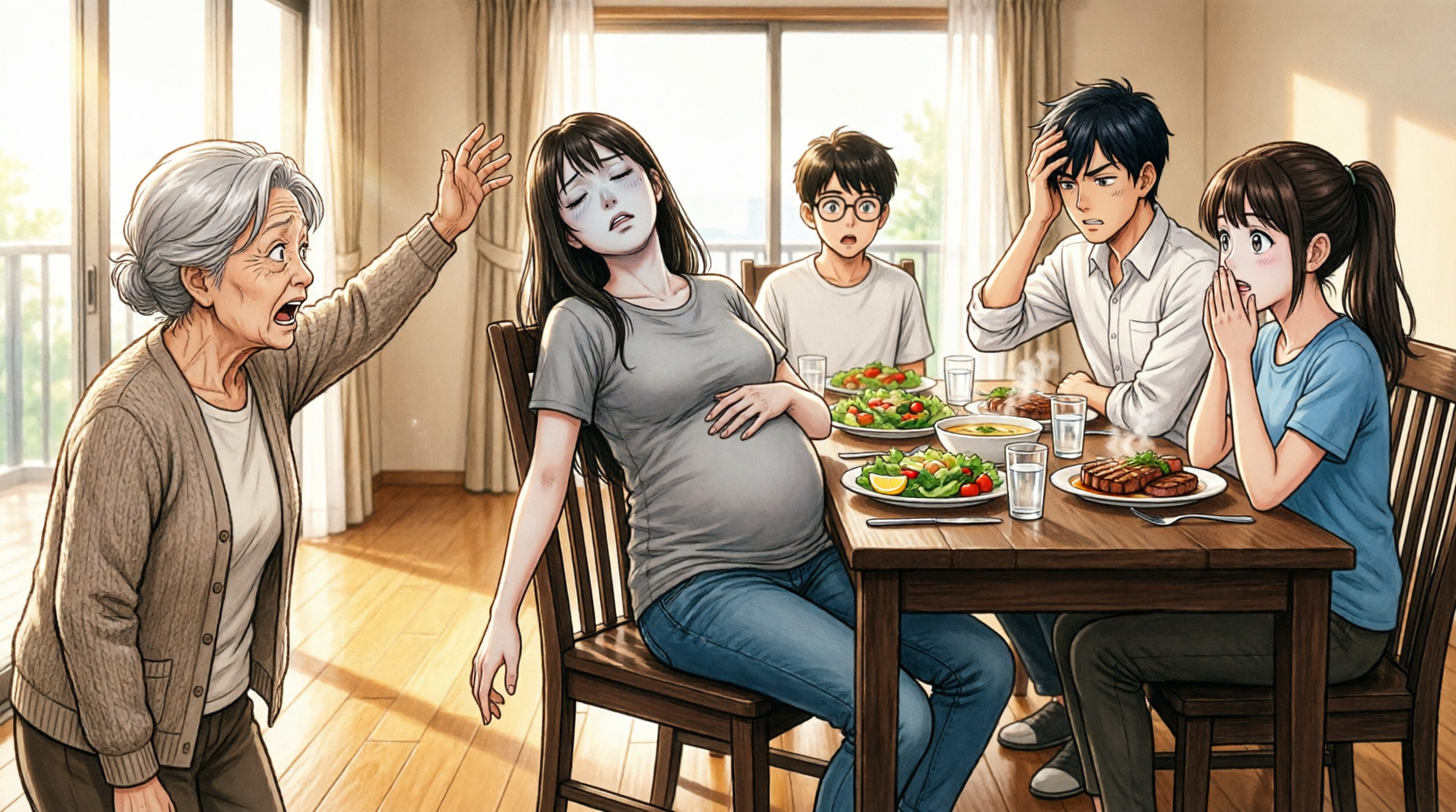
“Oh, Emily,” she said. “You do have a dramatic streak.”
“I need a hospital,” I managed.
Linda looked at David, not me. “For what? She’s tired. Pregnant women faint. Good Lord, when I was carrying you, I was still scrubbing floors and driving myself to appointments.”
“Mom, she asked for an ambulance.”
“And if you call one, you’ll have doctors rushing over for nothing when there are people actually dying.” Linda sat in my armchair and crossed one elegant knee over the other. “Give her some water. Some of those calming drops from the kitchen. She’ll be fine.”
I tried to sit up. My arms felt full of sand.
David hovered between us, phone still in his hand, eyes moving from me to her and back again.
“David,” I said. “Please.”
Linda leaned toward him and lowered her voice, but not enough.
“Don’t indulge this. She’s using the pregnancy to control every room she’s in. If you start rewarding it now, you’ll never stop.”
My skin went numb first. Then my legs. The room narrowed to the lamp, the blanket, David’s hand still not pressing the number that mattered.
The last thing I heard before the darkness closed was Linda saying, almost lazily, “Don’t you dare call. She’s faking.”
When I woke up, the ceiling above me was hospital white and cracked like lightning.
There was a monitor to my left, and on it I could hear not one heartbeat, but two—one steady, one fast and frantic. I turned my head, dry-mouthed and terrified, just as a nurse hurried in and said, “Easy, Emily. Don’t move too fast. We’re still trying to keep both babies stable.”
Both babies?
Part 2
For a second, I thought I was still dreaming.
I blinked up at the nurse and tried to lift my head, but my body felt heavy and wrong, like every bone had been packed in wet wool. There was an IV in my arm. A blood pressure cuff kept tightening around my upper arm at intervals that felt too frequent to be accidental. The room smelled like antiseptic, warmed plastic, and the stale metallic edge hospitals always carry under the cleaner scents.
“What did you say?” I asked.
The nurse was young, maybe mid-twenties, with tired eyes and a pink mark across the bridge of her nose where a mask had rubbed her skin raw. She adjusted the blanket over my legs and gave me the kind of careful smile medical staff use when they know a sentence is about to rearrange your life.
“You’re in the maternal-fetal unit at County General,” she said. “You had a hypertensive crisis and you lost consciousness. The doctor will explain everything, but right now I need you calm.”
“Who brought me here?”
She hesitated just enough to tell me I would not like the answer.
“The ambulance.”
“Who called it?”
Another pause. “A neighbor, according to the report.”
I stared at her.
A neighbor.
Not my husband.
Not the man who had sworn we were finally getting our miracle.
The monitor beside me kept chirping softly, one strong rhythm and one much quicker one that seemed to skitter under my skin.
“My baby,” I whispered. “Is the baby okay?”
The nurse glanced at the screen, then back at me. “They’re hanging on. The doctor will be here in a moment.”
They.
I closed my eyes because the room had started to tilt again. When I opened them, the nurse had gone and a doctor was coming in, flipping through a chart with quick, efficient fingers. She was in her fifties, compact and broad-shouldered, with short silver-streaked hair tucked behind one ear and the expression of someone who had long ago decided panic was for other people.
“Emily?” she said, pulling a stool to my bedside. “I’m Dr. Camila Reyes.”
Her voice was warm, but direct. No false comfort. I liked her immediately in the desperate way you like competent people when your life is suddenly no longer your own.
“I need you to listen carefully,” she said. “You came in with severe preeclampsia. Your blood pressure was dangerously high. You had protein in your urine, significant swelling, uterine irritability, and signs that the placenta was under stress. We stabilized you, but you are not out of danger.”
My mouth felt numb. “And the baby?”
Dr. Reyes looked at me for a long second, measuring something.
“The babies,” she said. “Plural.”
I felt the word move through me like cold water.
“No,” I said automatically. “There’s one baby.”
“There are two.”
That should have sounded impossible. Instead it sounded like the part of a story where you realize the room has more doors than you thought.
Dr. Reyes turned the chart around and showed me a grainy ultrasound printout. I’m not one of those women who can look at a scan and instantly identify feet or profiles. All ultrasounds have always looked like weather maps to me—light and dark, ghosted curves, static with meaning inside it. But even I could see it now: two distinct shapes, one larger and better positioned, the other partially hidden behind it.
“It’s rare, but it happens,” she said. “The second fetus was obscured in previous imaging. Positioning, overlap, your anatomy, the timing—sometimes a twin hides. The larger baby appears developmentally appropriate. The smaller one is behind and under stress. There are blood flow issues we’re monitoring very closely.”
I stared at the scan until my eyes burned.
Two.
Two boys or girls or one of each, two sets of hands, two spines, two separate lives inside me all this time while I had folded tiny onesies and argued about stroller colors and thought there was only one.
I started crying then, not loud, not gracefully. The tears just kept leaking sideways into my hair while Dr. Reyes waited without trying to stop them.
“Does David know?” I asked finally.
“We haven’t spoken with him,” she said. “The emergency contact number we were given wasn’t answered.”
Of course it wasn’t.
I asked for my phone. The nurse brought it in a plastic bag along with my wallet and wedding ring, which someone had removed when they inserted the IV. The screen had a spiderweb crack across one corner. There were four missed calls from David, three short texts—How are you? / Call when you can / Mom says you need rest—and nothing else.
Mom says.
I pressed call anyway. Straight to voicemail.
I hung up and called my mother in North Carolina next. She answered on the first ring, voice breathless and already afraid, the way mothers answer when they hear the hour before they hear the words.
“Emily?”
“Mom.”
That was all it took. She heard something in my voice and said, “What happened?”
By the time I finished, she was already packing. She told me she’d be on the road within twenty minutes. Then I called my best friend Jessica, who reacted exactly the way I would have wanted if I had the energy to want anything. She swore, loudly and creatively, promised to bring my chargers, toiletries, loose clothes, and the extra-long phone cord I liked, and said, “Do not defend that man to me when I get there.”
I almost laughed.
That evening blurred. Magnesium through the IV. Blood pressure checks. A nurse helping me roll onto my side because apparently gravity mattered now in ways it never had before. Dr. Reyes coming back with an ultrasound tech who pressed cold gel over my belly while the machine threw shadows across the dim room.
“There,” the tech said softly. “Twin A.”
A strong heartbeat thumped through the speakers, deep and regular. Relief broke over me so hard it made me dizzy.
Then the probe shifted.
“And Twin B.”
The second heartbeat was there too, but higher, thinner, fragile in a way that made my throat close.
“Still with us,” Dr. Reyes murmured.
Still.
As if the baby had a choice in the matter.
That night I drifted in and out of a feverish half-sleep. In one dream I was on a beach at low tide. Two small figures stood at the shoreline, backlit by pale sun, waving to me. I tried to get to them, but every step sank ankle-deep in sand, then calf-deep, then nearly to my knees. One of the figures began to blur and thin out like mist, and no matter how I reached, I couldn’t get there.
I woke with my heart pounding.
The room was dark except for hallway light under the door and the green glow of the monitor.
I listened.
Only one heartbeat.
I froze so completely I could hear my own breath catch.
“There’s only one,” I whispered, then louder, “There’s only one.”
The nurse came running. She adjusted leads, pressed buttons, murmured for me to breathe, but my whole body had already gone cold.
“Sometimes they shift,” she said. “Sometimes the position changes and we lose a signal.”
“Did the baby die?”
“No one is saying that.”
But she didn’t say no.
I lay there until dawn with my hand over my belly, whispering apologies into the blanket to children I had not even known were both there. By morning my mother arrived smelling like highway coffee and face cream, her hair flattened on one side from too many hours against a headrest. She hugged me so carefully I could feel how badly she wanted to crush me to her chest and didn’t.
Then Jessica appeared behind her with a tote bag, a cardigan, and eyes hot with rage.
Neither of them said David’s name at first.
They didn’t have to.
When Dr. Reyes came in for rounds, she studied the overnight monitor strips, then looked at me.
“Both babies still have heart activity,” she said. “Twin B dipped, but recovered.”
The room exhaled around me.
Then she closed the chart, kept her hand on it, and asked, in a tone so measured it made me instantly afraid, “Emily, before you collapsed, did you take anything unusual yesterday? Any medication, drops, herbal tinctures, supplements, anything not prescribed by your OB?”
I stared at her.
“No. Why?”
Dr. Reyes looked at me, then at my mother, then back at the chart.
“Because,” she said quietly, “your bloodwork came back with something in it that should not have been in your system at all.”
Part 3
There are some sentences that seem to arrive in the room before your mind can catch up to them.
That was one of them.
My mother stopped smoothing the blanket over my legs. Jessica, who had just started unpacking a bag of toiletries onto the windowsill, slowly set down the toothbrush in her hand.
“What do you mean?” I asked.
Dr. Reyes pulled the stool closer to my bed and lowered her voice, not because the room was loud, but because some information automatically reshapes itself into a whisper.
“We ran an expanded tox screen,” she said. “Partly because your symptoms escalated unusually fast and partly because your uterine activity did not match what we’d expect from preeclampsia alone.”
I looked from her face to the chart and back.
“And?”
“There were traces of misoprostol metabolites in your system.”
The word meant nothing to my mother. I could tell by her expression. Jessica frowned, trying to place it.
I knew the drug only vaguely from late-night internet spirals and baby forums—the way pregnant women know random fragments of medical language by osmosis. A pill. Something to induce labor sometimes. Something that absolutely did not belong in the body of a woman trying to keep her pregnancy going.
“I didn’t take that,” I said.
“I know you’re saying you didn’t,” Dr. Reyes replied carefully. “And I am not accusing you of anything. But it was present.”
The room went quiet enough that I could hear the wheels of a cart squeak in the hallway.
My mother was the first to speak. “Could it be from some other medicine? A mistake?”
Dr. Reyes shook her head. “It’s possible a lab can misfire, but this wasn’t vague. It was specific enough that the pathologist flagged it.”
Jessica swore under her breath.
I stared at the ceiling crack over Dr. Reyes’s shoulder because looking directly at anyone suddenly felt too hard. “What would it do?”
“At this stage? It can trigger contractions, placental problems, fetal distress, bleeding.” She paused. “In a pregnancy already under strain, it can push things in a dangerous direction very quickly.”
My mouth filled with a bitter, metallic taste.
“So somebody gave me something,” I said.
The doctor did not answer immediately, which was its own answer.
“We need to document first and conclude second,” she said. “But I need you to think carefully about anything you ate or drank in the hours before you lost consciousness. Anything at all.”
The pomegranate spritzer flashed in my mind so sharply it made my scalp prickle.
David carrying it back to the table.
David insisting I drink it.
David watching me while I did.
But then another image collided with it: Linda in my living room, telling him to get the calming drops from the kitchen. I hadn’t actually swallowed those. I had blacked out first. So whatever got into me had likely happened earlier.
At dinner.
Only dinner.
“I had water,” I said slowly. “A little pasta. A few bites of bread. And one drink. A nonalcoholic spritzer David brought me from the bar.”
Dr. Reyes didn’t react visibly, but she wrote that down.
“Anyone else handle it?”
“I don’t know.”
“Did you leave it unattended?”
“Probably. It was a dinner party.”
Jessica folded her arms over her chest so tightly I thought the seams of her cardigan might pop. “You think someone drugged her.”
Dr. Reyes chose her words. “I think Emily needs to consume only hospital-provided food and drink while she’s here. I think everything related to last night needs to be documented. And I think she needs calm, not speculation.”
Calm. The hospital’s favorite impossible request.
After she left, my mother sat on the edge of the bed and took my hand. Her fingers were cool and dry and familiar in a way that nearly undid me.
“Do you think it was him?” she asked softly.
I wanted to say no so badly it almost hurt.
“He brought me the drink,” I whispered.
Jessica turned away and walked to the window because she was the kind of person who moved when she was angry, like if she stopped she might combust. “I am trying very hard not to go find that man right now.”
“Please don’t,” I said.
“I know.”
Around noon, David finally came.
He entered carrying white roses—my favorite—which would have been touching if I hadn’t been lying there with a tox report suggesting someone had tried to trigger labor in my body. He looked pale and badly shaved, with dark circles under his eyes and the stiff, guilty posture of someone stepping into a room where he knows he has already failed.
“Hey,” he said softly.
My mother stood before he could get closer. “You left her.”
He froze.
“Mom,” I said quietly. “Not now.”
She looked like it cost her a physical effort to step aside.
David set the flowers down, found a vase, filled it from the bathroom sink, all with exaggerated care, like if he arranged enough stems he might delay speaking like an actual husband.
Finally he sat beside me.
“I’m sorry,” he said. “I panicked.”
I watched his hands. He kept rubbing his thumbnail over the edge of his phone case.
“I asked you to call an ambulance.”
“I know.”
“You didn’t.”
He swallowed. “Mom said—”
There it was. The reflexive center of him. His mother’s opinion entering the room before his own.
“Mom said you were overreacting,” he finished. “She said if we let you rest it would pass.”
I looked at him and felt something inside me separate cleanly from hope.
“Did you leave me alone?” I asked.
His eyes flicked away. “I walked Mom downstairs.”
I almost laughed. Not because it was funny. Because sometimes the ugliness is so ordinary it becomes surreal.
“You left me unconscious to walk your mother downstairs.”
“I didn’t think—”
“No,” I said. “You didn’t.”
He scrubbed a hand over his face. “I know I was wrong.”
Wrong was not the word. Wrong was forgetting to defrost chicken. Wrong was mailing a bill late. This was something else entirely, but I didn’t have enough stable energy to name it.
Then he said, “Did the doctors tell you everything?” and the question landed strangely.
“Like what?”
He hesitated, and in that hesitation I heard not worry, but calculation.
“Just… how serious it is.”
“Serious enough that if the ambulance had come later, things could have gone very differently.”
His face tightened, but not in the way I expected. Not relief. Not terror. More like the flinch of someone hearing a near miss from the wrong side.
Then he glanced down at his phone. The screen lit up on the blanket between us.
A text banner flashed across it.
Anna: Your mom says not to panic yet.
David grabbed the phone so fast it was almost clumsy.
But I had already seen it.
He looked up, caught my expression, and forced a smile that belonged on someone else’s face.
“Work,” he said.
I didn’t answer.
Because I knew plenty of people from work.
None of them texted their coworkers your mom says not to panic yet while their wife lay in a hospital bed trying to keep two babies alive.
That night, while the smaller heartbeat skipped and recovered and skipped again through the speakers, I could not stop seeing that name.
Anna.
And for the first time since I woke up, I knew with a certainty that chilled me more than the IV fluid running into my arm:
What had happened to me had not been an accident.
Part 4
I have always hated the phrase women know.
Women do not know by magic. We notice. We add. We remember the tone, the timing, the thing that was said too fast, the thing that was not said at all. Then when the pattern finally becomes undeniable, people call that intuition because it is easier than admitting how much unpaid detective work women do just to survive ordinary relationships.
I did not know who Anna was.
But I knew she was not work.
The next morning I woke before sunrise to the sound of Twin B’s heartbeat chasing itself across the monitor like a bird against glass. The room was still blue with early light. My mother was asleep in the recliner under a hospital blanket, one hand tucked under her cheek. Her reading glasses had slipped halfway down her nose. Jessica had gone home after midnight with promises to come back before lunch.
I lay there with one hand on my belly and the other clenched in the sheet, replaying the previous day in ugly little fragments.
Anna.
Your mom says not to panic yet.
Misoprostol in my blood.
David bringing me the drink.
By the time my mother stirred awake and sat up with a start, I had already made one decision.
I would not confront David until my babies were safer than they were right now.
Not because he deserved patience. Because they did.
When Dr. Reyes came in on rounds, I asked if I could speak to her alone. My mother stepped out to get coffee. When the door clicked shut, I told the doctor about the text from Anna and the drink David had insisted on handing me himself.
She listened without interrupting, then nodded once.
“Document everything,” she said. “Dates, names, exact wording where you can remember it. And do not accuse anyone yet. Stress is the last thing your body needs.”
“So I’m supposed to smile at him?”
“You are supposed to protect your babies.” She met my eyes. “Sometimes that looks like smiling.”
I hated that she was right.
Jessica arrived with coffee for my mother, contraband cinnamon rolls for herself, and a face that said she had spent the drive over building several different ways to ruin David’s life.
“You look like you didn’t sleep,” she said.
“I didn’t.”
I told her about Anna while my mother was in the bathroom. Jessica went very still.
“Who’s Anna?”
“No idea.”
“Do you want me to find out?”
I looked at her. “Can you?”
Jess had once found out a man our mutual friend was dating was secretly married by locating his wedding registry through three different last-name spellings and a boat-club newsletter. So yes, if anyone could, it was Jessica.
“Probably,” she said. “If you have his laptop or email or literally any thread to pull.”
That afternoon Sarah came by with a balloon tied to a paper cup and guilt written all over her face. She hugged me awkwardly around tubes and said, “I should have seen you were that bad.”
“It wasn’t your fault.”
She fiddled with the ribbon on the balloon. “David was acting weird.”
I looked up. “What do you mean?”
“He was watching you the whole time, but not in a sweet way.” She made a face, trying to get it right. “More like waiting. And when Ryan offered everyone cider for the toast, David cut him off and said he’d get yours himself.”
The tiny hairs on my arms lifted.
“Did he make it at the table?”
“No. He went inside to the bar.” She frowned. “Actually, now that I think about it, he was gone longer than you’d expect for one drink.”
When Sarah left, I wrote that down.
Later, when my mother dozed again and the floor of the unit softened into the strange almost-quiet hospitals get between shift changes, Jessica sat on my bed and said, “I can go to the apartment.”
I looked at her.
“You said he used your laptop a while back, right? If he ever logged into email or forgot to clear browser history, there could be something.”
My pulse quickened in a way the blood pressure cuff immediately tattled on.
“That feels crazy.”
“So does drugging your pregnant wife.”
She had a point.
I texted David around five asking if he could bring my laptop from home because I “wanted to watch something other than daytime TV.” He replied too quickly, almost as if he was relieved to be useful.
Sure. I’ll bring it tonight.
When he arrived, he had the laptop and another bouquet and a new careful gentleness that now looked, to me, like performance notes from a man auditioning for the role of devoted husband.
“How are my boys?” he asked, putting the computer bag on the chair.
My boys. Not our boys.
Maybe he said it innocently. Maybe he didn’t. Once suspicion enters a room, it sits in every corner.
“They’re here,” I said. “That’s enough for now.”
He winced at the coldness in my tone and sat down. “Em, I know you’re angry.”
Angry. Such a small word for what he had earned.
I made myself soften my face. “I’m scared, David.”
That, at least, was true.
He immediately relaxed, as if fear in me was more manageable than distance. “I know. I know. We’ll get through this.”
We.
He leaned forward to kiss my forehead. I fought the instinct to pull away.
When he left, I waited until his footsteps had fully faded. Then Jessica, who had been hiding in the family lounge down the hall because she no longer trusted herself to be civil in the same room with him, slipped back in.
We opened the laptop.
My email loaded first. Work notes. Grocery receipts. A baby registry discount. Nothing. Jessica clicked into the trash folder and scanned with the speed of a woman who had weaponized office boredom for years.
“There,” she said.
A deleted sent message from my own account, timestamped three months earlier.
I frowned. “I didn’t send that.”
“No,” Jessica said grimly. “But someone did.”
She opened it.
Dear Anna,
I can’t keep pretending this is simple. Mom says leaving now would make me the bad guy, especially with Emily pregnant. She thinks I should stay until the delivery, make sure the babies are okay, and then do what I have to do. I hate hurting her, but I can’t keep living a lie. I love you. I mean that. Once this is over, we’ll finally have a real chance.
—D
For a moment I could not feel my hands.
Jessica said something—probably swearing—but it came from very far away.
I read the message again. Then I scrolled.
There was a reply below it. Not from Anna.
From Linda.
Use your own email next time. And make sure she finishes what you give her. One scare now is better than a mess later.
I stared at the screen until the words blurred.
Jessica made a sound I had never heard from her before, something between fury and horror.
And sitting in that hospital bed, my hand over a belly that contained two children fighting to stay alive, I realized I was no longer trying to figure out whether my husband was cheating on me.
I was staring at proof that he and his mother had planned something far worse.
Part 5
I did not scream.
I think that surprises people when I tell this part.
But rage does not always come out loud. Sometimes it goes so cold you feel it in your teeth.
Jessica shut the laptop as if the screen itself might burn me.
“Oh my God,” she said. “Oh my God.”
My mother had stepped back in halfway through, coffee still in hand, and from her face I knew she had seen enough. She set the cup down on the windowsill so carefully it barely made a sound.
“What did he do?” she asked.
Jessica looked at me.
I opened the laptop again because suddenly I needed the ugliness to be visible. If it was visible, it was real. If it was real, I wasn’t losing my mind.
My mother read the email without sitting down.
By the time she reached Linda’s reply, her mouth had gone white around the edges.
“That woman,” she said softly, and then louder, “that woman told him to poison you.”
“I don’t know what exactly was in the drink,” I said.
“You know enough.”
Jess reached for my hand. “We save everything. Screenshots, forward it, photograph it, all of it.”
She was already moving—sending the message to a new email account she set up on the spot, photographing the screen with her own phone, emailing copies to herself, to me, to my mother, because catastrophe apparently turns some people into stone and others into project managers. Thank God for project managers.
I called for Dr. Reyes.
When she came in and saw all three of our faces, she closed the door behind her without asking why. I handed her the laptop. She read, exhaled once, then pinched the bridge of her nose.
“That confirms motive,” she said quietly. “Not yet method, but motive.”
My mother looked ready to drive directly from the hospital to Linda’s house with a baseball bat.
“I’m calling the police.”
“No,” Dr. Reyes said immediately.
My mother turned on her. “They tried to kill my daughter.”
“And if Emily’s blood pressure spikes tonight because detectives are in and out of this room asking her to relive it, we may lose one or both babies.” Her voice was not unkind. Just firm. “I understand your anger. I share it. But the medical priority remains the pregnancy.”
I hated how the truth of that trapped me. Any other woman in any other body might have gotten to explode right then. Mine was also a house for two vulnerable lives, and that changed every option.
“So what do I do?” I asked.
Dr. Reyes handed the laptop back to Jessica. “You document. You preserve evidence. You do not eat or drink anything from outside this hospital. You do not tell David what you know. And you stay as calm as it is possible to stay under impossible circumstances.”
“I don’t know how.”
“No,” she said. “But you will.”
That night David came with a paper bag from an organic market—berries, sliced mango, some pressed juice in clear glass bottles with handwritten labels. My skin crawled looking at them.
“I brought you something better than hospital food,” he said.
I smiled.
I can still remember that smile. The effort of it hurt my cheeks.
“That’s sweet, but Dr. Reyes put me on a strict hospital-only diet,” I said. “No outside food, not even fruit.”
He blinked. “Since when?”
“Today.”
“Why?”
I shrugged lightly. “Twin B had a rough night. They don’t want to risk anything.”
For a second, something crossed his face. Not concern. Irritation? Disappointment? It was there and gone so fast I might have doubted it if I hadn’t already seen the email.
“Oh,” he said. “Okay.”
He took the bag back with him when he left.
The next two days settled into a weird, tense rhythm. Magnesium headaches. Monitoring. My mother reading magazines without turning the pages. Jessica running quiet little errands that were actually reconnaissance. David arriving every afternoon with flowers or books or exaggerated remorse. Linda calling constantly and not once being allowed past the nurses’ desk because Dr. Reyes had put a quiet restriction in my chart: no food, no unsupervised visitors, all interactions documented.
Twin B improved.
Not dramatically at first. Just enough that the decelerations eased and the heartbeat stopped sounding like it was sprinting uphill. Every time the tech slid the Doppler over my belly and found that thinner rhythm, steadier than before, I felt something inside me sharpen into purpose.
They were safer here.
Away from him.
On the fourth day after I found the email, Linda finally appeared in person, wearing a cream pantsuit and a smile so smooth it should have reflected light.
“Emily,” she said, taking in the room, the monitor, my mother in the recliner, Jessica in the corner with a crossword book she was not doing. “You gave us such a fright.”
Us.
I wanted to laugh in her face.
Instead I said, “Twin B’s heart rate is stronger today.”
Linda’s smile thinned by a millimeter.
“Oh,” she said. “How wonderful.”
There it was again. That tiny, wrong flicker I had begun to recognize in both her and David whenever the babies did better than expected. As if my children’s survival inconvenienced a plan I had not fully uncovered yet.
She sat at the edge of the bed and laid one manicured hand near my blanket, not on it, because maybe on some level she knew I would recoil.
“You know,” she said, “I’ve been thinking ahead. With twins, you’ll need help. Real help. After the birth, you and the babies should come stay with me for a while.”
My mother made a short sound of pure disgust.
Linda ignored her.
“My apartment is bigger. More practical. David can come and go from work easily, and I know what I’m doing with babies.”
No, I thought. You know what you’re doing to babies.
“Thank you,” I said, keeping my tone soft. “But my mother is staying. We’ll manage.”
Linda finally looked at her. “Donna means well, of course, but first-time twins are demanding.”
“I raised two kids on my own,” my mother said, her voice pleasant in the way that means danger. “And I never tried to poison either of them.”
The silence that followed felt like it had weight.
Linda’s head turned very slowly toward me.
If I had not already known what she was, I think that look would have taught me anyway. All softness gone. Nothing left but calculation and insulted pride.
Then, just as fast, the smile snapped back into place.
“Well,” she said. “Stress makes people say all kinds of wild things.”
Jessica stood up. “You should leave.”
Linda rose with a rustle of expensive fabric and turned toward me one last time.
“Think carefully about where you’ll really be safest, Emily,” she said. “Mothers know things.”
After she left, my mother burst into tears from pure rage. Jessica followed Linda into the hall just far enough to make it clear that if she ever came near me alone again, she would regret it.
That evening, while Jessica went to the apartment to gather more of my things, she texted me a photo.
Inside our bathroom trash, under tissues and packaging, was a crumpled pharmacy receipt dated the afternoon of Sarah’s dinner.
One item was circled in blue pen.
Misoprostol.
I showed the picture to Dr. Reyes when she came in for evening rounds.
She looked at it, then at me, and for the first time since I met her, she seemed genuinely stunned.
“Emily,” she said quietly, “that’s the same drug we found in your blood.”
I looked at the receipt, at the date, at the crooked blue circle someone had drawn around the name as if it needed to be remembered.
And in that moment, the last sliver of uncertainty died.
My husband had not merely failed me.
He had bought the thing that nearly killed my babies.
Part 6
Once certainty arrives, something strange happens to fear.
It does not go away. It gets organized.
That was what changed in me after the receipt. Before, I had been spinning—hurt, sick, confused, still trying to preserve the possibility that maybe I was misreading something monstrous as something merely awful. After the receipt, there was no maybe left.
There was only sequence.
Protect the babies.
Recover.
Leave.
Burn every bridge behind me if I had to.
Dr. Reyes sat on the edge of my bed that night with the receipt photo open on her phone and said, “You need copies of everything. I’ll document the tox results formally in a way that can be requested later. I’ll also note your report about the dinner, the email, and the pharmacy receipt.”
“Can they get in trouble?” I asked.
“If this is pursued? Yes.” She paused. “But criminal cases are slow. Right now, your safest move is still silence until delivery.”
I nodded.
Silence was beginning to feel less like passivity and more like strategy.
The next morning David came with sunflowers instead of roses, as if changing the flower might change the man carrying them. He kissed my forehead and asked how I’d slept.
“Fine,” I said.
That was the first outright lie I told him.
He sat beside me, smoothing the blanket over my legs with a tenderness that made my stomach turn. “Mom says you sounded tired when she left yesterday.”
I kept my face blank. “Did she?”
“She’s worried about you.”
No, I thought. She’s worried about losing control of a situation she thought she had managed.
I watched him as he spoke. Once you know someone is lying, it changes the proportions of their face. Little things become visible—the way they over-explain something simple and under-explain something important, the way they watch your reaction before they finish a sentence, the way their kindness is always slightly delayed, like they’re performing it from memory rather than feeling it in real time.
“Dr. Reyes says the smaller baby is improving,” I said.
It was almost cruel, the way I delivered it casually, like weather.
David smiled, but there was a beat too long before it reached his eyes. “That’s great.”
I nodded.
It was not great for him. I knew that now.
For the next two weeks I learned how to live in the same room as a lie without touching it.
My blood pressure came down. The swelling in my hands eased. Twin B—my hidden little fighter—gained ground slowly but steadily. The ultrasound tech started sounding less guarded. The nurses stopped giving each other that look when they glanced at the monitors. Dr. Reyes no longer said if we can buy time; she started saying if we can make it to thirty-four weeks, I’ll be pleased.
My mother rented a furnished one-bedroom less than ten minutes from the hospital. She brought in fresh T-shirts, nursing bras, lip balm, chargers, and the soft gray blanket I liked from home. Jessica handled the practical things nobody thinks about when they imagine survival—insurance calls, checking our lease, quietly moving my important documents out of the apartment before David could notice they were gone.
I had not yet told either of them my full plan, but they knew enough.
One afternoon, when the room smelled like microwaved soup and the sky outside the window had gone flat silver with rain, I finally said it aloud.
“I’m not going back,” I said.
My mother looked up from peeling an orange. “I know.”
Jessica, in the armchair, didn’t even pretend surprise. “Good.”
I laughed then, once, because their certainty steadied me. “That’s it? No speech?”
Jess shrugged. “What speech do you want? Stay with a man who bought labor-inducing pills and emailed his mistress from your account?”
Point taken.
The word mistress still landed like a slap, though. I had not let myself spend much energy on Anna yet because the murder-adjacent part of the story had shoved the adultery into a corner. But she was there. A third shadow in the room.
“Do you know who she is?” I asked.
Jessica nodded slowly. “I’m pretty sure.”
My stomach tightened.
“She works with him,” Jess said. “Or used to. Anna Bell. I found a conference photo on the company website and then her socials. She has pictures from restaurants in Charleston David has supposedly ‘never been to.’”
I closed my eyes.
A small grief, compared to the others, but sharp anyway. Cheating is intimate in its own humiliating way. Someone else knowing the shape of your husband’s laugh, the slope of his shoulder under a shirt, the words he uses when he wants to sound tender. It made my skin feel dirty, as if I had been living inside somebody else’s second draft.
“Don’t contact her yet,” my mother said. “We don’t know what kind of woman she is.”
I opened my eyes again. “The kind who sleeps with a married man.”
Jessica grimaced. “Fair.”
The day I reached thirty-four weeks, David came in looking almost buoyant for the first time since I had been hospitalized.
“Mom found a beautiful secondhand bassinet online,” he said, pulling up a photo on his phone. “Actually, she thinks maybe it makes more sense if, when you’re discharged, you and the twins stay with her for a while. There’s just more room there.”
There it was again. The campaign.
I had started to realize it was not only about help. Linda wanted proximity. Access. A way to keep me under her eye and the babies under her hand.
“No,” I said.
He frowned lightly, as if I were being mildly unreasonable over paint colors. “Em, come on. We’ve talked about this.”
“No, you and your mother have talked about this.”
He exhaled. “You always assume the worst with her.”
My laughter surprised both of us.
He stared at me. “What?”
“Nothing,” I said.
But it wasn’t nothing. It was the ridiculousness of a man lecturing me on assuming the worst when his mother had, in fact, attempted the worst.
That night, after he left, I got up to use the bathroom with the nurse’s help. On the way back down the hall, I heard voices near the family lounge.
David.
Linda.
I would know both of them in a fire.
“You let her mother get too involved,” Linda was saying in a hard whisper. “If Emily goes there after discharge, this becomes harder.”
“What do you want me to do, drag her to your apartment?”
“No, but you need to think about your sons.”
My sons, my sons, everybody suddenly owned my children except the woman carrying them.
Then David said, low and frayed, “I am thinking about them.”
Linda replied, “Then make sure they come home where they belong.”
I stood very still in the fluorescent hallway, one hand on my IV pole, and felt something settle into place so completely it almost felt like peace.
They were not planning to back off.
Which meant when I left that hospital, I would need to leave like someone escaping a fire—not arguing about the flames, not explaining myself, just taking what mattered and getting out.
Part 7
Thirty-five weeks pregnant with twins is not elegant.
By then I was all belly and careful movements, my skin stretched tight, sleep broken into miserable fragments, my lower back aching so steadily it felt like another organ. Twin A seemed to believe my ribs were a xylophone. Twin B, the fighter, liked to tuck low and jab at my bladder at three in the morning as if reminding me he had every intention of arriving on his own terms.
And still, compared to the weeks before, I was stronger.
That mattered. Strength gives you bandwidth for logistics.
Dr. Reyes scheduled my C-section for the following Thursday unless the babies forced our hand sooner. She explained it with the same brisk gentleness she used for everything: twin positioning, my preeclampsia history, the fact that she trusted my body exactly as far as the next blood pressure spike and no further.
“I want them out safely,” I told her.
“That,” she said, “we agree on.”
After she left, I finally told my mother and Jessica everything I had not yet said aloud in full.
Not just the email. Not just the receipt. The entire shape of the thing. The text from Anna. The way David’s face had changed every time the babies improved. The whisper in the hallway. Linda’s fixation on getting us into her apartment. The cold certainty that if I went home with him, I would not sleep a single peaceful minute again.
My mother listened with both hands wrapped around a paper cup of tea she never drank. Jessica sat cross-legged in the armchair, elbows on knees, eyes sharp and furious.
When I finished, the room stayed quiet for a moment.
Then my mother said, “You leave the hospital with me.”
Not as a question. Not even as advice. As if she were naming a law of physics.
“Yes.”
“We do not stop by the apartment,” Jessica added. “Not for clothes, not for the bassinet, not for anything.”
“Already handled,” my mother said. “Your important documents, the baby clothes, your laptop, your grandmother’s ring, the photo albums. Jess helped. The rest can be replaced.”
I stared at her. “You already did that?”
She lifted one shoulder. “You were growing two people. I figured I could pack a few boxes.”
I laughed and cried at the same time.
Jessica handed me tissues. “Also, I spoke with a family attorney. Quietly.”
Of course she had.
“And?”
“And he said the same thing Dr. Reyes did: leave first, litigate second. Get copies of the medical records. Keep all evidence. Do not warn David. Do not negotiate in the hallway like a woman in a TV movie.”
I looked at her through wet lashes. “Your support is really wrapped in insults.”
“You’re welcome.”
The next day, Linda visited alone.
That was unusual enough that my pulse started climbing before she reached the bed. My mother had gone downstairs for lunch. Jessica was on a phone call with the attorney in the hallway. For the first time since Dr. Reyes tightened visitor restrictions, Linda had managed to catch me mostly by myself.
She entered carrying a white cardigan folded over one arm and a container of what smelled like chicken stew.
“I brought homemade soup,” she said.
I pressed the call button for the nurse without looking away from her.
Linda noticed and smiled.
“You really do think I’m the villain, don’t you?”
“I think you should leave.”
She set the stew on the counter anyway and walked closer. Her perfume was floral and sharp, something old-fashioned and expensive. She looked immaculate, of course. Linda could probably stand in the center of an earthquake with perfect lipstick.
“You’ve always made things harder than they need to be,” she said lightly. “David was happy before everything had to become about your feelings.”
Something in me went still.
“My feelings,” I repeated.
“Yes.” She tilted her head. “Your sensitivities. Your little injuries. Men get tired, Emily. They want peace in their homes.”
I stared at her and realized with sudden clarity that she was not there to apologize, or even to manipulate gently. She was there because she could not tolerate losing the last word.
“You told him not to call an ambulance,” I said.
She didn’t blink. “I told him not to indulge theatrics.”
“You bought the pills.”
Her smile thinned.
“And you put them in my body,” I said.
At that, she finally shifted. Not guilt. Not shame. Annoyance.
“What happened to you,” she said, “was the result of a difficult pregnancy and your own fragile health.”
There are lies so bald they become confessions.
I pressed the call button again, harder.
Linda leaned down then, close enough that I could see the powder settled in the lines beside her mouth.
“I honestly thought nature had decided this for you,” she said in a voice so soft it barely seemed to disturb the air. “Some women aren’t built for motherhood.”
The nurse entered at that exact moment, followed by Jessica, who took one look at my face and said, “Get her out.”
Linda straightened, smile returning as if it had never left. “Such a hostile atmosphere,” she murmured, and left under the nurse’s supervision.
I was shaking so hard my teeth clicked.
Jessica grabbed both my hands. “What did she say?”
I told her.
By the time my mother got back, Jessica had already called Dr. Reyes and hospital security. Linda was barred from the floor entirely. David, when informed, called me with a tremor in his voice.
“What the hell happened?”
“Your mother threatened me in my hospital room.”
“She said you accused her of trying to kill the babies.”
I laughed. “That’s because she did.”
Silence.
Not offended silence. Not outraged silence. Just a blank stretch where any innocent man would have rushed in with disbelief.
“Emily,” he said finally, “you’re under a lot of stress.”
That sentence ended my marriage emotionally in a way the affair hadn’t, the receipt hadn’t, even the tox report hadn’t. Because right there, stripped of excuses, David had chosen his mother over observable reality again.
I hung up without answering.
That night I dreamed of the beach once more. Only this time I could reach the boys. They were small and solid and sun-warm, with damp curls at their temples and sea foam around their ankles. When I picked them up, one in each arm, there was no sand sucking me under anymore.
When I woke, Twin A rolled hard against my ribs. Twin B answered a second later.
Both alive.
Both fighting.
And two days before my scheduled surgery, when the nurse came in grinning and said, “Your husband brought a car seat brochure and keeps asking if twins can share a room,” I smiled back and thought, Let him plan. He has no idea he’s decorating a future he will never get.
Part 8
The morning my sons were born, the sky over Charleston was the color of pearl buttons.
I remember that because I was awake before dawn, staring out the hospital window at a thin wash of light over the parking garage and the tops of the oaks beyond it, trying to breathe past the tightness in my chest. Not fear exactly. Not only fear. Anticipation so strong it felt like another heartbeat.
A nurse came in at five-thirty to start pre-op checks. Blood pressure. Temperature. IV line. Compression sleeves on my legs that inflated with a soft mechanical sigh. The room smelled like chlorhexidine wipes and brewed coffee from the nurses’ station down the hall. Somewhere, a baby cried briefly and was soothed.
“You ready?” she asked.
“No,” I said honestly.
She smiled. “That’s the right answer.”
My mother arrived just after six with her hair still damp from a rushed shower and a tote bag she didn’t actually need because she coped by carrying things. Jessica followed ten minutes later with lip balm, mints, and the expression of someone prepared to physically throw a man through a window if required.
David came last.
He walked in with white roses again, wearing the blue shirt I had once told him made his eyes look softer. For a brief stupid second, seeing him there on the morning of our children’s birth with flowers in his hands and nerves all over his face, a memory tried to rise—of the man I once thought he was, the one who cried over a pregnancy test and kissed my stomach in bed.
Then I looked harder and saw the dampness at his temples, the way his gaze kept darting not to me, but to the monitors, the door, the hallway.
He was nervous, yes.
Not with joy. With uncertainty. With the discomfort of a man whose plan had already failed and who was now pretending he had wanted this outcome all along.
“How are you feeling?” he asked.
“Like I’m about to have surgery,” I said.
He tried to smile. “By the end of today, we’ll have our boys.”
Our boys.
There it was again. Possession without loyalty.
My mother went very still in the recliner. Jessica looked at the roses like she wanted to snap every stem.
The transport team came at eight-fifteen.
As they wheeled me down the hall, the overhead lights passing in white squares above me, I felt unexpectedly calm. The world narrowed the way it always does before something major—just the ceiling, the cold rail under my hand, the antiseptic air, Dr. Reyes already scrubbed in when we reached the OR.
“Good morning, Emily,” she said, as if we were meeting for coffee and not an operation that would divide my life into before and after. “We do this carefully, and then you meet your sons.”
In the operating room everything was bright enough to erase shadow. Stainless steel. Drapes. The clipped voices of practiced people. Someone tucked warmed blankets around my shoulders after the spinal anesthesia. Someone else adjusted the screen so I wouldn’t have to see below my chest.
I lay there and listened.
Machines. Metal. My own breathing.
Then pressure. Strange, deep, impersonal pressure.
“Almost there,” Dr. Reyes said.
And then—
A cry.
Loud, outraged, sharp as a thrown stone.
Every nerve in my body lit up at once.
“That’s Twin A,” someone said.
I started crying before I saw him.
Barely a minute later came the second cry.
Not weaker.
Not fragile.
Just as furious. Just as alive.
“That,” Dr. Reyes said, and I could hear the smile in her voice, “is your hidden little fighter.”
They brought them up one at a time over the screen, pink-faced and wet-haired and furious at being dragged into fluorescent light. I could not tell them apart yet. They were both perfect and squalling and real. One had his fist clenched tight under his chin. The other had a wrinkle between his eyebrows like he had come into the world already judging it.
“My boys,” I whispered.
I have no other language for what I felt then. Relief so profound it nearly emptied me out. Love so sudden and absolute it was almost terrifying. For weeks I had lived in a body that felt half like a battlefield. In one bright, crying minute, it became the place that delivered them into the world alive.
After recovery, they wheeled me back to my room, where the edges of everything felt soft and slightly delayed. My abdomen burned. My mouth was dry. But under all of it was a shining line of joy.
When David came in later, he looked pale.
“How are they?” he asked.
“Healthy,” I said. “Both of them.”
He nodded too quickly. “That’s good. That’s really good.”
Linda arrived behind him a few minutes later in cream again, somehow. Her eyes went first to me, then to the bassinets the nurses had parked by the wall so I could stare at my sons while they slept.
For the smallest fraction of a second, disappointment crossed her face so clearly it stole my breath.
Then it was gone, replaced by grandmotherly delight.
“Oh, they’re beautiful,” she said.
She did not touch them. Neither did David.
That mattered to me.
My mother and Jessica came that evening after the babies had been fed and checked. The room glowed gold from sunset light and the warmer over Twin B’s bassinet hummed softly in the corner. My mother stood over the boys with tears slipping down both cheeks. Jessica took one look at them and said, “Wow. They already look like trouble.”
I laughed, sore as I was.
“Have you named them yet?” my mother asked.
David was standing by the window. I didn’t look at him.
“Yes,” I said. “Owen and Noah.”
I had not told anyone I’d changed the names. David and I had spent months debating other ones, names attached to a future he no longer had any part in. Owen meant young warrior. Noah meant rest. Fight and peace. Both felt earned.
My mother repeated them softly, smiling.
“Owen and Noah,” she said. “Perfect.”
Later that night, after everyone left and the room had gone dim except for the lamp by the sink, Dr. Reyes stopped by.
She checked my incision, the boys, my blood pressure, then sat beside me for a moment.
“They’re strong,” she said. “Both of them.”
“I know.”
“And you?”
I looked at Owen’s mouth, parted in sleep. Noah’s tiny hand against the blanket.
“I’m done pretending,” I said.
She nodded once. “Then tomorrow we make a plan.”
The next morning, I woke to the sound of wheels in the hallway and Linda’s voice outside the door saying, “I brought the car seats.”
Car seats.
Plural.
As if my children were already packed into her future.
I looked at the door, at my sleeping sons, and felt the air in my lungs turn cold.
Because I suddenly understood exactly what they thought was still going to happen when I was discharged.
They thought I was coming home with them.
Part 9
Postpartum recovery with twins is not a gentle process. It is a parade of indignities stitched together by adrenaline.
The first time I stood up after surgery, I thought my body might split in half. The first time both boys cried at once while a nurse adjusted my meds and my incision throbbed under the mesh underwear they send you home in, I nearly laughed from sheer overload. Milk came in hot and painful. Sleep became something I measured in accidental twenty-minute scraps. My sons had identical ears, nearly identical mouths, and different cries—Owen’s loud and immediate, Noah’s thinner at first, though that changed quickly once he realized he could make demands like his brother.
Through all of it, one thought anchored me:
Do not let David take them anywhere.
Linda’s car seats appeared the next day in our room without permission, pink hospital tags looped around the handles. One was navy. One was gray. She had chosen them herself, of course, because Linda never imagined a world in which another woman’s child-related decisions outranked hers.
I asked the nurse to remove them.
When David came in and saw they were gone, he frowned. “Where are the seats Mom brought?”
“I had them taken out.”
“Why?”
“Because I didn’t ask for them.”
He rubbed his jaw. “Em, can we not fight over everything?”
The audacity of that sentence nearly impressed me.
Over everything.
As if attempted poisoning, adultery, manipulation, and plans to relocate my newborn sons into his mother’s apartment were all merely a pile of petty disagreements.
My mother was in the room that time. She stood from the chair by the window and said, “Emily’s not fighting. She’s deciding.”
David looked exhausted. Maybe he was. I no longer cared. Fatigue is not character.
He lowered his voice. “We need to figure out what happens when you’re discharged.”
“I already have,” I said.
His eyes narrowed slightly. “What does that mean?”
“It means I’m not going to Linda’s.”
He exhaled hard through his nose. “No one said you were being forced to.”
His mother had, repeatedly, but I let that pass.
“I’m also not going back to the apartment with you,” I said.
The room went very still.
My mother did not move. She had expected this moment. Jessica, who had entered halfway through and was pretending to organize baby socks in the drawer, paused but didn’t turn around.
David stared at me like I had switched languages.
“What?”
I looked him in the face.
“I know about Anna. I know about the email. I know about the receipt from the pharmacy. And I know what Dr. Reyes found in my blood.”
He went white, then red, then blank.
“Emily—”
“No.” My voice came out calmer than I felt. “Not one lie. Not one explanation. Not one word that starts with Mom said.”
He swallowed.
“You went through my email?”
I almost laughed. That was his first instinct. Not denial. Not remorse. Privacy.
“You used my email to tell your mistress you were staying with me until after the babies were born. You let your mother reply from it. If you wanted privacy, David, you should have tried honesty first.”
His gaze flicked to my mother, then Jessica, calculating in real time who knew what. “This is postpartum,” he said. “You’re exhausted. You’re making connections that—”
“I have toxicology reports,” I interrupted. “I have your email. I have the pharmacy receipt. I have witnesses.”
He said nothing.
And in that silence, something final finished breaking.
Later that afternoon, after he left without touching either baby, I met with the hospital social worker, a legal aid volunteer, and Dr. Reyes in a little consultation room that smelled like stale coffee and printer toner. My sons slept in bassinets beside the table while adults discussed the collapse of my life in calm procedural language.
Emergency protective order.
Temporary custody.
Controlled communication through counsel.
No disclosure of discharge location.
If you have never listened to people plan how you will leave your husband while your four-day-old newborns sleep in plastic bassinets beside you, let me tell you: it makes marriage look very flimsy.
The attorney, a woman named Marissa with silver hoops and a legal pad full of neat slanted writing, asked the practical questions no one wants to answer.
“Is he on the lease?”
“Yes.”
“Do you have access to independent money?”
“Some.”
“Would your mother’s address be safe for a while?”
My mother said, without hesitation, “Yes.”
“And if he contests custody?”
I looked down at Owen’s face, red and milk-drunk in sleep. Noah had one hand spread open above his head like a tiny surrender.
“Then he contests it,” I said. “But he doesn’t get to take them.”
After the meeting, Jessica pulled me aside in the hallway.
“There’s one more thing,” she said.
Something in her face made my stomach tighten.
“What?”
“I found Anna.”
I leaned against the wall.
“And?”
Jess glanced toward my room before lowering her voice. “I didn’t tell her everything. I just said I was contacting her on behalf of Emily Johnson and she needed to call me if she cared about the truth.”
“And?”
“She called back.”
I stared at her.
“She said David told her the marriage was basically over,” Jessica said. “He said you were unstable, controlling, and using the pregnancy to keep him stuck.”
A flash of shame hit me so hot it surprised me. Not because I believed it. Because someone out there had been fed a version of me designed to make betrayal easier.
“What else?”
Jessica’s jaw tightened. “She said Linda called him the day of Sarah’s dinner and asked whether you’d ‘finished the special drink.’ Anna thought it was some herbal nonsense for nausea. After you were hospitalized, David told her they’d had ‘a scare’ and that he needed time.”
I felt the wall steadying me.
“Will she say that officially?”
“She already texted me screenshots.”
Jessica handed me her phone.
The messages were there, blue and white on the screen, ordinary in the way evil so often looks once it enters a phone.
Anna: Did she finish it?
David: Most of it.
Anna: Your mom said not to panic if she starts cramping. She said it may only bring things forward.
David: This can’t get messy.
The hallway blurred for a second.
Jessica gripped my arm. “Breathe.”
I did.
Slowly. Carefully. Around the wound of being married to a man who had discussed “bringing things forward” about the lives inside my body as if he were rescheduling a meeting.
That night, after the babies fed and slept and fed again, I lay awake in the dim room listening to their small breathing noises and knew something with absolute clarity.
Leaving quietly was no longer enough.
Because a man who could write those texts would eventually tell himself a version where none of it was really that bad.
And I had two sons now.
I could not let them grow up anywhere near that kind of lie.
Part 10
The morning of discharge smelled like baby lotion, carnations from the nurses’ desk, and rain-wet pavement through the cracked window.
I had barely slept. Owen had cluster-fed half the night and Noah had decided two in the morning was an excellent time to be fully awake and studying my face with solemn concentration. By seven, both boys were finally drowsy again, tucked into matching pale blue sleepers with tiny white stars on the feet. My mother buttoned my cardigan for me because my hands were shaking too much to manage the tiny buttons.
“Are you okay?” she asked.
“No,” I said. “But I’m ready.”
Jessica arrived with the stroller and two diaper bags packed so methodically it looked like a military operation. The social worker came by with final paperwork. A security officer checked in discreetly, leaning in through the half-open door with the kind of casual posture that says I am not trying to alarm you, but I am absolutely here for a reason.
Dr. Reyes discharged us just before ten.
She looked at the boys, then at me, and said, “You know what to do if your blood pressure climbs, if either baby gets a fever, if your bleeding increases, and if your husband or his mother makes this difficult.”
I held her gaze. “Yes.”
She nodded. “Good.”
David walked in twelve minutes later carrying white roses and wearing the cologne I had once bought him for Christmas. Linda was behind him, crisp and smiling, a folded baby blanket over one arm like a prop. The timing was too precise to be accidental. They had assumed they would arrive just in time to help take us “home.”
David stopped dead when he saw the stroller, the packed bags, my mother in her coat, Jessica by the door, and the security officer visible through the glass panel outside.
“What’s going on?” he asked.
I looked at him and felt almost nothing. Not love. Not longing. Not even the hot clean hatred of the past few weeks. Just distance. The kind that comes after an amputation, when the pain is still real but you already know the missing part is not growing back.
“We’re leaving,” I said.
He gave a short confused laugh. “Yeah. I know.”
“Not with you.”
Linda’s smile vanished first.
“Emily,” she said in that warning tone she had used on me like I was a badly behaved child from day one, “this is not the place for drama.”
“No,” I said. “The place for drama was my living room while I lay unconscious and you told your son not to call an ambulance.”
David’s face changed. He took one quick look at my mother, at Jessica, at the security officer outside, and realized the room was not on his side.
“Can we talk privately?” he asked.
“No.”
“Emily—”
“No.” I reached into the diaper bag and pulled out the folder Marissa had helped assemble. Medical notes. Toxicology report. Printouts of the email. The receipt. Anna’s screenshots. Statements. Dates. Facts. The whole brutal spine of the story.
I held it out.
David didn’t take it.
Linda did.
She flipped through the first few pages, and I watched color drain from her face for the first time in all the years I had known her.
“This is absurd,” she said. “This is fabricated.”
“The pharmacy receipt was in our trash,” Jessica said.
“The toxicology report came from my hospital chart,” I added. “The messages came from David’s phone.”
David looked at his mother, then at the folder, then at me. “You went to Anna?”
“I didn’t have to. She came clean faster than you ever did.”
He actually flinched.
Linda recovered first. Of course she did. Women like her build their whole personalities around recovery without reflection.
“This is what stress does to weak women,” she said. “They invent narratives instead of facing reality.”
My mother stepped forward then, quiet and deadly. “The reality is that my daughter almost lost her life and her babies. The reality is that your son stood there and let it happen.”
Linda’s voice sharpened. “You have no idea what you’re talking about.”
“I know enough.”
David finally found his own anger. Probably because his fear had nowhere else to go.
“You can’t take my sons away from me.”
The phrase hit the room and died there.
My sons.
I put one hand on the stroller handle. “Watch me.”
“This is parental alienation,” he snapped. “You’re unstable. You’re exhausted. You’re letting your mother poison you against me.”
I laughed then. A tired, disbelieving sound.
“You’re really going with poison in this conversation?”
His jaw clenched.
I handed the folder to the security officer instead. “There’s a temporary order in process,” I said. “Until then, I want it noted that I am leaving voluntarily with my children and that neither of these people is to follow us or touch the stroller.”
The officer nodded once. “Understood.”
Linda took a step toward me. “You vindictive little—”
“Don’t,” Jessica said.
There are people who can fill a room by raising their voice. Jessica filled it by lowering hers. Linda stopped.
I looked directly at David.
“You asked what was going on. Here it is: I know about Anna. I know about the drink. I know about the pills. I know about your mother. And I know you were willing to wait for one or both of my babies to die if it meant you got a cleaner exit.”
His face went utterly still.
“That’s not what happened,” he said, but there was no conviction in it. Just habit.
“It is exactly what happened.”
He took one step closer. “Emily, I was scared.”
I stared at him.
That word again.
Scared.
As if fear had ever been an acceptable synonym for cruelty.
“I was scared too,” I said. “The difference is I didn’t try to solve it by sacrificing my children.”
His mouth opened. Closed. Opened again.
No words came.
Good.
Some men deserve a silence they cannot control.
The nurse arrived then with discharge bracelets cut, paperwork final, and two tiny caps she said the boys should wear because “newborn heads are dramatic.” The ordinariness of it nearly undid me. The world does not stop being practical just because yours is ending.
My mother took Owen. I took Noah. Jessica handled the bags. The security officer opened the door.
As we passed David, he said, very low, “You think this makes you righteous?”
I turned my head and looked at him one last time.
“No,” I said. “It makes me their mother.”
Then I walked out.
The hallway smelled like floor polish and coffee and rain carried in on people’s coats. My sons were warm against my chest, impossibly light and impossibly heavy at once. The elevator doors opened. We stepped inside. Jessica hit the lobby button.
As the doors slid shut, I caught the last image of David and Linda through the narrowing gap—him pale and furious, her rigid with disbelief, both of them finally looking exactly like what they were.
Not family.
A threat.
And when the elevator began to descend, carrying me toward the first day of a life that belonged only to me and my sons, my phone buzzed in my pocket.
It was Marissa, the attorney.
The judge had signed the emergency order.
Part 11
People imagine justice as a moment.
A verdict. Handcuffs. A confession in a courtroom. Something cinematic with a clean sound to it.
Real justice, if it comes at all, is paperwork and repetition and keeping your story straight while the people who harmed you try to make you sound irrational.
The emergency order gave me breathing room. It did not give me peace.
For the first week at my mother’s apartment, my world shrank to milk, diapers, blood pressure checks, and survival in three-hour increments. The apartment was small but bright, with a secondhand blue couch, thin curtains that let in too much morning light, and a kitchen window that overlooked a parking lot full of live oaks. My mother took the couch. I slept in the bedroom with the twins in bassinets on either side of my bed so I could hear them breathe.
Sometimes I’d wake in a panic anyway.
Not because one of them was crying. Because it was quiet and I had learned to fear quiet.
Jessica came almost every day, usually with groceries or coffee or some piece of information she delivered like a lawyer with better boots. Dr. Reyes checked in too, first through formal follow-ups and then through something warmer, more human. She never overstepped. She just made sure I knew that if anyone tried to rewrite what had happened medically, she would not allow it.
David texted through his attorney within forty-eight hours.
He wanted to “see the boys.”
The phrase made my skin crawl.
Marissa handled the reply: all communication through counsel, no direct contact, supervised visitation to be discussed after a full review of the medical concerns and pending allegations.
His next move was predictable. He claimed I was emotionally unstable after birth. That I was being influenced by my mother. That Linda had only ever tried to help. That the medication was “misunderstood” and that he had bought it for a coworker’s wife and “forgotten it in the car,” which would have been a better lie if it hadn’t ended up in our bathroom trash and in my bloodstream.
Anna helped more than I expected.
That part still surprises me.
She was not innocent. I will never pretend she was. She slept with a married man and asked the kind of questions women should never have to ask about another woman’s pregnancy. But when the truth fully hit her—when Jessica told her there had been twins, when she learned I’d nearly died, when she saw the tox report—something in her shifted. Maybe guilt. Maybe horror. Maybe simple self-preservation once she realized she had wandered far past affair territory into criminal territory.
She gave a written statement.
Then, later, under oath, she repeated the key things: David had told her his marriage was only being preserved “until after the babies.” Linda had called the pregnancy “an obstacle.” She had overheard Linda say, on speakerphone, “One healthy baby is already enough burden. Two would ruin everything.” She had seen David leave Sarah’s dinner early to “check whether the drink worked.”
Worked.
I still feel sick typing that word in my mind.
The investigation itself was slower than my rage wanted and faster than David deserved. There were interviews. Review of records. Pharmacy footage that showed David buying the medication himself two days before Sarah’s dinner. More texts recovered than he ever imagined would be seen again. Nothing elegant. Nothing redeeming. Just enough ugly truth to strip the softness off all his excuses.
He tried, briefly, to separate himself from Linda.
That was his ugliest move and maybe also his most predictable.
He asked to speak with me privately at a mediation office three months after the boys were born. Marissa told me I didn’t have to go. I went anyway because some part of me wanted to hear what voice he would use when his mother was no longer enough to hide behind.
He looked thinner. Less polished. There was stubble along his jaw and the expensive watch his mother had bought him for our wedding was gone.
“Emily,” he said, and his voice broke on the second syllable.
I sat across from him at a conference table that smelled faintly of lemon cleaner and old paper. Marissa sat at my left. His attorney sat at his right.
“You wanted to say something,” I said.
He nodded. Then looked at his hands. “I never wanted you dead.”
I stared at him.
That was what he opened with.
Not I’m sorry. Not I failed you. Not I betrayed you. Just a frantic narrowing of the accusation to the one version he thought he might survive.
“I know what that pill could do now,” he said quickly. “I didn’t then. Mom told me it would just—”
He stopped.
“Just what?” I asked.
His eyes lifted to mine.
“Complicate the pregnancy,” he said quietly.
The room went very still.
He had meant to soften the words. Instead he had confessed the thing underneath them.
“You mean hurt my babies.”
He shook his head too fast. “I wasn’t thinking clearly.”
“No,” I said. “You were thinking selfishly.”
Tears stood in his eyes. Real ones, I think. I don’t care.
“I loved you.”
I almost laughed.
“No,” I said. “You loved being taken care of by women and never having to choose decency over comfort.”
He flinched as if I had struck him.
“Linda pushed all of it,” he whispered.
I leaned back in the chair and looked at him with something colder than anger.
“She didn’t marry me,” I said. “She didn’t buy the pill. She didn’t hand me the drink. She didn’t leave me unconscious on the floor. You did.”
He cried then. I watched it happen the way I might watch rain start on a window. With no urge to step into it.
“I know I don’t deserve forgiveness,” he said.
For once, he was right.
“You don’t,” I replied.
The silence after that was clean. Final.
In the end, the legal resolution was less dramatic than the moral one. The criminal case did not become the full blazing trial Jessica would have preferred, mostly because prosecutors love certainty more than outrage and domestic cruelty rarely arrives with the neatness they want. But the evidence was enough to support an endangerment charge and enough, more importantly to me, to destroy David’s argument for unsupervised access.
He took a plea.
Linda, maddeningly, avoided the worst of it by being just far enough from the purchased receipt and just slippery enough in speech. But she was named in civil filings, barred from contact, and forced into a public position she had spent her whole life avoiding: exposed.
That mattered more than I expected.
Not because exposure heals you.
Because people like Linda survive by curating credibility. Once that cracks, they never walk through rooms the same way again.
By the time Owen and Noah were six months old, the twins had my laugh when they got overtired and my mother’s stubborn chin. Owen crawled first. Noah talked first. They both hated naps and loved bathwater and somehow managed to destroy my apartment with toys before they could even walk properly.
David sent birthday gifts through his attorney.
I returned them unopened.
Not to be cruel. To be clear.
Late love is still late. Regret is not repair. And fatherhood does not survive attempted convenience killings just because a man cries in mediation.
A week before the boys’ first birthday, I got one last email from David.
I am sorry every day. I know that doesn’t matter. I just needed to say it.
I read it once, then archived it.
No answer.
Because some apologies are not bridges. They are just the final proof that the person speaking understands, far too late, what they destroyed.
Part 12
The boys turned one on a bright April afternoon with paper lanterns strung across my mother’s small balcony and vanilla cake smeared across both their faces.
Owen got frosting in his eyelashes. Noah examined his slice suspiciously, then shoved his whole fist into it like a tiny, determined scientist. My mother laughed so hard she had to sit down. Jessica took pictures from every possible angle while pretending she wasn’t crying. There were balloons tied to the kitchen chairs, a blue tablecloth from the dollar store, and exactly the kind of happiness I used to think had to arrive through a perfect marriage and a pretty house and a husband standing close in photos.
It didn’t.
It arrived through survival. Through women who stayed. Through a home built after wreckage.
By then I had moved into my own place again—a modest two-bedroom across town with clean white walls, good locks, and a tiny patch of grass out back where the boys could eventually run. I was freelancing from home part-time while figuring out what full-time work with twins and childcare would look like. Money was tighter than I liked. Sleep was still a rumor. But my life felt clean in a way it had never felt while married.
No guessing what mood Linda would bring into a room.
No flinching when David’s phone lit up.
No measuring my words to keep another woman’s son comfortable.
Just me, my boys, and the ordinary mess of building something honest.
Sometimes, late at night, I would stand between their cribs after they finally fell asleep and look at them in the dark-blue glow of the monitor light. Two warm little bodies, breathing softly. Owen sprawled like he owned the mattress. Noah curled inward, one hand tucked under his cheek. I would think about how close I had come to losing them before I even knew both of them were there.
And every single time, the same thought would rise in me:
I chose right.
Not because the path was easy.
Because it was clean.
There were people—neighbors, distant relatives, one spectacularly rude woman from David’s side of the family—who implied I should have let time soften things. That children “need a father.” That men make mistakes. That bitterness is a poison all its own.
I learned to answer calmly.
“My sons need safety,” I would say. “A father is optional if the available one is dangerous.”
That usually ended the conversation.
And on the rare occasions when it didn’t, I ended it myself. That was another thing I learned after everything: boundaries work best when you stop decorating them for other people.
David never stopped trying to send messages, though they grew less frequent over time and remained filtered through legal channels. Updates about therapy. About how he was “working on himself.” About how he hoped one day I might reconsider “for the children.”
I never did.
There are stories people like to tell about forgiveness being freedom. Sometimes that’s true. Sometimes forgiveness is just another demand placed on the wounded by people who feel more comfortable with tidy endings than honest ones.
I did not forgive him.
I do not forgive Linda.
I don’t say that with heat anymore. I say it the way I’d say the weather in April is unpredictable or toddlers bite when they’re tired. It is simply true. They crossed a line that made forgiveness irrelevant. My job was never to make them feel morally restored. My job was to make sure my sons grew up where cruelty disguised as family could not touch them.
A month after the birthday party, I ran into Dr. Reyes by accident in the pediatrician’s parking lot.
She was getting out of her car with a canvas tote and a coffee balanced on top of a folder. She recognized me immediately.
“Well,” she said, smiling at the boys in the stroller, “there are my troublemakers.”
Owen beamed at her. Noah studied her shoes.
“They’re enormous,” she added.
“They eat like tiny truck drivers.”
She laughed.
For a minute we stood there in the warm sun and talked about ordinary things—sleep regressions, ear infections, the way twins develop their own weird private games. Then she looked at me more closely.
“You look lighter,” she said.
I thought about that.
I was tired. Of course I was tired. I had dark circles, spit-up on my shoulder half the time, and a grocery budget that required actual strategy. But underneath all of that, yes. Lighter.
“I am,” I said.
She nodded as if this confirmed something she had expected.
When she left, I loaded the boys into the car and sat behind the wheel for a moment without starting the engine. The parking lot shimmered in the noon heat. Somewhere nearby, a mockingbird was losing its mind in a tree. In the back seat, Owen had already kicked off one sock. Noah was narrating something serious to his stuffed elephant in baby syllables.
And I realized that the life I had now—the noisy, imperfect, fiercely guarded life I built after betrayal—was not the consolation prize.
It was the real thing.
That night, after baths and books and the usual twin negotiations with bedtime, I sat alone in my kitchen with a mug of tea and the window cracked open to let in spring air. The apartment smelled faintly of baby shampoo and the tomato basil soup I’d reheated for dinner. There were blocks under the table and a tiny sock near the fridge and dried cereal on the high-chair tray.
My phone buzzed once.
An unknown number.
I let it ring out.
A moment later a voicemail notification appeared.
I did not play it.
Maybe it was David. Maybe Linda. Maybe some final attempt at reinserting themselves into a life that had gone on without them. It did not matter enough to interrupt my tea.
I deleted the voicemail without listening.
Then I rinsed my mug, checked on my sons one more time, and stood in the doorway of their room with my hand on the frame.
Moonlight fell in pale stripes across the floor. Owen had turned sideways in his crib somehow. Noah slept with his lips parted, one arm thrown above his head. Safe. Both of them safe.
A year earlier, I had woken under hospital lights thinking I might lose everything.
Instead, I lost the lie.
And that was the best thing that ever happened to me.
THE END!
Disclaimer: Our stories are inspired by real-life events but are carefully rewritten for entertainment. Any resemblance to actual people or situations is purely coincidental.