Part 1
Hospitals have a way of erasing time.
The hallway outside my husband’s room smelled like antiseptic, old coffee, and floor wax, that sharp sterile mix that sticks in the back of your throat until food tastes wrong and your own clothes start smelling like fear. The fluorescent lights hummed overhead with the same steady irritation they always have, and every few seconds a machine somewhere gave a soft electronic chirp, like the building itself was breathing through clenched teeth.
Three floors above the emergency entrance, David lay in a hospital bed with one arm bandaged, three broken ribs, a concussion, and stitches disappearing into his hairline. He had gone out that morning to pick up cinnamon rolls for the girls because he always insisted Christmas breakfast should feel “more festive than toast,” and by 10:15 I was standing in the trauma bay with dried blood on my sleeve, listening to a surgeon explain internal bleeding in the careful, neutral voice doctors use when they’re trying not to hand panic a megaphone.
By some miracle, he was going to be okay.
That was the sentence I clung to.
He was pale and groggy and full of pain medication now, but alive. Stable. Monitored overnight. Not dying. Not disappearing on us.
I should have felt grateful enough to collapse.
Instead I felt split in half.
Because I still had the girls with me.
Maisie, my older daughter, was eight and trying very hard to act older than that. She had her dark hair tied back with the red velvet ribbon I’d put in that morning before everything went sideways, and it was now slipping loose around one ear. Ruby, my three-year-old, had lost one white patent-leather shoe somewhere between the ER waiting room and radiology and kept asking, every fifteen minutes, when Daddy was coming home.
I had already stretched them too far past tired. Past confused. Into that glassy, fragile little-kid zone where a small inconvenience can turn into heartbreak.
The nurse outside David’s room crouched beside me. “They can’t stay up here much longer,” she said gently. “We’re about to move another patient in, and it’s going to get crowded.”
I knew that. I’d known it for an hour and still kept delaying the decision, hoping something easier would appear.
It didn’t.
So I did what seemed safest.
I called my mother.
She picked up on the second ring, breathless, the television loud in the background. “Hello?”
“Mom, it’s me. David was in an accident.”
That got her attention fast. Not the warm kind. The sharp kind. The kind that sounds like someone mentally rearranging the day around new information. I explained quickly—surgery, stable now, girls exhausted, I needed somewhere safe for them for a few hours while I stayed at the hospital.
She said yes too easily.
“Of course,” she said. “Bring them over. Your father and I will manage. That’s what family is for.”
That sentence should have comforted me.
Instead something in me twitched, because my mother loved the idea of family more than the reality of caring for one. She liked polished photos, correctly addressed Christmas cards, and grandchildren who behaved decoratively for an hour and then went home. Still, I was operating on fumes, and their house was only ten minutes away. I had grown up in that house. I knew the front walkway, the brass knocker, the chipped flowerpot by the porch steps.
It was familiar enough to feel safe.
That was my mistake.
By the time I got the girls into the car, it was already getting dark. Not real night yet, but that washed-out gray-blue winter dusk that makes every street look colder than it is. Snow had started falling again, light at first, dry flakes skimming across the windshield. Ruby fell asleep before we reached the second traffic light, one mitten pressed to her cheek. Maisie sat upright in the front passenger seat, serious and quiet, her hands folded around the hem of her coat.
“Is Daddy gonna die?” she asked softly.
I gripped the steering wheel tighter. “No. The doctors fixed what they needed to fix.”
“But he looked really bad.”
“Yeah,” I said. “He did. But he’s going to get better.”
She nodded like she was filing that away and trying to believe it later.
My parents’ house looked exactly the same as it had my whole life. White siding. Dark shutters. Neatly trimmed hedges now frosted with snow. A wreath on the front door so symmetrical it looked measured. Warm yellow light glowing behind the living room curtains.
If I had seen anything missing—my mother’s car, the porch light, any sign at all that something was off—I would have stayed. I would have dragged the girls back to the hospital and let them nap in the waiting room chairs if I had to.
But nothing looked wrong.
I parked at the curb and twisted around to unbuckle Ruby, who was limp and warm with sleep. Maisie had already opened her own door.
“Listen to me,” I said. “Go straight inside. Grandma and Grandpa know you’re coming. I just have to go back and check on your dad, okay?”
Maisie gave me that solemn, too-adult little nod that always made my heart ache. “I’ll hold Ruby’s hand.”
“Good girl.”
I watched them climb out. Maisie took Ruby’s mittened hand. Ruby stumbled once, then leaned against her sister, half asleep. Their little winter boots crunched over the powdery snow on the driveway. Maisie looked back once, lifted a hand, and I lifted mine.
Then I drove away.
I can still see them in my rearview mirror if I let myself.
Two tiny figures headed toward a house I believed would open.
Back at the hospital, I barely made it to the chair outside David’s room before the adrenaline wore off and left me shaking. I texted my mother: Just dropped them off. Thank you.
No reply.
I remember noticing that. I remember thinking it was rude and then feeling irritated with myself for caring about manners on a day like that.
A nurse brought me bad coffee in a paper cup. I drank it anyway. Somewhere down the hall, a man coughed in long wet bursts. A janitor mopped around a vending machine. Snow tapped softly at the narrow window by the waiting area, fine and constant.
At 6:47 p.m., my phone buzzed in my hand.
Unknown number.
For one stupid second I almost ignored it. I was tired, angry, wrung out. I thought maybe it was spam or one of those robocalls about car warranties that always seem to come at the worst possible time.
Then I answered.
“Mrs. Anderson?” a calm voice said. “This is Riverside General Hospital. We have your daughters here.”
Everything in me went cold.
I sat up so fast the coffee sloshed onto my wrist. “What?”
There was the rustle of papers, distant voices, the kind of controlled noise you only hear in emergency departments.
“Eight-year-old Maisie Anderson and three-year-old Ruby Anderson,” the woman said gently. “They were brought in by ambulance about twenty minutes ago. They’re being treated for hypothermia and severe exhaustion. Your older daughter had your number written on a piece of paper in her coat pocket.”
My mouth stopped working. I could hear my pulse in my ears, loud and wrong.
“That can’t be right,” I whispered. “They’re with my parents.”
The woman paused just long enough for dread to become certainty.
“No, ma’am,” she said. “They are not.”
And by the time I got to my feet, one thought was already pounding through me hard enough to drown out everything else.
If my girls were in a hospital across town, then what had happened at my parents’ door?
Part 2
I don’t remember telling the nurse where I was going.
I remember the sound my chair made scraping backward across the linoleum. I remember my coat half falling off the hanger when I yanked it loose. I remember running—really running—through those polished corridors in boots that weren’t built for speed, slipping once near the elevators and catching myself on a cold metal rail.
Outside, the parking lot had disappeared under a fresh layer of snow.
The sky was that dense, low winter black that seems to press down on the tops of buildings. The windshield needed scraping, my hands were shaking too hard to do it properly, and I kept dropping the keys against the frozen asphalt. By the time I got the engine started, I was breathing like I’d sprinted a mile. The heater blew out air that still smelled faintly like crayons and french fries from the girls’ last car ride, and that smell nearly undid me.
Riverside General was eighteen minutes away in decent weather.
That night it felt like another country.
The roads were slick, and snow kept slapping sideways across the glass faster than the wipers could clear it. Every red light felt personal. Every slow driver in front of me felt unbearable. I kept gripping the steering wheel so hard my fingers ached, and over and over one useless thought circled through my head: I left them there. I left them there. I left them there.
By the time I reached the ER entrance, I was crying so hard I could barely see the sliding doors.
A nurse spotted me almost immediately, probably because panic has a look to it. She was in navy scrubs, her hair twisted into a bun that had started to fall loose, and she touched my elbow without wasting time on gentleness.
“Mrs. Anderson?”
“Yes.”
“Come with me.”
The emergency department smelled like warm plastic, disinfectant, and overheated air. We passed curtained bays, a child crying somewhere behind one of them, a television bolted high in a corner playing a holiday movie with the sound off. My boots squeaked on the floor. My breath came in sharp bursts I couldn’t control.
Then she pulled back a curtain.
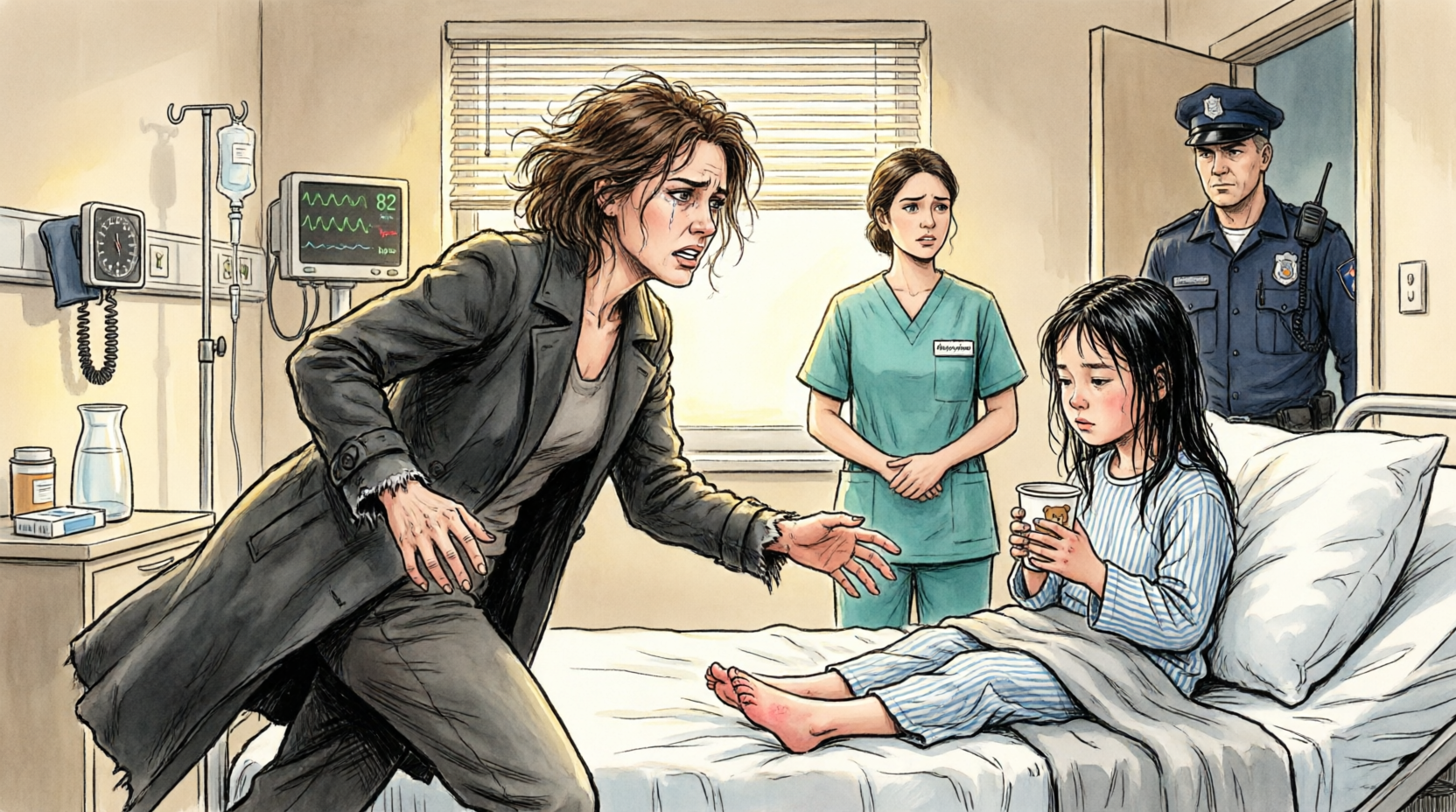
My girls were side by side in narrow hospital beds.
Heated blankets were tucked around them so tightly only their faces showed. Ruby looked shockingly small against all that white and blue. Her lips still had a faint bluish tint around the edges, and there was a pulse-ox clip on her tiny finger that looked obscenely large. Maisie was awake, staring at the ceiling with the blank, brittle expression people get when they’ve gone too far past fear and landed in survival.
My knees nearly gave out.
“Maisie,” I said, but it came out as a gasp.
She turned her head when she heard me. The second she saw my face, something broke. Not loudly. Not dramatically. Just one fragile crack in the set of her mouth, and then tears started slipping sideways into her hair.
I dropped to my knees beside her bed and took her hand.
It was still so cold.
Not cool. Not chilly. Cold in that deep, frightening way that seems wrong on a living child.
“What happened?” I asked.
Her throat worked when she swallowed. Her voice came out rough, scraped thin. “Grandma and Grandpa wouldn’t let us in.”
I stared at her.
For a second the sentence made no sense. My brain could not fit those words together into reality. My parents were cold people, yes. Critical. Unpleasant. The sort who could make a seven-minute visit feel like a performance review. But this? No. I kept waiting for the missing piece. The misunderstanding. The part where she said they weren’t home or she knocked on the wrong door or some stranger answered.
But Maisie just kept crying quietly and said, “We knocked, and Grandma opened it. She looked at us weird and said, ‘Get lost. We don’t need you here.’”
I felt something inside me go utterly still.
No heartbeat. No breathing. Just still.
“She said that?” I whispered.
Maisie nodded. “I told her you said we were supposed to come inside.”
Her eyes squeezed shut. “Then Grandpa came and said, ‘Go bother somebody else.’ He sounded mad.”
The words landed one by one, hard and clean.
“They shut the door,” she said. “I knocked again. Nobody came back.”
Behind me, Ruby whimpered.
I turned and went to her bed. She was drifting in and out, eyelashes wet, cheeks blotchy from crying. When I bent down, she lifted one hand weakly toward me.
“Mommy,” she whispered. “I was so cold.”
I gathered as much of her as the wires would allow and kissed the damp hair at her temple. Her skin smelled like hospital soap and that strange metallic warmth of fever blankets.
A doctor in his fifties waited until both girls were calmer before motioning me a few feet away. He had kind eyes and the tired posture of somebody on the back end of a very long shift.
“Your daughters are stable,” he said quietly. “That’s the first thing I want you to hear.”
I nodded, because if I opened my mouth too soon I was going to scream.
“Your older daughter carried your younger one for a considerable distance,” he went on. “Based on where they were found and what she’s been able to tell us, likely close to two miles. In below-freezing temperatures. Your younger child’s body temperature was dangerously low when EMS brought her in.”
I pressed a hand over my mouth.
“Who found them?”
“A man named Gerald Fitzpatrick,” he said. “Retired firefighter. He was driving home and saw your older daughter collapse while still trying to drag or carry the younger one. He called 911 immediately and stayed with them until the ambulance arrived.”
The room tilted a little.
“Where?”
“Near Morrison Street.”
It took me one second to place it. Three, maybe four blocks from my parents’ street. Not random wandering. Not lost immediately. They had walked. Kept walking. Past unfamiliar houses. Past intersections my eight-year-old daughter didn’t know. Through blowing snow with a three-year-old who must have gotten heavier with every block.
“How long were they out there?” I asked.
The doctor exhaled slowly. “We can’t know exactly. But longer than was safe. Quite a bit longer.”
Then he looked at me the way doctors do when they don’t want to finish a sentence because finishing it would be cruelty.
“Another hour,” he said, “and this conversation might be very different.”
I turned away from him because I couldn’t let him see my face.
When I went back to the beds, Maisie was looking at Ruby, not at me.
“I tried to carry her,” she said quietly. “At first I held her hand, but she kept crying and sitting down. So I put her on my back like this.” She moved one shoulder weakly, demonstrating through the blankets. “Then my arms hurt. Then my legs hurt. Then I couldn’t feel my fingers.”
I sat beside her and took her hand in both of mine.
“Why didn’t you go back and knock again?” I asked before I could stop myself.
The question sliced through me the second it was out. It sounded like blame. Her eyes widened, and I hated myself instantly.
“I did,” she said. “Twice. Then Grandpa turned the porch light off.”
I closed my eyes.
There are moments when the last tiny thread holding your old version of someone snaps for good. That was mine.
My mother had not been confused.
My father had not been distracted.
They had not failed to notice two children on the porch.
They had made a choice.
The doctor came back with admission paperwork. Overnight observation for both girls. Monitoring for lingering complications. Fluids. Rewarming. Possible muscle strain for Maisie from carrying Ruby so far.
I signed forms with a hand that barely looked like mine.
I stayed until both girls were asleep, though “asleep” isn’t really the word for the way they drifted under exhaustion. Maisie kept twitching awake every few minutes, eyes flying open to check whether I was still there. Ruby whimpered through dreams I knew she wouldn’t remember and yet would feel somewhere in her body anyway.
When I finally stood up, my knees cracked.
I still had to go back upstairs and tell David.
He was awake when I got there, propped slightly up in bed, one side of his face shadowed by the dim hospital lamp. He took one look at me and knew something had happened.
“What is it?”
I sat in the vinyl chair beside him and told him everything. The door. The words. The walk. The ambulance. The almost.
By the time I got to the part about Ruby’s body temperature, the color had drained from his face.
“Your parents did that?” he asked.
His voice was so quiet it scared me more than shouting would have.
I nodded.
He stared at the wall for a long time, jaw tight enough to show a pulse in his temple. Then he looked back at me.
“What are you going to do?”
Outside the window, the snow kept falling in thick silent sheets, covering everything in something that looked clean and was not.
I folded my hands in my lap because they were shaking again, and for the first time all night, the panic started to harden into something colder.
“Not enough with words,” I said. “Words never mattered to them.”
David held my gaze.
“So what then?”
I looked at the dark glass, saw my own reflection staring back—drained, furious, and suddenly very clear—and I knew exactly one thing.
By morning, my parents were going to learn that leaving my daughters in the cold had cost them more than they ever imagined.
Part 3
I didn’t sleep that night.
There was nowhere to do it anyway.
I spent half the time downstairs with the girls and the other half upstairs with David, carrying coffee between floors like that could keep me upright. By dawn, the inside of the hospital had taken on that weird washed-out early-morning hush, when the night staff looks haunted and the day staff hasn’t fully arrived yet. The windows were pale gray. The vending machine coffee had started tasting like burnt cardboard. Somewhere a floor buffer whined down the corridor, and I remember wanting to throw it through the glass.
The girls were stable. That was the only reason I stayed functional.
Ruby’s color had returned, and she finally slept without whimpering every few minutes. Maisie was awake when I came down around six, sitting up slightly in bed with her blanket tucked under her arms like she was trying to hold herself together.
“Did I do something wrong?” she asked me.
That question still lives in my bones.
I sat on the edge of the bed and pushed her hair back from her face. “No, baby. No. You did everything right.”
“Grandma looked mad before she even opened the door.”
“Maisie.” My voice came out too sharp, and I softened it. “Listen to me. None of this is your fault.”
She stared at the blanket. “I didn’t know where our house was. I just tried to go where the cars were.”
That made sense in the terrible logic of a frightened child. Follow the roads. Follow the lights. Keep moving. Protect Ruby. She had done more in those freezing hours than some adults do in a lifetime of claiming to love people.
When the nurse came in to check vitals, I stepped out into the hall and finally let myself shake.
I knew my parents. That was the hardest part. Not that they were secretly monsters. That would have been easier, in a way. The truth was uglier and more ordinary. They were the kind of people who had spent my whole life calibrating warmth according to usefulness.
My sister, Caroline, got praise, tuition help, and Sunday dinners with my mother’s good china because she had married a lawyer and moved to the right neighborhood and wore clothes that looked expensive without seeming like she tried. I got lectures. I got critiques disguised as concern. I got reminders that David came from “different stock,” which was my father’s favorite expression when he wanted to insult someone without sounding vulgar.
When I married David, they skipped the wedding because they “didn’t approve of the timing.” When Maisie was born, they came to the hospital for twelve minutes, took two photos, and spent most of the visit commenting on how tired I looked. Ruby’s birth didn’t even earn a visit. My mother mailed a blanket with the tags still on.
They had always been emotionally stingy.
But this was something else.
This was not indifference.
This was not neglect.
This was decision.
And the more I thought about that, the more a single truth kept settling deeper: if I let them spin this into confusion or stress or a family misunderstanding, they would do what they had always done. Rewrite. Minimize. Outlast.
I was done letting them do that.
By nine in the morning, I had a yellow legal pad, my phone charger, and a list.
I wrote down every detail while it was still fresh.
Time I dropped the girls off.
What my mother said on the phone that morning.
The exact wording Maisie remembered.
The doctor’s name.
The street where Gerald Fitzpatrick had found them.
Every person who might later claim not to know.
Then I called Child Protective Services.
The woman who answered sounded careful at first, in that bureaucratic way people do when they think they’re about to hear about a custody grudge or a spite report. I told her exactly what happened. No embellishment. No dramatic language. Just facts.
Two children.
Ages eight and three.
Dropped at grandparents’ home by prior arrangement.
Turned away.
Forced to walk in freezing conditions.
Hospital admission for hypothermia and exhaustion.
Her tone changed by the second minute.
By the time she transferred me to an investigator, her voice had gone flat with focus.
Next I called the police department handling Morrison Street. They already had the incident report started because EMS had flagged the circumstances, but they had not yet connected it to my parents by name. I fixed that.
Then I called an attorney.
Not because I wanted theatrics. Because I knew my parents valued one thing above love, above decency, above blood.
Reputation.
They owned a small accounting firm that served half the local small businesses in our county. My father handled the numbers; my mother handled the clients with her polished smile and saintly phone voice. Their entire identity was built on being respectable. Dependable. The kind of people you trust with tax records and payroll and private financial damage.
I sat in a hospital waiting area with bad coffee and swollen eyes and thought: people who leave children outside to freeze should not be protected by the costume of respectability.
So I wrote one more thing.
A post.
I did not name them. I didn’t need to. I described what had happened in plain language. Two girls. Christmas Day. A mother at the hospital with an injured husband. Grandparents who had agreed to help, then turned children away and shut the door. An eight-year-old carrying her three-year-old sister through the snow until both collapsed.
I posted it in three local community groups. Then five. Then every parent network and neighborhood page I belonged to.
By the time I looked up again, my phone was vibrating nonstop.
Hundreds of comments.
Private messages.
People asking if the girls were alive.
People demanding names.
People tagging friends.
Someone asked what street it happened on. I said Oakwood Lane.
That was enough.
Within an hour, somebody had replied: Isn’t that where Warren & Elise Anderson live?
And then it started.
The thread split open. Shock. Fury. Parents saying they knew exactly who my mother was. Former clients of the firm saying they couldn’t imagine it. Others saying, actually, yes they could. Because it’s always interesting how quickly “unthinkable” becomes “now that you mention it…”
My phone rang around noon.
Mom.
I answered on speaker and set it on the little table in the waiting room.
“What have you done?” she demanded.
Not hello. Not where are the girls. Not are they okay.
“What have you done?”
I felt something cold and almost calm move through me.
“I told the truth.”
“Our phone hasn’t stopped ringing. People are making disgusting accusations.”
“You left my daughters outside in the snow.”
There was a sharp inhale on the other end. “We did not know they’d go wandering off.”
For a second I actually laughed. It came out ugly.
“Wandering off? They were eight and three. What exactly did you think would happen when you slammed the door in their faces?”
“We thought you were coming right back.”
“You told them to get lost.”
There was a pause. Not guilt. Calculation.
“You are blowing this completely out of proportion.”
My fingernails bit into my palm.
“Ruby’s lips were blue,” I said. “Another hour and we might have buried her.”
Mom’s voice hardened. “They’re fine now, aren’t they?”
I ended the call without another word.
Upstairs, David was more awake and more furious than he had been all morning. When I told him about the reports and the post, he nodded once.
“Good.”
“You don’t think I’m acting out of rage?”
He looked at me like the question offended him. “I think rage is the only sane response.”
By evening, twelve clients had either called the accounting office or posted publicly that they were “reviewing relationships.” My mother’s business page had turned into a bonfire of horrified reviews. A local parenting blogger had messaged me asking for permission to share the story. I said yes.
And just before six, a detective called and said she wanted to interview Maisie formally with a child specialist as soon as the doctors cleared it.
Her last sentence sat with me long after the call ended.
“Mrs. Anderson,” she said, “this is one of those cases where the details are so bad people will try very hard to pretend they aren’t real. I’d advise you to save everything.”
I looked out at the snow still falling past the hospital windows, steady and indifferent, and realized something with a clarity that made me dizzy.
The story was out now.
And if my parents thought public shame was the worst part, they had no idea what was coming next.
Part 4
The first person from my family to show up wasn’t my mother.
It was my Aunt Paula.
Of course it was Paula.
She had always functioned as my mother’s unofficial defense attorney, translator, and emergency public relations team. If my mother insulted someone at a dinner table, Paula would later explain that she was “just overtired.” If my father snapped at a waiter, Paula would mention his blood pressure. If Caroline forgot a birthday, it was because she was busy. If I forgot one, it was because I had “become self-involved.”
Paula arrived at my house six days after Christmas in a camel coat, lipstick perfect, boots clicking hard against the porch boards. The girls were home by then, though “home” didn’t yet mean settled. Ruby had bounced back the way little children sometimes do, quick and miraculous, but Maisie had not. She startled at the sound of the front door opening. She asked twice a day whether Grandma knew where we lived. She refused to go near the windows after dark if snow was falling.
I met Paula on the porch so she wouldn’t see any of that.
The air smelled like ice and chimney smoke. Somebody down the street was burning cedar logs, and the sharp, clean scent kept catching in my nose while Paula launched in without greeting.
“You need to stop this.”
I leaned against the railing. “Good afternoon to you too.”
“Don’t be smart.” Her face was flushed, whether from cold or anger I couldn’t tell. “Your mother is barely holding herself together. Your father hasn’t slept. People are treating them like criminals.”
“They are criminals.”
Paula blinked hard, offended on principle. “They made a terrible mistake.”
I crossed my arms. “A mistake is forgetting mittens. A mistake is buying the wrong medicine. Turning away two children in freezing weather and ignoring them while they knock on the door is a choice.”
Her mouth tightened. “That is not how your mother told it.”
That interested me. “Oh?”
“She said she opened the door, told the girls to wait a minute, then got pulled away. She said she assumed you were parking the car or coming back to get them.”
I looked at her for a long second.
Then I said, very evenly, “Maisie remembers the exact words.”
Paula’s expression shifted—just slightly, just enough to show the start of doubt.
“She’s eight,” Paula said quickly. “Children get confused under stress.”
“The doctors found both girls unconscious on Morrison Street.”
Paula opened her mouth.
I didn’t let her speak.
“Ruby’s body temperature was dangerously low. Maisie carried her for close to two miles. She was so exhausted her arms had spasmed. She couldn’t fully uncurl her fingers for hours.” My voice stayed level somehow, which made the words sound even sharper. “So if my mother’s story is that she got distracted for a minute, your first question should be why my daughters had to nearly die before anyone in that house checked the porch.”
Paula looked away first.
“You’re destroying your family,” she said, but the confidence was gone now.
“No,” I said. “I’m protecting the one that matters.”
She left ten minutes later, angry because anger is easier to carry than reality.
Inside, Maisie was sitting cross-legged on the living room rug with one of Ruby’s picture books open in her lap. She wasn’t reading it. Just turning pages without seeing them.
“Was that Great-Aunt Paula?” she asked without looking up.
“Yep.”
“Did you tell her to go away?”
I sat beside her and tucked the blanket around her legs. “Pretty much.”
She nodded like that was the only acceptable outcome.
Therapy started the following Monday.
Dr. Patricia Hammond’s office was in a converted old house near the elementary school, the kind with squeaky hardwood floors, a basket of mismatched slippers by the door, and soft lamps instead of overhead lights. It smelled like peppermint tea and crayons. I had chosen her because she specialized in childhood trauma and because the school counselor had used the phrase “calm nervous systems” when describing her, which sounded like exactly what we needed.
Maisie disappeared into Dr. Hammond’s office clutching her stuffed fox and came out forty-five minutes later looking wrung out but lighter, like some pressure valve had finally hissed.
Ruby was too young for formal sessions, but Dr. Hammond suggested play-based check-ins and told me what to watch for.
“Children that young store distress in the body first,” she said. “Sleep, appetite, clinginess, regression. The memory won’t necessarily come out as a coherent story.”
“And Maisie?”
Dr. Hammond folded her hands in her lap. “Maisie understands enough for this to cut deep. Not just the cold. Not just the fear. The betrayal.”
I sat very still.
“She keeps checking doors in session,” Dr. Hammond went on. “And she asked me whether grown-ups are allowed to lie when they’re supposed to keep you safe.”
That sentence sat in the center of my chest like a stone.
“What do I do?”
“You tell her the truth in age-appropriate ways. You reassure without overpromising. You keep routines as stable as possible. And you do not, under any circumstance, minimize what happened to make the adults feel better.”
I laughed once without humor. “That won’t be a problem.”
It wasn’t.
The detective came on Wednesday.
Detective Sarah Morrison was tall, composed, and had the kind of plain, steady face that made children less afraid of her. She brought a child psychologist for Maisie’s interview and spent almost an hour at my kitchen table going over timelines, weather conditions, medical reports, and the sequence of calls.
“Mr. Fitzpatrick’s statement is very strong,” she said, flipping through a file. “He found them in a state that aligns with prolonged cold exposure and physical exhaustion. He says the older one was still trying to pull the younger one by the hood when he got out of his truck.”
I gripped the edge of my chair.
“Does he know who they are?”
“He does now. He asked how they were doing.”
I made a note to thank him properly, then realized that “properly” didn’t seem big enough for someone who had stumbled onto my daughters at the exact moment the universe still allowed saving.
When Maisie’s interview ended, Detective Morrison came back into the kitchen and shut her folder carefully.
“This is one of the clearer cases I’ve handled involving family,” she said.
“Clearer how?”
“No ambiguity. No conflicting timeline that holds. Your daughter’s account is detailed and consistent. The medical evidence supports prolonged exposure. The weather report confirms dangerous conditions. And your parents had accepted responsibility for the children that afternoon based on your messages.”
That last part had been a gift from my mother’s own habit of wanting everything in writing. I still had her text from that morning:
Bring the girls whenever. We’ll keep them warm while you handle the hospital.
I had stared at those words at least twenty times since.
“Will there be charges?” I asked.
She didn’t dodge. “I’ll be recommending them.”
That night David came home.
He was slower than usual, sore and stitched and still pale under the eyes, but stubborn enough to sign himself out the second the surgeon allowed it. The girls clung to him so hard I got nervous about his ribs. Ruby buried her face in his sweatshirt and cried in hiccupping little bursts. Maisie stood very straight for about five seconds, then melted completely and held on like she could physically keep him from leaving again.
We ate takeout soup at the kitchen table because nobody had the strength for anything else.
Halfway through dinner, the doorbell rang.
David froze. So did Maisie.
That was new. The way fear can spread through a room like dropped ink.
I got up and checked the camera feed on my phone.
My father was standing on the porch in his dark wool coat, hands in his pockets, shoulders squared the way he used to square them before coming into my room to tell me I had disappointed him.
I did not open the door.
He rang again.
Then he called my phone.
I answered only because I wanted a record.
“You need to stop this circus,” he said immediately.
No apology. No question about the girls. Just irritation, because that was his native language whenever consequences inconvenienced him.
“You came to my house?”
“I came to talk sense into my daughter.”
I looked at him through the screen on my phone. Snow caught on his shoulders and hair. He looked older than he had a week earlier. Smaller too. It did not move me.
“You don’t have a daughter standing at this door,” I said. “You have the mother of the children you abandoned.”
His jaw flexed. “For God’s sake, stop using dramatic words.”
“Leave.”
“You are not going to ruin us over a misunderstanding.”
I almost smiled at the absurdity of the word. Misunderstanding. As if the temperature had been misunderstood. As if two miles of footprints in the snow had been misunderstood. As if blue lips and IV fluids and nightmares were all just unfortunate punctuation.
“Go,” I said again.
When he didn’t move, David stood up from the table despite my protest and called the police non-emergency line himself.
My father left three minutes before the cruiser arrived.
But as I stood there by the darkened window, watching his taillights disappear down the street, Detective Morrison’s words came back to me.
I’ll be recommending charges.
And suddenly the front porch no longer felt like the real battleground.
Because if my father was already bold enough to show up at my door before the case had even been filed, then once the prosecutor got involved, this was going to get uglier than I had planned for.
Part 5
The prosecutor called on a Thursday morning while I was cutting Ruby’s toast into triangles she would immediately ignore in favor of stealing blueberries off Maisie’s plate.
Her name was Carla Nguyen, and she had one of those voices that sounded warm until you noticed how efficiently she arranged information. She introduced herself, said the district attorney’s office had reviewed the police file, the medical reports, and the weather data from Christmas afternoon.
Then she said, “We are moving forward.”
I put the knife down.
Maisie looked up from her cereal. “Mom?”
I smiled at her automatically. “Nothing, baby. Eat.”
Carla continued. “The initial charge recommendation is child endangerment with aggravating factors due to weather conditions, ages of the children, and the preexisting caregiver arrangement.”
The phrase preexisting caregiver arrangement mattered more than I expected. It meant this wasn’t an abstract moral failing. It meant responsibility had been accepted. Then violated.
“What do you need from me?” I asked.
“Cooperation. Documentation. And likely testimony later. We’ll also want the children’s treatment records and any written communication confirming your parents agreed to watch them.”
I had all of that already organized in a folder on my dining room table, because once rage had somewhere lawful to go, it became very efficient.
After I hung up, I stood at the sink longer than necessary, staring at the ice crystals forming on the inside corners of the kitchen window. Outside, the neighborhood was waking up—car doors slamming, a dog barking, someone dragging a recycling bin to the curb. Normal life. Trash day. School day. Morning.
My parents were about to be charged with a crime.
And I still had to sign a permission slip for Maisie’s field trip.
That’s the rude thing about crisis. It never arrives with the courtesy to pause everything else.
Richard Chen, the attorney I’d hired for the restraining order and protective paperwork, came by that afternoon with a slim leather briefcase and a face that suggested he’d already met a hundred versions of my parents in court.
“They will try three things,” he told me at the dining room table while Ruby colored on a placemat nearby. “Minimize. Reframe. Appeal to family.”
I nodded. “They’ve already started.”
“They may also ask to meet privately. Do not.”
“What if they want to apologize?”
He gave me a look over the rim of his glasses. “Real apologies don’t require access to the victim before arraignment.”
That answer pleased me more than it should have.
The arraignment happened the following week.
I didn’t go.
Not because I was afraid to see them. Because I refused to turn their first public consequence into a theater performance for their benefit. They wanted me in the room so they could scan my face for weakness, for grief, for whatever old family lever might still move. They were not getting that.
Instead, I stayed home with the girls, waited for Richard’s text, and baked banana muffins with Ruby because stirring batter kept my hands from shaking.
Not guilty, the text read at 10:17 a.m.
Of course.
Nothing in my parents’ emotional vocabulary had ever included immediate accountability. “Not guilty” made perfect sense in a family where outcomes always mattered more than actions. If a child survived, the adults hadn’t really done anything wrong. If the story could still be polished, nobody had to look at the scratch marks.
Around noon, Gerald Fitzpatrick called.
Until that week, I had known him only as the retired firefighter who found my daughters in the snow. We’d spoken twice already—once by phone after I got his number from Detective Morrison, once briefly when he dropped off a teddy bear for Ruby and a paperback nature guide for Maisie because he “didn’t think hospitals were good places to come empty-handed.” Even his gifts had been practical kindnesses. Something to hold. Something to look at. No fuss.
“How are the girls?” he asked.
“Better every day.”
“Good.” He cleared his throat. “Listen, I’m going to be testifying if they need me. I just wanted you to know I don’t scare easy, and I’m not changing my story for anybody.”
I leaned against the kitchen counter. “Thank you.”
He let out a short breath. “No need. Anybody with eyes would do the same.”
But that wasn’t true, was it? Anybody with eyes had not done the same. My parents had looked straight at two children and chosen not to help. The world was full of people with eyes and no courage.
Gerald had both.
That mattered.
A few days later he came by in person.
He was broad-shouldered, silver-haired, with the weathered face of somebody who had spent years outdoors and mostly in service of other people. He took off his boots carefully by the door without being asked. Ruby handed him a stuffed rabbit as if that were a formal greeting ritual, and he accepted it with equal seriousness.
Maisie hovered at first, half hidden behind the hallway wall. Gerald never pushed. He just sat at the kitchen table, drank the coffee I offered, and told the girls in a low, easy voice about the time he’d rescued a raccoon from a church basement because “even troublemakers deserve a second chance if they haven’t actually committed tax fraud.”
Ruby laughed so hard milk came out of her nose.
Maisie cracked a smile.
That was the first time I saw her fully smile after Christmas.
When he left, she stood at the door in her socks and asked, “Will you come back sometime?”
He glanced at me first, polite enough to understand lines, then back at her.
“If your mom says it’s okay,” he said, “I’d be honored.”
After he drove away, Maisie went to her room and came back with a drawing. Two girls in puffy coats. A man beside them with a giant orange hat that Gerald had not, in fact, been wearing. Child art doesn’t care about realism. Above all three of them she’d written in shaky pencil: The Good Man.
I cried in the pantry so she wouldn’t see.
Meanwhile, the legal machine kept moving.
CPS opened a formal neglect and endangerment file, mostly redundant to the criminal case but important for protective history. Richard filed the restraining order extension. The girls’ school added both my parents’ names to the no-contact list, and the principal sat me down in her office with peppermint tea and a packet of safety protocols like we were discussing a bomb threat instead of grandparents.
“It happens more than you’d think,” she said quietly. “Adults who feel entitled to a child after they’ve lost access.”
That word again.
Entitled.
It fit.
On Friday evening, my mother’s lawyer called.
He was smooth. Courteous. The kind of man who probably billed by the sigh.
“My clients would like an opportunity to express remorse and discuss a family-centered resolution.”
I almost laughed into the phone.
“A family-centered resolution,” I repeated. “You mean one where they avoid consequences.”
“My clients are devastated.”
“My daughters were admitted for hypothermia.”
A pause.
“I understand emotions are high.”
“No,” I said. “You understand your clients are frightened.”
I hung up before he could reshape the sentence.
That night, after the girls were in bed, David and I sat in the living room with the lights off except for the Christmas tree we still hadn’t taken down. The ornaments glowed softly in the dark. Ruby’s paper angel from preschool hung crooked near the bottom. Maisie’s handmade salt-dough star had cracked in one corner years ago, and I’d kept it anyway.
David rested carefully back against the couch, still sore if he moved too fast.
“Do you ever wonder why they did it?” he asked.
I stared at the tree lights. “Every hour.”
“What’s your answer?”
I thought about my mother’s tight smile. My father’s contempt for weakness, which always seemed to mean vulnerability in anyone but himself. The way both of them had looked at children their whole lives—as decorations when convenient, interruptions when not.
“They didn’t want the inconvenience,” I said finally. “And once they decided that, they saw the girls as a problem to be pushed away.”
David was quiet a long time.
Then he said, “They should be very glad a stranger found them before I did.”
The house went silent around us.
And in that silence, with the colored lights reflecting faintly in the dark window, I realized something new that made the hair rise on my arms.
I had spent weeks asking why my parents had done it.
But the next question was worse.
If they could do that to my children once, what else had they been capable of all along that I had simply spent my life trying not to name?
Part 6
The hearing was set for late February.
By then the streets had turned into that ugly winter in-between—gray snowbanks, salt crusting the edges of sidewalks, frozen puddles wearing a skin of dirt. Christmas felt far away to other people. To me it sat in the center of every day like a nail under carpet, something you stopped looking at only because you already knew exactly where it was.
Maisie had improved enough that Dr. Hammond started calling her progress “meaningful,” which sounded oddly formal for something as precious as your child sleeping through the night without screaming. Ruby had started forgetting in the merciful toddler way, though she still hated being cold now. If the house dipped a degree, she’d come find me with her blanket dragging behind her and ask, “Mommy, we staying inside, right?”
Always, I told her.
Always.
On the day of the hearing, Richard wanted me there.
“You don’t have to say yes to seeing them,” he told me. “But judges notice presence. So do prosecutors.”
So I went.
The courthouse was all beige stone and old radiator heat, the kind of building that smells faintly like paper dust and damp wool. I wore the only black coat I owned and the boots I’d bought two years earlier for a work conference because they made me feel more competent than I actually was. David couldn’t come; he was back at work and still not fully cleared for long days on hard benches. Gerald came instead.
He waited with me in the hallway outside courtroom 3B, hands folded over the handle of his cane—not because he needed the cane much, but because old injuries from firefighting liked to remind him of themselves in the cold.
“You okay?” he asked.
“No.”
He nodded once. “Good answer.”
That made me smile despite everything.
When my parents came around the corner, I understood for the first time what public consequence really looks like on a body.
My father’s suits had always fit him like armor. That morning his jacket hung loose at the shoulders, like he’d lost weight too fast. My mother looked carefully assembled—hair done, pearls in place, lipstick chosen to suggest restraint—but there was a puffiness under her eyes that makeup couldn’t quite cover. They both slowed when they saw me.
Neither of them looked like they expected Gerald.
Good.
My mother took half a step in my direction. Richard moved smoothly between us without even glancing away from his phone.
“My client is not available for discussion,” he said.
My mother’s chin lifted. “I only wanted to say—”
“No,” I said.
Just that.
A small word. Solid enough to stand on.
She closed her mouth.
Inside, the hearing was less dramatic than television promises and more brutal because of that. No speeches. No booming gavel. Just facts arranged in order until denial looked ridiculous.
The prosecutor presented the timeline.
The weather conditions.
The medical records.
The distance.
The text message confirming my parents had agreed to care for the girls.
Gerald’s statement.
Then Gerald himself took the stand.
I will never forget the way his voice sounded in that room. Not angry. Not theatrical. Simple. Steady. He described driving down Morrison Street after checking on an elderly neighbor. Described seeing what at first looked like a heap of coats near a snowbank. Described realizing one of the coats was moving.
“The older girl was conscious for maybe ten seconds after I reached them,” he said. “She kept saying, ‘Please help my sister first.’”
The courtroom went very still.
My mother’s attorney tried to imply confusion, accident, overreaction. Gerald didn’t give him room.
“No, sir,” he said once, almost kindly. “I know what hypothermia looks like. I spent thirty-two years pulling people out of bad situations. Those girls had been in the cold far too long.”
Then the prosecutor showed the photographs.
Not all of them. Just enough.
The blankets in the ER.
Ruby’s colorless face.
Maisie’s red, raw hands.
I didn’t look at my parents. I didn’t need to.
The defense strategy was exactly what Richard predicted: minimize, reframe, appeal.
My mother claimed she had been overwhelmed, thought I was parking, assumed the girls were with me. My father said he “didn’t realize” the seriousness of the weather and thought the children had been told to wait in the car. Neither explanation held up under the text messages, the timeline, or Maisie’s recorded interview. Richard had warned me that bad lies often sound insultingly flimsy once they’re forced into sequence. He was right.
When the prosecutor asked my mother, “If you believed the children were in the car with their mother, why did you turn off the porch light?” the room changed.
Because that had been in Maisie’s statement. A detail so small and specific it rang true the second she said it.
My mother blinked. “I don’t recall doing that.”
The prosecutor didn’t raise her voice. “You don’t recall, or you deny it?”
My mother looked at her lawyer.
That pause said everything.
My father was worse. He got irritated, which had always been his tell whenever the truth cornered him.
“This is being treated like we put them out in the woods,” he snapped at one point.
The prosecutor’s expression didn’t move. “No, sir. It is being treated like you shut your door on an eight-year-old and a three-year-old in below-freezing weather. Which is what happened.”
Click Here to continuous Read Full Ending Story Final Part: I left my eight-year-old daughter and her three-year-old sister at my parents’ home on Christmas Day.