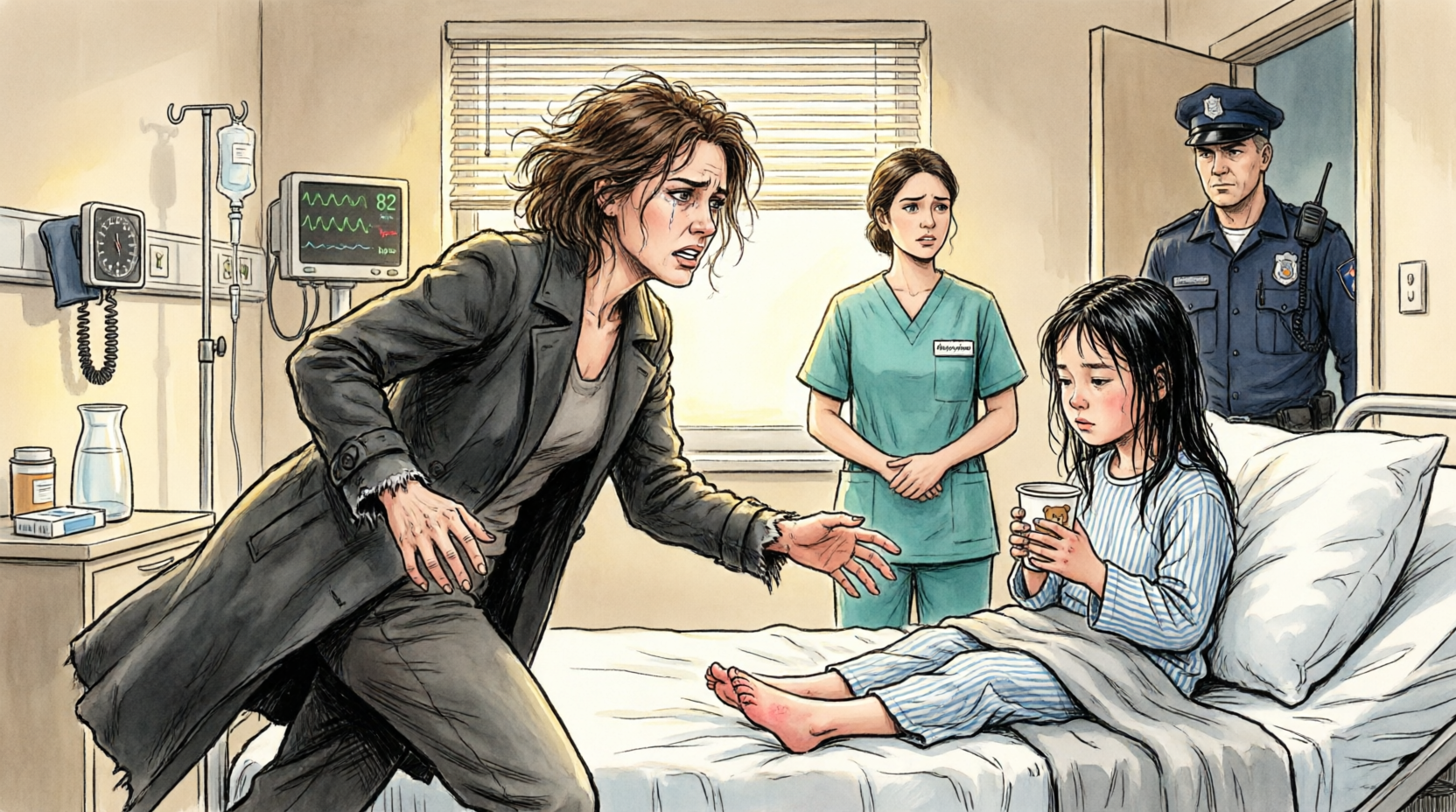
I think that was the moment he understood the old tools weren’t going to work. Bluster. Dismissal. Moral superiority. None of it could lift the facts off the floor.
The judge’s ruling came at the end of a long afternoon.
Conviction on misdemeanor child endangerment.
Probation.
Community service.
Mandatory parenting education.
No contact with the children.
Protective order upheld.
My mother cried then. Not quietly. My father went stiff and red and stared straight ahead, which was how he had always tried to survive shame—by pretending it was happening to someone else.
I did not cry.
I felt tired. So tired I thought maybe I’d been tired my whole life and just hadn’t had language for that particular flavor until then.
Outside the courtroom, Paula materialized from somewhere near the elevators, eyes bright with rage.
“Are you happy now?”
Gerald shifted slightly beside me. Richard opened his mouth. I answered first.
“No,” I said. “But I’m finished.”
That enraged her more than if I’d shouted. She launched into some breathless speech about broken family lines, public disgrace, old people losing everything, how my mother had barely eaten in weeks, how my father’s business partners were panicking, how there were kinder ways to handle things.
“There are kinder ways to be a grandparent,” I said.
She stopped.
Gerald put a hand lightly at my elbow, not guiding exactly, just reminding me I could leave. So I did.
By the end of the week, the accounting firm lost its biggest client.
By the end of the next week, six more had terminated contracts.
I heard it through the same community grapevine that had carried the story in the first place. Business owners talk. So do church ladies, accountants, teachers, barbers, and parents waiting in school pickup lines. The details changed depending on who told them, but the core stayed fixed: respectable people had left two little girls outside in the snow, and now respectable people wanted distance.
My mother called from a new number on a Sunday afternoon.
I answered by accident because I thought it might be the pharmacy.
“Our lives are ruined,” she said.
I stood at the kitchen counter, a loaf of bread half sliced in front of me.
“You nearly ruined my children’s.”
“We have been punished enough.”
The nerve of that sentence actually hollowed me out for a second. Punished enough. As if there were some chart where terror and frostbite and abandonment converted neatly into dollars lost and clients gone.
“I don’t decide that,” I said. “Reality does.”
Then I blocked the number.
That night David found me standing in the girls’ doorway while they slept. Ruby starfished under her blanket. Maisie curled on her side with the stuffed fox under her chin. The night-light painted the room in soft amber and left a line of warm gold across the floorboards.
“You okay?” he asked quietly.
I didn’t turn around.
“I think they’re just now realizing the court wasn’t the end of it.”
David came up beside me and looked in at the girls.
“No,” he said. “It was the beginning.”
And the next morning, when Richard forwarded me the notice that the restraining order had been permanently extended, I realized there was still one thing left that my parents had not yet lost.
The illusion that, given enough time, I might forgive them.
Part 7
They lost that illusion in the mail.
Not because I sent anything dramatic. No scorched-earth letter. No stack of legal citations. No final speech with the sort of lines people wish they’d thought of sooner. I simply stopped responding to every hand extended toward me from the wreckage.
That silence did more than anger ever could.
My mother started writing letters in February. At first they came twice a week, then once a week, then irregularly, as if even guilt has trouble maintaining a schedule when it isn’t getting results. The envelopes were cream-colored, always addressed in the exact same slanted handwriting I’d spent childhood recognizing from report-card notes and passive-aggressive birthday cards.
I threw the first few away unopened.
Then one afternoon, after Maisie’s therapy and before picking Ruby up from preschool, curiosity won.
I sat in my parked car with the heater ticking and tore open the flap.
My dear Hannah,
I know you don’t want to hear from me, but I am still your mother. Nothing can change that. We made a terrible mistake in a terrible moment. Your father was stressed. I wasn’t feeling well. Everything happened so quickly. We are paying for it now every hour of every day. Please don’t harden your heart so much that you forget we are family.
That was the whole thing in miniature, wasn’t it?
We made a mistake.
We were stressed.
We are suffering.
Don’t be so hard.
Nothing about the girls.
Nothing about what they experienced.
Nothing specific enough to qualify as remorse.
I folded the letter once, neatly, and dropped it into the gas station trash can before driving away.
By March, the business was gone.
Officially gone. Office lease terminated. Sign removed. Website scrubbed down to a blank page and then taken offline entirely. The firm my parents had built over thirty years vanished in less than ten weeks once enough people understood the difference between “well-regarded” and “trustworthy.”
Paula kept bringing me updates like she thought human misery was an emotional invoice I was morally obligated to pay.
“Your father’s stocking shelves at Milton’s Market now.”
“That sounds exhausting.”
“He’s sixty-three.”
“He was still younger than the man who found my daughters in the snow.”
She hated when I answered that way—plain, unsoftened, impossible to climb over.
“My mother has a call center job,” Paula said another time, standing in my kitchen while I packed Maisie’s lunch. “She gets screamed at all day by strangers.”
I zipped the lunchbox. “I imagine being powerless is new for her.”
Paula stared at me as if she no longer recognized the niece she used to patronize into submission.
Maybe she didn’t.
I didn’t recognize her either. Not really. Not after all those years of neutrality that had somehow always broken in my mother’s favor. People like Paula love peace as long as it means asking the wounded party to limp more quietly.
One evening in late March, my sister Caroline called.
We had spoken only twice since Christmas, both times briefly, both times with that strained politeness people use when they’ve already chosen a side and are waiting for you to notice.
“Mom says you won’t read her letters.”
“I read one.”
“And?”
“And it was about her.”
A pause.
Caroline sighed. “Look, I’m not defending what they did.”
That is always what comes right before someone defends what they did.
“But destroying their entire lives? Was that really necessary?”
I stood at the kitchen sink staring out at the yard where Ruby had left a plastic watering can upside down in the dead grass. “They almost killed my children.”
“You keep saying that like they wanted that.”
“No,” I said. “I keep saying it because intention doesn’t warm a freezing child.”
Caroline was quiet for a beat. “You know Mom says she thought you were right behind them.”
“I know. Maisie says Grandma opened the door, looked at her, and said, ‘Get lost.’ Those are not confusing words.”
“She’s eight.”
“And she carried a three-year-old nearly two miles. I’m comfortable trusting her memory.”
That landed. I heard it in the silence that followed.
Caroline tried a different route. “If you keep this up forever, one day you might regret it.”
“What exactly would I regret?”
“Not forgiving them before it’s too late.”
I dried my hands slowly on a dish towel. “Caroline, if I let them back in, and one day Maisie asks me why I chose the people who abandoned her over the child who begged to be believed, that’s regret. The rest is just distance.”
She did not call again for a while after that.
The most unexpected shift in that season was Gerald.
He went from witness to regular presence so gradually I almost missed the transition. First he stopped by to check on the girls. Then he showed up with a bag of sidewalk chalk “for warmer weather planning.” Then he came to dinner because Ruby had specifically requested “the nice man with the laugh.” Then he was helping David rehang the crooked gate in the backyard, telling terrible stories about firehouse pranks while Maisie and Ruby sat on overturned buckets like they’d paid admission.
He never overstepped. That was the miracle of him.
He asked before bringing gifts. He listened more than he spoke. He remembered details the way loving people do—not to demonstrate attentiveness, but because other people’s lives actually mattered to him. Maisie mentioned once that she liked ladybugs, and the next week he brought her a little field guide to backyard insects. Ruby said she hated peas and he solemnly promised never to become the kind of grown-up who tricked children about vegetables.
“You can’t make promises like that unless you mean them,” Maisie told him.
He put a hand to his chest. “Young lady, I have integrity.”
That made her laugh so hard juice came out her nose.
Dr. Hammond noticed his effect immediately.
“He’s regulating the room just by being in it,” she told me after one of Maisie’s sessions. “Steady adults do that for children who’ve been frightened. Predictability is medicine.”
I wrote that sentence down.
Predictability is medicine.
Maybe that’s why my parents had always felt dangerous even before Christmas. Not because they were loud or chaotic. Because their affection was conditional and their moods were weather systems. You could never quite know what version of them you were walking toward.
By April, Maisie had started asking whether Gerald would come to her school’s science night. By May, Ruby had started introducing him to strangers as “my Mr. Gerald.”
He cried, quietly and with great embarrassment, the afternoon David and I asked if he would be willing to become the girls’ legal guardian in an emergency.
We did it in the backyard over lemonade while Ruby chased bubbles and Maisie drew fossils in chalk on the patio.
Gerald took his glasses off and rubbed both eyes with the heels of his hands. “I never had children of my own,” he said. “Didn’t work out that way.”
“You’d be good at it,” David said.
Gerald laughed once. “At my age, I’d be more of an elderly raccoon supervising from the porch.”
“You found them,” I said. “You stayed. You’ve stayed.”
He went quiet at that.
Then he nodded.
“It would be an honor.”
That night, after the girls were in bed, I sat at the kitchen table and realized something that should have made me sad and instead just felt true.
A stranger had become safer than my blood.
And once you really accept that, there are only two ways to live:
either lie to yourself forever,
or build a new definition of family and mean it.
The next morning, another letter arrived from my mother.
This one was thicker.
And before I even opened the envelope, I knew from the weight of it that it still wasn’t going to contain the one thing I had never received from her in my life:
the truth without bargaining attached.
Part 8
The thicker letter turned out to be worse.
I opened it at the kitchen table while the girls were upstairs arguing over whose turn it was to choose the bedtime story, and by the second paragraph I wished I had just dropped it straight into the recycling bin with the grocery flyers.
This one was longer, shakier, drenched in the sort of self-pity my mother had always mistaken for vulnerability.
She wrote that they were losing the house.
That my father’s hip hurt from stocking shelves.
That she now cleaned office buildings at night because nobody respectable would hire her after “the legal misunderstanding.”
That her life had become humiliating.
That perhaps I could find some Christian compassion and speak to the prosecutor about “softening public perceptions.”
Not one sentence asked how Maisie’s nightmares were.
Not one asked whether Ruby still cried if her socks got wet.
Not one said: I see what I did to your children.
Just humiliation. Rent. Pain. Reputation.
It was like reading a weather report from somebody else’s disaster and being asked to grieve the roof more than the people trapped under it.
I didn’t tear the letter up.
I kept it.
Not because it moved me. Because it was evidence—not for court anymore, but for myself. Proof against the inevitable erosion of memory. The human mind loves to sand down its own splinters. Years from now, part of me might have been tempted to wonder if I’d exaggerated, if maybe time had hardened me into unfairness.
That letter would answer that temptation in my mother’s own handwriting.
Maisie’s ninth birthday came in October.
She wanted a chocolate cake with purple frosting, a bounce house in the yard, and exactly nine girls sleeping over even though I told her that number sounded less like a party and more like a lawsuit. We negotiated down to six. Ruby considered this a personal betrayal until I bribed her with extra icing roses.
The day of the party was windy and bright, with leaves scraping along the deck and the first real bite of fall in the air. The bounce house billowed in the backyard like some giant blue cartoon lung. Kids ran in and out with their socks half on, cheeks pink, voices carrying over each other in every direction. There was pizza and shrieking and spilled juice and a thousand tiny disasters that all somehow added up to joy.
Gerald came early to help David anchor the bounce house and stayed late to teach the girls a card trick involving a queen of hearts that no one, including him, ever fully got right. Ruby climbed into his lap three times and once fell asleep against his sleeve for almost ten minutes despite the noise. Maisie’s best friend Taylor whispered to me while they were waiting for cake, “Mr. Gerald is the coolest grown-up here,” and I laughed because she wasn’t wrong.
At one point, while the girls were decorating cupcakes in the kitchen, Taylor tugged my sweater sleeve.
“Mrs. Anderson?”
“Yeah?”
“Maisie told me about last Christmas.”
Children always choose the moments that leave adults least prepared.
I looked down at her. She had frosting on her chin and rainbow sprinkles stuck to her wrist.
“She did?”
Taylor nodded. “She said her grandparents were bad people.”
I exhaled slowly. “She’s had a hard year.”
Taylor thought about that with the grave seriousness only nine-year-olds can summon. “My grandma makes me soup when I’m sick,” she said. “Why would grandparents do that?”
I could have given her the adult answer. Narcissism. Entitlement. Emotional cruelty. Personality structures built around appearances and control.
Instead I said the truest simple thing I had.
“Because being related to someone doesn’t automatically make them kind.”
She accepted that immediately. Children often do. It’s adults who contort themselves trying to make blood sound holier than behavior.
“Well,” Taylor said, “Mr. Gerald acts more like a grandpa anyway.”
Then she walked off before I could answer, as if that settled it.
Maybe it did.
By then, the criminal case was behind us, the no-contact order was stable, and my parents had retreated into the edges of local life like embarrassed ghosts. I heard about them only through Paula or Caroline when either of them got brave—or guilty—enough to mention it.
“They sold the house,” Caroline said during one of our few calls that fall.
I stood in the laundry room matching tiny socks while she talked. “I know.”
“They’re in a two-bedroom apartment near the highway now.”
“That sounds loud.”
She made an exasperated noise. “Do you have to be like this?”
“Yes.”
A pause.
Then, quieter, “Mom says she dreams about the girls.”
I clipped two clothespins onto the basket rim harder than necessary. “Good. Maisie used to wake up screaming that she couldn’t feel her hands.”
Caroline went silent.
There are some truths that make continuation impossible unless the other person is willing to stop pretending. She wasn’t. Not then.
The first snowfall of the new winter came earlier than expected.
I noticed because Maisie stopped playing mid-sentence and went very still by the living room window. It wasn’t even a real storm yet, just soft flakes beginning to drift under the porch light, but I watched her shoulders rise.
“Hey,” I said gently. “Come here.”
She didn’t cry. She just crossed the room fast and pressed into my side like she needed proof that walls existed.
“We’re not going anywhere,” I said.
“I know.”
“You’re safe.”
“I know.”
But she stayed there for a long time anyway, listening to the radiator click and the kettle start to hiss in the kitchen while snow gathered outside.
That night, after the girls were asleep, I stood at the sink looking out at the white lawn and thought how odd trauma is. Not dramatic all the time. Often just a weather pattern returning to your body before your mind has time to prepare.
My phone buzzed on the counter.
Unknown number.
I nearly ignored it.
Then I answered, already angry.
It was a mediator.
An actual professional mediator.
“My name is Teresa Holland,” the woman said. “Your parents have retained me in hopes of arranging a restorative conversation.”
I laughed once. “They hired someone to ask me for forgiveness?”
“They asked for facilitated dialogue.”
“What part of the restraining order sounded like a conversation starter?”
To her credit, Teresa didn’t retreat. “I understand you’re upset.”
“That’s an incredible sentence.”
She sighed softly. “Mrs. Anderson, people make catastrophic mistakes. Sometimes structured accountability—”
“They had accountability. It came with a judge.”
“Your parents say they want to apologize.”
“Then they can write something truthful and sit with not getting a response.”
The line was quiet for a beat.
Then Teresa said, in a tone almost reluctant, “They also say they’ve lost everything.”
There it was. The real payload.
I turned off the burner under the kettle before it could scream. “And my daughters lost the ability to trust winter.”
When I hung up, the house had gone so silent I could hear snow sliding off the gutters.
I went upstairs to check on the girls.
Ruby slept curled around a stuffed rabbit. Maisie had one arm flung over the blankets, face soft in the night-light glow, nothing about her sleeping body suggesting the child who had once staggered through unfamiliar streets carrying her sister in the dark.
I stood there for a long minute with my hand on the doorframe.
And the thought that came to me was so simple it almost felt cruel.
My parents still believed this story ended with them being let back in.
They still didn’t understand that for me, the ending had already changed.
The next move, whatever pathetic or expensive form it took, wasn’t going to be about reconciliation.
It was going to be about whether they could finally survive hearing no and not mistaking it for injustice.
Part 9
They did not survive hearing no gracefully.
Two weeks before Christmas, a delivery driver left a large white box on my porch wrapped in a red satin ribbon so ridiculous it looked like it belonged in a department store window. My name was on the label. The sender line was blank.
I knew before I touched it.
David knew too. He glanced at the ribbon and said, “Absolutely not,” the way some people say grace before dinner.
The girls were in the living room building a pillow fort and arguing over whether stuffed animals needed their own socks in winter. I waited until they were distracted, then carried the box straight to the kitchen and opened it with scissors.
Inside were three wrapped presents, a tin of homemade shortbread, and a cream envelope addressed in my mother’s handwriting:
For our beloved granddaughters.
There’s a particular kind of rage that doesn’t feel hot at all. It feels efficient.
I took the entire box—presents, cookies, card, ribbon—and dropped it into the outside trash bin with enough force that the metal lid banged.
When I came back inside, Ruby looked up.
“Was it cookies?”
“Nope.”
That satisfied her. Childhood is such a mercy sometimes.
My phone rang less than an hour later.
Blocked number.
I let it go to voicemail. Then I listened.
My mother’s voice came through watery and urgent. “Please don’t throw the gifts away. They’re for the girls. We just want them to know we love them.”
I deleted the message and changed the gate code that afternoon.
The next day I called the girls’ school again—not because the order had changed, but because I have learned that repetition is the mother of safety. I reminded the principal, the office staff, and both teachers that neither of my parents was ever to speak to the girls, pick them up, or send items through the office.
The principal nodded in that serious, no-nonsense way I had come to appreciate. “We’re aware,” she said. “And we’ll stay aware.”
Ruby’s preschool got the same call.
Then I notified the front desk at David’s physical therapy clinic, the church where the girls went for pageant rehearsal, and even the pediatric dentist because trauma teaches you that adults who feel entitled to children do not respect venue.
That evening, snow started again.
Not the violent kind from the year before. This was soft, pretty snow. The kind that makes suburban streets look like Christmas cards if you’ve never associated it with blue lips and ER monitors. Ruby pressed both hands to the window and squealed, “Can we build a snow bunny?”
Maisie didn’t say anything. She just looked at me.
“Yes,” I said. “Tomorrow, if the wind stays low.”
Her shoulders dropped half an inch.
That was how healing looked now. Not dramatic breakthroughs. Tiny body decisions. Muscles unclenching. Eyes leaving the exits.
Gerald came over the next afternoon carrying a bag of oranges, a pack of hot cocoa, and a scarf knitted in some heroic shade of mustard.
“Why the oranges?” David asked.
“Because my wife used to say every winter household needs vitamin C and a stubborn attitude.”
He said her name sometimes now—Lena—as if our house had made it possible again. I liked that. I liked that grief had somewhere to sit at our table without becoming the whole meal.
We all went outside together. The cold smelled clean and metallic. Snow packed under our boots with that satisfying crisp squeak. Ruby insisted on making the snow bunny six feet tall. Maisie corrected her on structural limitations. Gerald built absurdly oversized ears. David, still not thrilled about shoveling motions after the accident, supervised from a lawn chair like some sort of injured snow architect.
At one point, Maisie leaned against me, cheeks pink with cold.
“Last year I thought snow was bad forever,” she said quietly.
I tucked her hat lower over one eyebrow. “How about now?”
She considered. “Now I think snow is just snow. It depends who you’re with.”
That sentence hit me so hard I had to turn away under the excuse of adjusting Ruby’s mitten.
Christmas morning came bright and sharp.
The girls woke before dawn, of course. Ruby came barreling into our room yelling, “It’s present time!” and landed knee-first on David’s healing rib without any respect for medical history. Maisie followed less loudly but just as excited, hair wild, socks mismatched, carrying the stuffed fox under one arm as if it too deserved Christmas.
Downstairs, the tree lights glowed gold against the dark windows. Cinnamon rolls baked in the oven. Coffee filled the kitchen with that rich, bitter warmth that always feels like adulthood surviving another holiday. Gerald came over in a green sweater that Ruby declared “very elf-adjacent,” and he accepted that as a compliment.
We opened presents.
We made too much breakfast.
David burned one batch of bacon while trying to open a toy microscope.
Ruby got sparkly boots and wore them indoors for five straight hours.
Maisie got a fossil kit, three books, and a purple scarf she immediately wrapped around both herself and Gerald because apparently sharing neckwear was festive now.
No one said my parents’ names.
No one needed to.
Their absence was not a hole in the day. It was architecture. Space where danger was no longer allowed.
By late afternoon, the girls were sprawled on the rug in that post-present daze children get when joy finally outruns energy. Ruby was asleep with one glitter boot still on. Maisie was using the microscope to examine a pine needle and narrating its magnificence like a tiny naturalist.
David stood beside me in the kitchen while I rinsed dishes.
“You okay?” he asked.
I looked through the window at the backyard. Snow on the fence posts. Gerald out there in the fading light, pretending not to notice Ruby had taped a bow to his coat earlier. The whole world washed in that blue-gray stillness that comes just before evening settles.
“Yeah,” I said. “Actually, yeah.”
He kissed my temple. “Good.”
The peace of that moment should have been enough to end the day.
But around seven, the security camera on my phone buzzed.
Motion at the front gate.
I opened the app and froze.
Two figures stood under the porch light, half shadow, half snow. My mother in her long dark coat. My father beside her, shoulders hunched against the wind. My mother was holding something in both hands—flowers, maybe, or another box.
David saw my face and reached for the phone.
“What?”
I turned the screen toward him.
He swore under his breath.
On the camera feed, my mother stepped closer to the door. My father stayed back, jaw set, the posture of a man who still thought presence itself was authority.
Then my mother lifted her face toward the doorbell camera, and even through the muted video I could read the shape of her mouth as she spoke.
Please.
Behind me, in the living room, Maisie’s voice floated in, light and content:
“Mr. Gerald, look, I found another crystal.”
I stared at the screen and understood something with absolute certainty.
If I opened that door, I would be teaching my daughters that peace is always negotiable when guilty people cry hard enough.
And I was never going to teach them that.
So I set the phone down, reached for the intercom, and prepared to say the one word my parents had spent a lifetime trying to train out of me.
No.
Part 10
I pressed the intercom button.
“What are you doing here?”
My voice came out colder than I felt. Not shaking. Not loud. Just flat enough to travel.
On the camera feed, my mother flinched as if I’d slapped her. My father lifted his chin with that same old offended dignity, the one he used to wear when restaurant servers weren’t deferential enough or when I chose a college he hadn’t approved of.
“It’s Christmas,” my mother said.
As if that explained anything.
“It’s also a violation,” I said.
She held up what she was carrying—a poinsettia wrapped in foil, the leaves glossy red under the porch light. Of course it was a poinsettia. My mother had always favored gestures that looked festive from across a room.
“We just wanted five minutes.”
“No.”
Snow moved through the cone of the porch light in small, relentless swirls. My father finally stepped closer.
“You are being cruel now,” he said.
That word.
Cruel.
I looked through the hallway into the living room where Maisie was laughing at something Gerald had said. Ruby had finally woken up and was trying to balance three candy canes inside the bowl of her toy dump truck. My house smelled like cinnamon, coffee, and the piney wax of the tree candles I only lit once a year. Warmth. Safety. The ordinary holiness of a quiet Christmas evening.
Then I looked back at the screen.
“You left my children outside in the freezing dark.”
My mother shook her head immediately. “We made a terrible mistake.”
“You made a choice.”
My father’s mouth flattened. “Enough with the performance.”
That sentence was so familiar it almost made me tired instead of angry. Every time my father was confronted with pain he didn’t want to acknowledge, he called it dramatics. Emotion. Performance. It was his way of insisting only his reactions counted as real.
David held out his hand for the intercom. I gave it to him.
“If you don’t leave,” he said, calm as stone, “I’m calling the police.”
My mother started crying then. Not loud. Not theatrical. The kind of crying designed to make everybody nearby feel responsible for the fact of tears itself.
“Please,” she said. “We’ve lost everything.”
The line between us crackled softly.
I believed her.
That was the thing. I believed she had lost the house she loved, the business she used as social proof, the predictable life she had spent decades arranging around appearances. I believed my father’s pride had been gutted by late-night grocery shifts and the humiliation of answering to managers younger than his children. I believed consequence had scraped them raw.
None of that changed the temperature outside on the night my daughters were turned away.
And for once in my life, I refused to let my mother’s suffering outrank someone else’s.
“You lost everything after you chose to endanger my children,” I said. “They lost safety before they were old enough to spell the word.”
I ended the intercom.
Then I called the police non-emergency line and reported a violation.
My parents left before the cruiser arrived, but not before the camera caught my father yanking the poinsettia hard enough to tear the foil wrapper in his hand and dropping it onto the porch. One bright red leaf stuck to the wet wood for hours afterward like a small ugly flag.
Maisie noticed it the next morning.
“Why is there a flower outside?”
I crouched beside her while Ruby banged a spoon against her cereal bowl like a tiny percussionist.
“Because some people don’t understand boundaries,” I said.
She thought about that and then asked the question I had known was coming eventually.
“Was it Grandma?”
“Yes.”
She didn’t cry. Didn’t even look especially surprised. That was somehow sadder.
“Did you let her in?”
“No.”
Her whole face softened.
“Good.”
That one word might have healed something in me.
The police report added another layer to the file. Richard told me it was useful, if depressing. “Entitled people almost always test the edges once they realize they can’t charm their way back,” he said.
By spring, my parents had stopped trying direct contact.
Not because they understood.
Because they had exhausted their current methods.
Paula still tried.
She appeared in April with a foil-wrapped pound cake and the tired eyes of someone carrying other people’s moral debt.
“Your mother is in therapy now.”
“That’s nice.”
“She says the counselor told her she’s never taken true accountability in her life.”
I set the mail on the table. “That sounds expensive, learning things I figured out when I was twelve.”
Paula winced. “You don’t have to make everything sharp.”
“I do when people keep trying to sand the facts down.”
She stood in my kitchen while Ruby colored at the table and Gerald, in the backyard, helped Maisie identify bird calls using a phone app. The spring air coming through the cracked window carried in the wet green smell of new grass.
Paula looked out at them and did something I had not expected.
She sighed like a woman finally too tired to defend the wrong people.
“They really did lose her,” she said quietly.
“Who?”
“Maisie.”
I followed her gaze. Maisie was pointing excitedly at a robin on the fence, and Gerald was leaning in, all attention, all patience. No performance. No conditional warmth. Just presence.
“Yes,” I said. “They did.”
Paula rubbed both hands over her face. “I don’t know how your mother thought any of this would end.”
“She thought family meant immunity.”
Paula didn’t argue.
That summer, David and I made Gerald’s place in our lives formal. Legal paperwork. Emergency contacts. School forms. He laughed and called himself “the backup grandpa model with improved reliability,” and Ruby decided this meant he needed a cape for his birthday.
Maisie, who had once checked every lock in the house twice before bed, started sleeping with her bedroom door open again. She joined soccer. She got into an argument at school about whether trilobites were underrated. She became a child whose biggest visible crisis was one friend being mean about a lunchbox, which felt like a miracle I could have gotten on my knees for.
The girls asked about my parents less and less.
That was another truth nobody warns you about: absence becomes normal faster than people who value blood ties would ever admit. If what was missing had been harmful, the body does not mourn it the same way.
In October, on the second anniversary of the Christmas storm, we took the girls apple picking instead of staying home with memory. The orchard smelled like cold dirt, hay, and sugar donuts. Ruby ate half a caramel apple and got it in her hair. Maisie carried a basket too large for her on purpose because she liked proving she could.
On the drive home, sleepy and sunburned by autumn light, she said from the back seat, “I’m glad we have our own family.”
David caught my eye over the rearview mirror.
I asked lightly, “What do you mean, your own family?”
Maisie yawned. “Us. Daddy. You. Ruby. Mr. Gerald. The people who actually show up.”
Kids have a way of reducing decades of emotional theory to one clean sentence.
That night, after they were asleep, I sat on the back porch under a blanket with a mug of tea gone cold in my hands. Crickets in the bushes. Porch boards creaking under David’s boots as he came out to join me.
“You thinking?” he asked.
“Always.”
He sat down beside me. “About them?”
“About the fact that I don’t think about them much anymore.”
He smiled a little. “That’s probably the healthiest possible ending.”
I leaned back and listened to the night.
He was right, but endings are odd things. We expect them to arrive with fanfare. Closure. Thunder. A speech.
Sometimes they arrive quietly.
A child sleeps with her door open.
A dangerous name stops coming up at dinner.
A porch light means welcome again instead of fear.
And by the time I truly understood that, there was only one final thing left for me to decide.
Not whether I would forgive my parents.
I already knew I wouldn’t.
The real question was whether I was finally ready to say that out loud—to them, to anyone, without softening it for comfort.
I got that chance sooner than I expected.
Because three weeks later, my mother emailed me with the subject line:
Before it’s too late.
And even before I clicked it open, I knew the message would demand the one thing she still believed she was owed.
A last chance.
Part 11
My mother’s email arrived at 11:14 p.m., because of course it did.
People who live on emotional manipulation love late-night timing. They count on fatigue to soften boundaries. They hope darkness makes you nostalgic or weak or at least less precise.
The subject line was: Before it’s too late.
I stared at those words while the dishwasher hummed in the kitchen and rain ticked against the back windows. The girls were asleep upstairs. David had already gone to bed. Gerald had left an hour earlier after helping Ruby build what she insisted was a “research castle” out of cardboard boxes in the garage.
I clicked.
Hannah,
I know you probably won’t answer this, but I’m asking as plainly as I can. Your father isn’t well. He won’t go to the doctor because he says we can’t afford more bad news, but he’s thinner, weaker, and he gets out of breath going up the apartment stairs. I am asking for one meeting. One conversation. Not for me. For him. Before it is too late.
I know you think we don’t deserve it. Maybe we don’t. But there has been enough punishment. Enough suffering. We are old now, and time is running out.
I keep thinking about the girls as babies. How small Maisie’s fingers were. How Ruby smelled like powder the first time I held her. I know you think I have no right to those memories, but they are still mine.
Please. One hour. Public place. No pressure. Just a chance to say what should have been said long ago.
Mom
I read it twice.
Then I read it a third time, slower.
There were better words in it than before. More awareness, maybe. Or at least more desperation dressed up as awareness. But even now, in a note supposedly about repair, she had still used the language of her own suffering like a battering ram. Punishment. Time. Old age. Memories. Nothing about what she had taken from my daughters except as scenery for her grief.
Not enough.
I closed the laptop and sat there in the dark kitchen listening to the rain.
My father did get sick that winter. Not dramatically. Not movie-sick. Just the slow, humiliating kind that comes after years of anger, hard work you weren’t built for, ignored pain, cheap food, and pride. Paula told me in pieces because she still couldn’t decide whether she wanted to be the messenger or simply could not stop herself.
“It’s his heart, probably,” she said over the phone one afternoon while I folded laundry. “Or lungs. He won’t get tests.”
“That sounds like a decision.”
“For God’s sake, Hannah.”
“What?”
“He’s still your father.”
I set a stack of towels into the basket and looked out the window at Ruby in the yard wearing rain boots in dry weather because apparently shoe logic is not a child’s problem to solve.
“He was still my children’s grandfather,” I said.
Paula inhaled sharply, then went quiet.
My mother sent two more emails.
Then one through Teresa the mediator.
Then one final note that was, to her credit, the closest she had ever come to the truth.
I should have protected them.
I should have protected you years before that day too.
I know now that asking for your forgiveness is still asking you to carry my comfort.
I am trying not to do that anymore.
That line stopped me.
Not because it fixed anything.
Because it was correct.
I showed it to David.
He read it, handed the phone back, and said, “That’s the first honest sentence she’s ever sent you.”
“Maybe.”
“Does it change anything?”
I looked through the kitchen doorway where Maisie sat at the table doing homework with her tongue pressed against the corner of her mouth in concentration, while Ruby lined up crayons from shortest to tallest and called it “important math.”
“No,” I said. “But it matters that she finally wrote it.”
In the end, I agreed to one meeting.
Not for closure. Not for reconciliation. And absolutely not for my father.
I agreed because I wanted to say the final thing in person and never doubt later that I had been clear.
We met at a diner halfway across town on a rainy Thursday in March.
A place with vinyl booths, sticky laminated menus, and a pie case by the register. Neutral ground. Bright enough to stop nostalgia from doing favors. Public enough to keep everyone behaved.
My mother arrived first. My father came with her but looked diminished in a way illness and consequence can do together—shoulders caved slightly inward, skin sallow, one hand trembling when he reached for the coffee cup. He looked older than his years. Smaller than my memory.
And I felt nothing like triumph.
Just distance.
We made tiny talk for less than thirty seconds before I stopped it.
“You asked to meet,” I said. “So say what you need to say.”
My mother folded and unfolded her napkin. My father stared at the table for a long time, then looked at me with eyes that were still his, still sharp, but dulled around the edges by something I could not tell was regret or exhaustion.
“I was wrong,” he said.
No preface.
No sermon.
No complaint about being old or lonely or misunderstood.
Wrong.
It should have mattered more.
Maybe it would have if he’d said it before the court dates, before the business collapse, before the jobs, the apartment, the years. Maybe if he’d said it the night my daughters were in the hospital. Maybe if he had said it on my porch instead of calling me dramatic. Timing changes the moral weight of truth.
Still, I listened.
My mother cried quietly. My father did not.
He said, “There isn’t an excuse that doesn’t sound pathetic now. I was irritated. Your mother was upset. The girls looked like… responsibility we hadn’t chosen in that moment. And instead of acting like decent people, we acted like ourselves.”
That last part landed harder than anything else.
Because that was it exactly.
Not a slip.
Not a freak break in character.
A revelation of character under pressure.
My mother nodded through tears. “I spent my whole life wanting things neat and manageable. I treated people like interruptions if they arrived with needs I hadn’t scheduled for. I know that now.”
I let silence do what it needed to do.
Finally my mother whispered, “Is there any path back?”
There it was.
The actual question.
Not apology. Access.
I looked at both of them. Really looked.
At the age in their faces.
The fear.
The lateness of their honesty.
The years they had spent training me to absorb injury quietly so their comfort could survive.
And I thought of Maisie, age eight, knocking on that door with Ruby’s hand in hers.
I thought of porch light off.
I thought of blue lips.
I thought of the words get lost.
“No,” I said.
My mother closed her eyes.
I went on because I wanted no ambiguity left in the world.
“You do not get access to my daughters. You do not get holidays. You do not get redemption through proximity. I’m glad you finally told the truth. I’m glad you can name what you did. I hope whatever time you have left is honest. But there is no path back into our lives.”
My father’s jaw worked once. Then he nodded.
Maybe, at the end, he respected plain language more than anyone had ever taught me he could.
My mother asked if she could write to the girls for when they were older.
“You can write anything you want,” I said. “I make no promises about delivery.”
That was all.
No hugging.
No tears from me.
No softening.
I paid for my coffee, stood up, and left them in the booth under the buzzing diner lights with a plate of untouched fries between them and the bill still clipped beneath the ketchup bottle.
Outside, the rain had stopped. The air smelled wet and metallic. Clouds were breaking, thin strips of late light showing through.
When I got home, Ruby met me at the door wearing a superhero cape and rain boots again, because that is apparently her permanent aesthetic. Maisie shouted from the living room, “Mom, Mr. Gerald says my volcano project is scientifically dramatic but emotionally convincing.”
I laughed—really laughed, sudden and helpless.
That sound echoed through my house, bright and familiar.
And in that moment I knew the story was over.
Not because my parents had apologized.
Not because I had forgiven them.
Not because everyone had finally learned the same lesson.
It was over because I no longer needed anything from them.
Part 12
Years later, if you ask my daughters about Christmas, they won’t start with the bad one.
That matters.
Ruby remembers glitter glue and cinnamon rolls and the year Gerald dressed as an elf so convincingly that she cried because she thought Santa had outsourced management. Maisie remembers the fossil kit, the bounce house, the science museum membership we got one spring when she announced paleontology was not a phase but “a long-term intellectual direction.” Childhood, for them, did not stay trapped on a frozen sidewalk.
That is the happiest ending I know how to measure.
Maisie is thirteen now.
She is taller than I was at fifteen, opinionated about books, protective of Ruby in a way that has softened but never vanished, and deeply unimpressed by adults who confuse authority with wisdom. Sometimes when she’s doing homework at the kitchen table with her glasses sliding down her nose, I catch flashes of the eight-year-old who staggered through the snow carrying her sister because there was no one else.
Not in a tragic way.
In a reverent one.
Ruby is eight. Wild, funny, impossible to rush. She remembers fragments of the night in the snow—mostly sensations, she says. The burn in her fingers. Being sleepy. Maisie’s coat zipper pressing against her cheek while she was carried. She doesn’t remember my parents’ faces from that day, and I have never corrected that mercy.
Gerald is family in every way that counts.
Not honorary. Not symbolic. Real.
He comes to school concerts. He helps with science fair displays. He knows which cereal Ruby will only eat dry and which one Maisie pretends she has outgrown but absolutely hasn’t. When David and I updated our wills last year, the attorney never blinked when we named him again. By then it was simply factual.
My parents never met the older versions of the girls.
That is not a tragedy. That is a result.
My father died before he ever saw Ruby lose her first tooth or Maisie win the district science fair. He had two years after our diner meeting. Some heart issue, eventually. A call from Paula. A funeral I did not attend. My mother wrote once afterward, not asking for anything this time, just saying:
He died knowing he deserved what he lost.
I believed that more than I expected to.
My mother is still alive. Still in that apartment, though a different one now. Still in therapy, according to Paula, though I no longer collect updates the way I used to. Every once in a while she sends a birthday card. Not to the girls directly—to me, for them. I keep them in a box in the closet, unopened but not discarded. Not out of sentiment. Out of accuracy. Someday, if either girl asks, I want the record intact. I want them to know that silence was not the same as pretending.
Maisie asked once when she was eleven, “Do you think Grandma really changed?”
We were driving home from soccer. The car smelled like wet grass and orange slices. Ruby was asleep in the back seat with one shin guard still on.
“I think she may have learned the truth about herself,” I said. “That’s not the same as becoming safe.”
Maisie nodded. “Okay.”
That answer was enough for her because she had already grown up inside the better lesson: remorse does not erase risk. An apology does not buy access. Late love is still late.
And that, more than anything, is what I wanted my daughters to learn from all of it.
Not that the world is cruel.
They know that already.
Not that family can fail you.
They know that too.
What I wanted them to learn was this:
When someone shows you that your safety matters less than their comfort, believe them the first time.
Then leave the door closed.
People sometimes hear the story in fragments through town gossip or old newspaper archives or because Paula, even now, cannot fully stop narrating it like a cautionary tale about pride. And every so often someone says some version of the same thing to me.
“Do you ever feel guilty?”
No.
Not for reporting it.
Not for the court case.
Not for the ruined business.
Not for the apartment.
Not for the old age they spent stripped of the identity they preferred.
Because guilt belongs to the people who opened a door, saw two little girls, and chose themselves.
I chose my daughters.
Over blood.
Over appearances.
Over the fake peace of pretending children should recover quietly so adults can stay comfortable.
I would choose them again in every version of this story.
That’s why I sleep well.
That’s why our house feels warm even in winter.
That’s why when the first snow falls now, Maisie opens the front door and breathes in the cold like she owns it, and Ruby runs outside in oversized boots screaming that she’s going to build a snow dragon, and I stand on the porch with my coffee and watch them without dread.
The snow did not win.
My parents did not win.
Fear did not win.
The girls did.
Not because nothing bad happened.
Because bad things happened, and they were still protected after.
Because the adults who failed them were not allowed to keep the script.
Because the man who found them became proof that strangers can be better than blood, and because their mother learned, finally and fully, that love without protection is just decoration.
Sometimes I think back to the last thing my father ever said to me in that diner.
“I was wrong.”
He was.
But wrong is not the same as forgiven.
Truth is not the same as restored.
And family is not a title you keep after you shut the door on a freezing child.
So this is the ending.
Clear.
Complete.
Exactly what it should be.
My parents were never welcomed back.
My daughters grew up safe.
And every Christmas since, when the tree lights come on and the house smells like cinnamon and coffee and somebody inevitably burns the first tray of cookies, I look around at the people who stayed, the people who earned their place, and I feel the kind of peace that can only come after you stop begging broken people to love correctly.
I chose my children.
That choice cost my parents everything.
I have never regretted it for a single day.