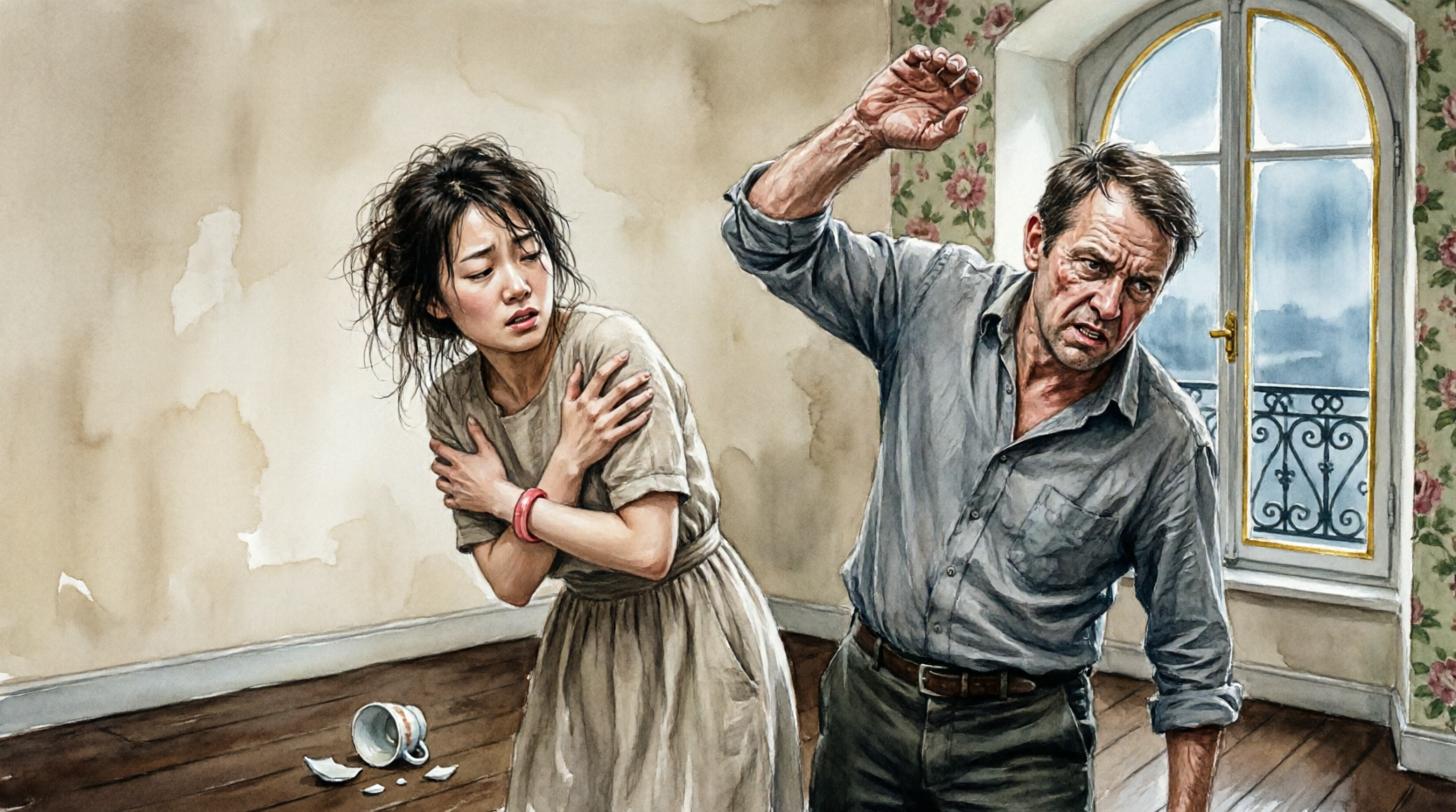
“Sir, your wife didn’t fall down the stairs,” the doctor said slowly, as if each word had to break through a stone wall before reaching him. “The X-rays show old fractures in different stages of healing, a poorly healed hip injury, two improperly fused ribs, and repeated trauma. This doesn’t match a fall. It matches constant violence.”
I remained motionless on the gurney, the rough sheet sticking to my legs and my entire body throbbing with pain. I couldn’t see him well from where I was, but I could feel him. The way he stopped breathing for a second. The dry sound of the X-ray trembling between his fingers.
The doctor took another step toward the bed.
“And there is something else.”
My husband looked up, pale, empty, as if he no longer knew which lie to use.
“Your wife is pregnant.”
Silence suddenly fell over the room.
I didn’t hear the medicine carts in the hallway, nor the distant TV from another room, nor the murmuring of the nurses. Only that sentence, repeating inside me as if my body couldn’t fully receive it.
Pregnant.
I felt a deep chill, deeper than the pain of the beatings.
My husband looked at me. Not with tenderness. Not with relief. Not with guilt. He looked at me as if he had just seen a ghost.
The doctor continued, this time without any softness:
“According to the tests and the ultrasound, she is about fourteen weeks along. There is bleeding and risk, but the pregnancy is still ongoing. And, before you say another outrageous thing, let me clarify something: the mother does not decide the sex of the baby. The father determines it.”
I saw how those words pierced him like knives.
For years, he had beaten me for not giving him a son. For years, he spat in my face that I was defective, useless, cursed. For years, his mother prayed while he broke my body, as if my daughters were an offense to God and not two innocent creatures.
And now a doctor, wearing a white coat with the tired voice of someone who has seen too much misery, had just destroyed the great lie upon which my hell was built.
It wasn’t my fault. It never was.
My husband opened his mouth.
“Doctor… I…”
“Don’t explain it to me,” the doctor cut him off. “I’ve already notified Social Services and the hospital’s legal department. The patient cannot leave today. And you are not going to be left alone with her either.”
I felt something break inside me. Not fear. That was still there, clinging to my skin like a cold sweat. It was something else. A small crack in my obedience.
My husband took a step toward me, using that fake voice he used in front of strangers.
“Mary… tell them it was an accident.”
I looked at him.
My mouth was busted, my cheekbone was burning, and my entire body had become a collection of old and new aches. And yet, something inside me, something that had been buried under fear for years, shifted.
“No,” I whispered.
He froze.
“Mary…”
“I didn’t fall.”
I said it again, louder.
The doctor held my gaze. And in that instant, I knew that even though my hands were still trembling, I had crossed a point of no return.
The door opened. A nurse walked in holding a clipboard, followed by a woman in a tailored suit with her hair tied back and a badge hanging around her neck. She wasn’t a police officer. She wasn’t a doctor. But her presence filled the room with a different kind of gravity.
“Mrs. Mary Miller,” she said with a firm voice, “I am Vanessa Sullivan, from Child Protective Services and the Domestic Violence Unit. I am here to support you.”
My husband spun around immediately.
“That’s not necessary. This is a family matter.”
The woman didn’t even look at him.
“That is exactly why I am here.”
I wanted to cry. Not out of relief. I wasn’t quite there yet. I cried because someone was finally naming what was happening without sugarcoating it. Without calling it “marital problems.” Without calling the cruelty an “outburst.” Without asking me to be patient.
My husband tried to step closer again.
“Mary, think carefully about what you are going to say.”
And then he added in a lower voice, just for me:
“If you speak, I’ll take the girls from you.”
The air got caught in my throat.
There was the real blow. Not to my face. Not to my ribs. To my daughters. He always knew exactly where to twist the deepest threat.
Vanessa must have noticed something in my expression, because she took a step forward.
“Sir, step out of the room.”
“She is my wife.”
“And she is an injured patient. Outside.”
My husband clenched his jaw. He looked at the doctor, at the social worker, at me. He ran his calculations. Like always. What was convenient. How hard he could press. When to retreat so he could strike with more precision later.
Finally, he leaned toward me just enough so that only I could hear.
“This isn’t over.”
Then he walked out. The door closed behind him.
And for the first time in years, the room didn’t feel like a prison. It felt like a trench.
Vanessa came to my side.
“I need to ask you some questions,” she said softly, “but first I need you to tell me if your daughters are home alone.”
The mere question sent me into a panic.
My girls.
I had left them that morning with the neighbor across the street, Mrs. Parker, when he dragged me to the backyard and then everything turned into punches, ringing ears, and darkness. Were they still there? Had he picked them up? Had his mother taken them?
“I don’t know,” I replied with a broken voice. “I don’t know where they are.”
Vanessa signaled to the nurse, who immediately stepped out with her cell phone in hand.
“We are going to locate them,” she said. “But I need you to tell me the truth, the whole truth, so we can protect them too.”
The whole truth.
What a difficult phrase after so many years of getting used to naming nothing.
I started slowly. Not with the first slap. Nor with the day my daughters were born and my mother-in-law refused to hold them. Nor with the mornings in the backyard.
I started with a small sentence.
“It wasn’t just today.”
And then it all poured out. The punches. The kicks. The insults. The times I hid the bruise with a scarf. The times my mother-in-law heard everything and just kept praying. The nights my girls covered their ears. The mornings I cooked with a swollen eye.
Vanessa didn’t interrupt me. She just wrote. Every now and then she would ask for a date, a frequency, a name. The doctor nodded in silence, as if many of the injuries were already speaking for me.
When I finished, I felt empty. Not cured. Not free. Empty. Like a house after all the broken furniture has been dragged out.
An hour later, a young doctor came to do my ultrasound. I didn’t want to look at the screen. I was afraid to grow attached to a life that might already be slipping away inside me. But she asked if I wanted to hear the heartbeat.
I nodded.
And then the room filled with a fast, stubborn, tiny thumping.
Thump-thump. Thump-thump. Thump-thump.
I closed my eyes. They instantly filled with tears.
I still didn’t know if I wanted this baby or if I was terrified of it. I didn’t know if my body could sustain it. I didn’t know if it was a boy or a girl, and, for the first time in my life, I realized I didn’t care. Just hearing it in there, alive, insisting, shattered me and held me together at the same time.
“She is still here,” the doctor said. “But we need to monitor her closely.”
She.
It wasn’t a diagnosis. Just a figure of speech. But that word made me think of my other two daughters, of their undone braids, of their bare feet running through the house, of the way they would go completely still when he came home in a bad mood. I thought about everything they had already witnessed. About everything I called endurance when it was really just fear.
Shortly after, the nurse returned.
She carried a plastic bag with a pink sweater, a hairbrush, and a crumpled drawing of a little house with three flowers.
“Mrs. Parker has them,” she said. “They are scared, but they’re okay.”
My entire body folded in pure relief.
“Your oldest sent this,” the nurse added, handing me the drawing. “She said it was so you wouldn’t cry.”
I couldn’t hold the paper without shaking.
My six-year-old girl already knew how to console a battered mother. That truth pierced me worse than any X-ray.
Later, Vanessa came back with more documents. She explained that they could request protective orders. That I didn’t have to go back to that house. That there were shelters. That they could help me file a police report. That my daughters wouldn’t automatically be left in his hands just because he was the father. Every sentence dismantled a lie I had spent years believing.
“But I need to ask you something important,” she said at the end. “Do you want to formally press charges?”
I looked at the drawing. The three flowers. One big and two small. I thought of my daughters. In the backyard. Of my mother-in-law praying. Of his voice saying, “If you speak, I’ll take them from you.” I thought of the baby’s heartbeat.
And for the first time, the fear wasn’t big enough to eclipse the rage.
“Yes,” I answered. “I want to press charges.”
Vanessa nodded as if, somehow, she had been waiting for that answer since before she walked in.
Night fell over the hospital, and they moved me to a more secure room. They took photographs of my injuries. I signed papers with a hand that wouldn’t stop shaking. A police officer asked me questions awkwardly, as if he didn’t quite know where to look when a woman quietly describes hell. Even so, I did it. Every time my voice broke, I thought of my daughters hearing everything from the other room.
I couldn’t keep calling that a family.
Past midnight, the doctor returned with more test results.
He carried a blue folder and wore a strange expression, the kind that mixes professionalism with something akin to disbelief.
“Mrs. Miller,” he said, “there is a finding I need to explain to you calmly.”
I felt my stomach knot up.
“Did something happen to the baby?”
“Not exactly. But this is important.”
He opened the folder and pulled out another, smaller X-ray. He pointed to an area of the pelvis and then looked at me to make sure I was listening.
“Due to internal scarring and signs on your uterus, it appears you had a previous pregnancy that didn’t go to term. It wasn’t treated in a hospital. And it doesn’t look like a properly managed miscarriage.”
The room started buzzing again.
“No…” I whispered. “I never…”
And then I remembered. Heavy bleeding, two years ago. Unbearable pain. My mother-in-law coming in with a bitter herbal tea. My husband saying it was just “a badly managed late period.” Then a fever. Then two days unable to get out of bed.
The doctor kept talking, but at first I didn’t hear him. My heart was pounding in my ears.
“Furthermore,” he finally said, “based on how it healed, it’s highly probable there was an external intervention. A homemade one. Ma’am… someone terminated one of your pregnancies.”
I froze.
The walls, the bed, the sheet—everything stopped making sense. A pregnancy. Mine. That I didn’t even know how to name. That they tore away from me without telling me. That maybe I didn’t even understand while it was happening because, in that house, even pain had to go through someone else’s version.
“No…” I repeated. “No…”
The doctor lowered his voice.
“Based on the timeline, this happened approximately two years ago. And judging by the measurements of the scarred bone remnants… it’s very likely that this pregnancy was also male.”
I felt my world shatter all over again.
He hadn’t just beaten me for not giving him a son. He had probably ripped one out of me.
The door to the room swung open.
Vanessa walked in, pale, cell phone in hand, her face completely unraveled.
“Mary,” she said, looking first at me and then at the doctor, “we have a problem.”
My heart leaped into my throat.
“My daughters?”
She swallowed hard.
“Your mother-in-law disappeared from the neighborhood an hour ago… and she took your oldest girl.”