…that the man who had just thrown me out of his life might never have been the true architect of my downfall.
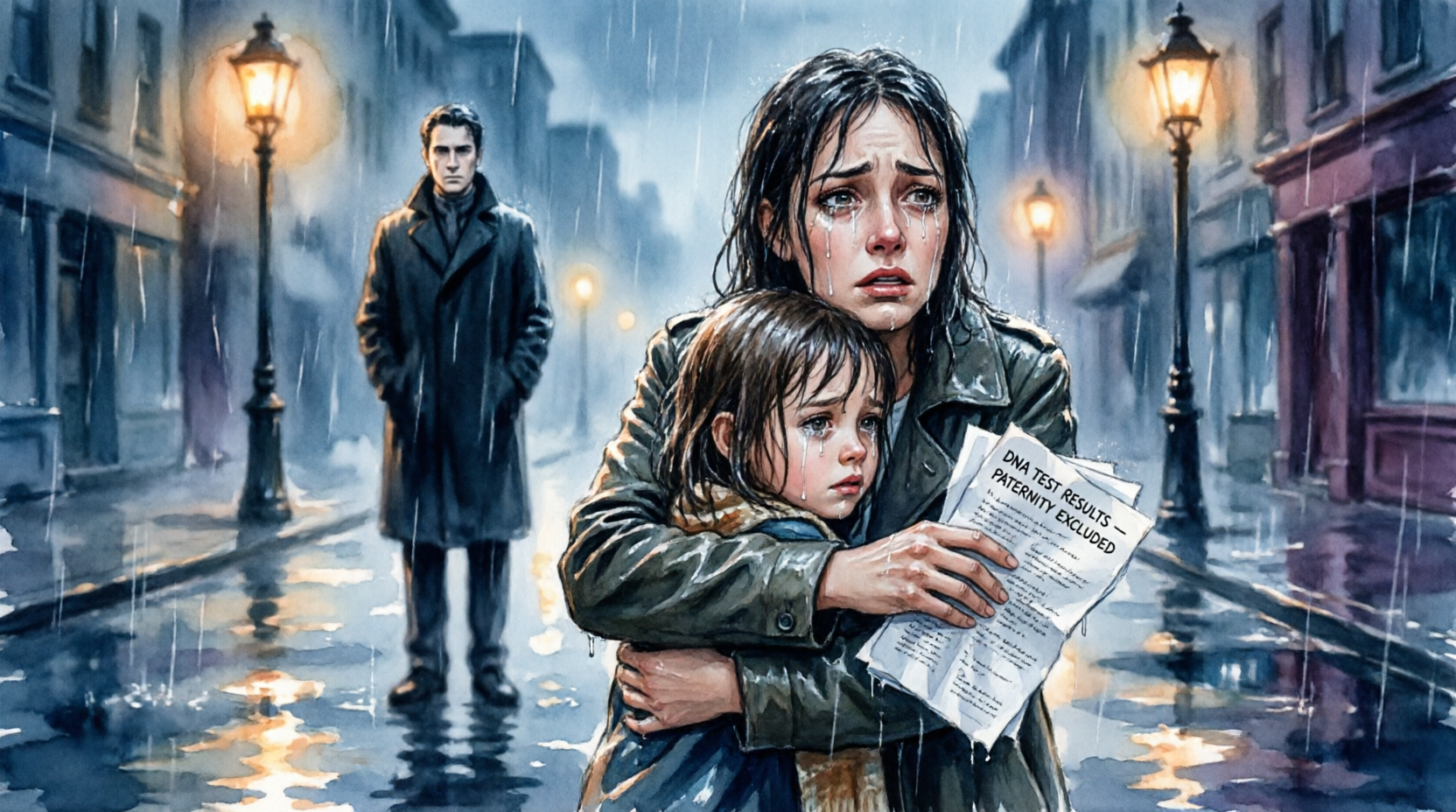
I took the photograph with trembling hands. Rain slid down the glossy edge of the paper, and the stranger’s black umbrella could barely hold back the wind. Lili shifted against my chest—wet, tired, and frightened, with that small, broken whimper that only children have when they no longer understand why the world has suddenly turned hostile. I was so dazed that, for a second, I thought I was seeing things.
But I wasn’t. The image was clear.
It showed the corner of a clinical room—an exam table, an overhead lamp, a metal stand with instruments covered by green fabric… and, in the foreground, a man’s wrist resting against the edge of the bed. He was wearing a braided leather bracelet, frayed at one end.
That bracelet. I recognized it instantly.
Miguel had worn it since long before we were married. He said it had belonged to his father, though he never fully told me where it came from. He only took it off to sleep or bathe. There was no way to mistake it. It was his.
But what chilled my blood wasn’t just that.
The photo also captured the partial reflection of a monitor and, looking closely, a date in the bottom corner of the screen. It was from the same month I had gotten pregnant with Lili.
I looked up at the man. “Who are you?”
He didn’t answer immediately. He continued to hold the umbrella over us with a strange stillness, as if he knew that any wrong word could break something even more fragile than the night itself.
“My name is Daniel Varela,” he finally said. “And you’re not going to like what I have to tell you. But you can’t go on without knowing.”
I looked at the photograph again. “Why is Miguel there? What room is that? What does this mean?”
Daniel took a deep breath. “I can’t explain it to you on a sidewalk, with the baby soaked and you on the verge of collapsing. I swear I’m not going to hurt you. I just want you to hear everything before you decide what to do with me… or with him.”
I didn’t trust him. I couldn’t.
A stranger appearing in the middle of Manhattan, in the rain, with a photo of my husband inside a clinic and an expression of premature condolences was not exactly a reassuring image. But I had nowhere else to go. Miguel had just shut the door on me. My phone was almost dead. Lili was shaking. And I was holding a soaked envelope in my hand with a DNA result that didn’t fit anything I knew about my own life.
“Five minutes,” I said, clinging to the last shred of control I had left. “In a public place. If I don’t like a single thing you say, I’m gone.”
He nodded. “Fair enough.”
He took us to a 24-hour diner three blocks away. The warmth of the place hit my face with an almost humiliating force. Suddenly, I was aware of how wet I was, how exhausted, how hungry, and how ridiculous I looked carrying a small suitcase as if an entire life could fit inside it. A waitress looked at us with pity, seeing the child wrapped in my coat, and pointed us to a discreet corner by the fogged-up window.
Daniel ordered hot chocolate for Lili, tea for me, and black coffee for himself. He didn’t try to touch the girl or make polite small talk. He just waited. That, out of all possible things, was what made me distrust him a little less. Dangerous men usually force intimacy too soon. He seemed to understand the value of space.
Lili fell asleep on my lap after a few sips of warm milk that the waitress brought over on her own initiative. I smoothed the hair plastered to her forehead and looked back at the photograph.
“Talk,” I said.
Daniel rested his hands on the table. “I work in asset security and private verification. Four months ago, a client hired me to investigate her husband. She suspected he was being manipulated in an inheritance conflict. That man was Miguel.”
I felt the name hit me again, as if it could still hurt more. “Who was the client?”
He hesitated. “Your mother-in-law.”
I didn’t know whether to laugh or vomit.
Miguel’s mother, Clara Mendoza, had spent years faking cordiality with me. She never liked me, but she wasn’t a blatant villain either. Her style was more subtle: insinuations, silences, little comments about “how quickly some women build their future.” She never openly opposed the marriage, but she never stopped reminding me that her son “deserved peace of mind.”
“My mother-in-law hired you to investigate her own son?”
“Not exactly,” Daniel replied. “She hired me because she believed someone wanted to claim a portion of the family fortune through a child whose paternity, according to her, was doubtful. At first, I thought it was just a paranoid mother-in-law and a classic fight over money. But when I started following Miguel, I found something else.”
My throat was dry. “What?”
From his slim briefcase, he pulled another clear folder. Not a large one, but several papers protected in sleeves. Photographs. Copies. Dates.
“I found repeated visits to a private fertility clinic. It was under a foundation that serves as a front for certain procedures. I found payments made by a third party. I found Miguel meeting several times with someone who wasn’t a divorce lawyer or a genetic counselor, but a specialist in assisted reproduction and biological sample management. And then I found this photo.”
He pointed to the image again.
“That day, according to the entry log, Miguel was in a room where he had no business being as a supportive husband. He entered through a staff door. With the bracelet visible. And he wasn’t alone. He was with Dr. Helena Strauss.”
The name meant nothing to me. “And who the hell is Helena Strauss?”
“The doctor who signed the initial fertility report for both of you three years ago.”
A brutal chill ran down my back.
Three years ago. Yes. When we had been married a short time and started talking about children. I remembered that process perfectly, though suddenly, the memories seemed poorly lit. There were tests, consultations, delays, anxiety. Miguel insisted on doing everything “through the most discreet and private channels,” supposedly to protect us from stress and family questions. Then came the pregnancy with Lili, almost like a miracle, and I assumed that life was finally giving us a break.
Daniel continued. “The clinic where Miguel was that night was involved years ago in two confidential lawsuits regarding sample substitution and manipulation of inseminations. The cases were closed with private settlements. They never hit the press. When I saw Strauss’s name and Miguel’s presence there, I started looking further back.”
I couldn’t breathe properly. “Are you telling me that…?”
I didn’t finish the sentence. I couldn’t.
Daniel finished what I didn’t dare think yet. “I’m telling you that the DNA test he showed you might be real and yet not mean what he told you. Lili might not be Miguel’s biological daughter. But that wouldn’t necessarily imply infidelity on your part. It could imply something much worse: a deliberate alteration of the reproductive process.”
My mind split in two. One part of me was still sitting at the apartment door, with Miguel screaming that this child wasn’t his. The other was now in this diner, watching the pieces move toward an unthinkable place.
“No. No,” I whispered, shaking my head. “That’s impossible. I… I went through the treatment with my own body. I was there.”
“Yes,” Daniel said with unbearable calm. “And that’s why I know this is going to sound crazy to you. But listen closely: in assisted procedures, especially when there’s light sedation or lab manipulation, you don’t see what happens with the samples. You trust. And if the person you trusted most was your husband, and he also controlled the medical narrative…”
He didn’t finish. He didn’t have to.
I saw it then, like a lightning bolt—random moments that, until tonight, had never seemed suspicious.
Miguel insisting on accompanying me to every appointment. Miguel talking to the staff without me. Miguel changing labs “because this one is better, honey, safer.” Miguel asking me not to stress over technical details. Miguel telling me that the important thing was that we had a baby, not how it happened. And above all, the way he cried when I told him I was pregnant. Too much. As if the emotion held something else. As if there was also fear.
“Why would he do that?” I finally asked, in a voice that no longer sounded like mine. “Why would anyone do something like that?”
Daniel held my gaze. “That’s what I still don’t fully know. But I do know one thing: someone has been preparing this downfall for a long time. The DNA test didn’t appear by accident. It was requested at the exact moment. It was leaked to the family in the exact way. It was used today, when the asset division of your father-in-law’s company is about to close. And if Miguel proved he had no legitimate offspring with you, he regained a very convenient legal and financial position regarding certain family trusts.”
The word trusts hit me with a different kind of disgust. It wasn’t just the marriage anymore. It was the money. The inheritance. The last name. The same old structure dressed in a different way.
“My daughter…” I whispered. “They used my daughter.”
“Yes.”
There was no dodging it. No attempt to soften it. The word sat there, brutal. Used.
I put my hand to my mouth to keep from making a sound that would wake Lili.
“So, what? She isn’t Miguel’s, but it also doesn’t mean I cheated? Are you telling me they could have used another sample? Another donor? Without telling me anything?”
Daniel nodded slowly. “I believe so. And I also believe Miguel knew long before today.”
I closed my eyes. Not out of disbelief. But because of the scale of the collapse.
My husband hadn’t just accused me of a non-existent betrayal in front of our daughter. He hadn’t just thrown me onto the street with a suitcase. He had waited for the perfect moment to do it using a biological truth—likely constructed with the participation or knowledge of others. He had let me raise and love Lili in a frame of apparent normalcy while he prepared, perhaps for years, the day he could cut us out of his life at the lowest cost to him and the highest to me.
And he had done it while looking me in the eye.
“I need proof,” I said. “Something more than photos and suspicions. If I’m going to face this, I need more than just intuition.”
Daniel nodded. “I know. That’s why I looked for you today. I had two options: wait to gather everything and risk Miguel destroying you first, or find you as soon as I knew the test was going to be used. I chose the latter.”
“How did you know it would be today?”
He reached into his jacket and pulled out a copy of an email. It was between two lawyers from Miguel’s group. One of them mentioned clinically:
“Once the paternity situation is notified, proceed with eviction and immediate signing to shield assets before Monday.”
Eviction. Me. Like I was furniture. A piece of paperwork. A risk to be evacuated.
I cried then. Not beautifully. Not in silence. Not like in the movies. I cried with my head down, one hand clutching Lili and the other crushing that cursed photo against the table. I cried for the humiliation, for the naivety, for the career I had left behind, for the years given away to a man who planned my ruin with legal vocabulary and medical lies. I cried until I was empty.
Daniel didn’t touch me. Not once. He just waited.
When I could speak again, the first thing I asked was the only thing that truly mattered: “Is Lili in danger?”
He answered without hesitation. “Not immediate physical danger, I don’t think. But legally and financially, yes. If Miguel consolidates the narrative of fraud or adultery, he will try to distance himself from her completely. And if his family manages to prove there was deliberate deception on your part, they will look to isolate you, discredit you, and leave you without resources before you even understand what they’re doing to you.”
I took a deep breath. “Then we don’t have time.”
“No.”
“What do we do?”
That question changed the air between us. Because I was no longer a victim listening to a revelation. I was a mother starting to organize.
Daniel rested his hands on the table, and for the first time, I saw something like respect on his face.
“First, you leave here with a safe place to sleep and the number of a lawyer specializing in reproductive malpractice and family law. Second, we preserve all the evidence. Third, we get your complete history from the fertility clinic before they alter it. Fourth, we run independent tests on any samples that might still exist, if they exist. And fifth…” he looked at me with a quiet hardness, “stop thinking you lost everything tonight.”
I didn’t know what to say. But I understood.
I hadn’t lost everything. Not yet.
I had lost a house, yes. A marriage that perhaps never existed as I believed. A version of my past.
But I hadn’t lost the entire truth.
And above all, I hadn’t lost my daughter.
That night he took me to a small hotel in Midtown where he had already made a reservation under a false name. The lawyer, a woman named Nora Klein, met with me via video call at 1:30 a.m. without a hint of disbelief on her face. That scared me even more—if she wasn’t surprised, maybe it was because she had seen similar things.
I showed her the photo. The email. The DNA report. Everything.
“We can’t prove yet that the sample was manipulated,” she said, “but we can prove that the timing, the use, and the pressure structure suggest financial premeditation. That buys us time. And the clinic… if there’s a complete history, someone is going down.”
“And if Lili isn’t Miguel’s biological daughter?”
Nora didn’t blink. “That doesn’t automatically make him innocent. If he participated in or consented to a procedure with undisclosed genetic material, the problem is enormous. If he then used that result to expel you and leave the child unprotected, it’s worse.”
The next morning, the war began.
It wasn’t an emotional war. It was one of paperwork, calls, urgent measures, preservation of evidence, and access to records before they vanished. Nora moved an expert witness, requested a judicial preservation order, and filed an urgent action to prevent Miguel from emptying joint accounts or moving assets linked to my support and Lili’s while the situation was clarified. Daniel, for his part, got something even more useful: a former employee of the clinic willing to talk.
Her name was Teresa Chung. She had been a lab coordinator two years ago. She met us in a rented office in Lower Manhattan, anxiety stitched across her face. She had the look of someone who had been living with a secret for a long time and now didn’t know if speaking would save her or sink her.
“I didn’t see everything,” she said before even sitting down. “But I saw enough to quit.”
She told us that in that clinic, there were “special clients.” Wealthy men. Influential couples. Cases handled outside standard protocol. Samples labeled opaquely. Verbal orders.
“Dr. Strauss always said the same thing: ‘The important thing isn’t the genetics, it’s the family project,’” she remembered with a grimace of disgust. “But sometimes that meant horrible things.”
My breathing grew shorter. “Do you remember me?” I asked.
She looked at me closely. Then she closed her eyes for a second. “Yes. You were the wife of Dr. Ramirez. There were comments. Too many comments.”
Nora intervened. “What comments?”
Teresa swallowed. “That he didn’t want ‘surprises.’ That everything had to be ‘shielded.’ Once I heard Strauss tell him that the procedure was already done and that if he insisted on maintaining ‘zero traceability,’ he had to pay more. I also heard the name of a frequent donor family, but I never got to see the full file.”
“Zero traceability?” I repeated.
Teresa nodded. “Erasing tracks. Breaking the documentary trail. Making it look like the origin can’t be traced.”
I felt like tearing my skin off. Not because of Lili. Never because of her. Never. But because of the level of coldness.
My daughter hadn’t been born from the twisted love of an insecure man. She had been born within an architecture of control and money where my consent, my body, and my motherhood were movable parts.
“And Miguel knew?” I asked.
Teresa held my gaze. “Yes.”
Not “I think so.” Not “it’s possible.” Yes.
That one word forever changed the way I would remember him.
With that, Nora had enough to request something stronger. The clinic received formal notification. The file was preserved. The servers were frozen. And when the press smelled medical blood involving big money, Strauss’s name began appearing in places she never thought it would.
Miguel tried to call me thirty-seven times in two days. I didn’t answer. Then came the text that made me realize with total clarity who he truly was:
“We can talk like adults and resolve this without destroying everyone’s life. Lili shouldn’t have to carry the weight of your decisions.”
My decisions.
I showed the text to Nora. She gave a humorless smile. “They always go back to that. When you cut off their control, they turn the disaster they built into a reaction of yours.”
I didn’t respond.
The final proof arrived a week later.
Among the preserved records, an old storage file revealed the identity of the genetic batch used in my procedure. It didn’t belong to Miguel. Nor to a standard anonymous donor. It belonged to a private bank linked to a specific family that had signed a restricted use agreement for “phenotypic affinity and financial discretion.”
The Carrington family. Long-time partners of the Ramirezes. Financial allies of the Mendozas. The same circle of insular wealth that had always looked at me like I was a temporary intruder.
They didn’t just want “no surprises.” They wanted a child who was still socially theirs, even if biologically she wasn’t Miguel’s.
I stared at the sheet for long minutes. Lili was sleeping on the hotel bed, clutching a stuffed bunny Daniel had bought her when she finally stopped shaking at night. She had dark eyelashes, calm breathing, and a small curve in her chin that for two years I had associated with Miguel. Now I didn’t know where it came from. But it didn’t matter in the same way anymore.
Because I understood something decisive: my daughter was not a lie. The lie was the system that had brought her into the world without my truth.
Miguel fell quickly after that. Not morally—men like him don’t fall because of a conscience. They fall because of the structure. The clinic distanced itself from him. Dr. Strauss tried to blame him for undue pressure. He tried to claim that everything was done by an “informal partner agreement.”
It didn’t work. The emails. The dates. The sedation. The broken traceability. The subsequent use of the DNA as a weapon. It was all too much.
The divorce stopped being his sentence over me and became my legal exit from him. Lili’s custody was shielded. And the criminal case began to take shape.
I don’t know how much longer it will last. These things never end as fast as they should.
But I do know this: the night I thought I had lost everything, I was actually escaping a story much worse than the street, the rain, or a soaked envelope.
I had lived seven years with a man capable of deciding the genetic origin of our child without saying a word to me, and then using that same origin to expel me from his life as if I were the guilty one.
That was what I really discovered. And that was what changed my marriage… and my way of understanding love, forever.
Because no, I didn’t lose everything that night. I lost Miguel. And in time, I understood that might have been the beginning of my salvation.