Another one.
Emily.
Alive.
Starving.
Terrified.
But alive.
I started crying before I even realized I was crying.
Walt covered his face with one hand.
One of the investigators whispered, “Thank God.”
But the radio was not finished.
Another voice cut in.
“Detective… you need to see this.”
Vale straightened immediately.
“What is it?”
Silence.
Then:
“There are more rooms.”
Part 7
There were four rooms beneath Dr. Graves’s lake house.
Four.
State police found them hidden behind a false storage wall in the basement.
Concrete.
No windows.
Heavy locks mounted outside the doors.
The kind used for containment.
Not protection.
Containment.
I learned the details slowly over the next twelve hours because Detective Vale tried to shield me from the worst of it.
But horror travels anyway.
Through overheard conversations.
Through reporters whispering into cameras outside your street.
Through the faces of exhausted officers who stop looking surprised because shock has become routine.
Emily Harrow was alive.
So were two other children.
A ten-year-old boy from Dayton listed missing for eleven months.
And a little girl from Kentucky whose disappearance never even made national news because her mother struggled with addiction and police originally assumed she had wandered away.
Three children.
Alive under a doctor’s lake house.
While Maplewood held bake sales and Christmas drives and trusted him with babies.
The fourth room was empty.
That room frightened investigators most.
Because empty rooms imply movement.
Or plans.
Or previous occupants.
At 8:40 that morning, national media trucks lined Main Street all the way past the courthouse.
Helicopters circled low enough to rattle windows.
Reporters camped outside my yard despite police barriers.
One anchor called Maplewood “America’s house of buried secrets.”
I hated how dramatic people became around suffering that did not belong to them.
Inside my house, Tyler sat cross-legged on the living room floor building a puzzle while armed state troopers stood watch outside.
A puzzle.
Children always return to ordinary things when terror becomes too large.
It is how they survive.
I carried him grilled cheese triangles and apple slices at noon.
He took one bite.
Then asked quietly:
“Did they find Emily?”
I sat beside him carefully.
“Yes.”
“Is she okay?”
“She’s alive.”
Tyler nodded.
Then he whispered:
“I told her not to cry.”
I turned toward him slowly.
“What?”
His small fingers pressed puzzle pieces together too hard.
“At the lake house.”
Cold moved through my chest.
“You met her?”
He nodded.
“When?”
“Before Michelle gave me the medicine.”
Every sound in the room disappeared for a second.
I kept my voice steady with effort.
“Tyler… what happened at the lake house?”
His face went pale instantly.
Too pale.
I almost stopped.
But children carry poison when adults refuse to hear them.
And Tyler had already carried enough alone.
“She was in the room downstairs,” he whispered.
“She cried at night.”
I felt physically sick.
“What did Michelle tell you?”
“That Emily was bad.”
His hands started shaking.
“She said bad kids had to stay hidden until they learned how to behave.”
I closed my eyes briefly.
Control.
Punishment.
Isolation.
Michelle had turned imprisonment into discipline.
The language of abusers is always terrifyingly ordinary.
Tyler stared at the puzzle without seeing it anymore.
“She told me if I didn’t stop making things harder for Daddy, I’d stay there too.”
The room tilted around me.
“What things?”
He looked ashamed suddenly.
“I told my teacher Daddy cried after Michelle yelled at him.”
That was it.
That tiny.
That human.
A child noticing fear.
A child speaking honestly.
And somewhere after that, Michelle began deciding Tyler was dangerous to her plans.
I took the puzzle from his hands gently.
“Look at me.”
He did.
“You didn’t do anything wrong.”
Tears filled his eyes instantly.
“She said I ruin everything.”
“No.”
I held his face carefully.
“She ruined everything.”
He started crying then.
Not loud.
Not dramatic.
The exhausted crying of a child who had spent too long trying not to become inconvenient.
I pulled him against me and held him while cameras flashed outside my curtains like distant lightning.
That afternoon, Detective Vale returned with information that made the entire case even darker.
Rachel Mercer was missing.
Her apartment emptied.
Car abandoned near a bus station forty miles away.
No confirmed sightings.
But before disappearing, she left another package at the sheriff’s office addressed specifically to me.
Vale placed it carefully on my kitchen table.
Inside was a small stack of photographs.
Most showed Michelle with Dr. Graves.
Fundraisers.
Church events.
Lake parties.
Smiling pictures.
Normal pictures.
Then came the final photo.
And my blood turned to ice.
Brian.
Standing beside Dr. Graves outside the lake house.
Holding a shovel.
The timestamp was six months old.
“No,” I whispered automatically.
Vale stayed quiet.
Because there was nothing left to soften.
My son had been there.
At the house.
Near those rooms.
Near those children.
Walt sat heavily in the kitchen chair.
“Jesus Christ.”
I kept staring at the photograph.
Brian looked thinner.
Worn down.
Exhausted.
But not confused.
Not unaware.
Present.
Complicit.
Tyler walked quietly into the kitchen before I could hide the photo.
His eyes landed on it immediately.
Then he looked away fast.
Too fast.
Children recognize danger before adults admit it exists.
“Buddy,” Vale said gently, “did Daddy take you to that house?”
Tyler nodded once.
“How many times?”
His lips trembled.
“A lot.”
I could barely breathe.
“What happened there?”
Tyler swallowed hard.
“Michelle said it was our special place.”
The room fell silent again.
Then he added the sentence that finally broke whatever denial still lived inside me:
“Daddy stopped talking normal there.”
Not evil.
Not violent.
Children rarely describe monsters dramatically.
They describe changes.
“He stopped talking normal.”
Vale crouched carefully beside him.
“What do you mean?”
Tyler’s face tightened with concentration.
“He talked quiet.
Like Michelle.”
A copy.
That was what Brian became there.
Not leader.
Follower.
Michelle had hollowed him out slowly until fear and obedience wore his face.
But the result was still the same.
Children locked underground.
An empty coffin.
A burial.
At 4:17 p.m., news broke nationally that investigators believed Graves and Michelle may have operated a trafficking ring disguised through medical manipulation, custody fraud, and falsified death records.
The entire country exploded.
Maplewood became cursed overnight.
People screamed outside the courthouse.
Church members tore down Dr. Graves’s nameplate themselves.
One woman fainted during a live interview after learning her niece’s old “accidental drowning” case was being reopened.
And through all of it, Tyler remained mostly quiet.
That frightened me more than crying would have.
Traumatized children often become very calm before the real collapse arrives.
That evening, while I made spaghetti neither of us touched, Tyler suddenly asked:
“Can dead people come back angry?”
The spoon slipped from my hand into the sink.
“Why would you ask that?”
He stared toward the dark kitchen window.
“Michelle said Emily’s parents stopped looking because people forget dead kids after a while.”
My stomach twisted violently.
Tyler continued softly:
“She said if people came back, everyone would hate them for ruining things.”
I walked to him immediately and knelt beside his chair.
“Listen to me carefully.”
He looked at me.
“The people who hurt children are the ones who ruin things.
Not the children who survive.”
His eyes filled slowly.
“Even if they make everybody sad?”
I thought about Brian.
About funerals.
About cameras.
About Maplewood collapsing under truths nobody wanted.
Then I answered honestly.
“Sometimes truth makes people sad before it makes them free.”
He leaned against me quietly.
And for the first time since he climbed out of that grave, he fell asleep before checking the locks.
That should have comforted me.
Instead, it terrified me.
Because exhausted children stop checking doors only when their bodies finally lose the strength to stay afraid.
Around midnight, my phone rang again.
Detective Vale.
Her voice sounded tight.
“We found Rachel Mercer.”
Relief hit me instantly.
“Is she okay?”
A pause.
“No.”
Everything inside me went cold.
“She’s alive?”
“Yes.”
Another pause.
“But barely.”
My grip tightened around the phone.
“What happened?”
“She was found outside Columbus near an abandoned motel.
Beaten.
Drugged.
Dumped in a drainage ditch.”
I sat down slowly.
“Did she say who did it?”
Vale inhaled carefully.
“She said one thing before losing consciousness.”
I waited.
Then Vale spoke quietly:
“She said Michelle didn’t start this.”
The room seemed to shrink around me
“What?”
“She kept repeating the same sentence.”
Silence stretched.
Then:
“‘Find the pastor before Sunday.’”
Every nerve in my body locked.
Pastor.
Maplewood First Methodist.
The same church where Tyler’s fake funeral happened.
The same church where Dr. Graves served as elder.
The same church where Michelle cried in the front pew while my grandson suffocated underground.
Outside my kitchen window, thunder rolled across Maplewood again.
And for the first time since Tyler came home alive, I realized something even worse than evil hiding in town.
Evil had been praying beside us the entire time.
Part 8
Maplewood First Methodist canceled Sunday service for the first time in thirty-two years.
That alone terrified people more than the news helicopters.
Churches in towns like ours do not close unless death itself walks through the doors.
By Friday morning, state police surrounded the building with barricades while investigators carried out boxes of records under white evidence tarps.
Pastor Daniel Mercer disappeared before dawn.
Gone.
No goodbye.
No statement.
No explanation.
Just an empty parsonage behind the church and a half-drunk cup of coffee still sitting on the kitchen counter.
Rachel Mercer’s father.
The same Rachel who helped alter Tyler’s funeral paperwork.
The same Rachel who was beaten nearly to death after trying to warn us.
Everything connected.
Every road in Maplewood suddenly led back to that church.
I stood in my kitchen staring at television footage while Tyler quietly fed cereal pieces to the stuffed fox beside his bowl.
He had started doing that three mornings ago.
One piece for him.
One piece for the fox.
Children invent rituals when life becomes uncontrollable.
The news anchor spoke in a grave voice:
“Authorities now believe Maplewood First Methodist may have been used to identify vulnerable families through counseling programs and charitable outreach databases.”
My stomach turned.
Not random children.
Selected children.
Families in debt.
Parents overwhelmed.
Custody battles.
Addiction.
Isolation.
People who would struggle to fight back if something happened.
Tyler looked up from his cereal.
“Grandma?”
I muted the television immediately.
“Yes?”
“Are we bad people?”
The spoon nearly slipped from my hand.
“No.”
“But Michelle said only bad families get chosen.”
I crossed the kitchen instantly and knelt beside him.
“Listen carefully to me.”
He looked frightened already.
“Bad people choose victims.
That’s different.”
His eyes searched mine desperately.
“Then why did they pick me?”
There it was.
The question underneath every nightmare.
Why me?
No child should carry that question.
No adult really survives it either.
I touched his cheek gently.
“Because they thought they could control your father.”
Tyler stared down at the cereal bowl.
“They did.”
Truth hurts differently when it comes from children.
At 10:12 a.m., Detective Vale arrived with two federal agents.
Federal.
The word alone changed the air inside my house.
This was no longer county crime.
No longer state crime.
Bigger now.
One of the agents introduced himself as Noah Beck from the FBI Crimes Against Children Task Force.
Just hearing the name made my chest tighten.
Task force.
Like there were enough horrors in the world to require entire departments.
Vale placed a thick folder on my dining table.
“We found Pastor Mercer’s financial records.”
Walt, sitting nearby with black coffee in his hand, muttered:
“This keeps getting worse.”
Vale nodded once.
“It does.”
She opened the folder.
Inside were photographs.
Church youth retreats.
Adoption fundraisers.
Community outreach lists.
And spreadsheets.
Hundreds of names.
Children.
Families.
Notes beside them.
Financial stress.
Single parent.
Insurance coverage.
Behavior concerns.
No support network.
I felt physically ill.
The church had become a catalog.
A hunting ground disguised as ministry.
Agent Beck spoke quietly:
“We believe Mercer identified vulnerable families, Graves handled medical documentation, and Michelle recruited through emotional manipulation.”
“Recruited?” I whispered.
“For access.”
My stomach turned again.
“Brian?”
Beck’s face stayed carefully neutral.
“We think Brian began as a financial target.
Then became compromised.”
Weak men.
Again.
Weak men opening doors monsters walk through.
Vale slid another photograph toward me.
I froze.
It showed Michelle standing beside Pastor Mercer in the church fellowship hall six months earlier.
Tyler stood nearby coloring at a folding table.
Michelle was smiling.
Mercer’s hand rested lightly on Tyler’s shoulder.
Predatory people always look ordinary in photographs.
That is how they survive long enough to become dangerous.
Tyler suddenly stood from the kitchen table and backed away from the photo.
His face had gone white.
“He smells like dirt.”
Every adult in the room turned toward him.
Vale crouched carefully.
“Tyler?”
Tyler pointed shakily at Pastor Mercer’s picture.
“He came to the lake house.”
My blood turned cold.
Agent Beck immediately leaned forward.
“When?”
“After Emily cried too loud.”
The room stopped breathing.
Tyler hugged himself tightly.
“He prayed.”
No one spoke.
Because somehow that detail was worst of all.
Not the basement.
Not the lists.
Prayer.
Tyler continued softly:
“He told Michelle God sends difficult children to difficult people for a reason.”
I felt rage rise so sharply it almost blurred my vision.
Religion twisted into permission.
Cruelty wrapped in scripture.
Walt slammed his coffee mug onto the counter hard enough to spill it.
“Son of a bitch.”
Agent Beck spoke carefully.
“Tyler… did Pastor Mercer ever hurt you?”
Tyler shook his head immediately.
“No.”
“Did he hurt the other children?”
A long silence.
Then Tyler whispered:
“He watched.”
The room went dead quiet.
Watched.
Not helped.
Not stopped.
Watched.
My stomach rolled violently.
Vale closed her eyes briefly.
Even Agent Beck looked shaken now.
Tyler’s hands trembled harder.
“He said some children are meant to disappear so better families can survive.”
That sentence sat in my house like poison.
Because people always imagine evil sounds dramatic.
It doesn’t.
Sometimes it sounds reasonable.
Practical.
Moral even.
That is why it spreads.
One of the federal agents stepped outside immediately to make calls.
The investigation exploded again after Tyler’s statement.
By afternoon, search warrants expanded across three counties.
Church records seized.
Medical files reopened.
Foster placements reviewed.
And everywhere, the same names kept surfacing:
Graves.
Mercer.
Michelle.
Donors.
Counselors.
“Support coordinators.”
A network hiding behind charity and grief.
That evening, the news broke something else.
Pastor Mercer’s wife had been dead for nine years.
Officially:
Suicide.
Now investigators were reopening her case too.
Nothing in Maplewood stayed buried anymore.
Around sunset, Tyler asked to visit the cemetery.
Every adult in the room tried to hide their reaction.
“Why?” I asked gently.
He stared toward the window.
“I left my shoe.”
My chest hurt instantly.
One shoe.
The muddy footprint on my porch.
The tiny sock.
He had climbed out of his own grave missing a shoe.
I should have realized sooner why he kept glancing at children’s sneakers in stores and television commercials.
Trauma hides in ridiculous little details.
We went just before dark with two patrol cars following behind.
Maplewood Cemetery looked different now.
Floodlights.
Police tape.
News vans outside the gates.
The burial site remained partially excavated for evidence processing.
Tyler held my hand tightly while we walked through damp grass.
Then he stopped.
The open grave sat ahead of us.
The coffin removed.
The earth torn apart by investigators.
Tyler stared silently for a long time.
Then he whispered:
“It was louder than I remembered.”
I knelt beside him carefully.
“What was?”
“The dirt.”
No child should know what burial sounds like from underneath.
Tyler pointed toward a muddy patch near the headstone.
“My shoe.”
One tiny sneaker still lay half-buried in the mud.
An officer retrieved it gently and handed it to him.
Tyler held it against his chest like something sacred.
Then he asked quietly:
“Can we leave now?”
We turned back toward the gate.
That was when headlights flashed suddenly near the cemetery entrance.
A black SUV.
Fast.
Too fast.
Federal agents immediately shouted.
One grabbed Tyler and pulled him behind a patrol car.
The SUV slammed through the temporary barrier tape and sped directly toward the cemetery road.
For one terrifying second, I thought they were trying to reach Tyler.
Then the passenger door opened.
Something rolled out onto the gravel.
A body.
The SUV sped away before officers could fire.
Chaos exploded.
Federal agents drew weapons.
Sirens screamed.
Someone tackled me to the ground while officers surrounded the motionless figure near the gate.
Then Detective Vale shouted:
“She’s alive!”
The body moved weakly.
Red scarf.
Rachel Mercer.
Barely conscious.
Covered in bruises.
Blood soaking through one sleeve.
She tried to speak while paramedics rushed toward her.
Vale knelt beside her.
“Rachel.
Who did this?”
Rachel’s lips trembled.
Her eyes moved wildly until they found Tyler behind the patrol car.
Then she started crying.
“I tried to stop it,” she whispered.
Vale leaned closer.
“Who?”
Rachel coughed hard.
“Mercer… and Graves… but Michelle…” Her voice broke.
“She liked it.”
Silence swallowed the cemetery.
Rain began falling softly again.
Rachel grabbed Vale’s sleeve desperately.
“There’s another child.”
Every adult froze.
Vale’s voice sharpened instantly.
“Where?”
Rachel’s breathing turned ragged.
“The church.”
My blood turned to ice.
“The tunnels.”
Agent Beck stepped forward immediately.
“What tunnels?”
Rachel looked terrified now.
“Under the church.”
Vale grabbed her shoulder carefully.
“How many children?”
Rachel shook violently.
“I don’t know anymore.”
Part 9
The tunnels beneath Maplewood First Methodist stretched farther than anyone imagined.
Old coal passages from the 1920s.
Half-collapsed storage corridors.
Hidden rooms sealed behind maintenance walls.
Places forgotten by the town above them.
Perfect places for secrets.
At 11:42 p.m., federal agents descended under the church armed with flashlights, rifles, medical kits, and maps pulled from county archives.
Above ground, rain hammered the stained-glass windows while television helicopters circled like vultures over the parking lot.
Below ground, they found another child alive.
Seven-year-old Lucas Bennett.
Missing for four months.
Curled beneath church blankets inside a locked room hidden behind old hymn storage shelves.
Alive.
Drugged.
Terrified.
When they carried him out through the church basement doors, half the officers outside started crying openly.
Even hardened agents looked shaken.
One little boy wrapped in emergency blankets under church lights became the image that broke the country.
Not because America suddenly discovered evil existed.
Because people realized evil had been singing hymns beside them every Sunday.
Pastor Mercer was arrested at 2:13 a.m. hiding in a hunting cabin near the county line.
Dr. Graves was transferred into federal custody after evidence tied him to multiple disappearances across three states.
Rachel Mercer survived emergency surgery.
Barely.
Michelle Porter?
Michelle tried to run.
Federal marshals found her six hours later at a bus terminal outside Indianapolis wearing dyed hair, fake glasses, and carrying cash inside a diaper bag.
The moment officers grabbed her, she screamed one sentence over and over:
“Brian promised he could handle the boy!”
Not Tyler.
Not my grandson.
The boy.
Even at the end, she refused to see children as human.
Brian broke first.
Three days after the tunnel rescue, he requested a full confession interview.
I did not attend.
I could not.
Some betrayals become too large to witness directly.
But Detective Vale later told me everything.
Brian admitted Michelle targeted him after his gambling debts spiraled out of control.
She introduced him to Dr. Graves through church counseling.
At first, it was small.
Prescription fraud.
Insurance tricks.
Signing papers without asking questions.
Then debts grew.
Pressure grew.
Fear grew.
And every time Brian hesitated, Michelle reminded him of foreclosure, prison, losing Tyler, losing everything.
Weakness became obedience.
Obedience became complicity.
Then came the lake house.
Then the children.
Then Tyler.
Vale told me Brian cried hardest when describing the cemetery.
Not because Tyler knocked.
Because Tyler called him Daddy while knocking.
That detail haunted him most.
Good.
It should.
At trial, prosecutors called the network “a system of organized child exploitation hidden behind medicine, religion, and family trust.”
The country called it the Maplewood Horror Case.
I hated that name too.
Because horror makes evil sound supernatural.
It wasn’t supernatural.
It was human.
That was worse.
The trials lasted nearly eleven months.
Every week brought new victims.
New records.
New missing-child investigations reopened.
Some families got miracles.
Children found alive.
Others got only truth.
And truth is a brutal thing when it arrives too late.
Michelle never cried in court.
Not once.
She wore soft colors.
Held tissues.
Spoke quietly.
Exactly the same performance she gave at Tyler’s funeral.
But this time the whole world saw beneath it.
The spreadsheets.
The trust plans.
The vulnerability scores.
The recordings.
The tunnels.
And finally, Tyler’s testimony.
I fought against letting him testify.
Every protective instinct inside me screamed no.
But trauma experts explained something important:
Children sometimes heal by reclaiming their voices where adults once stole them.
So Tyler testified by closed-circuit video from a private room with therapists nearby.
He wore a blue sweater I bought him after the cemetery.
He held the stuffed fox the entire time.
The courtroom watched in silence while my grandson described waking up underground.
The knocking.
The dirt.
The dark.
Then the worst part.
He described calling for his father.
No one in that courtroom breathed normally after that.
When prosecutors asked why he climbed out and came to my house, Tyler answered with simple honesty:
“Because Grandma Ellie always believes me.”
I broke down crying in the second row.
Not because I was strong.
Because I realized trust had saved his life.
Nothing heroic.
Nothing dramatic.
A child simply knew one adult who would open the door.
That was enough.
Michelle received six life sentences without parole.
Dr. Graves died in prison before his second trial began.
Officially:
Heart failure.
Nobody in Maplewood mourned him.
Pastor Mercer received multiple federal convictions tied to trafficking, conspiracy, unlawful imprisonment, fraud, and abuse.
Brian accepted a plea agreement in exchange for full cooperation.
Twenty-two years.
Some people thought it was too light.
Others thought prison would destroy him anyway because unlike Michelle, Brian still possessed a conscience.
I honestly did not know which punishment was worse.
The hardest part came six months after sentencing.
Tyler asked to see his father.
Every adult around me disagreed.
Therapists.
Agents.
Lawyers.
Even Walt.
But Tyler insisted quietly for weeks.
Finally, one counselor told me:
“Children sometimes need to see whether monsters still look human.”
So I took him.
The prison smelled like bleach, metal, and old regret.
Brian looked thinner than I had ever seen him.
Gray already touching his hair.
When Tyler entered the visitation room, Brian started crying immediately.
Tyler did not.
That nearly destroyed me.
Children who stop expecting comfort become frighteningly calm.
Brian whispered:
“I’m sorry.”
Tyler sat across from him silently.
Then asked the question that mattered most.
“Why didn’t you help me?”
The room died around us.
Brian covered his face.
“I was scared.”
Tyler nodded slowly.
“I know.”
Not anger.
Not screaming.
Just devastating understanding.
Then Tyler asked:
“Did you love me?”
Brian looked up instantly.
“With everything I had.”
Tyler’s eyes filled for the first time.
“Then why was Michelle louder?”
I will never forget my son’s face after hearing that sentence.
Because Tyler had unknowingly spoken the entire truth of the case.
Evil did not win because it was stronger than love.
It won because too many weak people let fear speak louder than love.
Brian sobbed so hard guards nearly ended the visit.
Tyler simply stood.
Then he walked to his father and hugged him once.
Short.
Small.
Merciful.
Not forgiveness.
Goodbye.
We never went back.
Years passed slowly after Maplewood.
The church was demolished.
Not abandoned.
Demolished.
People wanted the ground itself gone.
The cemetery removed Tyler’s headstone privately at our request.
For a long time he could not wear dress shoes because they reminded him of funerals.
Rainstorms triggered panic attacks.
Dark closets made him shake.
And every night for almost two years, he checked the locks before bed.
Healing is not beautiful.
Movies lie about that.
Healing is repetitive.
Exhausting.
Quiet.
It happens in tiny ordinary moments.
A child laughing unexpectedly after months of silence.
A full night’s sleep without nightmares.
The first time Tyler walked into church again by choice.
The first time he stopped hiding food under his mattress.
The first time he believed adults could protect instead of bury.
When Tyler turned sixteen, he asked me to drive him somewhere.
No explanation.
Just directions.
We ended up at Maplewood Cemetery.
The rain had finally stopped after three straight days of storms.
Tyler walked silently through wet grass until we reached the old burial site.
No stone now.
Just earth.
He stood there for a long time with his hands in his pockets.
Then he said quietly:
“I don’t think I’m dead there anymore.”
I felt tears rise immediately.
“What do you mean?”
He looked out across the cemetery.
“For a while it felt like part of me stayed underground.”
His voice stayed calm.
“But I think it came back.”
I took his hand.
He squeezed mine once.
Then he smiled a little.
Not the frightened smile from after the coffin.
A real one.
Teenage.
Alive.
On the drive home, Tyler asked if we could stop for burgers.
Halfway through eating fries in the truck, he suddenly laughed at something stupid on the radio.
I stared at him for a second too long.
He noticed immediately.
“What?”
I smiled through tears.
“Nothing.”
But it wasn’t nothing.
It was everything.
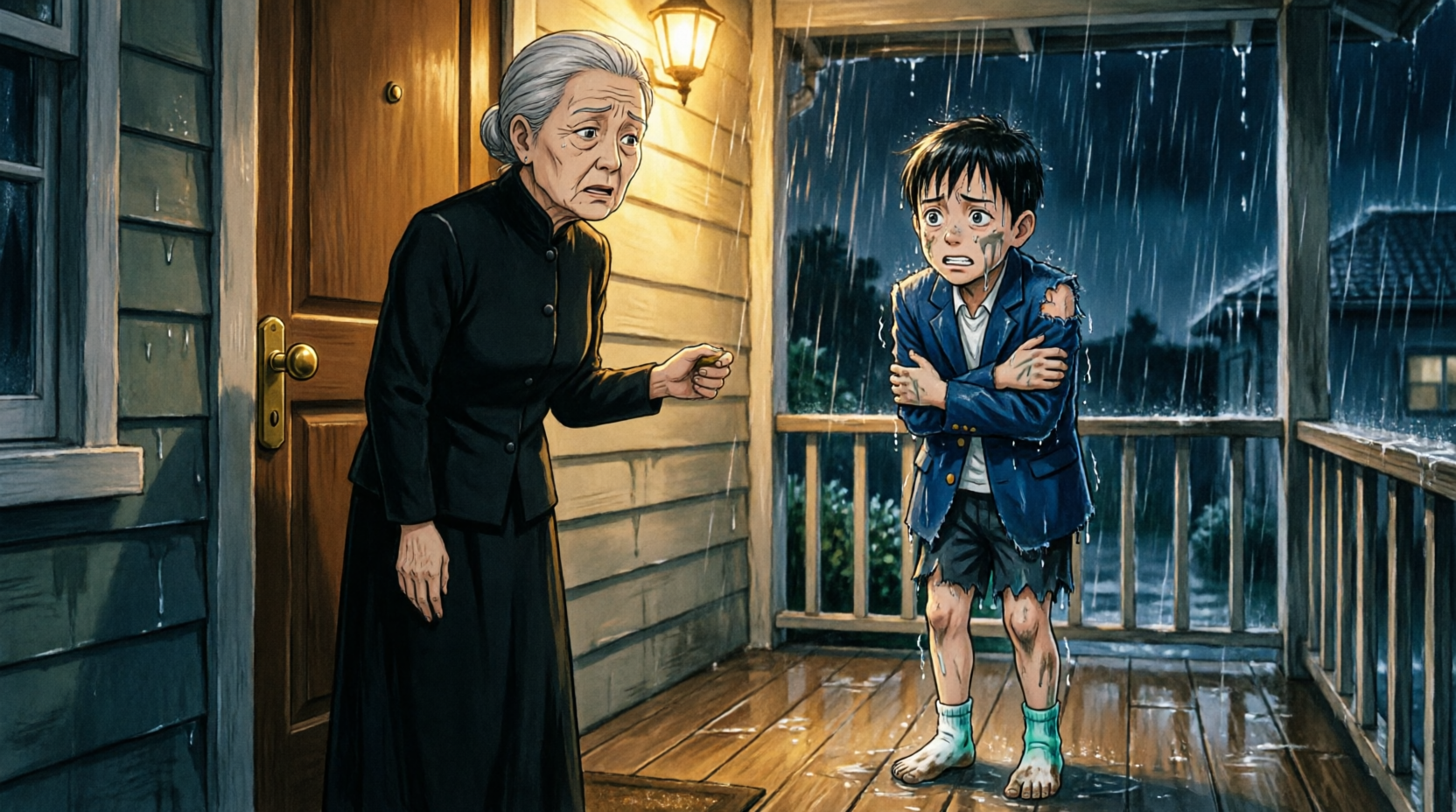
Because years earlier, I came home from my grandson’s funeral and found him standing on my porch in torn clothes, soaked from rain, shaking with grave dirt still under his nails.
The world called it a miracle.
They were wrong.
The miracle was not that Tyler survived the coffin.
The miracle was that after everything buried on top of him — fear, betrayal, darkness, grief, silence, evil — he still grew into someone gentle enough to laugh.
And every time I hear that laugh now, I remember something the monsters never understood:
Children are not weak because they cry.
Children are strong because they keep learning how to love after adults give them every reason not to.