Daniel had been my son for thirty-one years, but that morning he looked like a stranger wearing a familiar face. He stood at my front door pulling on his jacket, and I remember noticing the small things first. The sleeve was twisted near his wrist. His hair was still damp from a rushed shower. He would not quite look at Noah for more than a second at a time. Megan stood beside him with the diaper bag over one shoulder, rocking from foot to foot even though the baby was asleep against her chest.
She had the hollow-eyed look of a woman who had not slept in weeks. I knew that look. I had worn it when Daniel was a newborn, back when my husband still worked nights and I learned how long darkness could feel with a crying infant in my arms. New parents are tired in a way that changes the shape of a house. Dishes stack up.
Laundry sours in the washer. Coffee gets reheated until it tastes like metal. So when Daniel and Megan asked me to watch Noah for an hour or two while they went shopping, I did what any grandmother would do. I opened my arms. “Of course,” I said. “Go. I’ve got my grandson.” That sentence would come back to me later in the hospital, sharper than any accusation. I had said it with love.
They had heard it as cover. Noah was only two months old, light as a warm bundle of laundry and still new enough to smell like milk, powder, and the soft cotton of washed sleepers. Megan kissed his forehead before handing him to me. Her lips lingered there half a second too long. At the time, I thought she was just reluctant to leave him. Now I know reluctance can look almost exactly like fear. Daniel smiled, but it did not reach his eyes.
“Thanks, Mom,” he said. “We won’t be long.”
The front door closed behind them with an ordinary click.
Then Noah started crying.
At first, I thought it was the shock of being moved from his mother’s arms into mine.
Babies object to change with their whole bodies.
Their lungs do not care about your schedule, your nerves, or whether you have had breakfast.
I rocked him in the chair by the window and hummed the same lullaby I used to hum to Daniel.
The winter light sat pale on the carpet.
The clock on the wall ticked in that irritatingly loud way clocks only do when a baby is upset.
I checked the bottle Megan had packed and warmed it under running water.
I tested it against my wrist.
Perfect.
Noah turned his face away and wailed.
That was the first wrong thing.
A hungry newborn may fuss at first, but a hungry newborn does not usually refuse the thing he is begging for.
I changed positions.
I put him against my shoulder.
I cradled him low.
I walked slow loops from the living room to the kitchen, counting my steps under my breath because counting gives fear something to hold.
Then the sound changed.
It stopped being newborn fussing and became something rawer.
It had edges.
His little back arched hard against my arm.
His fists pulled tight against his chest, and his legs jerked up as if his body were protecting a place I could not see.
I had raised Daniel.
I had babysat nieces, nephews, neighbors’ babies, and half the children from church at one point or another.
I knew the difference between tired and terrified.
This was terrified.
“Easy, sweetheart,” I whispered. “Tell Grandma what hurts.”
He screamed.
Not cried.
Screamed.
There are sounds that pass through your ears, and there are sounds that go straight into your bones.
Noah’s scream went into my bones.
My phone was on the kitchen counter, and Daniel’s name was the first one in my favorites.
For one second, my thumb hovered over it.
Then Noah stiffened again, and something older than politeness rose up inside me.
Check him.
That was all the voice said.
I laid him on the changing table and unzipped his sleeper.
Snap.
Zipper.
Fold the cloth back.
Slide one hand beneath the knees.
His hair was still damp from a rushed shower.
He would not quite look at Noah for more than a second at a time.
Megan stood beside him with the diaper bag over one shoulder, rocking from foot to foot even though the baby was asleep against her chest.
She had the hollow-eyed look of a woman who had not slept in weeks.
I knew that look.
I had worn it when Daniel was a newborn, back when my husband still worked nights and I learned how long darkness could feel with a crying infant in my arms.
New parents are tired in a way that changes the shape of a house.
Dishes stack up.
Laundry sours in the washer.
Coffee gets reheated until it tastes like metal.
So when Daniel and Megan asked me to watch Noah for an hour or two while they went shopping, I did what any grandmother would do.
I opened my arms.
“Of course,” I said. “Go. I’ve got my grandson.”
That sentence would come back to me later in the hospital, sharper than any accusation.
I had said it with love.
They had heard it as cover.
Noah was only two months old, light as a warm bundle of laundry and still new enough to smell like milk, powder, and the soft cotton of washed sleepers.
Megan kissed his forehead before handing him to me.
Her lips lingered there half a second too long.
At the time, I thought she was just reluctant to leave him.
Now I know reluctance can look almost exactly like fear.
Daniel smiled, but it did not reach his eyes.
“Thanks, Mom,” he said. “We won’t be long.”
The front door closed behind them with an ordinary click.
Then Noah started crying.
At first, I thought it was the shock of being moved from his mother’s arms into mine.
Babies object to change with their whole bodies.
Their lungs do not care about your schedule, your nerves, or whether you have had breakfast.
I rocked him in the chair by the window and hummed the same lullaby I used to hum to Daniel.
The winter light sat pale on the carpet.
The clock on the wall ticked in that irritatingly loud way clocks only do when a baby is upset.
I checked the bottle Megan had packed and warmed it under running water.
I tested it against my wrist.
Perfect.
Noah turned his face away and wailed.
That was the first wrong thing.
A hungry newborn may fuss at first, but a hungry newborn does not usually refuse the thing he is begging for.
I changed positions.
I put him against my shoulder.
I cradled him low.
I walked slow loops from the living room to the kitchen, counting my steps under my breath because counting gives fear something to hold.
Then the sound changed.
It stopped being newborn fussing and became something rawer.
It had edges.
His little back arched hard against my arm.
His fists pulled tight against his chest, and his legs jerked up as if his body were protecting a place I could not see.
I had raised Daniel.
I had babysat nieces, nephews, neighbors’ babies, and half the children from church at one point or another.
I knew the difference between tired and terrified.
This was terrified.
“Easy, sweetheart,” I whispered. “Tell Grandma what hurts.”
He screamed.
Not cried.
Screamed.
There are sounds that pass through your ears, and there are sounds that go straight into your bones.
Noah’s scream went into my bones.
My phone was on the kitchen counter, and Daniel’s name was the first one in my favorites.
For one second, my thumb hovered over it.
Then Noah stiffened again, and something older than politeness rose up inside me.
Check him.
That was all the voice said.
I laid him on the changing table and unzipped his sleeper.
Snap.
Zipper.
Fold the cloth back.
Slide one hand beneath the knees.
I had done that motion so many times in my life that my hands were calm even when my chest was not.
Then I lifted the fabric above the diaper line.
The world narrowed.
Low on Noah’s abdomen, just above the waistband, was a dark purple bruise.
It was swollen around the edges.
It was not a rash.
It was not a birthmark.
It was not some harmless mark from a diaper tab or a car seat buckle.
It looked like fingers.
Four pressure marks, curved in a way no accident could easily explain.
My mouth went dry so fast it hurt.
The refrigerator hummed behind me.
The bottle sat untouched on the counter.
The house felt suddenly too clean, too quiet, too ordinary for what I was seeing.
Someone had hurt him.
That was the first full thought.
The second was worse.
Someone had hurt him before placing him into my arms.
I took a picture with my phone at 10:23 a.m.
I did not do it because I wanted proof against my son.
I did it because I have lived long enough to know that when a child is hurt, adults can become very creative with excuses.
A bruise can become a bump.
A scream can become colic.
A frightened mother can become forgetful.
A guilty man can become offended.
Some truths need witnesses before cowards start explaining them away.
I wrapped Noah in the blue blanket from the diaper bag, grabbed my purse, and found the hospital intake card I kept in my wallet from a previous visit.
By 10:26 a.m., I was backing out of my driveway.
The bottle was still on the counter.
The diaper bag was open on the passenger seat.
Noah cried in the car seat behind me, his little voice catching on every breath.
I did not call Daniel.
I did not call Megan.
I drove to County General Hospital with both hands locked around the steering wheel and prayed in a way that felt less like faith and more like begging.
There are moments when love stops sounding gentle.
It becomes a locked jaw.
A white-knuckled wheel.
A refusal to wait for permission from the people who may already be lying.
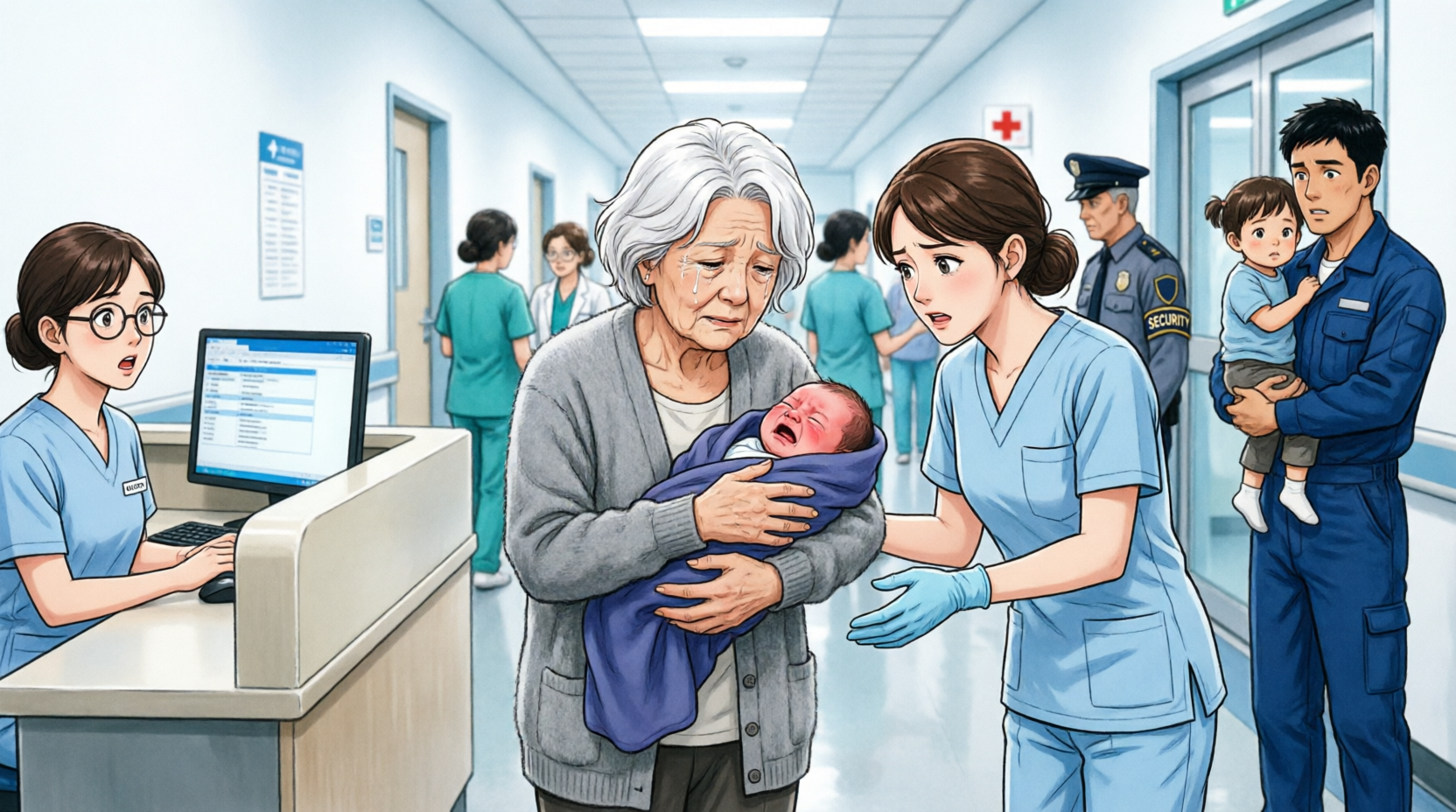
The emergency entrance doors slid open in front of me, and the smell hit first.
Antiseptic.
Burnt coffee.
Rainwater drying on the rubber mats.
I carried Noah to the triage desk, and the receptionist looked up with the practiced expression of someone who had seen too much and still had to ask for a name.
“He won’t stop crying,” I said. “I found a bruise.”
The triage nurse came around the counter immediately.
She had kind eyes until she pulled back the blanket.
Then the kindness stayed, but the softness left.
That was how I knew.
Her pen stopped above the intake form.
The receptionist stopped typing.
A young father near the vending machine stopped bouncing his toddler.
For a moment, the room held its breath around my grandson.
Nobody moved.
The nurse lowered her voice.
“Who had Noah before you?”
The question did not sound like suspicion.
It sounded like a door locking.
“My son and his wife,” I said. “Daniel and Megan. They dropped him off less than half an hour ago.”
She wrote down every word.
When I showed her the photo from 10:23 a.m., she asked me to send it to the hospital’s secure intake address.
Another nurse came and guided us behind a curtain.
They weighed Noah.
They checked his temperature.
They placed a tiny band around his ankle.
The pediatric doctor arrived with a face that had been trained into calm, but his eyes moved quickly.
He examined Noah gently, narrating every touch before making it.
“Grandma is right here,” he said softly. “We are just checking you, buddy.”
I stood so close my knees touched the side of the exam table.
I wanted to reach for Noah every time he cried.
I also knew the doctor needed space to see what I had seen.
The bruise looked worse under hospital light.
Brighter.
Crueler.
The doctor’s jaw shifted once, just once, before he looked at the nurse and asked for photographs, measurements, and a social work consult.
That was when my phone rang.
Megan.
I stared at her name until it stopped.
Then Daniel called.
I stared again.
The nurse saw the screen.
“Answer on speaker,” she said quietly.
I tapped the button with a shaking finger.
“Mom, where are you?” Daniel snapped. “Why aren’t you answering?”
“At the hospital,” I said.
Silence.
It lasted maybe two seconds, but it changed everything.
“What hospital?” he asked.
“County General.”
Megan made a sound in the background.
It was not surprise.
It was dread.
Daniel spoke over her.
“Why would you take him there? He cries all the time. You know babies cry.”
The doctor looked up.
The nurse’s pen moved faster.
“He has a bruise, Daniel.”
Another silence.
Then, much lower, he said, “What kind of bruise?”
A mother knows her child’s voice.
I knew Daniel’s lying voice when he was seven and had broken a lamp.
I knew his defensive voice when he was seventeen and had stayed out past curfew.
The voice on that phone was neither.
It was calculation.
Megan was crying now, not loudly, but close enough to the phone that I could hear the wet, broken inhale.
“Tell me you didn’t take him to the hospital,” Daniel said.
The room changed temperature.
The nurse looked at the doctor.
The doctor looked at Noah.
And I understood that Daniel had not asked what happened to his son.
He had asked whether I had brought witnesses.
“I’m going to hang up now,” I said.
“Mom,” he said sharply.
I ended the call.
My hands shook after that.
Not during.
After.
The doctor told me what would happen next.
Because Noah was an infant and the bruise was suspicious, the hospital was required to make a report.
A social worker would speak with me.
Security would be notified.
Daniel and Megan could come to the hospital, but staff would manage the situation.
I nodded as if I understood, but all I could see was Daniel at two months old, sleeping with one fist pressed against his cheek.
You never imagine raising a child who might one day frighten a baby.
You imagine scraped knees.
Bad grades.
Broken hearts.
You imagine mistakes large enough to hurt themselves.
You do not imagine this.
The social worker arrived with a tablet and a voice like steady ground.
Her name was Carla.
She asked me to walk through the morning minute by minute.
I told her everything.
The front door.
The bottle.
The crying.
The mark.
The photograph.
The drive.
The phone call.
She did not gasp.
She did not make promises.
She documented.
That calmness almost broke me because it meant this was not rare enough.
While Carla typed, Megan arrived.
She came through the curtain first, pale and shaking, with Daniel half a step behind her.
The moment she saw Noah on the exam table, she covered her mouth.
Daniel looked at me.
Not at Noah.
At me.
“What did you tell them?” he asked.
Carla stepped slightly between us.
“Mr. Parker, we are here to focus on Noah’s safety.”
“My baby is safe,” Daniel said too fast.
Megan whispered, “Daniel, stop.”
He turned on her so quickly that I saw her flinch.
It was small.
A blink-and-you-miss-it movement.
But the nurse saw it.
Carla saw it.
I saw it, and my stomach dropped.
“Megan,” Carla said gently, “would you like to step into the hall with me?”
Daniel laughed once.
It was an ugly sound.
“She doesn’t need to step anywhere.”
That was the moment I stopped seeing my exhausted son and started seeing the room around him.
The nurse moved closer to Noah.
The doctor stayed by the chart.
A security officer appeared beyond the curtain, not entering, just present.
Megan looked at me with eyes I will never forget.
They were begging and ashamed at the same time.
I said her name softly.
“Megan.”
Daniel snapped, “Don’t.”
And Megan broke.
“It was last night,” she whispered.
Daniel went still.
Carla’s fingers paused above the tablet.
Megan kept looking at Noah, not at Daniel.
“He wouldn’t stop crying. Daniel said I was useless. He took him from me. I heard Noah scream, and Daniel said he just grabbed him wrong.”
The words came out in pieces.
Ugly pieces.
Human pieces.
“I wanted to bring him in,” she said. “Daniel said they’d take him away. He said it would be my fault because I couldn’t calm him.”
Daniel’s face drained.
“She’s confused,” he said.
But nobody in that room looked confused.
The doctor asked Daniel to wait outside.
Daniel refused.
Security stepped in then, calm but firm.
“Sir, step into the hallway.”
For one second I thought my son might make the worst choice of his life in front of all of us.
Then he looked at the security officer, looked at the doctor, looked at me, and understood the room was no longer his.
He stepped out.
Megan collapsed into the chair beside the exam table.
Not dramatically.
Not like people fall in movies.
She folded down as if her bones had finally admitted they were tired.
“I’m sorry,” she whispered to Noah. “I’m so sorry.”
I wanted to hate her.
Part of me still did.
But another part of me saw a young mother cornered by fear, shame, and a man I had raised but no longer recognized.
Compassion is not the same as excuse.
That was a lesson I learned in that room.
The hospital report moved quickly after that.
Noah was admitted for observation.
The doctors ordered scans and bloodwork to rule out other injuries and medical causes for bruising.
Every form had his name on it.
Every photograph had a timestamp.
Every person who touched him wrote down what they saw.
By evening, a child protective services investigator and a police officer had both spoken with Megan.
I gave my statement twice.
The second time, I did not cry.
The first time, I cried so hard the officer paused the recorder and handed me a tissue.
Daniel did not come back behind the curtain.
He stayed in a consultation room until the officer spoke with him.
I do not know exactly what he said in there.
I only know that when he came out, he would not meet my eyes.
An emergency safety plan was put in place before Noah left the hospital.
Daniel was not allowed unsupervised contact.
Megan was allowed to remain with Noah only under conditions she agreed to in writing.
I was listed as temporary kinship support because the social worker said Noah already knew my voice and had settled against me after the examination.
That detail nearly undid me.
After all the crying, all the fear, all the fluorescent lights, he had quieted when I held him.
Not completely.
Not magically.
But enough.
The first night home, I sat in the old chair by the window with Noah asleep on my chest.
The same chair.
The same room.
The same clock on the wall.
But nothing felt ordinary anymore.
The bottle had been washed.
The changing table had been cleaned.
The blue blanket had been replaced because the original had been bagged with the sleeper as part of the hospital documentation.
Those little absences were everywhere.
A missing blanket can make a room feel like evidence.
Megan called me the next morning from her sister’s house.
She sounded smaller than I had ever heard her.
“I should have told you,” she said.
“Yes,” I said.
I did not soften it.
“I know.”
“You should have taken him in when it happened.”
“I know.”
“You should have protected him before you protected Daniel.”
She cried then, and I let her cry.
Forgiveness can come later.
Safety has to come first.
Over the next weeks, the case became something larger and colder than a family argument.
There were interviews.
Medical records.
Court dates.
A protective order.
Parenting classes for Megan.
Anger intervention for Daniel after he admitted enough for the court to understand what had happened, though not enough to satisfy the grandmother in me.
Noah healed faster than the rest of us.
The bruise faded from purple to green to yellow, then disappeared as if skin could simply decide to forget.
But I did not forget.
Megan did not forget.
And Daniel, whether he admitted it fully or not, learned that a baby’s body can tell the truth even when adults try not to.
Months later, Noah laughed for the first time in my kitchen.
It was a small sound, breathy and startled, as if he had surprised himself.
Megan was there, sitting across the room with Carla’s approval and my watchful eyes on her.
She covered her mouth and cried quietly.
This time, the sound did not frighten me.
It sounded like grief learning where to put itself.
Daniel was not there.
That is not a triumphant sentence.
It is a necessary one.
Family does not mean handing a child back into danger because the person who caused it shares your blood.
Blood is not a shield.
Love is not denial.
And motherhood does not end when your child becomes the person you have to stand against.
I still think about that Saturday morning.
The formula smell.
The soft sleeper.
The way Daniel pulled at his jacket sleeve.
The way Megan kissed Noah’s forehead too long.
I think about how close I came to calling them instead of checking him.
I think about how many terrible things survive because someone chooses politeness over instinct.
There are moments when love stops sounding gentle.
It becomes a locked jaw, a white-knuckled wheel, and a refusal to wait for permission.
That morning, love looked like a grandmother taking a picture she wished she never needed.
It looked like a hospital intake form.
It looked like a nurse whose voice changed before she asked the question that saved my grandson.
And it looked like one tiny baby, finally sleeping against my chest, while the adults around him learned that truth has a pulse of its own.