At 4:30 in the morning, the kitchen was still half-dark, lit by the stove hood and the weak yellow glow over the sink. The house smelled like eggs, coffee, and someone else’s expectations. Emily stood barefoot on the cold tile with her two-month-old son sleeping against her chest. His breath warmed the collar of her shirt. His tiny fingers had curled into the fabric as if holding on was instinct.
Mark walked in wearing yesterday’s exhaustion and a loosened tie. He did not kiss the baby. He did not ask if Emily had slept. He did not even look at the breakfast she had already started. He said one word. ‘Divorce.’ The coffee maker clicked behind her. The pan hissed softly on the stove. His parents’ breakfast plates were already set on the table, because they liked to eat early and somehow that had become Emily’s responsibility too.
For a few seconds, she could not make her body move. Not because she was surprised that the marriage had cracked. She had felt that for months. What stunned her was the casual cruelty of the timing. He said it while she held his son. Mark did not explain. He did not apologize. He barely looked at her face. That was what hurt most, the way he made a marriage ending sound like a calendar adjustment. Emily turned off the stove. She placed the spatula beside the pan with careful fingers. Her rage did not flare. It went cold and silent, settling somewhere behind her ribs where fear used to live.
Then she walked past him.
‘Emily,’ he said, finally looking up from his phone. ‘Don’t make this dramatic.’
She stopped in the hallway, but she did not turn around. For three years, she had tried not to be dramatic. She had tried to be useful, agreeable, grateful, quiet.
She had smiled when Mark’s mother corrected the way she cooked breakfast. She had stayed silent when Mark’s father joked that Mark was ‘carrying the whole household.’ She had endured Mark’s sister saying she was lucky to have a roof over her head.
Every little comment had been dressed up as family honesty. Every insult had been softened with a laugh. Every time Emily swallowed her answer, she told herself that peace was worth the silence.
But peace should not require a woman to erase herself.
That morning, with her baby’s cheek pressed against her chest and the kitchen still warm behind her, Emily finally understood the difference between keeping peace and disappearing inside someone else’s house.
ACT II — THE BLUE SUITCASE
In the bedroom, Emily pulled her old blue suitcase from the closet. It was the same suitcase she had brought into that house after the wedding, when she still believed moving in with Mark’s parents was temporary.
Back then, Mark had called it practical. Just a few months, he said, until they saved enough for their own place. Emily had believed him because people in love often mistake promises for plans.
She packed slowly because panic would have made her forget something important. Diapers went in first. Then bottles. Two outfits for the baby. A sweater for herself. A small pack of wipes.
Then she opened the bottom drawer of her nightstand.
The folder was there.
It was plain, worn at the corners, and heavier than it looked. Emily handled it more carefully than anything else she packed, because inside it was the part of the story Mark never thought she would be able to prove.
When she came back into the kitchen, Mark was leaning against the island, scrolling through his phone. The eggs sat cooling in the pan. The coffee had finished dripping. His parents’ plates still waited.
‘You’re really leaving?’ he asked.
Emily looked at him fully for the first time that morning.
‘I’m not making a scene,’ she said quietly. ‘I’m making a decision.’
Mark blinked as if the sentence had reached him in a language he did not speak. He thought she would drive around for an hour, cry in a parking lot, and return before his mother noticed breakfast was late.
He thought she had nowhere to go. He thought the baby would make her too scared to leave. He thought the roof over her head belonged only to his family.
Most of all, he thought she had nothing.
Outside, the driveway was still dark. Mark’s SUV sat beside his father’s pickup. The porch light flickered above the steps. A small American flag moved gently beside the mailbox in the early morning air.
Emily buckled her son into his car seat. Her hands shook once, then steadied. She had imagined screaming. She had imagined throwing every plate in that kitchen. Instead, she closed the car door softly.
Before she pulled away, her phone buzzed.
A message from Mark’s mother appeared on the screen: Breakfast at 6. Don’t forget the coffee cake.
Emily stared at the words for a moment. They did not know yet. They still thought she was inside, still available, still obedient enough to remember dessert while her marriage collapsed.
She turned the phone face down and drove away.
ACT III — THE WOMAN WHO OPENED THE DOOR
Emily did not go far. She drove across town to a small brick house with a narrow porch and wind chimes by the door. The sound of them was soft, metal against morning air.
Mrs. Henderson had been Emily’s neighbor before she married Mark. She was retired, widowed, and the kind of woman who noticed everything but only spoke when it mattered.
When Mrs. Henderson opened the door, she saw the baby first. Then the suitcase. Then Emily’s face, pale and sleepless, with that brittle calm people wear when they are trying not to fall apart.
She did not ask a single question.
She simply stepped aside.
‘Come in, sweetheart,’ she said.
It was the first kind sentence Emily had heard all morning. Not advice. Not judgment. Not a demand to think about the family. Just space, warmth, and a door opening instead of closing.
By noon, Mark’s family group chat had become exactly what Emily expected. Where are you? This is unnecessary. Think about the baby. You’re embarrassing the family.
She read the messages at Mrs. Henderson’s kitchen table with a cup of coffee cooling beside her hand. The baby slept in a borrowed blanket. Sunlight moved slowly across the table edge.
Then Emily opened the folder.
Inside were copies of bank statements, renovation receipts, a county records email, and one legal envelope Mark had never seen. These were not memories. They were not feelings. They were physical proof.
When Mark and Emily moved into his parents’ house, the arrangement was supposed to help everyone. Mark said they would save money. Emily said she wanted to contribute. She still had money from her father’s life insurance.
Her father had been careful his whole life, and after he was gone, that money became the last practical way he could protect her. Emily had not used it on luxuries. She had used it on Mark’s family home.
The roof had needed work. The plumbing had been unreliable. The kitchen floor, the same one Mark’s mother loved showing off whenever relatives visited, had been repaired partly because Emily paid for it.
At first, people thanked her. Then they stopped mentioning it. Then the story changed. The house became Mark’s family home again, and Emily became the woman who should be grateful to live there.
They never said her name.
But the receipts did.
That afternoon, Emily met Mr. Calloway in a small office between a tax service and a dental clinic. There were no glass walls, no dramatic speech, no polished intimidation. Just a calm older lawyer who listened.
Emily told him about the divorce word at 4:30 a.m. She told him about the breakfast plates, the years of comments, the life insurance money, and the way everyone acted as though her silence meant consent.
When she finished, she slid the folder across his desk.
Mr. Calloway opened it. He read the first page. Then the second. Then the third. His expression remained calm, but the room seemed to change around the papers.
‘Does your husband know you kept copies of these?’ he asked.
‘No,’ Emily said.
Mr. Calloway closed the folder gently, as if he understood that the papers represented more than money. They represented years of being told she had no place while her own contribution held the place together.
‘Then we will handle this carefully,’ he said. ‘You do not need to raise your voice when the paperwork is clear.’
For the first time that day, Emily felt her shoulders lower. Not because everything was fixed. Not because the pain had left. But because someone had looked at the evidence and called it real.
ACT IV — THE TABLE FOR FAMILY DECISIONS
Two days later, Mark asked Emily to come back to the house ‘so everyone could talk like adults.’ The phrase sounded mature, but Emily knew the shape of it before she arrived.
His mother would be waiting. His father would sit with folded arms. His sister would pretend to look at her phone while listening to every word. Mark would let them talk first.
So Emily went.
But she did not go alone.
Mr. Calloway walked beside her up the porch steps with the legal envelope tucked under his arm. Emily held her baby close. The porch boards creaked under her shoes. Behind the door, voices lowered.
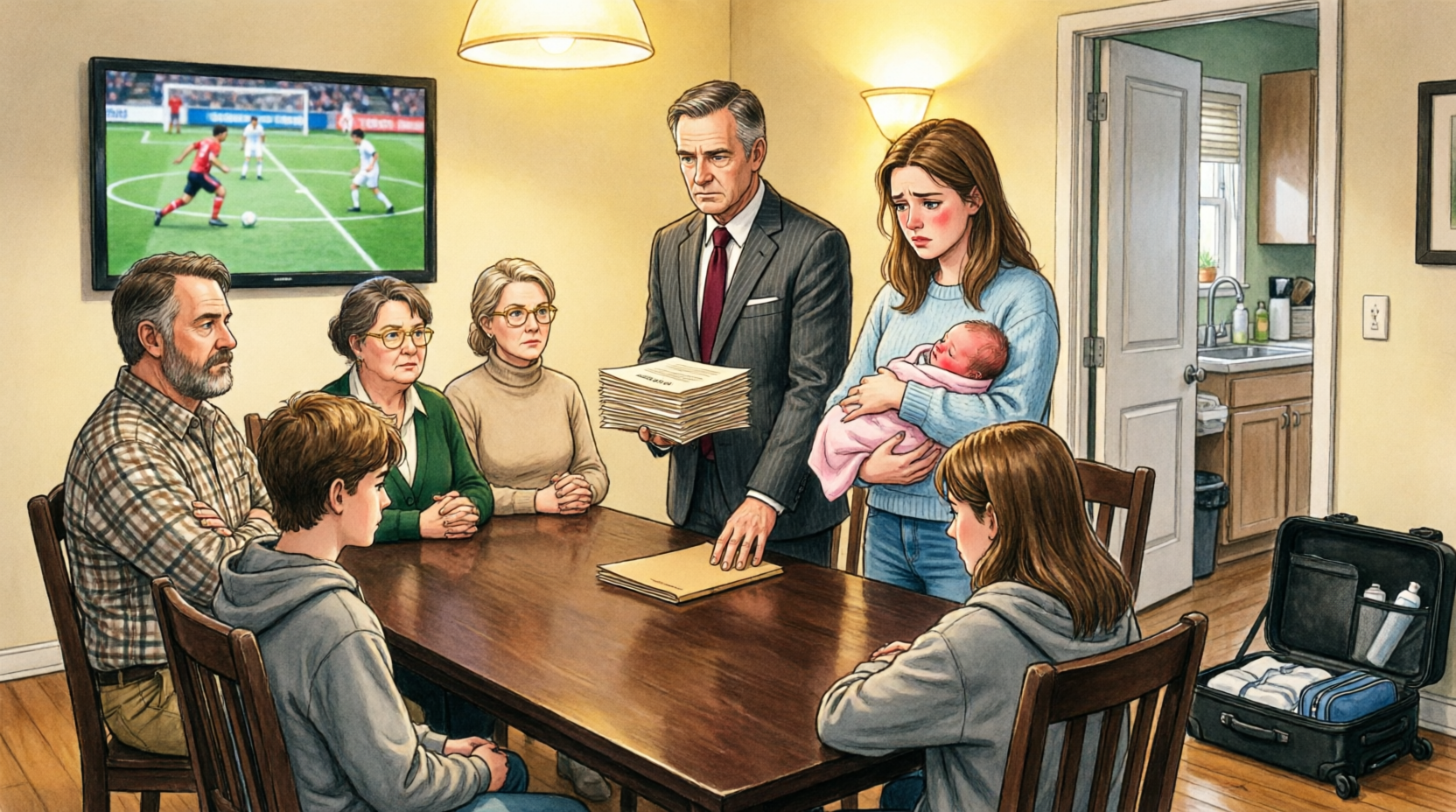
Inside, the whole family was already there. The TV was playing a football game nobody was watching. A casserole dish sat on the counter. Someone’s coffee had gone cold beside a folded napkin.
Framed family photos lined the wall like the house itself was trying to insist nothing had changed. Mark stood near the dining room, eyes avoiding Emily’s. His sister had her phone in hand.
Mark’s mother looked Emily up and down.
‘Well,’ she said, loud enough for everyone to hear, ‘I hope you’re finished making this harder than it needs to be.’
Nobody defended Emily. Mark looked at the floor. His sister gave a small nervous laugh. Mark’s father leaned back in his chair with the weary authority of a man who expected everyone else to fold.
A fork paused halfway between a plate and a mouth. A glass hovered near someone’s hand. The baby slept peacefully against Emily’s shoulder, unaware that the room around him had gone stiff.
Nobody moved.
Emily held her son a little closer. She could feel the old habit rising in her, the reflex to soften herself so the room would not turn colder. She locked her jaw and let the silence do its work.
Then Mark’s mother pointed toward the kitchen island.
‘You can sit over there,’ she said. ‘This table is for family decisions.’
The sentence landed exactly as she intended. It was meant to put Emily back where they believed she belonged: close enough to serve, too far away to matter.
Emily walked toward the kitchen island.
But she did not sit.
She placed the legal envelope on the counter. Mr. Calloway stepped forward with the calm of a man who had spent years watching people underestimate paperwork.
‘No,’ he said. ‘Mrs. Carter should sit at the table.’
Mark’s mother blinked.
‘Excuse me?’
Mr. Calloway opened the envelope and placed one document in the middle of the dining table. No one touched it at first. The football game kept flashing bright colors across the living room wall.
Mark’s mother reached for the paper with the tight smile she always used when she believed she was still in control. She read the first line. Then the second.
The smile disappeared.
Her hand lowered slowly to the table.
‘What is this?’ she asked.
Mr. Calloway answered before Emily could. ‘It is the signed agreement connected to Mrs. Carter’s financial contribution to this property.’
Mark finally looked up. His face changed, not with concern, but with recognition. He did not know the papers were coming, but somewhere inside him, he knew exactly what they meant.
Mr. Calloway placed another page beside the first.
‘And these are the monthly payments made from Mrs. Carter’s account when the household expenses fell behind.’
Mark’s father leaned forward. His sister stopped pretending to scroll. Mark’s mother looked at Emily then, really looked at her, maybe for the first time since Emily had entered that house as Mark’s wife.
‘You paid that?’ she asked.
Emily did not raise her voice. She did not need to. Her white knuckles loosened around the baby blanket, and the words came out steadier than she expected.
‘I helped keep this house steady,’ she said. ‘Because I thought I was part of this family.’
Mark rubbed one hand over his mouth.
‘Emily, I didn’t know you had all this.’
‘I know,’ Emily said.
And that was the whole point.
For years, they had mistaken her quiet for weakness. They had mistaken her patience for dependence. They had mistaken her kindness for permission.
ACT V — WHEN THE RECORDS ANSWERED
Mr. Calloway placed the final page on the table. It was the county records email. The paper looked ordinary, but the silence around it sharpened the moment it landed.
Mark’s father picked it up first. He read it once. Then again. Then he looked at Mark, and the room shifted in a way no one could pretend not to feel.
No one said a word.
The casserole sat untouched. The coffee stayed cold. The baby slept against Emily’s shoulder with his small mouth open, completely unaware that the adults around him were watching control slip from one side of the table to the other.
Mr. Calloway closed the folder.
‘You dismissed her in public,’ he said calmly. ‘Now the records are answering in public.’
Emily looked at Mark. She remembered him standing in the kitchen at 4:30 a.m., saying divorce while she held their son and breakfast warmed for the very people who treated her like an inconvenience.
‘You asked for a divorce while I was feeding your family and holding our son,’ she said. ‘So now we will do this properly.’
Mark’s mother opened her mouth, but no words came out. For once, there was no correction, no sharp little joke, no command disguised as common sense.
Emily did not feel triumphant. That surprised her. What she felt was clearer than triumph and heavier than anger. She felt the strange, steady dignity of someone who had finally stopped begging to be believed.
Then her phone buzzed.
One new voicemail.
County Clerk’s Office.
Everyone saw the name on the screen. Mark’s sister lowered her phone completely. Mark’s father stopped moving. Mark looked from Emily to Mr. Calloway as if trying to calculate what else he had missed.
Emily pressed play before anyone could tell her not to.
The room held its breath. The football game kept flashing behind them, too bright and too loud, but nobody heard it anymore.
And when the woman on the recording said the first sentence, Mark’s mother reached for the back of the chair behind her.