Arthur’s Easter Sunday had started with black coffee, lemon cleaner, and the quiet kind of loneliness he had learned not to complain about. At 2:13 p.m., he was standing at the kitchen sink with dish soap slick on his hands, watching the coffee go cold beside a plate he had not bothered to fill.
The house smelled faintly of ham glaze because he had cooked the way Lily used to like, even though he knew she would not be there. She had her own life now. That was what he told himself. A husband. A big house. Holidays with polished people who knew how to hold champagne glasses and say all the right things at the wrong volume.
He had tried not to hate that world. He had tried not to resent the way Richard’s family made every invitation feel like a favor, every favor feel like a debt, and every debt feel like proof that Arthur was lucky to be included at all. Then his phone buzzed.
He almost wiped his hands first. Then he saw Lily’s name. “Dad… please come get me,” she whispered. The words came out broken, thin, and breathless. Arthur went still. “Lily?” “He hit me again.” There are sounds a parent recognizes before the mind understands them. The wet breath. The tremor in the throat. The way fear makes someone whisper even when no one is standing beside them.
Arthur heard a scream.
Then he heard the phone hit something hard.
Under it all, classical music kept playing, and children laughed somewhere in the distance.
For one second, Arthur was not in his kitchen anymore.
He was remembering Lily at six years old, standing on a dining chair in her socks, asking him if she could crack the eggs for pancakes.
He was remembering her at nineteen, crying beside a highway after a flat tire, too embarrassed to admit she did not know where the spare was.
He was remembering college, when she called during her first panic attack and said, “Dad, I think I’m dying,” and he drove through the night just to sit outside the emergency room with her until she could breathe again.
He was remembering the night Richard proposed.
Lily had called him late, whispering like a girl trying not to wake a dream.
“He asked me,” she said.
Arthur had smiled because fathers are trained by love to smile first.
But her laugh had come half a second late.
That half second stayed with him.
For two years, he told himself he was being unfair.
Richard was polished, yes.
Cold sometimes.
Too quick to answer for Lily.
Too good at putting one hand on the small of her back and steering her away from conversations he did not like.
But Arthur had shaken his hand.
He had given his blessing.
He had watched Lily walk down an aisle toward a man he did not fully trust because she was looking back at him with hope in her eyes.
That was the thing Richard had taken first.
Not Lily’s freedom.
Not her voice.
Arthur’s permission.
Men like Richard love a blessing from the person who should have known better.
Arthur did not remember grabbing his keys.
He did not remember turning off the sink.
He only remembered the scrape of tires on his driveway and the taste of metal in his mouth as he drove.
Twenty minutes later, his pickup slammed into park outside Richard’s gated estate.
The place looked like a postcard for a life Arthur had never wanted.
White tents dotted the lawn.
Children in pastel shirts moved between trimmed hedges.
Painted eggs clicked into wicker baskets.
Soft music drifted through hidden speakers.
Someone near the side yard laughed too loudly.
Someone else called for more ice.
The air smelled like cut grass, barbecue smoke, expensive perfume, and sugar.
Everything looked cheerful.
Everything looked clean.
That was the lie.
Arthur climbed the marble steps two at a time.
He did not ring the bell.
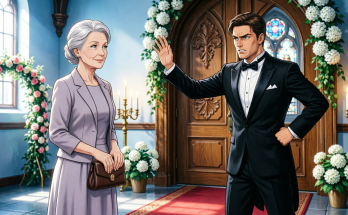
He reached for the handle, but Richard’s mother stepped into the doorway before he touched it.
She was dressed in ivory, diamond rings bright on her fingers, a mimosa in one hand.
Her perfume hit him first.
Powdery.
Sharp.
Expensive enough to feel like an insult.
“Go back to your lonely little house, Arthur,” she said.
Her mouth barely moved.
“Lily is resting. Don’t bring your drama here and ruin our family holiday.”
He tried to step around her.
She shoved him.
Hard.
His heel scraped against the porch stone.
For one ugly second, old training came back.
Arthur saw the angle of her wrist.
The open doorway behind her.
The way to move without warning.
The exact pressure that would put her on the ground and keep him standing.
He did not touch her.
That restraint cost him more than she would ever understand.
He pushed past instead.
The heavy door swung inward.
The living room froze in pieces.
A woman near the buffet stopped with a deviled egg halfway to her mouth.
A man in a linen jacket lowered his champagne but did not set it down.
Someone’s fork clicked once against china.
Outside, children kept laughing on the patio because no adult had bothered to tell them the house had just split open.
Lily was on the floor.
For a moment, that was the only fact in the world.
Not Richard.
Not the guests.
Not the money in the walls or the polished white rug beneath her.
Only Lily.
His daughter lay curled on her side in the center of the room, one hand tucked against her ribs and the other near her throat.
Her cheek was swollen.
One eye was darkening.
Her lip was split.
A thin red line marked the rug beneath her mouth.
Arthur had seen people hurt before.
He had seen men pretend not to be afraid.
He had seen rooms after violence and rooms before violence and rooms where every object told a story nobody wanted written down.
But nothing in his old life prepared him for the sight of his child trying to make herself smaller than a living room.
Richard stood over her, adjusting his French cuffs.
That was what stayed with Arthur later.
Not the blood.
Not the bruise.
The cuffs.
That neat, calm little gesture.
As if Lily were a mess he intended someone else to clean.
Richard poured himself a Scotch.
“Old man, calm down,” he said.
He sounded bored.
“She’s clumsy. She tripped.”
Arthur looked at Lily’s neck.
Four fingerprints.
One thumb mark.
“She tripped and left handprints on her own throat, Richard?” he asked.
Richard’s mother stepped in behind him, voice sharp enough to cut glass.
“Arthur, don’t be vulgar.”
As if the crime in that room was his language.
As if a father naming what he saw was the indecent part.
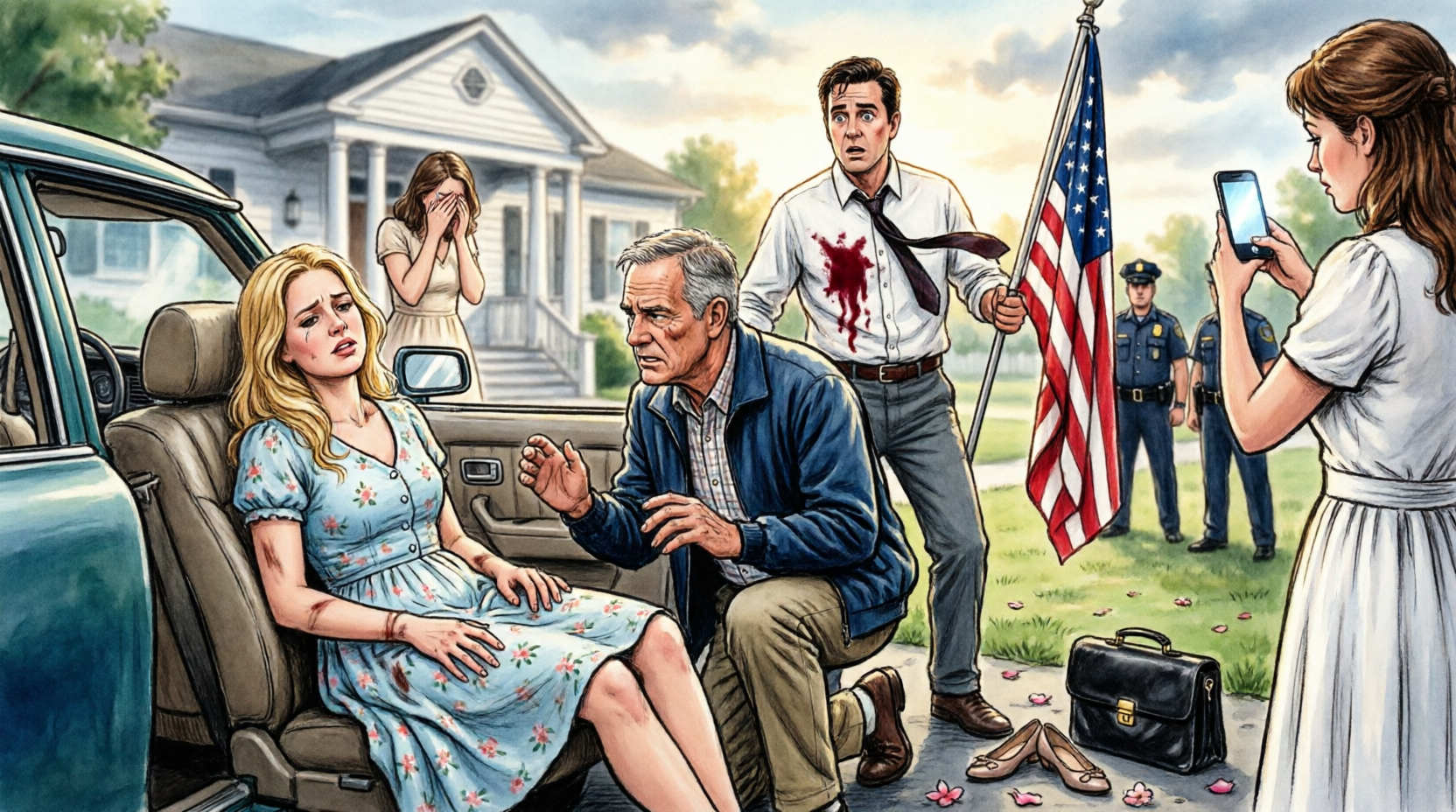
At 2:36 p.m., Arthur noticed the cracked phone under the edge of the sofa.
The screen was still glowing.
Still recording.
That mattered.
So did the blood on Richard’s cuff.
So did the Scotch on his breath.
So did the smear on the rug.
So did the way three guests stared at Lily and then looked away like eye contact might make them witnesses.
Through the back windows, Arthur saw the local Chief of Police laughing beside the barbecue with a paper plate in his hand.
That mattered most of all.
Arthur’s mind changed shape.
The panic did not leave.
It became organized.
He documented the room the way he had once documented hostile sites.
Exits.
Witnesses.
Victim condition.
Compromised authority.
Visible evidence.
Cracked phone.
Bloodstained cuff.
Thumb mark.
Recording.
A Chief eating lunch in the backyard of the man Arthur might need arrested.
This was no longer family drama.
This was evidence.
Richard laughed.
The sound made two guests flinch.
“Let me explain how the world works to a simple, retired old man like you,” Richard said.
He stepped closer, chest puffed out, Scotch glass loose in his hand.
“My family owns this town. The Chief is in my backyard right now, eating food I paid for. Go ahead. Call the cops. Let’s see who they put in handcuffs.”
The room went very quiet.
A candle on the buffet flickered.
The woman with the deviled egg lowered her hand.
A man near the fireplace stared at the white rug as if the pattern had suddenly become fascinating.
Nobody moved.
Arthur knew Richard was right about one thing.
Conventional law in that town had already been bought lunch.
But Richard made the mistake that arrogant men always make.
He mistook restraint for fear.
He mistook silence for surrender.
He mistook Arthur’s old flannel shirt and tired eyes for weakness because money had trained him to read people by polish.
Arthur knelt beside Lily.
She flinched when his hand touched her shoulder.
The flinch went through him harder than any punch could have.
Then she recognized him.
Her fingers caught his sleeve.
“Dad,” she whispered.
Her voice was so small he had to lean close.
“Don’t let him make me stay.”
Arthur felt something inside him go still.
“I won’t,” he said.
He slid one arm beneath her shoulders and another beneath her knees.
“Not another minute.”
Richard took a slow sip of Scotch.
“You walk out with her, Arthur, and I’ll have you arrested for kidnapping my wife.”
There it was.
The final proof.
Not concern for Lily.
Not panic.
Not even shame.
Possession.
Arthur stood with his daughter in his arms.
His jaw locked so hard he tasted copper where he had bitten the inside of his cheek.
“You are going to deeply, profoundly regret saying that,” he whispered.
Then he carried Lily through the front door.
The Easter party pretended not to breathe.
Richard laughed behind him.
His mother shouted about disgrace.
On the lawn, children kept dropping painted eggs into baskets, pastel shells clicking together in the bright spring light.
The world outside was still pretending to be beautiful.
Arthur crossed it with his daughter bleeding against his chest.
At the truck, he laid Lily across the front seat as gently as he could.
She made a small sound when her shoulder touched the upholstery.
He apologized under his breath.
Not because he had hurt her.
Because he had not gotten there sooner.
Her eyes fluttered.
“Dad,” she whispered.
“I’m here.”
“He said nobody would believe me.”
Arthur looked back at the house.
Richard was on the porch now.
Still smiling.
Still performing for his guests.
His mother stood behind him with the stiff posture of a woman who had never once mistaken cruelty for a problem.
Arthur reached under the dash.
His fingers found the black case before his mind fully admitted what he was doing.
He had not opened it in fifteen years.
He had buried that life on purpose.
He had put it behind him so thoroughly that Lily knew only pieces of it, mostly softened for a child.
Travel.
Government work.
Long absences.
Friends with strange phone numbers.
She never knew the details, and he had wanted it that way.
He had wanted to become ordinary.
A man with a pickup.
A man who fixed loose cabinet hinges.
A man who made coffee too strong and kept old receipts in a drawer.
A father, nothing more.
But some doors do not disappear because you stop looking at them.
They wait.
Inside the case were three things Richard knew nothing about.
A military-grade satellite phone.
An emergency authentication card.
A laminated contact sheet from a life Arthur had buried so he could become just Lily’s father.
The phone felt heavier than he remembered.
The plastic had gone slightly smooth at the edges.
The authentication card had one corner of laminate peeling back.
The names on the contact sheet were old, but not dead.
Not to him.
Not if the code still worked.
Arthur glanced at Lily.
Her eyes were half closed.
Her breath hitched.
He could still hear the music from the lawn.
He could still hear Richard’s laugh.
He activated the phone.
The encrypted line clicked once.
Then twice.
A tone answered.
Arthur spoke before the old part of himself could talk him out of it.
“We have a Code Black,” he said.
His voice did not shake.
“Burn it all down.”
On the porch, Richard’s smile widened, as if he thought the phrase was theater.
His mother said something Arthur could not hear through the glass.
Behind them, guests had started gathering near the doorway.
Some watched Lily.
Some watched Arthur.
Some watched the Chief in the backyard, still laughing beside the barbecue with a paper plate in his hand.
The line hissed softly.
Then a voice from Arthur’s old life answered.
Calm.
Familiar.
Unsurprised.
“Is your daughter alive?”
Arthur closed his eyes for half a second.
“She’s breathing,” he said.
The silence that followed was not confusion.
It was procedure.
“Authentication.”
Arthur slid the card free with one hand while his other rested against Lily’s shoulder.
He read the code.
Once.
Cleanly.
No extra words.
The line went quiet again.
Richard stopped laughing.
It happened slowly.
Not because he understood everything.
He did not.
That was the problem with men like Richard.
They thought every world worked like theirs, with favors, donations, handshakes, and men at backyard barbecues pretending a badge made them untouchable.
But Richard understood enough.
He understood Arthur had not called 911.
He understood the old man with the pickup had reached somewhere else.
He understood the room had shifted before he knew where the floor had moved.
Arthur heard the next click on the line.
“Status.”
Arthur looked through the windshield at his daughter’s face.
Then at the porch.
Then at the Chief laughing in the backyard.
“Victim injured,” he said.
“Active recording on scene. Local authority compromised. Multiple civilian witnesses. Suspect threatened false arrest.”
The words came from him in a voice he had not used in years.
Lily’s fingers tightened on his sleeve.
She was listening.
That almost broke him.
Because he did not want her to know this version of him.
He did not want her to hear the coldness.
He wanted to be the father who warmed soup, checked tire pressure, and waited outside doctors’ offices with bad coffee.
But love is not always soft.
Sometimes love is a hand that does not tremble when the room is trying to bury the truth.
The voice on the phone asked for the location.
Arthur gave it without adding a city name, because the system did not need a city name.
It needed coordinates.
The satellite unit found them.
A small green light blinked.
The truck’s dash camera chimed.
Arthur frowned.
He had forgotten the thing was still plugged in.
A tiny red light blinked against the windshield.
It had caught the porch.
The shove.
The open doorway.
Richard standing behind his mother.
Maybe even Lily’s voice from the first call, faint but present from Arthur’s phone speaker as he ran up the steps.
Arthur looked at Richard’s mother.
She saw the red light too.
Her face changed first.
Not with guilt.
With calculation.
That was somehow worse.
Her mimosa slipped from her hand and hit the porch stone.
Orange juice and champagne spread around the toe of her shoe.
Richard looked from her to the truck.
Then to Arthur.
Then to the black case.
For the first time since Arthur had arrived, Richard stepped down from the porch without swagger.
“Arthur,” he called.
His voice had changed.
The voice on the satellite phone returned, lower now.
“Keep the line open. Do not hang up. Tell me exactly where the Chief is standing.”
Arthur looked through the house, past the frozen guests, through the back windows, out to the lawn where the Chief was still laughing beside the barbecue.
A man in uniform can look very small when the wrong record starts running.
Arthur described it all.
The tents.
The side yard.
The back patio.
The Chief’s position.
The guests closest to the doorway.
The cracked phone under the sofa.
The bloodstained cuff.
The thumb mark on Lily’s throat.
He did not embellish.
He did not need to.
Evidence does not need poetry.
It needs sequence.
Time.
Place.
Condition.
Witnesses.
Arthur had all of them.
Richard kept walking toward the truck.
“Let’s not make this bigger than it needs to be,” he said.
Arthur almost laughed at that.
Bigger.
As if Richard had not made it big the moment he put his hands on Lily.
As if his mother had not made it bigger when she shoved a father off the porch.
As if the Chief had not made it bigger by eating lunch in the backyard while a battered woman lay on a rug inside.
Lily shifted in the seat.
“Dad,” she whispered.
Arthur put one hand over hers.
“You’re going to be okay.”
He did not know whether that was medically true yet.
He knew it had to become true.
Richard stopped beside the front of the pickup.
His Scotch glass was gone now.
His hands were empty.
That did not make Arthur trust them.
“Arthur,” he said again.
This time it almost sounded like a plea.
Behind him, his mother held onto the porch railing with both hands.
One guest had started crying silently.
Another had taken out a phone but did not seem to know what to do with it.
The Chief finally looked toward the house.
The backyard laughter thinned.
The whole estate seemed to hold its breath.
Arthur raised the satellite phone enough for Richard to see it clearly.
Not a threat.
Not a weapon.
A line.
Richard’s eyes dropped to the open black case.
Then to the emergency card.
Then to the dash camera’s red light.
That was the moment his confidence drained out of his face.
He had expected a lonely retired father.
He had expected a shouting match.
He had expected the local Chief to do exactly what the local Chief had been fed to do.
He had not expected procedure.
He had not expected a recording.
He had not expected the man he called simple to know exactly how to document a scene, preserve a victim, identify compromised authority, and keep a live line open.
Arthur looked at his daughter.
For years, he had worried that his silence about Richard had been respect.
It had not been respect.
It had been hesitation.
And hesitation had a cost.
He would carry that cost for the rest of his life, but Lily would not carry it alone.
The calm voice on the phone gave one more instruction.
“Stay where you are. Keep the victim visible. Keep the suspect in sight.”
Arthur obeyed.
Richard tried one more smile.
It failed before it reached his eyes.
“Arthur,” he said, softer now. “You don’t know what you’re doing.”
Arthur looked at him through the open truck door.
For the first time that day, his voice sounded almost gentle.
“No, Richard,” he said. “That’s the problem.”
The satellite phone clicked again.
The dash camera kept recording.
Lily’s hand stayed locked around his sleeve.
And inside that bright, expensive Easter afternoon, with eggs still scattered across the lawn and music still playing for a party that had already died, Richard finally understood he had not trapped Arthur’s daughter in his world.
He had dragged his own world into Arthur’s.