Sarah did not marry David because she thought he was dangerous. She married him because he was patient at first. He opened doors, remembered her coffee order, spoke respectfully to her father, and made stability look like love. At the beginning, even his carefulness seemed tender. Her father had never trusted charm without substance. Before the wedding, he gave Sarah a fireproof folder with her inheritance records inside. It held the trust packet, First Meridian Bank statements, account authorization pages, and copies of the original transfer protections.
Sarah had laughed then, embarrassed by his caution. She told him David was not that kind of man. Her father kissed Emma’s baby-soft forehead and said he hoped she was right. For a while, David let her believe she was. The change came slowly enough to make every piece seem reasonable. First, he suggested combining accounts because married people should not act like strangers. Then he began checking receipts. Then he asked why her father still had so much influence. By the time Emma turned 4, Sarah understood the truth she had been trying not to name. Control rarely arrives looking like a fist. First it arrives as concern. Then advice. Then paperwork.
Margaret, David’s mother, made the cage feel elegant. She never shouted. She smiled over wine, touched her pearls, and called Sarah fragile in a voice sweet enough to pass for concern. At family dinners, she praised David’s patience as if Sarah were a difficult project. David learned from her. Or perhaps Margaret had learned from him. Either way, they understood each other perfectly.
The trust signal Sarah had given David was access. She had added him to the joint account after the wedding because he said it would make taxes easier. She showed him where documents were kept because marriage, she thought, meant not hiding.
That trust became a map.
The first time Sarah questioned missing money, David called it a misunderstanding. The second time, he called it stress. The third time, he laughed and said she had never been good with financial pressure.
Then his sister began driving the car Sarah had paid for.
Sarah started documenting quietly. She photographed account screens. She saved bank alerts. She wrote down dates, times, and explanations. On paper, the pattern looked less like confusion and more like a plan.
On Tuesday, at 8:17 p.m., First Meridian Bank sent the alert.
The transfer confirmation appeared while Sarah stood in the kitchen, the smell of lemon cleaner sharp in the air. The joint-account ledger showed money leaving. The source line underneath made her hands go cold.
It was her inheritance.
Not grocery money. Not mortgage money. Not an emergency expense. The money her father had protected before she ever met David had been moved through paperwork David had no right to touch.
Sarah stared at the phone until the numbers blurred.
Above her, the chandelier hummed. The kitchen looked perfect in the way expensive rooms can look perfect while something ugly is happening inside them. Marble. Polished wood. Crystal. Silence waiting to be used against her.
David came in smelling like bourbon and cologne.
His tie was loosened just enough to look casual. His eyes were not casual at all. They moved from Sarah’s face to the phone in her hand, then back again.
“You transferred the money,” Sarah said.
“Our money,” David answered.
“My inheritance.”
His smile bent into something small and cruel. “Your father’s charity.”
Margaret entered behind him with wine in one hand and judgment already arranged on her face. Pearls sat against her throat. She looked around the kitchen as if she were inspecting a room after bad service.
“Don’t make this ugly, Sarah,” she said. “You know you’ve never been good under financial pressure.”
Sarah looked toward the stairs.
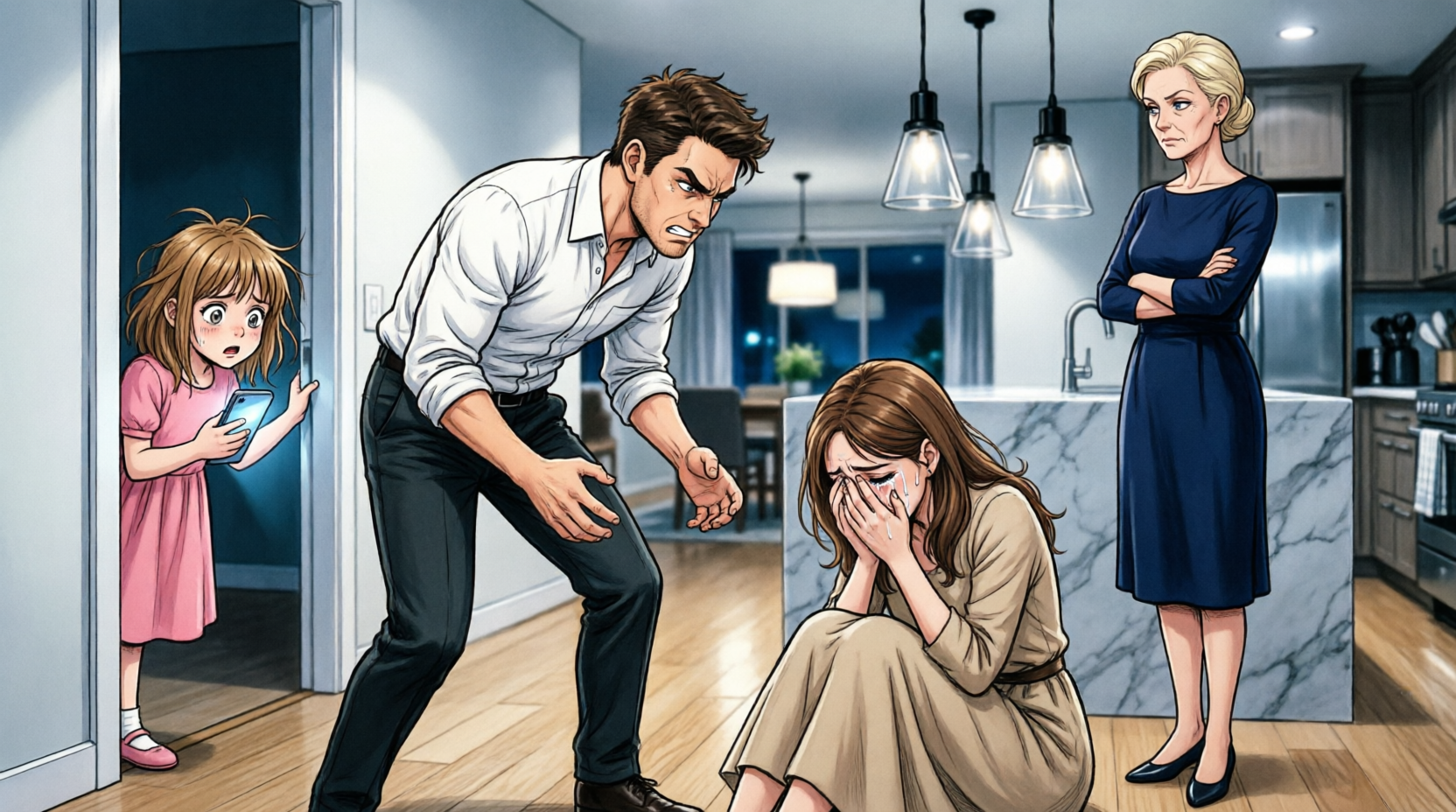
Emma was there. Four years old, in pink pajamas, one hand covering her mouth. Only her little feet and sleeve showed between the railing posts, but Sarah could see enough.
Her body wanted to run to her daughter. Her mind knew better.
Months earlier, after David locked Sarah’s phone in his desk drawer during an argument, Sarah had taught Emma a secret game. If Mommy holds up two fingers, run to the phone. Press the big red button. Say exactly what you see.
Emma thought it was a game because Sarah had made her laugh while practicing. Sarah had smiled through every rehearsal because fear is easier for a child to carry when it has rules.
That night, the rule became real.
“Put it back,” Sarah said.
David laughed. Then the laugh disappeared.
He crossed the marble in three steps. His hand caught the front of her silk blouse, twisting fabric against her collarbone. Sarah saw his cufflink flash under the chandelier right before he threw her backward.
The kitchen island caught her hip first.
Pain exploded white behind her eyes. She hit the wooden floor wrong, and her right leg twisted underneath her with a sound so clean and wrong that the room seemed to stop around it.
Emma screamed.
Margaret did not.
Her wineglass remained halfway lifted. A drop of red wine slid slowly down the crystal stem. The refrigerator kept humming. Somewhere, water ticked once inside the sink. Margaret looked at the floor instead of at Sarah, as if polished wood deserved more mercy.
Nobody moved.
Then Margaret took one careful sip and said, “Look what you made him do.”
That sentence stayed with Sarah longer than the first wave of pain. It was the perfect family verdict: the injured person had caused the injury, and everyone polite enough would pretend not to know the difference.
David crouched beside Sarah.
“Tell your father you slipped,” he said. “Tell everyone the floor was wet.”
Sarah could feel sweat collecting at her neck. Her leg burned so violently that the edges of the room doubled. For one savage second, she imagined grabbing his tie and pulling him down into the pain with her.
Instead, she lifted her right hand.
Two fingers.
Emma went still.
Then she ran.
David’s head snapped toward the hall. “Where is she going?”
The keypad beeped once. Twice. Three times. Each sound was tiny and bright in the huge kitchen. Sarah heard Emma breathing too fast, then her daughter’s trembling voice filled the room.
“Grandpa,” Emma whispered. “Mommy looks like she’s going to die! There was a very bad accident!”
For the first time in three years, David looked afraid.
The speaker crackled.
Sarah’s father answered with a voice so steady it seemed to cut through the bourbon, the cologne, and the lies. “Sarah, do not move.”
David looked at the phone. Margaret lowered her glass.
Emma sobbed, “Daddy pushed Mommy. Her leg is wrong.”
Sarah’s father did not ask Emma to explain. He did not tell her to calm down. He asked for the address only to confirm it, then said, “1294 Oak Haven. Send police and medical.”
David’s face changed when he realized another voice was already listening.
He stepped toward the phone. Sarah’s father said, “Do not touch that child.”
Margaret finally moved. Her hand shook, spilling red wine over her pearls. “David,” she whispered, “stop talking.”
But David had spent too long believing silence belonged to him. He pointed at Sarah and said, “She fell. She always exaggerates. She’s unstable.”
The phone recorded every word.
That recording became the first clean piece of evidence. The second was the First Meridian Bank transfer confirmation at 8:17 p.m. The third was the emergency medical report describing a spiral fracture inconsistent with a simple slip.
By the time police arrived, David was still trying to perform control.
He stood near the island, palms open, voice polished. Margaret sat rigidly at the counter, the front of her blouse stained with wine. Emma would not let go of the phone until Sarah’s father promised he was at the gate.
The paramedics reached Sarah first.
They cut the room into instructions. Stay still. Breathe. Look at me. Tell me where it hurts. Sarah answered because Emma was watching, and because pain had not taken away her ability to tell the truth.
Her father arrived as they lifted her onto the stretcher.
He did not shout at David. That almost frightened David more. He went to Emma, knelt carefully, and asked if she wanted to hold his sleeve. She grabbed it with both hands.
At the hospital, Sarah learned the break would require surgery. She also learned her father had already contacted First Meridian Bank’s fraud department and placed an emergency hold on the transfer.
The money had not cleared.
That fact made Sarah cry harder than the diagnosis.
Not because money mattered more than her leg. Because for three years David had taught her that every door opened only through his permission, and suddenly one door had slammed shut in his face.
The investigation moved quickly because the evidence was not emotional alone. It was documented.
There was the call recording. There was the bank ledger. There were Sarah’s screenshots from earlier withdrawals. There were photographs of the kitchen floor showing no spill where David claimed she slipped.
Margaret gave one statement at first. Then another. They did not match.
Her first version said Sarah had been hysterical. Her second said she had looked away and did not see the fall. The prosecutor did not need to call her a liar. The timeline did that by itself.
David’s defense leaned on the old language.
Stress. Miscommunication. A private family matter. An unfortunate accident. The words sounded expensive and familiar, but they had to stand beside Emma’s call.
“Grandpa, Mommy looks like she’s going to die.”
No polished sentence could soften that.
Sarah spent weeks recovering. The physical pain was brutal, but the quieter pain came in strange places. Reaching for a glass. Hearing footsteps in a hallway. Watching Emma flinch when a man raised his voice on television.
Healing was not a clean line. It was paperwork, therapy, court dates, bank forms, and mornings when Sarah woke furious that survival required so much administration.
Her father kept the fireproof folder on the hospital table.
Inside it, Sarah added new papers: the police report, hospital intake forms, surgical notes, protective order, and bank fraud claim. The folder became something different after that. Not just protection from theft.
Proof that she had been there.
Proof that she had told the truth.
Months later, the court reviewed the evidence. David’s assault charge moved forward. The financial investigation widened after First Meridian Bank traced prior transfers tied to his sister’s car and other expenses Sarah had never approved.
Margaret sat behind him in court, pearls replaced by a plain scarf.
She did not look at Sarah. She looked at the floor again. This time, the floor could not save her from what she had heard, seen, and excused.
Emma testified only through recorded statements and child specialists. Sarah made sure of that. Her daughter had already done enough.
When the call played, the courtroom went still…………………………..