“We are safe here.”
Emma fell asleep soon after.
I stayed awake long after her breathing softened.
At 2:13 a.m., my phone buzzed.
Unknown number.
No words.
Only a photo.
My blood turned cold.
It was the fireproof folder.
The original one.
The folder my father gave me before the wedding.
The one now locked inside his study safe.
Except in the photo, the folder lay open on David’s desk.
My pulse stopped.
Then a message appeared beneath it:
You should have checked what he copied before you ran.
I sat up too fast and pain shot through my leg.
Emma stirred beside me.
I froze until she settled again.
Then I called my father.
He answered on the first ring.
“I’m awake.”
Of course he was.
I sent him the photo.
Thirty seconds later, I heard his bedroom door open down the hall.
Then his footsteps.
Slow.
Controlled.
Angry.
He entered my room wearing a robe over pajamas, phone in hand, face white with fury.
“That folder has not left my safe.”
“I know.”
“Then he has copies.”
“Yes.”
My father looked at the message again.
His mouth tightened.
“What was in the full packet?”
“Trust documents.
Bank authorizations.
Quarterly statements.”
“And?”
I tried to think through medication and fear.
“There was a property schedule.”
My father went completely still.
“What property schedule?”
I stared at him.
“The one attached to the trust.”
His face changed in a way I had never seen before.
Not fear exactly.
Recognition.
“Dad?”
He sat slowly in the chair beside my bed.
“There is something I should have told you before now.”
Those are terrible words to hear at 2:19 in the morning with a broken leg and a sleeping child beside you.
“What?”
He looked toward Emma.
Then back at me.
“Your inheritance was never just cash.”
My throat tightened.
“What does that mean?”
“The trust holds money, yes.
But it also holds a minority ownership interest in Whitmore Development.”
For a second, I did not understand.
Then I did.
Whitmore.
David’s family company.
His father’s company before he died.
The company Margaret treated like a throne.
The company David believed would one day belong entirely to him.
My father’s voice dropped.
“Your grandfather invested in it thirty years ago, before the Whitmores became what they are now.”
I stared at him.
“No.”
“Yes.”
“How much?”
“Seventeen percent.”
The room went silent.
Seventeen percent was not control.
But it was power.
It was voting rights.
It was board access.
It was financial records.
It was the kind of ownership David and Margaret would have known about if they had looked deeply enough.
And apparently, now they had.
My father closed his eyes briefly.
“I kept it protected because your grandfather believed the Whitmores were dangerous even back then.”
I could barely breathe.
“David didn’t just want my inheritance.”
“No,” my father said quietly.
“He wanted the shares.”
The message on my phone suddenly felt less like a threat and more like a door opening under my feet.
You should have checked what he copied before you ran.
David had copies of the trust packet.
Margaret had witnessed forged authority.
And somewhere inside the company they thought belonged only to them, I held seventeen percent of the thing they loved most.
My father stood slowly.
“I need to call Attorney Bell.”
“At two in the morning?”
“Yes.”
“Why?”
His face hardened.
“Because if David knows about those shares, the broken leg was only the first move.”
Outside the window, the motion light snapped on.
My father and I both turned at the same time.
A black car sat at the end of the driveway.
Engine running.
Headlights off.
Watching the house.
Continuing Part 2 from your uploaded story.
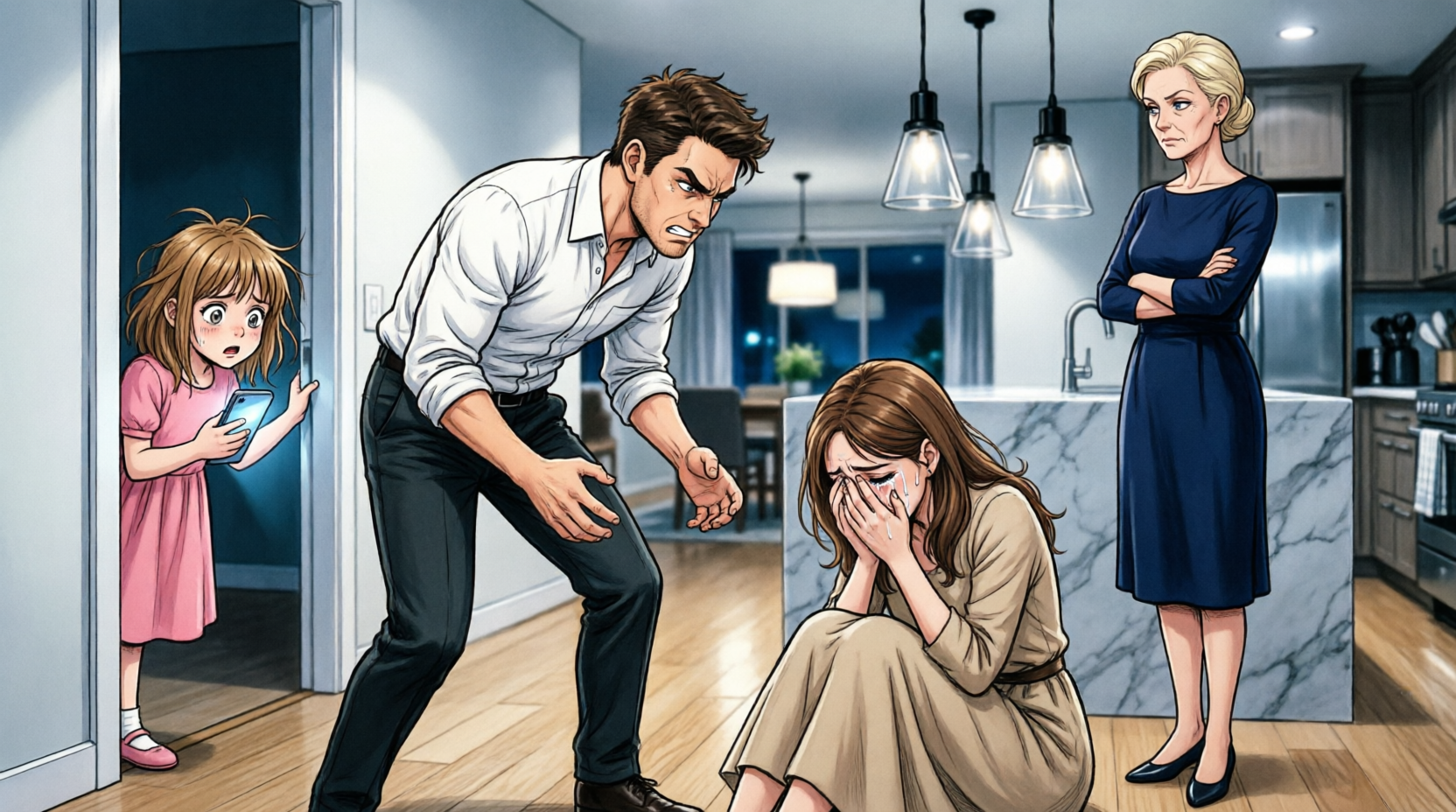
The Seventeen Percent They Could Not Steal
The black car sat at the end of my father’s driveway like a threat pretending to be patient.
No headlights.
Engine running.
Windows dark.
Rain slid down the windshield in thin silver lines, turning the car into a shadow with tires.
For a few seconds, none of us moved.
Emma slept beside me, one small hand curled against my sleeve.
My broken leg throbbed beneath the blanket.
My father stood near the window in his robe, phone in one hand, face so still it frightened me more than shouting would have.
The motion light washed the driveway in cold white.
The car did not move.
“Dad,” I whispered.
He raised one hand without looking back.
Quiet.
Then he pressed one number on his phone.
Not 911.
Someone else.
“Bell,” he said when the call connected.
“I need you awake.”
A pause.
Then my father’s voice dropped.
“Whitmore Development.
The trust schedule.
They know.”
Another pause.
His eyes stayed on the black car.
“Yes.
Now.”
He ended the call and immediately dialed again.
This time, emergency services.
“There is an unknown vehicle parked at the end of my driveway,” he said calmly.
“My daughter is under a protective order.
Her husband has been charged in a domestic assault investigation.
Send a patrol unit.”
He gave the address.
Then he looked at me.
“Do not turn on any more lights.”
My mouth had gone dry.
“Is it David?”
“I don’t know.”
But his face said something worse.
It said he did not think David was working alone anymore.
I looked at the phone in my lap.
The message was still there.
You should have checked what he copied before you ran.
Under it, the photo of the fireproof folder on David’s desk glowed like evidence from another life.
My father had always taught me that documents mattered.
He had taught me to keep originals, make copies, never sign under pressure, and never confuse politeness with protection.
I had listened.
But I had not understood.
Not fully.
Not until I learned that my inheritance was tied to seventeen percent of Whitmore Development.
Seventeen percent.
The number kept repeating in my head.
Not half.
Not control.
But enough.
Enough to request records.
Enough to block certain actions.
Enough to make Margaret nervous.
Enough to make David dangerous.
My father moved away from the window and lowered himself into the chair beside my bed.
His voice was quiet now.
“Sarah, I need you to listen carefully.”
“I am listening.”
“Your grandfather bought into Whitmore Development when it was still small.
Before David’s father expanded it.
Before Margaret married into it.
Before the family became what people think they are.”
I stared at him.
“Why didn’t you tell me?”
“Because the shares were locked inside the trust.
You did not need to manage them directly.
And because I hoped the Whitmores would never realize the voting structure still gave our family leverage.”
“Our family?”
“Yes.”
He looked suddenly older.
“The trust was built to protect you.
But it was also built because your grandfather believed the Whitmores were capable of burying people financially.”
A chill moved through me that had nothing to do with the room.
“What happened thirty years ago?”
My father looked toward the window again.
The black car still had not moved.
“Your grandfather had a partner named Alan Pierce.
Pierce helped Whitmore Development acquire land for its first major suburban project.
Then he discovered irregularities.”
“What kind?”
“Shell companies.
Inflated invoices.
Land transferred through relatives.
Permits pushed through with favors.”
The words felt distant and familiar at the same time.
Different decade.
Same family.
Same smell of expensive cologne and rot beneath polished floors.
My father continued.
“Pierce threatened to expose them.
A week later, he was ruined.”
“Ruined how?”
“Tax audit.
Bank loans called early.
Lawsuits.
Anonymous complaints to every board he sat on.”
My stomach tightened.
“And your father?”
“My father saw what happened and bought quietly into the company through a holding structure.
He believed ownership was the only way to watch them from inside.”
I tried to sit up, but pain shot through my leg.
My father reached for me.
“Careful.”
I swallowed hard.
“So David’s family company has been watched by our trust for thirty years?”
“Yes.”
“And David didn’t know?”
“I doubt he knew the full structure.
Margaret might have suspected.”
Margaret.
Of course.
Pearls.
Wine.
Soft cruelty.
A woman who never entered a room without knowing where the exits were.
I could see her now in the kitchen, wineglass lifted, saying, “Look what you made him do.”
Not shocked.
Not horrified.
Calculating.
Maybe she had not expected David to break my leg.
But she had expected something.
Pressure.
Fear.
A signature.
A surrender.
My father’s phone buzzed.
He looked down.
“Bell is pulling the trust documents now.”
“Can David use the copies?”
“Not legally.”
“That has never stopped him.”
“No,” my father said.
“But it changes what we do next.”
Outside, the black car finally moved.
Slowly.
Not leaving.
Rolling forward a few feet, then stopping again.
My father stood.
I grabbed his sleeve.
“Don’t go outside.”
“I’m not.”
He moved toward the hall.
“I’m getting the safe key.”
The moment he left the room, Emma stirred.
Her eyes opened halfway.
“Mommy?”
I smoothed her hair with shaking fingers.
“I’m here.”
“Is Daddy here?”
The question cut through me.
“No, baby.”
She blinked sleepily.
“Then why are you scared?”
I wanted to lie.
I wanted to say I was not scared.
But children who survive dangerous rooms become experts at hearing false comfort.
So I gave her a truth small enough to hold.
“Because someone is outside, and Grandpa is making sure we stay safe.”
Her little face tightened.
“Do I do the phone game?”
My heart broke so cleanly I almost made a sound.
“No, sweetheart.
Not right now.
You already did the phone game perfectly.
Tonight, Grandpa and I are handling it.”
She nodded solemnly.
Then whispered:
“Can I hold your hand?”
“Yes.”
She wrapped her fingers around mine and did not let go.
Downstairs, I heard my father open the study door.
Then the safe.
Then his footsteps returned, heavier now.
He entered carrying the original fireproof folder.
The real one.
Not David’s copy.
He placed it on the bed tray and opened it.
Inside were the documents I had seen before.
Trust packet.
Bank statements.
Authorization pages.
Quarterly reports.
But beneath those, in a section I had never examined closely, was the property schedule.
Whitmore Development Holdings.
Seventeen percent non-controlling minority interest.
Voting rights retained.
Transfer restricted.
Emergency review clause.
My father tapped that last line.
“This is what matters tonight.”
“What is it?”
“Emergency review clause.
If there is evidence of fraud, coercion, attempted unauthorized transfer, or criminal misconduct involving any trustee beneficiary, our attorney can demand immediate preservation of corporate records.”
I stared at him.
“Corporate records from Whitmore?”
“Yes.”
“David broke my leg and tried to steal from me.”
“Yes.”
“And because of that, we can force his company to open its books?”
My father’s expression was grim.
“Possibly.”
For the first time since the black car appeared, I felt something besides fear.
Not hope exactly.
Something sharper.
David had spent years making me feel small inside his house.
He had told me nobody was coming.
He had told me to lie.
He had believed my father’s folder was just proof of money.
But the folder was not only a shield.
It was a key.
My phone buzzed again.
Unknown number.
This time, no photo.
Only words.
Tell your father to stop calling lawyers.
My father read it over my shoulder.
His face did not change.
Then another message arrived.
You don’t understand what that company is worth.
Then another.
If you make this public, Emma loses everything.
Emma’s fingers tightened around mine.
She could not read the words.
But she felt the room change.
My father took the phone from me gently.
Then he did something that surprised me.
He took a screenshot.
Then another.
Then he forwarded everything to Attorney Bell and the detective.
Only after that did he block the number.
“Fear likes to feel urgent,” he said.
“Evidence likes to be preserved.”
I almost laughed.
It came out like a sob.
“How are you this calm?”
“I am not calm.”
He looked toward the window.
“I am disciplined.”
Outside, red and blue lights finally flickered at the end of the street.
The black car moved immediately.
Too fast.
It reversed without headlights, turned sharply, and disappeared down the road before the patrol car reached the driveway.
My father watched it go.
Then he called the dispatcher again and gave the direction.
The patrol officer arrived three minutes later.
He was young.
Too young, I thought unfairly.
But he listened.
He took the report.
He looked at the protective order.
He photographed the tire tracks near the curb.
He did not say maybe it was nothing.
For that alone, I could have cried.
By 3:10 a.m., Attorney Bell was on a secure video call from his home office, wearing a sweater over pajama pants and the expression of a man who had been waiting years for certain people to make one mistake too many.
His first words were:
“Do not respond to anything they send.”
My father said:
“We haven’t.”
“Good.”
Bell adjusted his glasses and looked at me.
“Sarah, I am sorry this is happening.
But you need to understand something.
If David and Margaret attempted to use forged authority over your trust while your trust holds voting shares in Whitmore Development, this is no longer only a domestic matter or bank fraud.”
“What is it?”
“Potential corporate fraud.
Potential attempted securities misconduct.
Potential conspiracy.
Potential witness intimidation depending on the messages.”
The words sounded enormous.
Too big for my bedroom.
Too big for my broken leg.
Too big for the sleeping child holding my hand.
Bell continued.
“I am filing an emergency preservation demand at 8:00 a.m.
I will also notify the court that any attempt by Whitmore Development to alter records, transfer assets, change voting structures, destroy communications, or remove directors may trigger sanctions.”
My father nodded.
“And the board?”
Bell’s mouth tightened.
“I know two independent directors who will not enjoy learning that the Whitmore family may have used forged documents to interfere with a shareholder trust.”
Shareholder.
The word felt strange attached to me.
For three years, David had called me fragile.
Bad with pressure.
Unstable.
Dependent.
Now his own company might have to answer to a shareholder he had thrown onto a kitchen floor.
Bell looked at me directly.
“Sarah, this may become public.”
My throat tightened.
“Because of the company?”
“Yes.
And because the Whitmores will likely try to frame this as a divorce dispute before anyone can frame it as financial misconduct.”
My father said:
“They already started.”
He sent Bell the messages.
Bell read them.
His expression went still.
“Good.”
I blinked.
“Good?”
“Good that they were foolish enough to write threats.”
He looked back at me.
“Bad for your peace.
Good for your case.”
That was how the next months would feel.
Every awful thing David did became another page.
Every lie became another exhibit.
Every threat became another timestamp.
I hated that my safety depended on documentation.
I was grateful for it anyway.
At dawn, Emma woke fully and asked for pancakes.
Children are miracles that way.
They can sleep through terror, wake into sunlight, and request syrup as if the world has not been trying to swallow their mother.
My father made them.
Terribly.
He burned the first batch and pretended it was because Emma liked “crispy edges.”
She giggled for the first time in days.
The sound filled the kitchen.
Not David’s kitchen.
Not marble.
Not chandelier.
Not lemon cleaner hiding bourbon.
My father’s kitchen.
Small.
Warm.
A little cluttered.
Safe enough for laughter to return.
I sat at the table with my leg elevated on a chair while Emma drew a picture of a house with a huge red phone beside it.
“That’s Grandpa’s phone,” she explained.
“It saves people.”
My father turned away quickly, pretending to check the stove.
I saw his shoulders shake once……………………………