Not dramatic. Not loud. Just still. The kind of silence that finally listened.
Sarah heard her own breathing on the recording. She heard Emma’s tiny voice. She heard David telling her to lie. Then she heard her father’s steady command, the one that had cut through the kitchen like a hand reaching into the dark.
“Sarah, do not move.”
That was the sentence that had saved her from being dragged into David’s version of events.
In the end, David could not explain the bank transfer, the fracture, the recording, and the missing spill all at once. Lies can survive in shadows, but they become clumsy under bright light.
The court granted Sarah protection. The financial freeze became permanent while the disputed transfers were reviewed. David faced consequences he had once insisted would never come.
Sarah and Emma moved in with her father during recovery.
The house was smaller than the mansion, but Emma slept better there. No chandelier humming above arguments. No marble floor polished for appearances. No wineglass lifted while someone pretended not to see.
Some nights, Emma still asked about the two-finger game.
Sarah told her the truth in words a 4-year-old could hold. “That was our safety signal. You did exactly right.”
Emma would nod seriously, then ask if Grandpa was proud. Sarah always answered the same way. “More than proud.”
Years later, Sarah would remember the kitchen in flashes: lemon cleaner, bourbon, cold marble, the tiny beep of a phone, a child’s voice shaking but brave enough to speak.
She would also remember the lesson.
Every door in her life had once opened through someone else’s permission. But that Tuesday night, with one broken leg and two raised fingers, Sarah found the smallest door out.
Emma opened it.
And when the world finally heard what David had done, nobody could pretend the floor was wet anymore.
Continuing from your uploaded story.
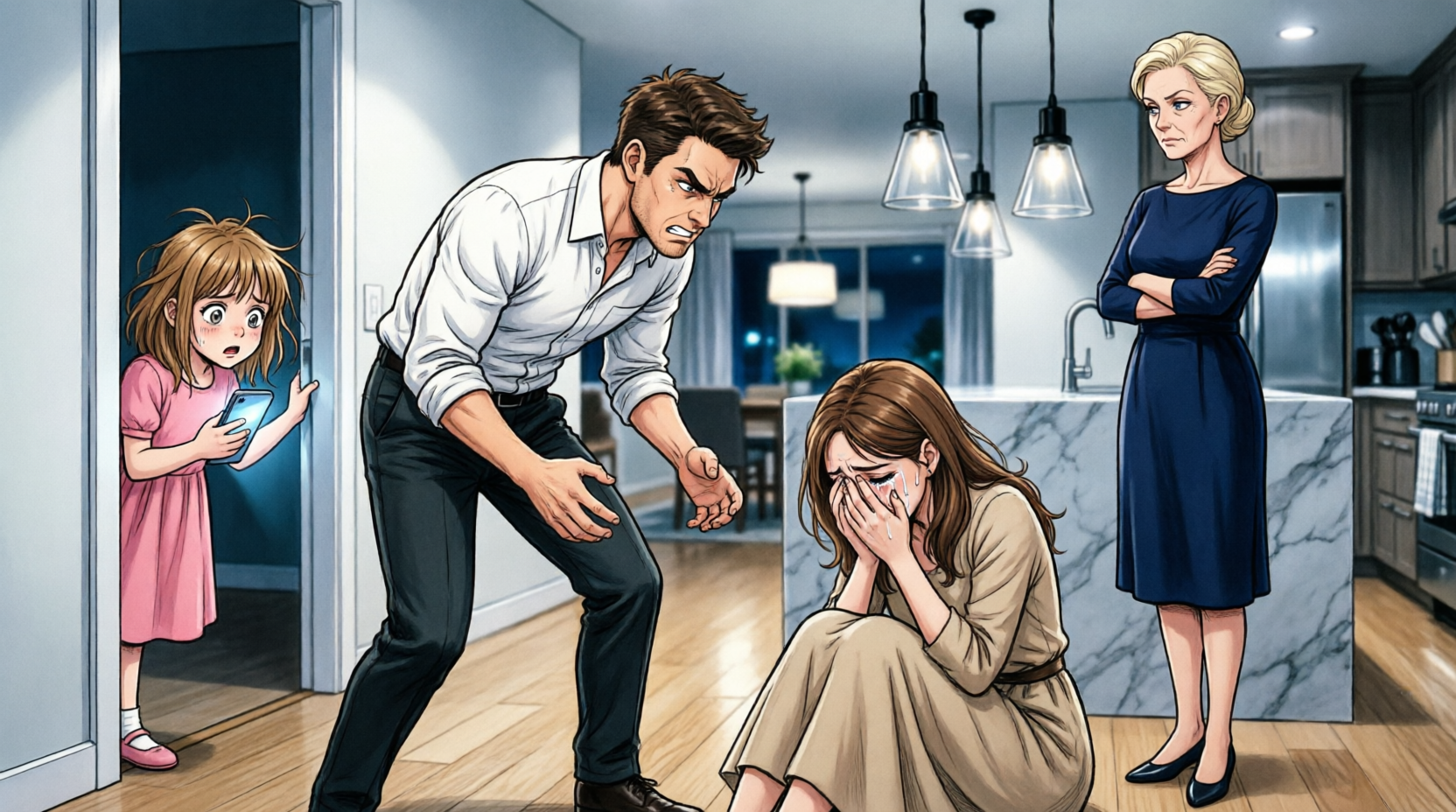
The House David Thought Still Belonged To Him
The first night in my father’s house, Emma slept with both hands wrapped around his shirt sleeve.
She did not let go even after she fell asleep.
My father sat beside her bed in the old blue armchair he had owned since I was a child, one hand resting on the blanket near her feet, his face carved into something hard and quiet.
He did not say David’s name.
He did not say Margaret’s name.
He did not ask me why I had stayed so long.
That was one of the reasons I survived those first days without breaking completely.
Because the people who love you properly do not begin rescue with interrogation.
They begin with shelter.
My leg was held together by metal plates, stitches, and medication that made the room drift at the edges.
Every time I closed my eyes, I heard the sound again.
The twist.
The crack.
Emma’s scream.
Margaret’s wineglass.
David’s voice saying, “Nobody is coming for you.”
But someone had come.
My father had come.
The ambulance had come.
The police had come.
The bank fraud team had come.
And worst of all for David, the truth had come with timestamps.
At 8:17 p.m., the inheritance transfer was triggered.
At 8:23 p.m., Emma called my father.
At 8:24 p.m., David told me to lie.
At 8:31 p.m., emergency services entered through the front gate.
Numbers were beautiful things when liars depended on confusion.
They did not care about charm.
They did not care about family reputation.
They did not care that Margaret wore pearls and said fragile with perfect sadness.
Numbers simply stood there.
Still.
Clean.
Unmoved.
For three weeks, David tried to reach me through everyone except me.
First came flowers.
White roses, of course.
The same kind he bought after every bad night, as if petals could mop blood off a floor.
My father threw them away before Emma saw them.
Then came emails.
Sarah, this has gone too far.
Sarah, lawyers are making this ugly.
Sarah, we both know you fell.
Sarah, think of Emma.
Sarah, your father is poisoning you against me.
My lawyer printed every message and added them to the file.
Then came Margaret.
Not in person at first.
She sent a handwritten note on cream stationery with her initials pressed into the top.
Dear Sarah,
I know emotions are high.
David is devastated.
A family should not be destroyed because of one unfortunate evening.
You must remember that Emma needs stability, not scandal.
I stared at that word for a long time.
Stability.
People like Margaret always used beautiful words for ugly arrangements.
Stability meant silence.
Family meant obedience.
Scandal meant truth spoken where others could hear it.
My father read the note once, folded it neatly, and placed it into the folder marked HARASSMENT / CONTACT ATTEMPTS.
Then he said, “She is more dangerous than he is.”
I looked at him from the couch, my leg elevated on pillows, my body still yellow with bruises.
“David broke my leg.”
“Yes,” my father said.
“And she taught him how to believe it was your fault.”
That sentence stayed with me.
Because David’s cruelty had always been loudest in private.
Margaret’s had been elegant enough for public rooms.
David took.
Margaret justified.
David pushed.
Margaret translated.
David controlled.
Margaret called it leadership.
For years, I had thought David was the storm and Margaret was the weather report.
Now I understood she had helped build the climate.
The first court hearing came on a rainy morning in February.
I wore a navy dress loose enough to hide the surgical brace and flat shoes because heels were impossible now.
My father drove.
Emma stayed with a child therapist who had soft gray hair, wooden toys, and a voice so gentle Emma whispered to her within ten minutes.
I hated leaving her.
I also knew I could not bring my four-year-old into a room where adults would argue over whether her mother’s pain counted.
David arrived in a charcoal suit.
Of course he did.
He looked tired in the careful way guilty men perform exhaustion when accountability inconveniences them.
Margaret sat behind him wearing a pale scarf instead of pearls.
That almost made me laugh.
Pearls would have reminded everyone of the wine.
She did not look at me.
David did.
His eyes moved over my brace, my cane, my father beside me, then the lawyer at my other side.
For one second, I saw the old calculation return.
He was measuring the room.
Looking for weakness.
Looking for the door that might still open through fear.
Then my father turned his head and looked at him.
David looked away first.
That small thing gave me more strength than any speech could have.
The hearing itself was not dramatic.
That surprised me.
Movies teach you that justice begins with shouting, revelations, and one perfect sentence that makes everyone gasp.
Real justice begins with paperwork.
Protective order.
Medical records.
Bank documentation.
Emergency call transcript.
Photographs.
Chain of custody.
Motion to freeze assets.
Motion to restrict contact.
Motion to prevent disposal of marital property.
David’s attorney used words like unfortunate, disputed, marital misunderstanding, and emotional escalation.
My attorney used fewer words.
Fracture.
Transfer.
Recording.
Child witness.
Pattern.
The judge listened without much expression.
Then the emergency call played.
Emma’s tiny voice filled the courtroom.
“Grandpa, Mommy looks like she’s going to die.”
Nobody moved.
Even David went still.
Then came his own voice on the recording.
“She fell.
She always exaggerates.
She’s unstable.”
Then Margaret’s whisper:
“David, stop talking.”
It was amazing how much truth lived inside those four words.
She had not said:
David, help her.
David, call an ambulance.
David, what have you done?
She had said:
Stop talking.
Because her first fear was not my injury.
It was exposure.
The judge granted the protective order.
David was barred from contacting me directly.
He was barred from my father’s property.
He was barred from seeing Emma without supervised review.
The inheritance transfer remained frozen pending investigation.
And for the first time since I married him, David was told no by someone whose answer he could not override.
He hated it.
I saw that hatred flash across his face before his attorney touched his sleeve and whispered something.
He put the mask back on.
But I had seen it.
So had my father.
Outside the courtroom, Margaret finally approached me.
My attorney stepped slightly forward.
My father did too.
Margaret ignored them both and looked straight at me.
“You have no idea what you’re doing to your daughter.”
My hand tightened around the cane.
For a second, I was back in that kitchen.
On the floor.
Sweating through pain.
Hearing Emma scream.
Then I remembered the two fingers.
The phone.
The door she opened.
“Yes,” I said quietly.
“I do.”
Margaret’s mouth tightened.
“David is her father.”
“And I am her mother.”
“You are teaching her to destroy family.”
“No.”
I looked her directly in the eyes.
“I am teaching her that family is not permission to hurt someone.”
For the first time since I had known her, Margaret had no immediate answer.
Her silence felt better than any apology she might have performed.
Then she leaned close enough that only I could hear.
“You think your father can protect you forever?”
My father’s voice came from behind me.
“No.”
Margaret stiffened.
He stepped beside me, calm as stone.
“But I can protect her long enough for the truth to finish its work.”
That was when Margaret finally looked afraid.
Not much.
Not openly.
Just a flicker.
But enough.
Because people like Margaret understood social battles.
Reputation.
Pressure.
Whisper campaigns.
Private dinners.
Family alliances.
They did not understand people who built files.
My father had built a file before David ever touched my money.
He had built it because he loved me without needing me to be naïve.
And now, page by page, that file was becoming a wall.
Two days after the hearing, First Meridian Bank called.
Not the local branch manager David played golf with.
Not the polite woman who used to smile too wide when Margaret walked in.
This call came from the fraud division.
A woman named Elise Navarro explained that the inheritance transfer had been attempted through layered authorization requests, one old signature scan, and a power-of-attorney draft that had never been properly executed.
My stomach went cold.
“A power of attorney?”
“Yes, Mrs. Whitmore.”
I closed my eyes at the married name.
She continued carefully.
“It appears a document was uploaded six weeks ago granting your husband financial authority over trust-adjacent accounts.”
“I never signed that.”
“We suspected as much.”
My father, sitting across from me at the kitchen table, looked up sharply.
Elise’s voice became more formal.
“We are sending the document to your attorney and to the investigating detective.”
When the copy arrived, I stared at the signature for almost a full minute.
It looked like mine.
Not perfect.
But close.
Close enough for a careless clerk.
Close enough for a man confident no one would question him.
My father put on his reading glasses.
Then his face changed.
“What?”
He pointed to the witness line.
Margaret Whitmore.
My mother-in-law had witnessed a forged document giving David power over my inheritance.
For a moment, I could not speak.
Not because I was shocked exactly.
Because part of me had already known.
Margaret had not simply watched abuse.
She had notarized the atmosphere around it.
She had been there in every quiet way.
Every dinner where David corrected my memory.
Every conversation where she called me fragile.
Every family meeting where money was discussed as if I were a child holding something too valuable for my own good.
This was not a mother protecting her son after one violent night.
This was a plan.
My father’s jaw hardened.
“Now we know why she came to the kitchen.”
I looked at him.
“What do you mean?”
“She wasn’t there by accident.”
The room seemed to tilt.
He tapped the bank alert printed beside the forged document.
“David triggered the transfer.
You confronted him.
Margaret was present to help control the story.”
I felt sick.
The kitchen returned to me again.
The way Margaret entered just behind him.
Wine already poured.
Expression already arranged.
Not surprised.
Prepared.
She had expected intimidation.
Maybe tears.
Maybe a signature.
Maybe me collapsing emotionally while they told me I was confused.
She had not expected Emma.
My brave little girl in pink pajamas.
My father said quietly, “Emma saved more than your life.”
I pressed both hands over my mouth and cried then.
Not loudly.
Not beautifully.
I cried because my four-year-old had been forced into courage no child should need.
I cried because I had taught her the signal while pretending it was a game.
I cried because it worked.
I cried because survival and guilt sometimes arrive holding hands.
That night, Emma crawled into my bed and touched the brace carefully.
“Does it still hurt?”
“Sometimes.”
“Did I do good with the phone?”
I pulled her close.
“You did exactly right.”
Her small body relaxed against mine.
“Grandpa said I was brave.”
“You were.”
She was quiet for a long moment.
Then she whispered:
“Is Daddy mad?”
My chest tightened.
Children ask simple questions that adults answer with broken hearts.
“Daddy is having grown-up consequences.”
“What are consequences?”
I brushed her hair gently.
“It means when someone makes a bad choice, other people help make sure they cannot keep making that bad choice.”
She thought about that.
“Like timeout?”
I almost smiled.
“Yes, baby.
A very serious timeout.”
She nodded.
Then:
“Are we safe here?”
I looked toward the hallway.
My father had installed new locks.
Cameras.
A security gate.
A motion light near the driveway.
But safety is not only hardware.
It is who believes you when you speak.
“Yes,” I said………………………